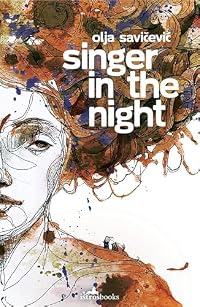
Singer in the Night
by Olja Savicevic
On This Page
Description
Famous soap opera scriptwriter Naranca is slowly losing her memory and decides to embark on a road trip down memory lane (in a golden convertible) in search of her greatest love and ex-husband, an artist whose uncompromising artistic integrity is opposed to Naranca's fickle life in the world of TV drama. It is a series of letters by Slavuj, written over several weeks and hand-delivered to the inhabitants of the street where they lived, that cracks open the novel. The letters, triggered by a show more mysterious couple who make love loudly in the middle of the night, keeping the neighborhood awake, touch upon the nature of love, war, lust, capitalism, and childhood, highlighting the paradox of the human condition through playful humor. Singer in the Night is a rich, sensual novel which comments on perception, on how life is really lived--never objectively, never encompassing the whole truth, and yet no less real to us. In its final message, the novel gives a playful warning about the consequences of choosing banality--whether it be nationalism, vanity or fame--over true human connection. show lessTags
Member Reviews
Plodding Through the Night
Review of the Istros Books english translation (2019) of the Croatian language original [book:Pjevač u noći|30238353] (2016)
There is a twist in the last few chapters of Singer in the Night which does make what came before interesting in retrospect, but it is so late in the game that it doesn't really make up for the drudgery of plodding through the initial 90% of the book. This was one of those books where if I hadn't assigned myself 10% or 16 pages of reading per day, I don't know if I would have made it through.
The plot roughly entails a retired soap opera writer who is in search of her first husband, a graffiti poet whose other main accomplishment seems to have been writing letters (which are provided as show more inter-chapters) to his fellow city street inhabitants complaining of their night-time amorous activities. The journey takes her to his mother's home and that of another paramour whose children are probably the most interesting characters. Lurking underneath are constant reminders and references to the Croat-Serb-Bosnian wars of the 1990s. The protagonist uses a common Croatian term of affection, f: dragi, m: draga translated as "my dear," constantly in a way that doesn't come across as affectionate but rather as condescending. There is also a regular reminder that the events of her youth were 20 years ago in what seems a pointless chorus.
I read Singer in the Night as part of the Translated Fiction Online Book Club (TFOBC) which had been organized by Istros Press and 5 other UK independent publishers for an initial 6 week period (March 26 to April 30, 2020) during this current world pandemic situation. There is now a plan for the Book Club to continue under the new name of the Borderless Book Club based on the enthusiastic response to the initial outing. The first meeting of the new group is on May 14, 2020 to discuss Claudio Morandini's [book:Snow, Dog, Foot|49007434] (2020) published by Pierene Press. show less
Review of the Istros Books english translation (2019) of the Croatian language original [book:Pjevač u noći|30238353] (2016)
There is a twist in the last few chapters of Singer in the Night which does make what came before interesting in retrospect, but it is so late in the game that it doesn't really make up for the drudgery of plodding through the initial 90% of the book. This was one of those books where if I hadn't assigned myself 10% or 16 pages of reading per day, I don't know if I would have made it through.
The plot roughly entails a retired soap opera writer who is in search of her first husband, a graffiti poet whose other main accomplishment seems to have been writing letters (which are provided as show more inter-chapters) to his fellow city street inhabitants complaining of their night-time amorous activities. The journey takes her to his mother's home and that of another paramour whose children are probably the most interesting characters. Lurking underneath are constant reminders and references to the Croat-Serb-Bosnian wars of the 1990s. The protagonist uses a common Croatian term of affection, f: dragi, m: draga translated as "my dear," constantly in a way that doesn't come across as affectionate but rather as condescending. There is also a regular reminder that the events of her youth were 20 years ago in what seems a pointless chorus.
I read Singer in the Night as part of the Translated Fiction Online Book Club (TFOBC) which had been organized by Istros Press and 5 other UK independent publishers for an initial 6 week period (March 26 to April 30, 2020) during this current world pandemic situation. There is now a plan for the Book Club to continue under the new name of the Borderless Book Club based on the enthusiastic response to the initial outing. The first meeting of the new group is on May 14, 2020 to discuss Claudio Morandini's [book:Snow, Dog, Foot|49007434] (2020) published by Pierene Press. show less
Ratings
Members
- Recently Added By
Lists

Borderless Book Club
22 works; 2 members
Author Information
12+ Works 90 Members
Some Editions
Common Knowledge
- Original language
- Croatian
Classifications
- Genres
- General Fiction, Fiction and Literature
- DDC/MDS
- 891.8 — Literature & rhetoric Asian Literature East Indo-European and Celtic literatures West and South Slavic languages (Bulgarian, Slovene, Polish, Czech, Slovak, Serbo-Croatian, and Macedonian)
- LCC
- PG1620.29 .A95 .P5413 — Language and Literature Slavic languages and literatures. Baltic languages. Albanian language Slavic. Baltic. Albanian Serbo-Croatian
- BISAC
Statistics
- Members
- 8
- Popularity
- 2,496,185
- Reviews
- 1
- Rating
- (2.25)
- Languages
- English, German, Italian
- Media
- Paper, Ebook
- ISBNs
- 5