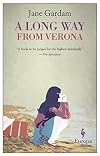
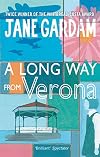
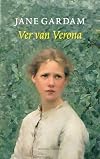
A Long Way from Verona
by Jane Gardam
On This Page
Description
A young girl aspiring to be a writer recounts her experiences growing up in England during the Second World War.Tags
Recommendations

















Member Reviews
Thirteen-year-old Jessica Vye narrates this engrossing coming-of-age novel from English author Jane Gardam, declaring at the outset that she is "not quite normal," and informing the reader that she is rather unpopular. Set in World War II-era Britain, the story centers around Jessica's discovery that she is and is meant to be a writer, and her experiences at school and outside it, including a disturbing encounter with an escaped prisoner of war, a brief infatuation with a young boy, and an episode in which she is caught up in an air raid. Throughout it all, she observes and comments on those about her with a merciless truth-telling. Or so she imagines...
Published in 1971, A Long Way from Verona was Gardam's debut, and although she wrote show more for both adults and children, was published as a young adult novel. I have seen some express some doubts as to this latter, despite the young heroine, but for my part, although I don't see this being published in the current young adult market—much to our detriment—can see it having been published for it in the early 70s. I myself first became aware of it some years ago, after seeing it referenced in Sue Sims and Hilary Clare's The Encyclopaedia of Girls' School Stories, due to its partial school setting, although it is not really a school story, as such. In any case, leaving aside issues of audience and genre, I read this as part of a group read with friends, and found it immensely involving. Gardam writes wonderfully well, and Jessica truly comes alive as a character and narrator. She is not a particularly pleasant character, and as I read I could see very well why she wasn't popular, as she showed little regard, or indeed interest, in the feelings of others, throughout the book. That said, she was a very interesting character, one who really observed and thought about the people and events in her life. I'm not sure she saw them as clearly as she believed—indeed, the discovery that perhaps her perception was not as fine-tuned as she believed it to be, was an important moment toward the end of the book—but the depiction of a young person so fiercely devoted to understanding the world around her gave this book some power. Although not destined to become a favorite—I don't think I'll ever reread it—I am very glad to have read this one, and hope to read more from Gardam. Recommended to those seeking young adult fare on the more cerebral side. show less
Published in 1971, A Long Way from Verona was Gardam's debut, and although she wrote show more for both adults and children, was published as a young adult novel. I have seen some express some doubts as to this latter, despite the young heroine, but for my part, although I don't see this being published in the current young adult market—much to our detriment—can see it having been published for it in the early 70s. I myself first became aware of it some years ago, after seeing it referenced in Sue Sims and Hilary Clare's The Encyclopaedia of Girls' School Stories, due to its partial school setting, although it is not really a school story, as such. In any case, leaving aside issues of audience and genre, I read this as part of a group read with friends, and found it immensely involving. Gardam writes wonderfully well, and Jessica truly comes alive as a character and narrator. She is not a particularly pleasant character, and as I read I could see very well why she wasn't popular, as she showed little regard, or indeed interest, in the feelings of others, throughout the book. That said, she was a very interesting character, one who really observed and thought about the people and events in her life. I'm not sure she saw them as clearly as she believed—indeed, the discovery that perhaps her perception was not as fine-tuned as she believed it to be, was an important moment toward the end of the book—but the depiction of a young person so fiercely devoted to understanding the world around her gave this book some power. Although not destined to become a favorite—I don't think I'll ever reread it—I am very glad to have read this one, and hope to read more from Gardam. Recommended to those seeking young adult fare on the more cerebral side. show less
Bücher liest man ja mit den unterschiedlichsten Erwartungen. Sie sollen einem Gefühle vermitteln, Spannung, Lehrreiches und/oder schlicht die Zeit vertreiben. Dieses Buch entspricht wohl mehr dem Letzteren, wobei es jedoch unfair wäre, es als 'bloße' Unterhaltungsliteratur abzutun, denn dafür ist es viel zu schön geschrieben. Vielleicht ist es eher ein Jugendbuch, denn eine 13jährige erzählt hier von ihrem Leben in England während des II. Weltkrieges. Und das so unglaublich schnodderig und altklug, wie 13jährige halt mal so sind - offenbar nicht allzu viel anders als heutzutage.
Die 13jährige Jessica lebt mit ihren eher unkonventionellen Eltern in einem kleinen Ort an der Küste, wo sie ein Leben führt wie vermutlich viele show more andere 13jährige auch. Doch sie ist anders als die meisten ihrer gleichaltrigen Schulkameradinnen. Zum einen weiß sie stets, wann jemand lügt, zum andern muss sie immer die Wahrheit sagen - nicht unbedingt zur Freude aller Anwesenden. Doch das stört Jessica nicht, denn sie hat eine unglaubliche Abneigung gegen jede Form der Anpassung. Eine ungemein sympathische 'Heldin' - unerschrocken und neugierig, die selbst in den brenzligsten Situationen (wie beispielsweise einem Bombenangriff) nicht den Kopf verliert.
Jane Gardam trifft den Ton dieses jungen Mädchens so überzeugend, dass ich keine Minute daran zweifelte, ihr persönlich zuzuhören. Wunderbar zu lesen, auch wenn es keine großartigen Höhepunkte gibt, wie Manche bemängeln. Einfach eine schöne Geschichte! show less
Die 13jährige Jessica lebt mit ihren eher unkonventionellen Eltern in einem kleinen Ort an der Küste, wo sie ein Leben führt wie vermutlich viele show more andere 13jährige auch. Doch sie ist anders als die meisten ihrer gleichaltrigen Schulkameradinnen. Zum einen weiß sie stets, wann jemand lügt, zum andern muss sie immer die Wahrheit sagen - nicht unbedingt zur Freude aller Anwesenden. Doch das stört Jessica nicht, denn sie hat eine unglaubliche Abneigung gegen jede Form der Anpassung. Eine ungemein sympathische 'Heldin' - unerschrocken und neugierig, die selbst in den brenzligsten Situationen (wie beispielsweise einem Bombenangriff) nicht den Kopf verliert.
Jane Gardam trifft den Ton dieses jungen Mädchens so überzeugend, dass ich keine Minute daran zweifelte, ihr persönlich zuzuhören. Wunderbar zu lesen, auch wenn es keine großartigen Höhepunkte gibt, wie Manche bemängeln. Einfach eine schöne Geschichte! show less
A Long Way from Verona was an impulse loan from the library... and what a pleasure it is to be able to wander through the stacks and browse after all these months of Click and Collect!
You'll have to excuse me with this one, I've been mulling over my response to the book for nearly a week now, and I'm still thinking out loud....
What I didn't know when I borrowed it was that the novel is marketed as YA, but I wonder how many young adults today will appreciate its allusions?
The curriculum was different in 1971 when the book was published, and — certainly here in Australia — authors could reasonably expect that young adult readers were familiar with Shakespeare and other classic texts. It had nothing to do with what kind of secondary show more school one attended or the age at which one left school; there was a common statewide curriculum. I had studied Julius Caesar, Romeo and Juliet and Macbeth before the school leaving age of 15, and then there was Hamlet and A Midsummer's Night Dream after that. (I did King Lear at uni but I'm not sure when Othello cropped up). These plays shaped my ideas about power and its abuse; about loyalty, fidelity and betrayal; about human strength and frailty and its exploitation; and about friendship and love of all kinds: a love of country, the love between parents, children and siblings; romantic love between adults, and the difference between infatuation and the real thing.
Today, however, specific texts aren't mentioned in the National Curriculum, and schools can tailor their choice of texts to suit the perceived needs of their communities. So some students may get the opportunity to study Shakespeare and other classic texts; but equally, they may not.
Part of the pleasure of reading A Long Way from Verona comes from the allusions to Romeo and Juliet signalled by its title and elsewhere. It's ironic, because Jessica's brief infatuation is nothing like Juliet's undying love, Christian is a pale and disappointing shadow of any Romeo, and the privations of wartime Britain are indeed a long way from the decadent luxury of Shakespeare's Verona.
The other factor is that in an era where YA readers expect stories to be 'relatable' and characters to be likeable, perhaps the quirky, intellectually precocious character of the narrator Jessica Vye fails that test. She's just not interested in the same things as the other girls. She tells us that she is not popular, and the reader can certainly see why!
Does it matter? I don't know. I would consider myself diminished had I not had the literary opportunities I've had. I didn't 'relate' to any of Shakespeare's characters or those in Austen or Dickens or Hardy, but I did relate to the themes. There is pressure today, however, for young people 'to see themselves' in the books they read and this means diversity of colour, ethnicity, gender identification and class. That's a good thing, and if it turns young people into readers, they will hopefully come to the books of our rich literary heritage in their own good time. And if they haven't seen any of the film versions of R&J, perhaps with Professor Google they can sort out anything that mystifies them in this book...
To read the rest of my review please visit https://anzlitlovers.com/2021/12/13/a-long-way-from-verona-by-jane-gardam/ show less
You'll have to excuse me with this one, I've been mulling over my response to the book for nearly a week now, and I'm still thinking out loud....
What I didn't know when I borrowed it was that the novel is marketed as YA, but I wonder how many young adults today will appreciate its allusions?
The curriculum was different in 1971 when the book was published, and — certainly here in Australia — authors could reasonably expect that young adult readers were familiar with Shakespeare and other classic texts. It had nothing to do with what kind of secondary show more school one attended or the age at which one left school; there was a common statewide curriculum. I had studied Julius Caesar, Romeo and Juliet and Macbeth before the school leaving age of 15, and then there was Hamlet and A Midsummer's Night Dream after that. (I did King Lear at uni but I'm not sure when Othello cropped up). These plays shaped my ideas about power and its abuse; about loyalty, fidelity and betrayal; about human strength and frailty and its exploitation; and about friendship and love of all kinds: a love of country, the love between parents, children and siblings; romantic love between adults, and the difference between infatuation and the real thing.
Today, however, specific texts aren't mentioned in the National Curriculum, and schools can tailor their choice of texts to suit the perceived needs of their communities. So some students may get the opportunity to study Shakespeare and other classic texts; but equally, they may not.
Part of the pleasure of reading A Long Way from Verona comes from the allusions to Romeo and Juliet signalled by its title and elsewhere. It's ironic, because Jessica's brief infatuation is nothing like Juliet's undying love, Christian is a pale and disappointing shadow of any Romeo, and the privations of wartime Britain are indeed a long way from the decadent luxury of Shakespeare's Verona.
The other factor is that in an era where YA readers expect stories to be 'relatable' and characters to be likeable, perhaps the quirky, intellectually precocious character of the narrator Jessica Vye fails that test. She's just not interested in the same things as the other girls. She tells us that she is not popular, and the reader can certainly see why!
Does it matter? I don't know. I would consider myself diminished had I not had the literary opportunities I've had. I didn't 'relate' to any of Shakespeare's characters or those in Austen or Dickens or Hardy, but I did relate to the themes. There is pressure today, however, for young people 'to see themselves' in the books they read and this means diversity of colour, ethnicity, gender identification and class. That's a good thing, and if it turns young people into readers, they will hopefully come to the books of our rich literary heritage in their own good time. And if they haven't seen any of the film versions of R&J, perhaps with Professor Google they can sort out anything that mystifies them in this book...
To read the rest of my review please visit https://anzlitlovers.com/2021/12/13/a-long-way-from-verona-by-jane-gardam/ show less
This was a pick of the Vintage Book Circle and sparked a wonderful discussion at our meeting. I really appreciated the beginning of this book and read parts aloud to my husband. It was delightful and funny and I really related to Jessica. The later half of the book was more complicated, troubling and kind of confusing. It was interesting that the person who suggested the title only remembered the first half. We were surprised that it was considered a children's book. It tackles some difficult topics. We wondered if it was at all autobiographical. It won the Phoenix Award in 1991, an award given to a twenty year old children's book that had not received an award earlier. We found it to be deserving, but maybe more appropriate for an show more older crowd. show less
My favorite author and my favorite genre - coming of age - perfection! Set during WWII, Jessica Vye refuses to conform or fit into her middle class Brit family or her school. The book is divided into three chapters "The Maniac" focuses on Jessica's decision to become a writer after meeting a famous author during a school talk. He encourages her, with monumental consequences. "The Boy" is Christian, whom Jess meets at a house party. He's a quasi-communist and takes Jess into a slum, where they are the victims of a German bombing. "The Poem" is her first publication, in the Times of London. And then there's everything in between. Should not be missed.
When she was nine, Jessica Vye was told by an author visiting her school that she WAS AN AUTHOR INDEED." This was after she had run home, gotten everything she had written and caught up with the author before he boarded her train. He sent her back that message in the mail, several months later. She of course never forgot it and it shaped her life.
World War ll and the world of ration cards, air raid shelters and gas masks had become part of everyday life in England. Jessica is quirky, she is very head strong and very vocal, unable to keep to her self what she thinks, this has made her popular with some, but unpopular with many. We follow along with her as she experiences her first crush, as she puts herself in danger, luckily living show more through a bombing. I loved her character and that of Miss Philomen, an elderly teacher who had been published. She was very observant, eccentric and a delight. So much of this coming of age story is.
Another offering from Nancy Pearl on NPR and a re-issue from the publisher. I love this author's writing, she is extremely talented with dialogue, and apparently this was the first book this author wrote. So the maturity of her later novels is missing but I think all the more delightful because of that.
Lastly Jessica Vye reminds me of myself at that age and it was very easy for me to relate to her, especially when I read these lines "I wish I read slower as a matter of fact because I can't get books to last>" A girl after my own heart. show less
World War ll and the world of ration cards, air raid shelters and gas masks had become part of everyday life in England. Jessica is quirky, she is very head strong and very vocal, unable to keep to her self what she thinks, this has made her popular with some, but unpopular with many. We follow along with her as she experiences her first crush, as she puts herself in danger, luckily living show more through a bombing. I loved her character and that of Miss Philomen, an elderly teacher who had been published. She was very observant, eccentric and a delight. So much of this coming of age story is.
Another offering from Nancy Pearl on NPR and a re-issue from the publisher. I love this author's writing, she is extremely talented with dialogue, and apparently this was the first book this author wrote. So the maturity of her later novels is missing but I think all the more delightful because of that.
Lastly Jessica Vye reminds me of myself at that age and it was very easy for me to relate to her, especially when I read these lines "I wish I read slower as a matter of fact because I can't get books to last>" A girl after my own heart. show less
Started this in the interest of reading all the Jane Gardam I have before I write about her. About a quarter of the way in, and... eh. It's a little neurotic/strident for me, and the narrator reminds me of a few very young high-maintenance types I go to school with. I might bail. I don't feel bad, though—it was her first novel, and if that's what it took for her to get to Old Filth, so be it.
Members
- Recently Added By
Lists

Favorite Childhood Books
1,602 works; 516 members

Favorite Coming of Age Novels.
164 works; 51 members

Best Books about Readers
23 works; 14 members

Best books about books
209 works; 104 members

20th Century Literature
1,161 works; 55 members

Top Five Books of 2014
1,064 works; 398 members

Backlisted
109 works; 9 members
Favourite Books
1,817 works; 316 members

Five star books
1,755 works; 108 members

Reading history in Children's Books
78 works; 3 members

Books Read in 2016
4,666 works; 197 members
Backlisted Podcast
65 works; 3 members
Author Information

38+ Works 8,895 Members
Jane Gardam was born in North Yorkshire, England in 1928. She is the author of many children's novels that include "A Long Way from Verona" (1971). She has also written novels and collections of stories for adults that include "God on the Rocks" (1978), "Bilgewater and the Pangs of Love and Other Stories" (1983) and "The Summer After the Funeral." show more Her book "Groundlings" was taken from "Showing the Flag and Other Stories" (1989). Gardam's novels and stories have received many literary prizes. (Bowker Author Biography) show less
Some Editions
Awards and Honors
Awards
Common Knowledge
- Canonical title
- A Long Way from Verona
- Original publication date
- 1971
- Epigraph
- 'The sun was shining on the sea.
Shing with all his might.
He did his very best to make
The billows strong and bright.
And this was odd because it was
The middle of the night'.
—Lewis Carroll
Ali... (show all)ce Through the Looking Glass - First words
- I ought to tell you at the beginning that I am not quite normal, having had a violent experience at the age of nine.
Classifications
- Genres
- Fiction and Literature, General Fiction, Children's Books, Young Adult
- DDC/MDS
- 813 — Literature & rhetoric American literature in English American fiction in English
- LCC
- PZ7 .G163 .L — Language and Literature Fiction and juvenile belles lettres Fiction and juvenile belles lettres Juvenile belles lettres
- BISAC
Statistics
- Members
- 433
- Popularity
- 70,635
- Reviews
- 12
- Rating
- (3.78)
- Languages
- Dutch, English, Finnish, German
- Media
- Paper, Audiobook, Ebook
- ISBNs
- 19
- ASINs
- 9