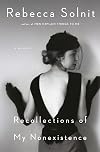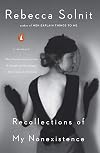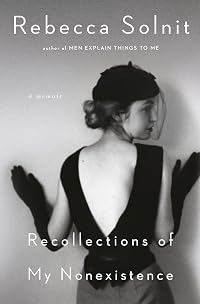
Recollections of My Nonexistence: A Memoir
by Rebecca Solnit
On This Page
Description
"In this memoir, celebrated author, historian, and activist Rebecca Solnit relates how she found her voice as a writer and as a feminist during the 1980s in San Francisco, in an atmosphere of gender violence on the street and the exclusion of women from cultural arenas. Then in her early twenties, Solnit tells of being poor, hopeful, and adrift in the city, which became her great teacher; of the small apartment she found, which became a home in which to metamorphosize; of how punk rock gave show more form and voice to her own fury and explosive energy. Solnit explores the way some men attempted to erase her, to shut her up, keep her out and challenge her credibility, as well as contemplating other kinds of nonexistence of groups for gender, ethnicity, and orientation. Her book ends with what liberated her as a person and as a writer--books themselves, the gay men and community who presented a new model of what else gender, family, and celebration could be, and her awakening to the spacious landscapes of the American west, which taught her how to write in the way she has ever since. Recollections of My Nonexistence connects Solnit's hugely popular polemical feminist writings of the last decade with the more lyrical, personal writing of her beloved earlier books A Field Guide to Getting Lost and The Faraway Nearby. This book is for everyone who has endured erasure and dismissal while coming of age in male-dominated spaces"-- show lessTags
Recommendations



















Member Recommendations
JuliaMaria Memoiren von Feministinnen, mit der Stadt als wesentlichem Element der Beschreibung.
Member Reviews
“And so there I was where so many young women were, trying to locate ourselves somewhere between being disdained or shut out for being unattractive and being menaced or resented for being attractive, to hover between two zones of punishment in space that was itself so thin that perhaps it never existed, trying to find some impossible balance of being desirable to those we desired and being safe from those we did not.”
“When I read, I ceased to be myself, and this nonexistence I pursued and devoured like a drug”
“Men’s bodies are weapons and women’s bodies are targets and queer bodies are hated for blurring the distinction or rejecting the metaphors.”
Men are scum. After reading books like this and watching current show more events, where this is played out every moment of every day, this is the only conclusion I can have. Yes, I am a male in America but I have try to be respectful and considerate toward the opposite sex. Probably not perfect but I do try. I love Solnit's writing. She pulls no punches and describing her experiences, as a young woman establishing her self in a male-dominated world, where many of her female friends had been sexually assaulted, or demeaned or ignored, is quite eye-opening. An important book. show less
“When I read, I ceased to be myself, and this nonexistence I pursued and devoured like a drug”
“Men’s bodies are weapons and women’s bodies are targets and queer bodies are hated for blurring the distinction or rejecting the metaphors.”
Men are scum. After reading books like this and watching current show more events, where this is played out every moment of every day, this is the only conclusion I can have. Yes, I am a male in America but I have try to be respectful and considerate toward the opposite sex. Probably not perfect but I do try. I love Solnit's writing. She pulls no punches and describing her experiences, as a young woman establishing her self in a male-dominated world, where many of her female friends had been sexually assaulted, or demeaned or ignored, is quite eye-opening. An important book. show less
Impossible to convey how much I enjoyed this book; the prose lifts off the page and straight into the mind, balancing sparkling, romantic images with some of the most cutting social criticism I’ve read in a long time. Sonlit is angry (and why shouldn’t she be!) but she remains so measured and calculated in her excoriation of patriarchy that her talking points blend seamlessly into a deeply personal narrative about living (as a woman, as a writer and a historian, as a multiplicity). This book feels like sitting down with an intelligent, compassionate stranger, and hearing them speak until you feel yourself morphing into a new, better person.
There are authors who I read who make me excited and happy to experience literature, and I’m show more very happy to have found many this year alone. show less
There are authors who I read who make me excited and happy to experience literature, and I’m show more very happy to have found many this year alone. show less
We often say silenced, which presumes someone attempted to speak, or we say disappeared, which presumes that the person, place, or thing first appeared. But there are so many things that were never murmured, never showed up, were not allowed to enter rather than forced to exit.
This collection of essays relate to the fact and the effect of women’s silence and invisibility -- from the absence of role-modeling and opportunity, to the incidence of insults and threats, rape and murder. I’ve read two of Solnit’s couple-dozen books now; I suspect many of them work this same material AND all of them will be worth reading. I highlighted many passages, here are a few (some of the short ones placed together):
From childhood onward, we were show more instructed to not do things -- not go here, not work there, not go out at this hour or talk to those people or wear this dress or drink this drink or partake of adventure, independence, solitude; refraining was the only form of safety offered. …
You could be erased a little so that there was less of you, less confidence, less freedom, or your rights could be eroded, your body invaded so that it was less and less yours, you could be rubbed out altogether, and none of those possibilities seemed particularly remote. …
I suppose some women push it down to some corner of their mind, make choices to minimize the reality of the danger so that it becomes an unseen subtraction of who they are and what they can do. … I erased myself as much as possible, because to be was to be a target. … What is armor after all but a cage that moves with you? … We die all the time to avoid being killed. … show less
This collection of essays relate to the fact and the effect of women’s silence and invisibility -- from the absence of role-modeling and opportunity, to the incidence of insults and threats, rape and murder. I’ve read two of Solnit’s couple-dozen books now; I suspect many of them work this same material AND all of them will be worth reading. I highlighted many passages, here are a few (some of the short ones placed together):
From childhood onward, we were show more instructed to not do things -- not go here, not work there, not go out at this hour or talk to those people or wear this dress or drink this drink or partake of adventure, independence, solitude; refraining was the only form of safety offered. …
You could be erased a little so that there was less of you, less confidence, less freedom, or your rights could be eroded, your body invaded so that it was less and less yours, you could be rubbed out altogether, and none of those possibilities seemed particularly remote. …
I suppose some women push it down to some corner of their mind, make choices to minimize the reality of the danger so that it becomes an unseen subtraction of who they are and what they can do. … I erased myself as much as possible, because to be was to be a target. … What is armor after all but a cage that moves with you? … We die all the time to avoid being killed. … show less
Wow! Vielleicht habe ich ein neues Genre für mich entdeckt. Nach "I'm Glad My Mom Died" und jetzt nun auch "Unziemliches Verhalten" scheint es so, dass ich ein Faible für Memoiren habe.
Das Buch regt zum Nachdenken an, ist aber gleichzeitig stellenweise auch poetisch geschrieben. Rebecca Solnit schreibt gleichzeitig verletztlich und analytisch.
"Vielleicht werde ich immer eher in Fragen als in Antworten leben." S.85
"Im besten Fall ist ein Gespräch eine Freude und ein Gemeinschaftswerk, man entwickelt einen Gedanken, eine Erkenntnis, tauscht Erfahrungen aus; im schlimmsten Fall ist das Gespräch ein Revierkampf (...)." S.87
"Wir wurden erzogen, Männern zu gefallen, und das machte es schwierig, uns selbst zu gefallen. Wir wurden dazu show more erzogen, uns auf eine Weise begehrenswert erscheinen zu lassen, die dazu führte, dass wir uns selbst und unsere Wünsche negierten." S.90
"Ganz ähnlich wie man seine Wohnung mit Büchern ausstattet, stattet man sein Denken mit dem Gelesenen aus, oder anders gesagt, die gelesenen Bücher nisten sich in der Erinnerung ein und werden Bestandteil des eigenen schöpferischen Rüstzeugs." S.115
"Die eigene Lebensweise kann eine Bereicherung für andere sein." S.196
"Überall in den USA und auch anderswo gibt es Menschen, die glauben, sie hätten Recht auf Homogenität, es manchmal auch einfordern, die behaupten, Koexistenz beeinträchtige oder bedrohe sie. Ich frage mich, wie es wohl sein mag, zu den Menschen zu gehören, die selbstverständlich davon ausgehen, sie und ihresgleichen würden ein Land und eine Kultur für immer dominieren, die Sicherheit in der Homogenität finden und eine heterogene Gesellschaft als - zumeist eingebildete oder rein metaphysische - Gefahr betrachten." S.199
"Heterosexuelle Männlichkeit erscheint mir oft wie eine große Entsagung, die Ablehnung nicht nur der unzähligen Dinge, die Männer nicht mögen dürfen, sondern auch einer Überfülle an Dingen, die sie nicht einmal wahrnehmen sollen." S.205
"Die Säuberlichkeit, mit der sich die Worte in Schwüngen und Schnörkeln über die handlinierten Seiten zogen, suggertierten einen Sinn für Ordnung und Anstand, der durch die ausgeuschte Höflichkeit der Gruß- und Abschiedsformeln in diesen Briefen nocht bekräftigt wurde - diesen Briefen über einen Genozid, über die Frage, wie die Ureinwohner*innen aus dem Weg geräumt werden konnten, während die Weißen in den Westen strömten, wie man sie unterwerfen und ihre Ressourcen plündern konnte, wie man sie in Schach halten und mit ein paar Almosen abspeisen konnte, nachdem ihre Gebiete in einem solchen Maß ausgbeutet worden waren, dass ihre Nahrungsquellen versiegten. Wir stellen uns Menschen, die an monströsen Taten beteiligt sind, als Monster vor, aber viele von ihnen halten sich einfach nur gewissenhaft und gehorsam an die Normen ihrer Zeit, haben gelernt, was sie fühlen und denken dürfen und was nicht." !!! S.218 show less
Das Buch regt zum Nachdenken an, ist aber gleichzeitig stellenweise auch poetisch geschrieben. Rebecca Solnit schreibt gleichzeitig verletztlich und analytisch.
"Vielleicht werde ich immer eher in Fragen als in Antworten leben." S.85
"Im besten Fall ist ein Gespräch eine Freude und ein Gemeinschaftswerk, man entwickelt einen Gedanken, eine Erkenntnis, tauscht Erfahrungen aus; im schlimmsten Fall ist das Gespräch ein Revierkampf (...)." S.87
"Wir wurden erzogen, Männern zu gefallen, und das machte es schwierig, uns selbst zu gefallen. Wir wurden dazu show more erzogen, uns auf eine Weise begehrenswert erscheinen zu lassen, die dazu führte, dass wir uns selbst und unsere Wünsche negierten." S.90
"Ganz ähnlich wie man seine Wohnung mit Büchern ausstattet, stattet man sein Denken mit dem Gelesenen aus, oder anders gesagt, die gelesenen Bücher nisten sich in der Erinnerung ein und werden Bestandteil des eigenen schöpferischen Rüstzeugs." S.115
"Die eigene Lebensweise kann eine Bereicherung für andere sein." S.196
"Überall in den USA und auch anderswo gibt es Menschen, die glauben, sie hätten Recht auf Homogenität, es manchmal auch einfordern, die behaupten, Koexistenz beeinträchtige oder bedrohe sie. Ich frage mich, wie es wohl sein mag, zu den Menschen zu gehören, die selbstverständlich davon ausgehen, sie und ihresgleichen würden ein Land und eine Kultur für immer dominieren, die Sicherheit in der Homogenität finden und eine heterogene Gesellschaft als - zumeist eingebildete oder rein metaphysische - Gefahr betrachten." S.199
"Heterosexuelle Männlichkeit erscheint mir oft wie eine große Entsagung, die Ablehnung nicht nur der unzähligen Dinge, die Männer nicht mögen dürfen, sondern auch einer Überfülle an Dingen, die sie nicht einmal wahrnehmen sollen." S.205
"Die Säuberlichkeit, mit der sich die Worte in Schwüngen und Schnörkeln über die handlinierten Seiten zogen, suggertierten einen Sinn für Ordnung und Anstand, der durch die ausgeuschte Höflichkeit der Gruß- und Abschiedsformeln in diesen Briefen nocht bekräftigt wurde - diesen Briefen über einen Genozid, über die Frage, wie die Ureinwohner*innen aus dem Weg geräumt werden konnten, während die Weißen in den Westen strömten, wie man sie unterwerfen und ihre Ressourcen plündern konnte, wie man sie in Schach halten und mit ein paar Almosen abspeisen konnte, nachdem ihre Gebiete in einem solchen Maß ausgbeutet worden waren, dass ihre Nahrungsquellen versiegten. Wir stellen uns Menschen, die an monströsen Taten beteiligt sind, als Monster vor, aber viele von ihnen halten sich einfach nur gewissenhaft und gehorsam an die Normen ihrer Zeit, haben gelernt, was sie fühlen und denken dürfen und was nicht." !!! S.218 show less
In this memoir, Solnit recalls her emergence as a writer of nonfiction. She is particularly adept at articulating her evolution as both a thinker and an activist. She acknowledges that her environment in San Francisco and the West have shaped her perspectives and openness to the oppressed and marginalized, especially gays and Native Americans. Although the memoir covers most topics that she has engaged with in her writing career, her particular focus here is feminisms and the misogyny that is endemic in society. Much of the book explores the many ways, both overt and covert, that cultural norms dismiss women’s humanity. She recognizes that though gender biases are still prevalent today and much remains to be done, she has seen show more remarkable progress in her lifetime.
The writing comes alive most when she talks about quotidian things like her first studio apartment and its furnishings and her friends and acquaintances. One recognizes that she has strong beliefs about many things, but she has a tendency to divert to lengthy philosophical argumentation. This is less engaging. show less
The writing comes alive most when she talks about quotidian things like her first studio apartment and its furnishings and her friends and acquaintances. One recognizes that she has strong beliefs about many things, but she has a tendency to divert to lengthy philosophical argumentation. This is less engaging. show less
[b:Recollections of My Non-Existence|51564648|Recollections of My Non-Existence|Rebecca Solnit|https://i.gr-assets.com/images/S/compressed.photo.goodreads.com/books/1582388512l/51564648._SY75_.jpg|72585343] is thoughtful, meandering memoir of Rebecca Solnit growing up after leaving home, discovering feminism, finding her voice as a writer, and watching her neighbourhood change. It largely focuses on her life during the 21 years she rented the same San Francisco studio apartment. (Living for so long in one place seems extraordinary to me.) Solnit's usual elegant prose, careful observation, and compassionate insight are all present. I did not find this her most powerful or memorable book, but all of her work that I've read has been show more rewarding. I love her distinctive writing style and appreciated learning how she came to be a published writer. Perhaps predictably, however, my favourite passages concerned her love of books and reading:
Solnit describes the experience of reading in a way that seems very familiar to me. This week I've read six books in pursuit of this very feeling, or escape from feeling:
While [b:Recollections of My Non-Existence|51564648|Recollections of My Non-Existence|Rebecca Solnit|https://i.gr-assets.com/images/S/compressed.photo.goodreads.com/books/1582388512l/51564648._SY75_.jpg|72585343] would be worth reading for that paragraph alone, it also provides interesting insight into the experiences that have inspired and honed Solnit's writing. show less
I loved the physical objects that are books and still do. The codex, the box that is the bird, the door into a world, still seems magical to me, and I still walk into a bookstore or a library convinced that I might be on the threshold that will open up onto what I most need or desire, and sometimes that doorway appears. When it does, there are epiphanies and raptures in seeing the world in new ways, in finding patterns previously unsuspected, in being handed unimagined equipment to address what arises, in the beauty and power of words.
Solnit describes the experience of reading in a way that seems very familiar to me. This week I've read six books in pursuit of this very feeling, or escape from feeling:
There are so many forms of annihilation.
But there were some that I craved. When I read, I ceased to be myself, and this nonexistence I pursued and devoured like a drug. I faded into an absent witness, someone who was in that world but not anyone in it, or who was every word and road and house and ill omen and forlorn hope. I was anyone and no-one and nothing and everywhere in those hours and years lost in books. I was a fog, a miasma, a mist, someone who dissolved into story, got lost in it, learned to lose myself this was as a reprieve from that task of being a child and then a woman and the particular child and woman that I was. I hovered about in many times and places, worlds and cosmologies, dispersing and gathering and drifting. A line by T.S. Eliot, the first poet whose work I got to know, comes to mind: 'prepare a face to meet the faces that you meet.' Alone, immersed in a book, I was faceless, was everyone, anyone, unbounded, elsewhere, free of meetings. I wanted to be someone, to make a face and a self and a voice, but I loved these moments of reprieve. If moments is the word: they were not intermissions in a normally sociable life; they were the life itself occasionally interrupted by social interludes.
While [b:Recollections of My Non-Existence|51564648|Recollections of My Non-Existence|Rebecca Solnit|https://i.gr-assets.com/images/S/compressed.photo.goodreads.com/books/1582388512l/51564648._SY75_.jpg|72585343] would be worth reading for that paragraph alone, it also provides interesting insight into the experiences that have inspired and honed Solnit's writing. show less
The focus that it takes to write a compelling memoir is fascinating and Rebecca Solnit has not disappointed with her, “Recollections of My Nonexistence”. Beginning with snippets from her childhood in the Bay Area and returning to that time throughout the work, Solnit paints a picture of San Francisco through the eyes of a female author, struggling for recognition during the slow gentrification of the 1970s, 80s, and 90s.
A large part of the work deals with the fear that women face simply walking down the street, but more so on their own in metropolitan places in America. This fear can carry over into the rural and suburban areas of the country just as easily, but there is something to be said for the distinct levels of anxiety that show more come along with being a solo, woman dweller in an urban area. This feeling of fear is not unique to living in America, as women all over the world deal with fear of place on a daily basis, but Solnit eloquently shows the depths of which this fear manifests in her own daily life, from the perspective of a middle-aged American woman.
But it isn’t all about fear. Solnit crafts a lovely history of her writing and the challenges she faced in the early days of learning to be a journalist and eventually moving over to the non-fiction (and later creative non-fiction) areas of composition. She weaves through her research on her early works and shows us the unique difficulties she faced to be taken seriously and to feel like she was on the right path. As she writes at the desk a friend gifted her after Solnit helped her release herself from a bad (to say the least) relationship, she allows her anxieties to inform her work in a way that is ever-engaging. Memoirs are so often rollercoaster rides of semi-good writing, but with this work, the prose often takes over in a way that transports you directly into the room where Solnit is writing. It allows the reader to come along for the journey, rather than to simply watch it unfold.
Overall, this memoir is well worth the read and I would recommend it to anyone that is interested in San Francisco history, memoirs of artists and/or authors, feminist scholars, or anyone that enjoys reading about the history of place through the lens of an individual lived life. I suppose that, in the end, is what a memoir should be and Solnit delivers fully with this work. show less
A large part of the work deals with the fear that women face simply walking down the street, but more so on their own in metropolitan places in America. This fear can carry over into the rural and suburban areas of the country just as easily, but there is something to be said for the distinct levels of anxiety that show more come along with being a solo, woman dweller in an urban area. This feeling of fear is not unique to living in America, as women all over the world deal with fear of place on a daily basis, but Solnit eloquently shows the depths of which this fear manifests in her own daily life, from the perspective of a middle-aged American woman.
But it isn’t all about fear. Solnit crafts a lovely history of her writing and the challenges she faced in the early days of learning to be a journalist and eventually moving over to the non-fiction (and later creative non-fiction) areas of composition. She weaves through her research on her early works and shows us the unique difficulties she faced to be taken seriously and to feel like she was on the right path. As she writes at the desk a friend gifted her after Solnit helped her release herself from a bad (to say the least) relationship, she allows her anxieties to inform her work in a way that is ever-engaging. Memoirs are so often rollercoaster rides of semi-good writing, but with this work, the prose often takes over in a way that transports you directly into the room where Solnit is writing. It allows the reader to come along for the journey, rather than to simply watch it unfold.
Overall, this memoir is well worth the read and I would recommend it to anyone that is interested in San Francisco history, memoirs of artists and/or authors, feminist scholars, or anyone that enjoys reading about the history of place through the lens of an individual lived life. I suppose that, in the end, is what a memoir should be and Solnit delivers fully with this work. show less
Members
- Recently Added By
Lists

Feminism
167 works; 4 members
Author Information

48+ Works 17,181 Members
Rebecca Solnit writes extensively on photography and landscape. She is a contributing editor to Art Issues and Creative Camera and is the author of three books. She has contributed essays to several museum catalogues including Crimes and Splendors: The Desert Cantos of Richard Misrach and the Whitney Museum's Beat Culture and the New America. She show more was a 1993 recipient of a National Endowment for the Arts Fellowship. (Bowker Author Biography) show less
Some Editions
Awards and Honors
Awards
Common Knowledge
- Canonical title*
- Unziemliches Verhalten: Wie ich Feministin wurde
- Original title
- Recollections of My Nonexistence
- Original publication date
- 2020-03-10
- Canonical DDC/MDS
- 814.54
- Canonical LCC
- PS3569.O585
*Some information comes from Common Knowledge in other languages. Click "Edit" for more information.
Classifications
Statistics
- Members
- 653
- Popularity
- 44,287
- Reviews
- 24
- Rating
- (4.13)
- Languages
- 10 — Catalan, English, French, German, Italian, Polish, Portuguese (Portugal), Spanish, Swedish, Turkish
- Media
- Paper, Audiobook, Ebook
- ISBNs
- 27
- ASINs
- 6