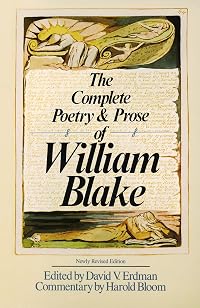
The Poetry and Prose of William Blake {Erdman, ed.}
by William Blake
On This Page
Description
Critical commentary illuminating Blake's allusions and references accompanies the texts of his poetic and prose works.Tags
Recommendations


Member Reviews
A long time ago (in high school), I was told by a teacher that he liked my poetry. It reminded him of William Blake. It's the sort of comment that sticks with you. For me, I still remember it from time to time a decade and change later. It's been a while since I've read any Blake, so perhaps it's time for another go.
Throughout the Complete Works, there are essentially three parts to Blake's writing:
- Philosophical writings on the nature of religion and the universe
- Straight random poetry in Songs of Innocence and Experience
- A looong collection of rambling poems detailing a strange fantastic mythology of angels, demons, and all sorts of other beings that seems to go on and on
The first is fascinating. Blake has quite a way with show more
Throughout the Complete Works, there are essentially three parts to Blake's writing:
- Philosophical writings on the nature of religion and the universe
- Straight random poetry in Songs of Innocence and Experience
- A looong collection of rambling poems detailing a strange fantastic mythology of angels, demons, and all sorts of other beings that seems to go on and on
The first is fascinating. Blake has quite a way with show more
words:show less
Principle 1: That the Poetic Genius is the True Man, and that the Body or Outward Form of Man is derived from the Poetic Genius. Likewise that the FOrms of all things are derived from their Genius, which by the Ancients was call'd an Angel and Spirit and Demon.
Principle 2: As all men are alike in Outward Form; so, and with the same infinite variety, all are alike in the poetic Genius.
...
Principle 4: As none travelling over known lands can find out the unknown; so, from already acquired knowledge, Man could not acquire more, therefor an universal Poetic Genius exists.
Principle 5: The Religions of all Nations are derived from each Nation's different reception of the Poetic Genius, which is everywhere call'd the Spirit of Prophecy.
I like it. It's weird, but I see echos of my own personal beliefs in there.
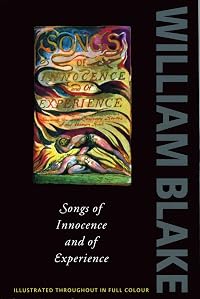
The second is what most people think of when they think of Blake. I really do recommend that everyone give Songs of Innocence and Experience a read when they get a chance. And find an illustrated version. The works and illustrations were both done by Blake and make more of a feel.
My favorites:
- A Cradle Song
- Night
- Spring
- A Dream
- On Anothers Sorrow
- Earth's Answer
- The Tyger
- My Pretty Rose Tree
- Infant Sorrow
- A Poison Tree
Infant Sorrow
My mother groand! my father wept.
Into the dangerous world I leapt:
Helpless, naked, piping loud;
Like a fiend hid in a cloud.
Struggling in my fathers hands:
Striving against my swadling bands:
Bound and weary I thought best
To sulk upon my mothers breast.
Sounds so familiar.
In a lot of these, I see what that high school teacher meant. They are familiar to what I'd written and before I'd ever read Blake. It makes me want to write once more. There's just something about reading and poetry. It lets you see the beauty in words and the world.
The third part, the weird mythology... has a lot of beautiful and terrible imagery.
3: Effluvia vapor'd above
In noxious clouds; these hover'd thick
Over the disorganiz'd Immortal,
Till petrific pain scurfd o'er the Lakes
As the bones of man, solid & dark
Blake has quite a way with words.
That being said, they just go on and on. Read a few pages. If you like it, there's lots more. If you find yourself skipping ahead, just give it up. It doesn't really change. Honestly, I skipped large parts. So it goes.
Overall, worth the read. It's an interesting contrast to what I normally read. If you give it a try, make sure you look at the illustrated versions. So very wonderfully weird.
Many poets think, feel, and imagine; Blake saw and knew.
Outstanding edition of Blake, the best available for a broad overview of his work.
Esp. like the proverbs of hell in marriage of heaven and hell.
See some writing on him: http://www.autodidactproject.org/guidblake.html
See some writing on him: http://www.autodidactproject.org/guidblake.html
the apocalypse, from The Four Zoas: Night the Ninth:
"... rivn link from link the bursting Universe explodes
"All things reversed flew from their centers rattling bones
"To bones Join, shaking convulsd the shivering clay breathes
"Each speck of dust to the Earths center nestles round & round
"In pangs of an Eternal Birth in torment & awe & fear
"All spirits deceasd let loose from reptile prisons come in shoals
"Wild furies from the tygers brain & from the lions Eyes
"And from the ox & ass come moping terrors. from the Eagle
"And raven numerous as the leaves of Autumn every species
"Flock to the trumpet muttring over the sides of the grave & crying
"In the fierce wind round heaving rocks & mountains filld with groans
"On rifted rocks suspended in show more the air by inward fires
"Many a woful company & many on clouds & waters
"Fathers & friends Mothers & Infants Kings & Warriors
"Priests & chaind Captives met together in a horrible fear
"And every one of the dead appears as he had livd before
"And all the marks remain of the Slaves scourge & tyrants Crown
"And of the Priests oergorged Abdomen & of the merchants thin
"Sinewy deception & of the warriors outbraving and thoughtlessness
"In lineaments too extended & in bones too strait & long
"They shew their wounds they accuse they sieze the opressor howlings began
"....
"One Planet calls to another & one star enquires of another
"What flames are these coming from the South what noise what dreadful rout
"As of a battle in the heavens hark heard you not the trumpet
"As of fierce battle while they spoke the flames come on intense roaring" show less
"... rivn link from link the bursting Universe explodes
"All things reversed flew from their centers rattling bones
"To bones Join, shaking convulsd the shivering clay breathes
"Each speck of dust to the Earths center nestles round & round
"In pangs of an Eternal Birth in torment & awe & fear
"All spirits deceasd let loose from reptile prisons come in shoals
"Wild furies from the tygers brain & from the lions Eyes
"And from the ox & ass come moping terrors. from the Eagle
"And raven numerous as the leaves of Autumn every species
"Flock to the trumpet muttring over the sides of the grave & crying
"In the fierce wind round heaving rocks & mountains filld with groans
"On rifted rocks suspended in show more the air by inward fires
"Many a woful company & many on clouds & waters
"Fathers & friends Mothers & Infants Kings & Warriors
"Priests & chaind Captives met together in a horrible fear
"And every one of the dead appears as he had livd before
"And all the marks remain of the Slaves scourge & tyrants Crown
"And of the Priests oergorged Abdomen & of the merchants thin
"Sinewy deception & of the warriors outbraving and thoughtlessness
"In lineaments too extended & in bones too strait & long
"They shew their wounds they accuse they sieze the opressor howlings began
"....
"One Planet calls to another & one star enquires of another
"What flames are these coming from the South what noise what dreadful rout
"As of a battle in the heavens hark heard you not the trumpet
"As of fierce battle while they spoke the flames come on intense roaring" show less
Ratings
Members
- Recently Added By
Lists

New Lifetime Reading Plan by Fadiman and Major
225 works; 5 members

Books You Read For University
184 works; 3 members

Books in the Bibliography of The History of Hell by Alice K. Turner
155 works; 1 member
Author Information

William Blake's poems, prophecies, and engravings represent his strong vision and voice for rebellion against orthodoxy and all forms of repression. Born in London in November 1757; his father, a hosier of limited means, could do little for the boy's education. However, when the young Blake's talent for design became apparent, his wise father sent show more him to drawing school at the age of 10. In 1771 Blake was apprenticed to an engraver. Blake went on to develop his own technique, a method he claimed that came to him in a vision of his deceased younger brother. In this, as in so many other areas of his life, Blake was an iconoclast; his blend of printing and engraving gave his works a unique and striking illumination. Blake joined with other young men in support of the Revolutions in France and America. He also lived his own revolt against established rules of conduct, even in his own home. One of his first acts after marrying his lifetime companion, Catherine Boucher, was to teach her to read and write, rare for a woman at that time. Blake's writings were increasingly styled after the Hebrew prophets. His engravings and poetry give form and substance to the conflicts and passions of the elemental human heart, made real as actual characters in his later work. Although he was ignored by the British literary community through most of his life, interest and study of his work has never waned. Blake's creativity and original thinking mark him as one of the earliest Romantic poets, best known for his Songs of Innocence (1789) and Songs of Experience (1794) and The Tiger. Blake died in London in 1827. (Bowker Author Biography) show less
All Editions
Some Editions
Common Knowledge
- Canonical title
- The Poetry and Prose of William Blake {Erdman, ed.}
- Original title
- The Poetry and Prose of William Blake
- Alternate titles
- The Complete Poetry and Prose of William Blake
- Original publication date
- 1965
- People/Characters
- William Blake
- Disambiguation notice
- Do not combine with the edition of Blake’s works edited by Geoffrey Keynes.
Classifications
Statistics
- Members
- 1,551
- Popularity
- 14,812
- Reviews
- 5
- Rating
- (4.43)
- Languages
- English, Russian
- Media
- Paper
- ISBNs
- 7
- ASINs
- 9