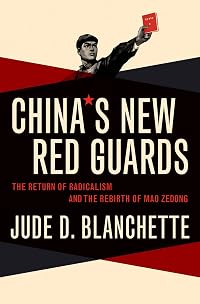
China's New Red Guards: The Return of Radicalism and the Rebirth of Mao Zedong
by Jude Blanchette
On This Page
Description
In China's New Red Guards, Jude Blanchette illuminates two trends in contemporary China that point to its revival of Mao Zedong's legacy--a development that he argues will result in a more authoritarian and more militaristic China.Ever since Deng Xiaoping effectively de-radicalized China in the 1980s, there have been many debates about which path China would follow. Would it democratize? Would it embrace capitalism? Would the Communist Party's rule be able to withstand the adoption and show more spread of the Internet? One debate that did not occur in any serious way, however, was whether Mao Zedong would make a political comeback.As Jude Blanchette details in China's New Red Guards, contemporary China is undergoing a revival of an unapologetic embrace of extreme authoritarianism that draws direct inspiration from the Mao era. Under current Chinese leader Xi Jinping, state control over the economy is increasing, civil society is under sustained attack, and the CCP is expanding its reach in unprecedented new ways. As Xi declared in late 2017, "Government, military, society and schools, north, south, east and west--the party is the leader of all."But this trend is reinforced by a bottom-up revolt against Western ideas of modernity, including political pluralism, the rule of law, and the free market economy. Centered around a cast of nationalist intellectuals and activists who have helped unleash a wave of populist enthusiasm for the Great Helmsman's policies, China's New Red Guards not only will reshape our understanding of the political forces driving contemporary China, it will also demonstrate how ideologies can survive and prosper despite pervasive rumors of their demise. show lessTags
Recommendations










Member Reviews
Back in the day I had a friend with an expat wife from the PRC who would make regular trips to see her family in China. To him, the most notable thing that concerned the people he met was the prevalence of open corruption, or at least what they considered to be corruption.
Flash forward 10-15 years and we have this book, which might be better entitled “China’s Grumpy Old Red Guards.” What tends to aggravate these folks is how the traditions of the pre-1981 years have been cast aside, leaving working-class folks in the lurch.
While examining the beliefs of these people in some detail, Blanchette goes to some lengths to demonstrate that the current leader of the PRC, Xi Jinping, is perfectly willing to exploit these feelings to show more chastise his opposition on the “right.” This is at least until organizations of a Neo-Maoist persuasion get too obstreperous and the hammer is dropped.
The basically insolvable issue, as most of the people who read this book will be aware of, is the Chinese Communist Party's efforts to retain the person of Mao Tsetung as the symbol of their legitimacy to wield power in Beijing, while repudiating the inheritance of the Great Cultural Revolution. It is to be hoped that the inability to transcend domestic contradiction in domestic conflict does not lead to foreign military adventurism. show less
Flash forward 10-15 years and we have this book, which might be better entitled “China’s Grumpy Old Red Guards.” What tends to aggravate these folks is how the traditions of the pre-1981 years have been cast aside, leaving working-class folks in the lurch.
While examining the beliefs of these people in some detail, Blanchette goes to some lengths to demonstrate that the current leader of the PRC, Xi Jinping, is perfectly willing to exploit these feelings to show more chastise his opposition on the “right.” This is at least until organizations of a Neo-Maoist persuasion get too obstreperous and the hammer is dropped.
The basically insolvable issue, as most of the people who read this book will be aware of, is the Chinese Communist Party's efforts to retain the person of Mao Tsetung as the symbol of their legitimacy to wield power in Beijing, while repudiating the inheritance of the Great Cultural Revolution. It is to be hoped that the inability to transcend domestic contradiction in domestic conflict does not lead to foreign military adventurism. show less
Ratings
Members
- Recently Added By
Published Reviews
ThingScore 75
[The Chinese Communist Party] may present itself as a united and monolithic organisation, but it is, in fact, a sackful of sects struggling for control of the narrative about the party’s supposed past miracles and the righteousness of its present policies. Blanchette recounts the history of this struggle and its consequences for the economy from the moments after Mao’s death, in 1976, to show more the present day.
The principal divisions are between those who see delivering an improved standard of living as vital to the party’s continued existence, and those who desire “true” socialism. Some are retired but well-connected cadres yearning for the hardline certainties of a time when they touched the hem of Mao’s garment. Others are younger people demanding a return to some entirely imaginary ideological purity of the past.
It is the latter, now labelled “neo-Maoists”, that the party leadership sees as a greater problem than the external “shadowy forces” often conjured up to unite the masses behind some political position. Having “wrapped themselves in the mantle of Mao”, neo-Maoist critics are peculiarly hard to jail or suppress, Blanchette explains. show less
The principal divisions are between those who see delivering an improved standard of living as vital to the party’s continued existence, and those who desire “true” socialism. Some are retired but well-connected cadres yearning for the hardline certainties of a time when they touched the hem of Mao’s garment. Others are younger people demanding a return to some entirely imaginary ideological purity of the past.
It is the latter, now labelled “neo-Maoists”, that the party leadership sees as a greater problem than the external “shadowy forces” often conjured up to unite the masses behind some political position. Having “wrapped themselves in the mantle of Mao”, neo-Maoist critics are peculiarly hard to jail or suppress, Blanchette explains. show less
added by peternh
Lists

The China Project Book List
100 works; 2 members
Author Information
5 Works 39 Members
Awards and Honors
Notable Lists
Classifications
Statistics
- Members
- 35
- Popularity
- 819,688
- Reviews
- 1
- Rating
- (3.83)
- Languages
- English
- Media
- Paper, Ebook
- ISBNs
- 4