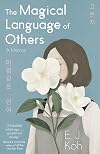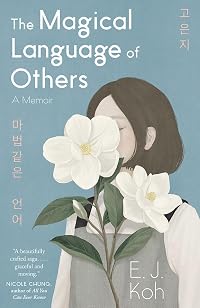
The Magical Language of Others: A Memoir
by E. J. Koh
On This Page
Description
"After living in America for over a decade, Eun Ji's parents return to Korea for work, leaving fifteen-year-old Eun Ji and her brother behind in the family's new California home. Overnight, Eun Ji finds herself in a world made strange in her mother's absence. Her mother writes letters over the years seeking forgiveness and love-letters Eun Ji cannot understand until she finds them years later hidden in a box. The letters lay bare the impact of her mother's departure, as Eun Ji gets to know show more the woman who raised her and left her behind. Eun Ji is a student, a traveler, a dancer, a poet, and a daughter coming to terms not only with her parents' prolonged absence, but her family's history: her grandmother Jun's years as a lovesick wife in Daejeon, the horrors her grandmother Kumiko witnessed during the Jeju Island Massacre. Where, Koh asks, do the stories of our mothers and grandmothers end and ours begin? How do we find words-in Korean, Japanese, English, or any language-to articulate the profound ways that distance can shape love? The Magical Language of Others is a fearless and poetic mind grappling with forgiveness, reconciliation, legacy, and intergenerational trauma-conjuring an epic saga and love story between mothers and daughters spanning four generations"-- show lessTags
Recommendations









Member Reviews
EJ Koh’s memoir The Magical Language of Others describes her relationship with her mom as well as her mom’s relationship with her grandma, interweaving intergenerational trauma and family dynamics. Koh’s parents move to Korea when she is young, leaving her and her brother in the US. Throughout her story, Koh exchanges letters with her mother, which inspires her to do some work in translation (which we know is an art in itself). Koh also delves into the history of Korea and Japan, as she spent some time studying in Japan as well.
This is probably one of the most beautiful pieces of contemporary literature that I have ever read. Though the memoir is on the shorter side, every word is intentional and evokes a deep meaning. Koh says a show more lot without writing a lot, and the reader does get a sense that there are some things that are left unsaid. However, this doesn’t diminish the impact of what is written. Her description of witnessing as a young child the fight between her dog and bird was one of the most visceral and heart-wrenching narratives that I’ve read. I actually picked this book as a book club read, and all the readers mentioned this scene as pretty impactful.
Aside from addressing her relationship with her mother, Koh’s life itself is really interesting, from her experience with dancing to the moment she decided to take a poetry class and realized that was an undiscovered passion. As someone who has also traveled to Korea and Japan and spent a lot of time in locations that are crucial to the story (norcal, OC, and Seattle), I really resonated with her descriptions of the historical context of these places. show less
This is probably one of the most beautiful pieces of contemporary literature that I have ever read. Though the memoir is on the shorter side, every word is intentional and evokes a deep meaning. Koh says a show more lot without writing a lot, and the reader does get a sense that there are some things that are left unsaid. However, this doesn’t diminish the impact of what is written. Her description of witnessing as a young child the fight between her dog and bird was one of the most visceral and heart-wrenching narratives that I’ve read. I actually picked this book as a book club read, and all the readers mentioned this scene as pretty impactful.
Aside from addressing her relationship with her mother, Koh’s life itself is really interesting, from her experience with dancing to the moment she decided to take a poetry class and realized that was an undiscovered passion. As someone who has also traveled to Korea and Japan and spent a lot of time in locations that are crucial to the story (norcal, OC, and Seattle), I really resonated with her descriptions of the historical context of these places. show less
"Languages, as they open you, can also allow you to close."
I don't think I've ever read a memoir so fast (one sitting), yet I didn't want it to end. And I don't think that I've ever read a memoir I know I'll read again, but I will with this one.
Koh's story reads like a novel but is full to bursting with facts and truths and history. Including her mother's letters really added depth and perspective to Koh's individual experiences, both as a teenager and adult, and also demonstrated letting go and slow-release forgiveness. Beautiful.
I don't think I've ever read a memoir so fast (one sitting), yet I didn't want it to end. And I don't think that I've ever read a memoir I know I'll read again, but I will with this one.
Koh's story reads like a novel but is full to bursting with facts and truths and history. Including her mother's letters really added depth and perspective to Koh's individual experiences, both as a teenager and adult, and also demonstrated letting go and slow-release forgiveness. Beautiful.
I'm sure I wouldn't have found this book had I not won it in a Goodreads Giveaway. I'm thankful I did. As a mother, the story was particularly touching to me—and a tiny bit close to home.
When the author was 14 and living in California, her mother and father moved back to Korea for a higher paying job, leaving her with her not-yet-twenty year old brother. They would not return for seven years, leaving her to finish raising herself alone.
Every other chapter is a letter (translated from Korean) from mom to daughter; the chapter that follows is about some pivotal time in the author's life.
It was a bit of a challenging read as it lacked a continuous flow, while at the same time moving quickly. Having a son who is a poet, I particularly show more liked the parts that gave insight into the soul of poets. My favorite line in the book, and one that will never leave me, was when the author's mother tells her friends what her daughter does for a living—"My daughter teaches people to let go." Now, I understand my son a little bit more. show less
When the author was 14 and living in California, her mother and father moved back to Korea for a higher paying job, leaving her with her not-yet-twenty year old brother. They would not return for seven years, leaving her to finish raising herself alone.
Every other chapter is a letter (translated from Korean) from mom to daughter; the chapter that follows is about some pivotal time in the author's life.
It was a bit of a challenging read as it lacked a continuous flow, while at the same time moving quickly. Having a son who is a poet, I particularly show more liked the parts that gave insight into the soul of poets. My favorite line in the book, and one that will never leave me, was when the author's mother tells her friends what her daughter does for a living—"My daughter teaches people to let go." Now, I understand my son a little bit more. show less
I found The Magical Language of Others a confusing, but rewarding title. The book's odd-numbered chapters offer English translations of letters sent to the author by her mother when the author lived with her brother in the U.S. and her parents returned to Korea because her father had received an exceptional job offer. In the even-numbered chapters, the author narrates different part of her family's history, going back several generations.
The confusion and rewards both result because the book is so firmly grounded in culture and history. I am not conversant in this culture or this history, so I have to read by gathering clues, looking for the significance of words or actions that might be obvious to a reader from a background similar to show more Koh's. I have a general sense of the tensions between Korea and Japan, but the specific historical moments she describes are unfamiliar to me.
I liked this book, but it wasn't an easy read, and I left it uncertain how much I had understood of what Koh hoped to communicate.
I received an electronic review copy of this book from the publisher via Edelweiss+. The opinions are my own. show less
The confusion and rewards both result because the book is so firmly grounded in culture and history. I am not conversant in this culture or this history, so I have to read by gathering clues, looking for the significance of words or actions that might be obvious to a reader from a background similar to show more Koh's. I have a general sense of the tensions between Korea and Japan, but the specific historical moments she describes are unfamiliar to me.
I liked this book, but it wasn't an easy read, and I left it uncertain how much I had understood of what Koh hoped to communicate.
I received an electronic review copy of this book from the publisher via Edelweiss+. The opinions are my own. show less
This memoir is told with letters and the stories of Eun Ji, her mother, and her grandmother. It was in interesting way to tell the female members of the family story.
I had trouble at times telling whose story she was telling and I had to go back to the beginning of the chapter to figure it out. I did not like her mother at all. Who leaves a 15-year-old in the custody of her 19 year-old brother and moves to Korea for 3 years with her husband for a better job then ups the time away twice? I felt that Eun Ji was abandoned and left to fend for herself. I liked the Grandmother Kumiko best. Having read other books about Korea after WWII, I understood where the grandmother was coming from. Eun Ji's mother seemed to care only for herself and show more not her children. I felt bad for both kids. show less
I had trouble at times telling whose story she was telling and I had to go back to the beginning of the chapter to figure it out. I did not like her mother at all. Who leaves a 15-year-old in the custody of her 19 year-old brother and moves to Korea for 3 years with her husband for a better job then ups the time away twice? I felt that Eun Ji was abandoned and left to fend for herself. I liked the Grandmother Kumiko best. Having read other books about Korea after WWII, I understood where the grandmother was coming from. Eun Ji's mother seemed to care only for herself and show more not her children. I felt bad for both kids. show less
Simply beautiful.
Ratings
Members
- Recently Added By
Lists

Top Five Books of 2020
982 works; 350 members

History: Asia
103 works; 1 member
Author Information
5 Works 360 Members
Awards and Honors
Awards
Distinctions
Notable Lists
Common Knowledge
- Canonical title
- The Magical Language of Others: A Memoir
- Original publication date
- 2020-01-07
- Important places
- Seoul, South Korea; Davis, California, USA; Jeju Island, Korea
- First words
- Dear Eun Ji,
Hello, hello, hello, my Eun Ji. (Chapter 1)
The present is the revenge of the past. (Chapter 2) - Last words
- (Click to show. Warning: May contain spoilers.)It was the first time.
- Blurbers
- Chung, Nicole; Kim, Crystal Hana; Blake, Sarah; Choi, Don Mee; Vanasco, Jeannie; Wong, Shawn (show all 7); Horrocks, Caitlin
- Original language
- English
Classifications
Statistics
- Members
- 259
- Popularity
- 125,448
- Reviews
- 6
- Rating
- (3.68)
- Languages
- English
- Media
- Paper, Audiobook, Ebook
- ISBNs
- 12
- ASINs
- 2