On This Page
Description
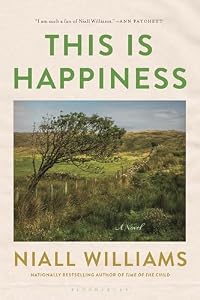
"Change is coming to Faha, a small Irish parish that hasn't changed in a thousand years. For one thing, the rain is stopping. Nobody remembers when it started; rain on the western seaboard is a condition of living. But now - just as Father Coffey proclaims the coming of the electricity - the rain clouds are lifting. Seventeen-year-old Noel Crowe is idling in the unexpected sunshine when Christy makes his first entrance into Faha, bringing secrets he needs to atone for. Though he can't show more explain it, Noel knows right then: something has changed. As the people of Faha anticipate the endlessly procrastinated advent of the electricity, and Noel navigates his own coming-of-age and his falling in and out of love, Christy's past gradually comes to light, casting a new glow on a small world. Harking back to a simpler time, This Is Happiness is a tender portrait of a community - its idiosyncrasies and traditions, its paradoxes and kindnesses, its failures and triumphs - and a coming-of-age tale like no other. Luminous and lyrical, yet anchored by roots running deep into the earthy and everyday, it is about the power of stories: their invisible currents that run through all we do, writing and rewriting us, and the transforming light that they throw onto our world."--Publisher description. show lessTags
Recommendations






Member Recommendations

Member Reviews
Setting aside my extreme appreciation of most things Irish: literature, language, music, landscape, culture, please believe me that you do not want to miss Niall Williams's This is Happiness. Niall Williams's This is Happiness offers irresistible story-telling.
It is 1958, electricity is coming to ever-rainy Faha in County Clare, in the west of Ireland. Noe Crowe is rusticating at his grandparents’ house having found his vocation for the priesthood faltering. Just before the electric men arrive, the rain stops and along comes Christy, to stay as a lodger as the Crowes senior have the rare telephone. He is one of the men involved in electrification but Noe immediately intuits that Christy is not only different but here on a mission. show more Gradually Christy's secret and his purpose emerge and intertwine with Noe's own efforts to figure himself out at least enough to know what direction to move in with his life. The novel is so rewarding I've said enough. Read it.
A sub-theme in the novel is music: As Noe begins to play the fiddle, Christy and Noe bicycle around the region in the hopes of happening upon Junior Crehan playing at a session or dance. If you do read the novel, be sure to go to your browser and look up Junior Crehan, one of County Clare's most wonderful composers and fiddlers of the last century and be sure also to go listen on youtube or wherever to a bit of his music, and listen to him talk about his life. Look up too, the Irish words that pop up here and there in the text.
At one moment, the narrator, Noe (pronounced No, 'short' for Noel--one of countless sly language moments as the Irish language itself contains no word for 'No' -- or 'Yes' for that matter) watches his grandfather standing quietly for hours in his upper field on the small family farm in the village of Faha in Clare, just . . . doing what looks like nothing, just looking about. Subtly but forcefully Williams quietly demonstrates as well what having electricity, that mysterious and now essential enabler of how we live now, will change everything: what will be gained and what will be lost.
The novel is so rich in detail, in humor, so emotionally engaging, so rewarding I've said enough. Read it. *****
Also don't miss History of the Rain which was a best book for me a few years back. show less
It is 1958, electricity is coming to ever-rainy Faha in County Clare, in the west of Ireland. Noe Crowe is rusticating at his grandparents’ house having found his vocation for the priesthood faltering. Just before the electric men arrive, the rain stops and along comes Christy, to stay as a lodger as the Crowes senior have the rare telephone. He is one of the men involved in electrification but Noe immediately intuits that Christy is not only different but here on a mission. show more Gradually Christy's secret and his purpose emerge and intertwine with Noe's own efforts to figure himself out at least enough to know what direction to move in with his life. The novel is so rewarding I've said enough. Read it.
A sub-theme in the novel is music: As Noe begins to play the fiddle, Christy and Noe bicycle around the region in the hopes of happening upon Junior Crehan playing at a session or dance. If you do read the novel, be sure to go to your browser and look up Junior Crehan, one of County Clare's most wonderful composers and fiddlers of the last century and be sure also to go listen on youtube or wherever to a bit of his music, and listen to him talk about his life. Look up too, the Irish words that pop up here and there in the text.
At one moment, the narrator, Noe (pronounced No, 'short' for Noel--one of countless sly language moments as the Irish language itself contains no word for 'No' -- or 'Yes' for that matter) watches his grandfather standing quietly for hours in his upper field on the small family farm in the village of Faha in Clare, just . . . doing what looks like nothing, just looking about. Subtly but forcefully Williams quietly demonstrates as well what having electricity, that mysterious and now essential enabler of how we live now, will change everything: what will be gained and what will be lost.
The novel is so rich in detail, in humor, so emotionally engaging, so rewarding I've said enough. Read it. *****
Also don't miss History of the Rain which was a best book for me a few years back. show less
The first three pages of the paperback edition of Niall Williams’s This is Happiness are filled with enthusiastic accolades and rave reviews when the hard cover edition initially appeared published by sources like The New York Times, The Wall Street Journal, and The Guardian. Despite the big build up, I was not disappointed—the book was as good as the other reviewers said it was.
The story takes place in 1956 in the tiny fictional village of Faha in County Clare, Ireland, which is near the West Coast, where it rains a lot. Nevertheless, the entire first chapter consists of the sentence: “It had stopped raining.” Things are about to change in Faha because not only is the sun shining, but electricity will be available for the show more first time. [This is actually true—western Ireland was about 40 years behind the rest of “first world” countries in gaining access to electrical power. On the other hand, I’m not sure it is true that it ever stopped raining in County Clare.]
But change wasn’t going to happen very fast. In one of my favorite sentences in a delightfully written book, the author observed, “Nothing happened, and continued to happen.”
As in any novel set in Ireland, the characters must deal with the Catholic Church. The main character, Noel, has recently left the seminary and is living with his grandparents. A particularly officious nun, Mother* Acquin, tells Noel that “his mother in heaven” has sent her to help him renew his priestly vocation. (*Not “sister,” as she corrects at least two characters who would thus bemean her status.)
Christy has come to Faha as part of the crew setting up electricity in Faha, but is also seeking to reunite with a girl he once knew there. His arrival changes Noel’s life.
But the plot and the “action” really don’t matter very much. What is important is the sense of place so eloquently and poignantly created by a masterful novelist. The pervasive tone of the novel is bittersweet, with very little bitter.
I thoroughly enjoyed this heartwarming book.
(JAB) show less
The story takes place in 1956 in the tiny fictional village of Faha in County Clare, Ireland, which is near the West Coast, where it rains a lot. Nevertheless, the entire first chapter consists of the sentence: “It had stopped raining.” Things are about to change in Faha because not only is the sun shining, but electricity will be available for the show more first time. [This is actually true—western Ireland was about 40 years behind the rest of “first world” countries in gaining access to electrical power. On the other hand, I’m not sure it is true that it ever stopped raining in County Clare.]
But change wasn’t going to happen very fast. In one of my favorite sentences in a delightfully written book, the author observed, “Nothing happened, and continued to happen.”
As in any novel set in Ireland, the characters must deal with the Catholic Church. The main character, Noel, has recently left the seminary and is living with his grandparents. A particularly officious nun, Mother* Acquin, tells Noel that “his mother in heaven” has sent her to help him renew his priestly vocation. (*Not “sister,” as she corrects at least two characters who would thus bemean her status.)
Christy has come to Faha as part of the crew setting up electricity in Faha, but is also seeking to reunite with a girl he once knew there. His arrival changes Noel’s life.
But the plot and the “action” really don’t matter very much. What is important is the sense of place so eloquently and poignantly created by a masterful novelist. The pervasive tone of the novel is bittersweet, with very little bitter.
I thoroughly enjoyed this heartwarming book.
(JAB) show less
During a mid-century spring marked by unprecedented sunshine, things are changing in the wee village of Faha, County Clare. The electricity is coming in, and the Crowes are on the telephone now. Young Noel Crowe has abandoned Dublin as well as his seminary studies and is struggling to find himself in his grandparents' rural outpost. "Faha was no more nor less than any other place. If you could find it, you'd be on your way somewhere else."
Often accompanied on a rickety bicycle by his grandmother's boarder Christy, an agent of the electric company, Noel spends many evenings seeking the music of a wandering fiddle player widely touted as the finest that ever bowed a string. "Once he heard a tune it never left him...In time Junior Crehan show more carried so much music in him he became a one-man repository...in whose playing was the playing of all those before him on into the mists of the long ago."
Love is in the air, but having trouble finding where to settle. Noel falls, in rapid sequence, for each of the three daughters of the local doctor, simultaneously attempting to mend a decades-old rift between his new friend Christy and the woman he left at the altar.
The novel proceeds at the unhasty pace of a one-horse buggy, and you seriously need to slow down and let it do so. In the hands of an Irish master, the English language sheds all its Anglo-Saxon clunkery, and becomes the music you didn't know you were seeking yourself.
"You live long enough you understand prayers can be answered on a different frequency than the one you were listening for. We all have to find a story to live by and live inside, or we couldn't endure the certainty of suffering. That's how it seems to me."
Give yourself a gift; read this one without giving a thought to when you will finish or what you will read next. show less
Often accompanied on a rickety bicycle by his grandmother's boarder Christy, an agent of the electric company, Noel spends many evenings seeking the music of a wandering fiddle player widely touted as the finest that ever bowed a string. "Once he heard a tune it never left him...In time Junior Crehan show more carried so much music in him he became a one-man repository...in whose playing was the playing of all those before him on into the mists of the long ago."
Love is in the air, but having trouble finding where to settle. Noel falls, in rapid sequence, for each of the three daughters of the local doctor, simultaneously attempting to mend a decades-old rift between his new friend Christy and the woman he left at the altar.
The novel proceeds at the unhasty pace of a one-horse buggy, and you seriously need to slow down and let it do so. In the hands of an Irish master, the English language sheds all its Anglo-Saxon clunkery, and becomes the music you didn't know you were seeking yourself.
"You live long enough you understand prayers can be answered on a different frequency than the one you were listening for. We all have to find a story to live by and live inside, or we couldn't endure the certainty of suffering. That's how it seems to me."
Give yourself a gift; read this one without giving a thought to when you will finish or what you will read next. show less
An Irish book that's not depressing? The world turned upside down! Just when I had begun to believe the price that one paid for gorgeous storytelling and lyric Irish prose was tragedy and despair. :-)
This is the memoir of 17yr old Noel Crowe, living with his grandparents in an Irish village that would seem to have been forgotten by time: though the year is 1960, they're still living in sod houses, using peat for fuel, relying on communal phones, driving horse carts to church, and waiting for electricity. (Imagine learning about Sputnik from the newspapers because you're still living in a place without televisions or radios! The cognitive dissonance is real.) The story is told in first person by Noe as a senior citizen, reflecting back show more on a few extraordinary months of his youth, when the rain in Faha inexplicably ceased to fall and he, Noe, took the first, formative steps towards acquiring the wisdom that now informs his perspectives on life.
Having left his religious education behind and unsure of what he wants out of life, Noe comes under the influence of Christy, an older, gentle wanderer who has arrived at Faha to help electrify the town. Under Christy's benign tutelage, Noe gradually comes to understand that life is equal parts pain and pleasure, but it's often the pain that makes the pleasure possible. "I saw the sorrow in his happiness had made shine his eyes" Noe at one point says of Christy - how beautiful and Irish is that?
Along the way we are treated to lovely vignettes about the inhabitants of Faha, some gorgeously evocative prose (especially about sun and rain), an homage to the simplicity of rural living, a brief primer on Irish folk music, an exploration of the nature of storytelling, romantic adolescent misadventures, a poignant love story, and a provocative exploration of human nature: our fear of change, our foibles, but also our enormous capacity for empathy.
The best piece of advice I can give to potential readers: don't try to speed your way through this! The pleasure of the tale is in slowing down and letting the charm of the story, the beauty of the prose, and the wistfulness of the themes enfold you. In fact, some of the members of my book club highly recommended doing this as an audiobook, in order to fully appreciate the cadence and lyricism of Williams' language. As for me, I may even give Irish authors a second chance. show less
This is the memoir of 17yr old Noel Crowe, living with his grandparents in an Irish village that would seem to have been forgotten by time: though the year is 1960, they're still living in sod houses, using peat for fuel, relying on communal phones, driving horse carts to church, and waiting for electricity. (Imagine learning about Sputnik from the newspapers because you're still living in a place without televisions or radios! The cognitive dissonance is real.) The story is told in first person by Noe as a senior citizen, reflecting back show more on a few extraordinary months of his youth, when the rain in Faha inexplicably ceased to fall and he, Noe, took the first, formative steps towards acquiring the wisdom that now informs his perspectives on life.
Having left his religious education behind and unsure of what he wants out of life, Noe comes under the influence of Christy, an older, gentle wanderer who has arrived at Faha to help electrify the town. Under Christy's benign tutelage, Noe gradually comes to understand that life is equal parts pain and pleasure, but it's often the pain that makes the pleasure possible. "I saw the sorrow in his happiness had made shine his eyes" Noe at one point says of Christy - how beautiful and Irish is that?
Along the way we are treated to lovely vignettes about the inhabitants of Faha, some gorgeously evocative prose (especially about sun and rain), an homage to the simplicity of rural living, a brief primer on Irish folk music, an exploration of the nature of storytelling, romantic adolescent misadventures, a poignant love story, and a provocative exploration of human nature: our fear of change, our foibles, but also our enormous capacity for empathy.
The best piece of advice I can give to potential readers: don't try to speed your way through this! The pleasure of the tale is in slowing down and letting the charm of the story, the beauty of the prose, and the wistfulness of the themes enfold you. In fact, some of the members of my book club highly recommended doing this as an audiobook, in order to fully appreciate the cadence and lyricism of Williams' language. As for me, I may even give Irish authors a second chance. show less
I listened to this in audiobook format.
This novel is about a young man's coming of age in a small Irish village just before the dawn of modernity. There's a few plot arcs but the real story here in the storytelling itself. This is a sublime example of the use of language to evoke time, place, and character. Rich with nostalgia, the storyteller (the young man himself decades later) reminisces about a simpler time, a simpler place, and a people for whom community was everything. I loved the humor, the perfect turns of phrase, and the positively uplifting quality in a time when so many books are grief-stricken. Highly recommend.
This novel is about a young man's coming of age in a small Irish village just before the dawn of modernity. There's a few plot arcs but the real story here in the storytelling itself. This is a sublime example of the use of language to evoke time, place, and character. Rich with nostalgia, the storyteller (the young man himself decades later) reminisces about a simpler time, a simpler place, and a people for whom community was everything. I loved the humor, the perfect turns of phrase, and the positively uplifting quality in a time when so many books are grief-stricken. Highly recommend.
Now this is what I recognise as Irish writing. What is evident in his writing is that it comes from a deep love for his people and his country. He writes of their idiosyncracies with affection and acceptance. His writing is peopled with wonderfully drawn characters and vivid rural images. So yes it is a character driven novel but also a love story, not only between man and woman but between friends, grandparents and community.
Noe, short for Noel, is a teenage orphan who recently moved from Dublin to live with his grandparents in a small Irish town. Just prior, he enrolled in a seminary with the thought of seeking a priestly calling, but dropped out. Instead, he is now trying to find direction in life. Suddenly, in his small community of Faha, it stopped raining, and the sun came out. The sun never stays out in this rainy realm of the world, but it did here.
The sun, of course, metaphorically stands for new knowledge’s light to shine on all of life. Although Faha’s residents are first overjoyed with the natural light, it exposes problems and details not before seen. In a story set 60 years ago, the Irish government is spreading electricity to even the show more smallest places. An employee named Christy enters the town to dwell in Noe’s house, and it soon becomes clear that he came not at the electric company’s bidding but at his heart’s tugging.
In the ensuing drama, Noe learns about love – not just the sentimental sort either. No, he learns about enduring love, the kind that brings about broken hearts lasting a lifetime. He sees value in being the outlier in a village by doing one’s own thing when everyone else does another. He learns what happiness truly means. This tale could only be set in Ireland, oppressed for centuries by the British so that the Irish became enchanted with the joy of the smallest things. Noe went to seminary to learn to live; he left confused; and in these days in Faha, he learned to live again. From Christy, his grandparents, and the entire village, he learned happiness.
The narrative grips from the beginning, not from an titilating plot line but from the words’ innate strength. Niall Williams knows how to enliven a good story that consumes a reader’s mind with vivid imagery, strong central ideas, and deep meaning. A bookish friend recommended this work to me “without reservation,” and I will concur with that recommendation. Like the sun in Faha, this book exposes new light in the human pursuit of happiness. show less
The sun, of course, metaphorically stands for new knowledge’s light to shine on all of life. Although Faha’s residents are first overjoyed with the natural light, it exposes problems and details not before seen. In a story set 60 years ago, the Irish government is spreading electricity to even the show more smallest places. An employee named Christy enters the town to dwell in Noe’s house, and it soon becomes clear that he came not at the electric company’s bidding but at his heart’s tugging.
In the ensuing drama, Noe learns about love – not just the sentimental sort either. No, he learns about enduring love, the kind that brings about broken hearts lasting a lifetime. He sees value in being the outlier in a village by doing one’s own thing when everyone else does another. He learns what happiness truly means. This tale could only be set in Ireland, oppressed for centuries by the British so that the Irish became enchanted with the joy of the smallest things. Noe went to seminary to learn to live; he left confused; and in these days in Faha, he learned to live again. From Christy, his grandparents, and the entire village, he learned happiness.
The narrative grips from the beginning, not from an titilating plot line but from the words’ innate strength. Niall Williams knows how to enliven a good story that consumes a reader’s mind with vivid imagery, strong central ideas, and deep meaning. A bookish friend recommended this work to me “without reservation,” and I will concur with that recommendation. Like the sun in Faha, this book exposes new light in the human pursuit of happiness. show less
Members
- Recently Added By
Published Reviews
Rich in sentiment and humour, this evocation of an Irish village in the 1970s examines grief, faith and first love....It takes time for Niall Williams to convince you that tourist fodder isn’t what he’s producing in This Is Happiness...The pleasure of this novel lies in its eye for detail. The plot, having been established, then takes a long time to do not very much more..... He has a show more humorist’s eye, and his own fond amusement at the people he writes about shines out through the writing.
The fields of Ireland are very crowded, but by the conclusion of This Is Happiness, you feel Williams has justified adding another book to the herd. show less
The fields of Ireland are very crowded, but by the conclusion of This Is Happiness, you feel Williams has justified adding another book to the herd. show less
added by vancouverdeb
Lists

Books Read in 2023
5,547 works; 145 members

Kirkus Starred Fiction Reviews of Books Published in 2019
411 works; 12 members

Books Read in 2024
4,623 works; 126 members

Fiction (Non-Fantasy) by Irish Authors Set in Ireland
87 works; 3 members
Author Information

21+ Works 4,860 Members
Author and playwright Niall Williams was born in Dublin in 1958. He received a Master's degree in Modern American Literature from University College Dublin, where he also studied English and French literature. In 1980, he moved to New York and worked as a copywriter for Avon Books. In 1985, he moved back to Ireland to become a full-time writer. show more His first four books were co-written with his wife and deal with their life together in Kiltumper, Ireland. On his own, he has written three plays and five novels. His first novel, Four Letters of Love, became an international bestseller. (Bowker Author Biography) show less
Some Editions
Awards and Honors
Awards
Notable Lists
Series

Common Knowledge
- Original publication date
- 2019
- People/Characters
- Noe; Christy; Annie Mooney; Doady; Ganga; Sophie Troy (show all 8); Charlie Troy; Ronnie Troy
- Important places
- Ireland; Faha, County Cork, Ireland
- Dedication
- To the memory of
P.J. Brown (1956-2018) - First words
- It had stopped raining.
- Quotations
- Neighbours, as Jesus knew, can be a not insignificant challenge to anyone's Christianity.
It was a condensed explanation, but I came to understand him to mean you could stop at, not all, but most of the moments of your life, stop for one heartbeat and, no matter what the state of your head or heart, say This is ha... (show all)ppiness, because of the simple truth that you were alive to say it.
Books, music, painting are not life, can never be as full, rich, complex, surprising or beautiful, but the best of them can catch an echo of that, can turn you back to look out the window, go out the door aware that you've be... (show all)en enriched, that you have been in the company of something alive that has caused you to realise once again how astonishing life is, and you leave the book, gallery or concert hall with that illumination, which feels I'm going to say holy, by which I mean human raptness.
Because there were fewer sources of where to find out anything, there was more listening.
That was one of the things about him. He walked this line between the comic and the poignant, between the certainly doomed and the hopelessly hopeful. In time I came to think it the common ground of all humanity.
The truth turns into a story when it grows old. We all become stories in the end. So, though the narrative was flawed, the sense was of a life so lived it was epic.
The fact is, I did not appreciate until much later in my own life what subterfuge and sacrifice it took to be independent and undefeated by the pressures of reality.
After a liquid lunch in Craven's, he had found the margins of the roads badly drawn.
Everybody carries a world. But certain people change the air about them.
Nobody in Faha could remember when it started. Rain there on the western seaboard was a condition of living. It came straight-down and sideways, frontwards, backwards and any other wards God could think of. It came in sweeps,... (show all) in waves, sometimes in veils. It came dressed as drizzle, as mizzle, as mist, as showers, frequent and widespread, as a wet fog, as a damp day, a drop, a dripping, and an out-and-out downpour. It came the fine day, the bright day, and the day promised dry. It came at any time of the day and night, and in all seasons, regardless of calendar and forecast, until in Faha your clothes were rain and your skin was rain and your house was rain with a fireplace. It came off the grey vastness of an Atlantic that threw itself against the land like a lover once spurned and resolved not to be so again. It came accompanied by seagulls and smells of salt and seaweed. It came with cold air and curtained light. It came like a judgment, or, in benign version, like a blessing God had forgotten he had left on. It came for a handkerchief of blue sky, came on westerlies, sometimes—why not?—on easterlies, came in clouds that broke their backs on the mountains in Kerry and fell into Clare, making mud the ground and blind the air. It came disguised as hail, as sleet, but never as snow. It came softly sometimes, tenderly sometimes, its spears turned to kisses, in rain that pretended it was not rain, that had come down to be closer to the fields whose green it loved and fostered, until it drowned them.
It was where, when darkness fell, it fell absolutely, and when you went outside the wind sometimes drew apart the clouds and you stood in the revelation of so many stars you could not credit the wonder and felt smaller in bod... (show all)y as your soul felt enormous. - Last words
- (Click to show. Warning: May contain spoilers.)It had started raining.
Classifications
Statistics
- Members
- 1,120
- Popularity
- 22,446
- Reviews
- 61
- Rating
- (4.38)
- Languages
- English, German, Italian
- Media
- Paper, Audiobook, Ebook
- ISBNs
- 18
- ASINs
- 5