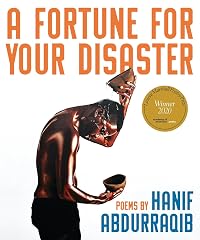
A Fortune for Your Disaster
by Hanif Abdurraqib
On This Page
Description
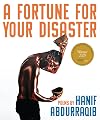
In his much-anticipated follow-up to The Crown Ain't Worth Much, poet, essayist, biographer, and music critic Hanif Abdurraqib has written a book of poems about how one rebuilds oneself after a heartbreak, the kind that renders them a different version of themselves than the one they knew. It's a book about a mother's death, and admitting that Michael Jordan pushed off, about forgiveness, and how none of the author's black friends wanted to listen to "Don't Stop Believin'." It's about show more wrestling with histories, personal and shared. Abdurraqib uses touchstones from the world outside-from Marvin Gaye to Nikola Tesla to his neighbor's dogs-to create a mirror, inside of which every angle presents a new possibility. show lessTags
Recommendations

Member Reviews
A Fortune for Your Disaster is an overwhelmingly fantastic collection of contemporary poetry. Rich, meaningful images parade through every poem, taking readers into deeply understood emotions. The works express pain, turmoil, depravation at the hands of others. The poems elicit strong reactions in readers, growing stronger with every re-reading of the poems
Every poem tells about the experience of being marginalized by America's racist society. That racism exists not just in its most obvious forms but even more in its subtle forms, the forms we most like to ignore and pretend do not exist. It is this form of subtle racism that assigns waiters to be white and dish washers and busboys to be brown. It assigns lead roles in films to be show more played by one race and supporting roles by others. It allows peaceful protests to turn into riots and then be condemned instead of heard. It expresses surprise when a Black woman wins a Nobel Prize for Literature (Toni Morrison) or amasses a billion dollar personal fortune (Oprah Winfrey) while also being far more respected the a billionaire white man playing golf and sending tweets even as the country he leads descends into chaos.
Symbolism throughout each poem augments the very format of the book. Three divisions separate the poetry into sections: The Pledge, The Turn and The Prestige, terms taken from magicians symbolically stating the magical impact of poetry. The poetry works as a form of magic, casting spells on readers. It bring us to the awareness that we all share in the pain we create.
This use of symbolism also appears through the repeated poetry about Marvin Gaye, Nikola Tesla and in several poems carrying the same title used repeatedly with different content.
Abdurraquib also uses the tools of poems often unseen or unnoticed by readers: white space, positioning on a page, line breaks and other devices. Often, verses are separated by a slash rather than a line break, protecting the rhythm of the poem while highlighting its impact.
This is a rich collection from beginning to end. I found favorites, of course, as well as a few I simply did not quite understand, but I also found some I will not soon forget.
A recurring title, "How Can Black People Write About Flowers At A Time Like This," carries with it the messages that pain exists in all times but that, on the other side of pain is hope and beauty. After all, we cannot admire the beauty of flowers carried to ur funerals.
"I Tend To Think Forgiveness Looks The Way It Does In The Movies," is the poem that strikes me the most and to which I have come back to that poem more than any others.
There is also some prophesy, some prescient understandings in the poetry. Our current times filled with pandemic, economic collapse, corrupt and incapable government and divisiveness between citizens rather than the unity we need is summed up, in three short phrases in the poem, "No Diggity," when it says, "party's over boys/where we going/for breakfast." Yes, the old party, the old life we have lived for so long is over. Where are we going as we start a new day in our lives? show less
Every poem tells about the experience of being marginalized by America's racist society. That racism exists not just in its most obvious forms but even more in its subtle forms, the forms we most like to ignore and pretend do not exist. It is this form of subtle racism that assigns waiters to be white and dish washers and busboys to be brown. It assigns lead roles in films to be show more played by one race and supporting roles by others. It allows peaceful protests to turn into riots and then be condemned instead of heard. It expresses surprise when a Black woman wins a Nobel Prize for Literature (Toni Morrison) or amasses a billion dollar personal fortune (Oprah Winfrey) while also being far more respected the a billionaire white man playing golf and sending tweets even as the country he leads descends into chaos.
Symbolism throughout each poem augments the very format of the book. Three divisions separate the poetry into sections: The Pledge, The Turn and The Prestige, terms taken from magicians symbolically stating the magical impact of poetry. The poetry works as a form of magic, casting spells on readers. It bring us to the awareness that we all share in the pain we create.
This use of symbolism also appears through the repeated poetry about Marvin Gaye, Nikola Tesla and in several poems carrying the same title used repeatedly with different content.
Abdurraquib also uses the tools of poems often unseen or unnoticed by readers: white space, positioning on a page, line breaks and other devices. Often, verses are separated by a slash rather than a line break, protecting the rhythm of the poem while highlighting its impact.
This is a rich collection from beginning to end. I found favorites, of course, as well as a few I simply did not quite understand, but I also found some I will not soon forget.
A recurring title, "How Can Black People Write About Flowers At A Time Like This," carries with it the messages that pain exists in all times but that, on the other side of pain is hope and beauty. After all, we cannot admire the beauty of flowers carried to ur funerals.
"I Tend To Think Forgiveness Looks The Way It Does In The Movies," is the poem that strikes me the most and to which I have come back to that poem more than any others.
There is also some prophesy, some prescient understandings in the poetry. Our current times filled with pandemic, economic collapse, corrupt and incapable government and divisiveness between citizens rather than the unity we need is summed up, in three short phrases in the poem, "No Diggity," when it says, "party's over boys/where we going/for breakfast." Yes, the old party, the old life we have lived for so long is over. Where are we going as we start a new day in our lives? show less
Yeong-hye and her husband go through the mundane, routine motions of married life until one day when Yeong-hey throws every ounce of meat in their refrigerator away and announces that she's become a vegetarian. Startled and confused, her family is outraged with this decision and simply cannot understand any reason why Yeong-hye would choose to forgo eating meat. When she explains to them that the catalyst was a terrifying nightmare full of violence and horror, her family remains insensitive and judgmental. Throughout the book we see that Yeong-hye's quest to achieve of a more plantlike existence ultimately impacts the lives of those around her as well as her own well being.
There were moments in this book that I thought were absolutely show more beautiful - specifically the rapid changes from a dreamlike environment to Yeong-he's brutal, bloody nightmares - which really made me think that this would translate well to film (David Lynch, where are you?). However, as much as I appreciated the underlying messages of The Vegetarian, I just wasn't as blown away by it as I expected to be. I have a feeling that I set my expectations too high or maybe I approached the book with too much knowledge of what it was about. Whatever the case, this book just didn't really do much for me. show less
There were moments in this book that I thought were absolutely show more beautiful - specifically the rapid changes from a dreamlike environment to Yeong-he's brutal, bloody nightmares - which really made me think that this would translate well to film (David Lynch, where are you?). However, as much as I appreciated the underlying messages of The Vegetarian, I just wasn't as blown away by it as I expected to be. I have a feeling that I set my expectations too high or maybe I approached the book with too much knowledge of what it was about. Whatever the case, this book just didn't really do much for me. show less
I'm at a loss for words. This was so very moving. I adore how Abdurraqib mixes social and personal commentary with his obvious love of music. I wouldn't dare be so bold as to claim I understood everything I just read. But I definitely experienced it.
Really gorgeous poetry; the poems about Marvin Gaye in particular felt so powerful and compassionate at the same time. Sometimes the poems felt kind of cerebral, but then there are just lines that completely rend you and it's amazing.
I don’t read or listen to much poetry and I certainly don’t consider myself qualified to assess any poem’s quality. I can say, however, that the imagery in some of these poems took my breath away, made me gasp out loud once or twice and even brought tears to my eyes once. On the other hand, some of them did not evoke an emotional response, or even much of an intellectually appreciative nod, from me. HA read his own poems and I appreciated his incidental comments and personal remarks throughout the narration.
Beautiful use of the page (think Kwame Alexander or Jason Reynolds, or even Sharon Creech). I would recommend this title to lovers of poetry and novel in verse, particularly those who are willing to take time to reflect, and want a short read that sticks with them for a while.
"I might undo the forest winding its way along the sides of my face so that I can more closely resemble a man worthy of waking to roses at his feet in a kill or be killed" (23)
"I might undo the forest winding its way along the sides of my face so that I can more closely resemble a man worthy of waking to roses at his feet in a kill or be killed" (23)
Continuing my journey through his entire printed collections; my first of Hanif’s poetry, taking its name from of all things a Fall Out Boy lyric. I love his work, and this is more of the same.
Members
- Recently Added By
Lists

Youth: Reading, Writing, Humor, Satire
63 works; 1 member

Youth: Poetry
124 works; 1 member
Author Information

11+ Works 2,544 Members
Awards and Honors
Awards
Common Knowledge
- Original publication date
- 2019
Classifications
Statistics
- Members
- 178
- Popularity
- 184,346
- Reviews
- 7
- Rating
- (4.22)
- Languages
- English
- Media
- Paper, Audiobook, Ebook
- ISBNs
- 4
- ASINs
- 2