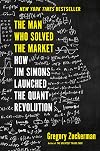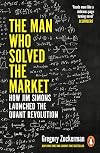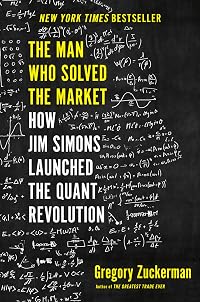
The Man Who Solved the Market: How Jim Simons Launched the Quant Revolution
by Gregory Zuckerman
On This Page
Description
Jim Simons is the greatest moneymaker in modern financial history. His record bests those of legendary investors, including Warren Buffett, George Soros and Ray Dalio. Yet Simons and his strategies are shrouded in mystery. The financial industry has long craved a look inside Simons's secretive hedge fund, Renaissance Technologies and veteran Wall Street Journal reporter Gregory Zuckerman delivers the goods. After a legendary career as a mathematician and a stint breaking Soviet codes, Simons show more set out to conquer financial markets with a radical approach. Simons hired physicists, mathematicians and computer scientists - most of whom knew little about finance - to amass piles of data and build algorithms hunting for the deeply hidden patterns in global markets. Experts scoffed, but Simons and his colleagues became some of the richest in the world, their strategy of creating mathematical models and crunching data embraced by almost every industry. Simons and his team used their wealth to upend the worlds of politics, philanthropy and science. They weren't prepared for the backlash. In this fast-paced narrative, Zuckerman examines how Simons launched a quantitative revolution on Wall Street, and reveals the impact that Simons, the quiet billionaire king of the quants, has had on worlds well beyond finance. show lessTags
Recommendations

Member Reviews
I had always believed in the efficient market hypothesis. This book convinced me that I was wrong: it's not that there aren't inefficiencies to be exploited in financial markets, it's just that humans suck at seeing them. The same cognitive biases that create those inefficiencies in the first place also prevent us from exploiting them. We see signal where there is only noise, we anchor our expectations, we become emotionally invested in our choices. But the machine is immune to all that.
Zuckerman gets into a lot more detail about Renaissance's models than I expected him to. I guess by now there are enough ex-employees willing to share company secrets. Or maybe the company secrets they are willing to share are not that big anymore: using show more Markov chains to model price movements, looking for price ratios instead of absolute prices, etc. Whatever is happening at quant funds right now is probably way beyond any of that (convolutional neural networks that count cars in Walmart's parking lots, that sort of thing).
I was ready to roll up my sleeves and start modelling stuff, but fortunately I got to this point in the book first: "In the five years leading up to spring of 2019, quant-focused hedge funds gained about 4.2 percent a year on average, compared with a gain of 3.3 percent for the average hedge fund in the same period." Well, the S&P500 yields on average 9.8% a year (6% after inflation). For Simons to get his average 66% yearly return he had to hire a team of geniuses. I'm no genius, and I'm not in a position to hire any geniuses to work for me, so I guess I'm staying with index funds (except maybe for some "fun money").
Overall this is a well written, well researched book, and I got a lot out of it. show less
Zuckerman gets into a lot more detail about Renaissance's models than I expected him to. I guess by now there are enough ex-employees willing to share company secrets. Or maybe the company secrets they are willing to share are not that big anymore: using show more Markov chains to model price movements, looking for price ratios instead of absolute prices, etc. Whatever is happening at quant funds right now is probably way beyond any of that (convolutional neural networks that count cars in Walmart's parking lots, that sort of thing).
I was ready to roll up my sleeves and start modelling stuff, but fortunately I got to this point in the book first: "In the five years leading up to spring of 2019, quant-focused hedge funds gained about 4.2 percent a year on average, compared with a gain of 3.3 percent for the average hedge fund in the same period." Well, the S&P500 yields on average 9.8% a year (6% after inflation). For Simons to get his average 66% yearly return he had to hire a team of geniuses. I'm no genius, and I'm not in a position to hire any geniuses to work for me, so I guess I'm staying with index funds (except maybe for some "fun money").
Overall this is a well written, well researched book, and I got a lot out of it. show less
This was an audiobook for me. The story was rather incredible especially considering some of the participants and the quite scientific approach they took, so different from traditional financial circles. But then again there in probably lies the answer to how the market was "solved." There is no doubt they were and seem to continue to be successful in pulling numbers from the market, but the roller coaster ride always seemed to put them on the precipice of disaster.
The book itself was enjoyable as the suspense and personalities involved in the drama of tackling the financial markets from a different strategy kept me interested in discovering the next turn. Almost like a real crime mystery book. The quants did seem to prevail and of show more course we still don't know exactly how they did it as the book does not really go there.
It winds up with the creator of the funds Jim Simon seemingly sailing off into the sunset as he approaches his 90's, a chain smoker at that! I found it amusing how he portrays this liberal bent of lets make everyone pays their fair share for the good of the down trodden. Yet they really didn't as the exploited every loophole they could to keep those riches in their own pockets. And well lived lives of luxury beyond luxury on the spoils of their gains. show less
The book itself was enjoyable as the suspense and personalities involved in the drama of tackling the financial markets from a different strategy kept me interested in discovering the next turn. Almost like a real crime mystery book. The quants did seem to prevail and of show more course we still don't know exactly how they did it as the book does not really go there.
It winds up with the creator of the funds Jim Simon seemingly sailing off into the sunset as he approaches his 90's, a chain smoker at that! I found it amusing how he portrays this liberal bent of lets make everyone pays their fair share for the good of the down trodden. Yet they really didn't as the exploited every loophole they could to keep those riches in their own pockets. And well lived lives of luxury beyond luxury on the spoils of their gains. show less
You my have heard of the investing term "quant" before. It refers to a person or investing process that is "quantitive," or focused on algorithms and pattern recognition as opposed to traditional investing. The most famous and profitable quant firm is Renaissance Technologies, founded by mathematician Jim Simons. This book tracks Simons' life and career.
I picked up this title because I wanted to learn more about quant investing—something I've been hearing about for years but not something I've ever carefully researched. I felt like this book served as a decent non-technical introduction.
The basic approach of quant investing is to do statistical analysis of a massive set of data. Because short-term trends have more data points to work show more with, it is easier to come out ahead in short-term trades. Quant funds look to do high volumes of trades and come out ahead a very small percentage of this time. Like many other modern funds, this makes them reliant on high degrees of leverage to get a good return on capital.
There is something fascinating about the investing approach that emerged out of Renaissance's work—they don't have stories about why most of their investment strategies work. Zuckerman quotes statistician George Box; "all models are wrong, but some are useful." We're constantly seeking out stories about why the world is the way it is. Although we can derive meaning from these stories, when it comes to something as complex as investing, it is often more limiting than useful to rely on stories for why things do or don't work. It is the sort of approach that would only emerge in a fund staffed by scientists and mathematicians.
For many years, Renaissance hasn't allowed any outside investors in its flagship fund, Medallion; it is all money from employees (the fund is limited to $10 billion, and even with massive fees of 5% of principle and 40% of returns, it regularly needs to return investor funds). Often times hedge funds are considered to epitomize what is wrong with the financial system. The fact that Renaissance's most profitable fund doesn't even allow outsiders (who would need to be phenomenally wealthy to participate in the first place), highlights the madness of the current state of wealth inequality in the world.
The end of the book explores the ironic political dimensions of Renaissance. Jim Simons is a Democrat, and was one of Hillary Clinton’s largest campaign donors in 2016. At this point in the company’s evolution, Simons had stepped down from the CEO role, and one of the new Co-CEOs was Bob Mercer. Mercer just happens to have been Trump’s largest donor in the 2016 cycle, and also was an investor in Breitbart and Cambridge Analytica, along with his daughter Rebekah. More than anything else, this highlights that both the Republican and Democratic parties represent the shared whims of the neoliberal elite rather than some significant portion of the populace.
The book is an interesting portrait of one of the most influential financiers of the past generation. That said, it fails to rise to the bar set by books like “Barbarian’s at the Gate” by Bryan Burrough in that the book lacks a compelling narrative arc. show less
I picked up this title because I wanted to learn more about quant investing—something I've been hearing about for years but not something I've ever carefully researched. I felt like this book served as a decent non-technical introduction.
The basic approach of quant investing is to do statistical analysis of a massive set of data. Because short-term trends have more data points to work show more with, it is easier to come out ahead in short-term trades. Quant funds look to do high volumes of trades and come out ahead a very small percentage of this time. Like many other modern funds, this makes them reliant on high degrees of leverage to get a good return on capital.
There is something fascinating about the investing approach that emerged out of Renaissance's work—they don't have stories about why most of their investment strategies work. Zuckerman quotes statistician George Box; "all models are wrong, but some are useful." We're constantly seeking out stories about why the world is the way it is. Although we can derive meaning from these stories, when it comes to something as complex as investing, it is often more limiting than useful to rely on stories for why things do or don't work. It is the sort of approach that would only emerge in a fund staffed by scientists and mathematicians.
For many years, Renaissance hasn't allowed any outside investors in its flagship fund, Medallion; it is all money from employees (the fund is limited to $10 billion, and even with massive fees of 5% of principle and 40% of returns, it regularly needs to return investor funds). Often times hedge funds are considered to epitomize what is wrong with the financial system. The fact that Renaissance's most profitable fund doesn't even allow outsiders (who would need to be phenomenally wealthy to participate in the first place), highlights the madness of the current state of wealth inequality in the world.
The end of the book explores the ironic political dimensions of Renaissance. Jim Simons is a Democrat, and was one of Hillary Clinton’s largest campaign donors in 2016. At this point in the company’s evolution, Simons had stepped down from the CEO role, and one of the new Co-CEOs was Bob Mercer. Mercer just happens to have been Trump’s largest donor in the 2016 cycle, and also was an investor in Breitbart and Cambridge Analytica, along with his daughter Rebekah. More than anything else, this highlights that both the Republican and Democratic parties represent the shared whims of the neoliberal elite rather than some significant portion of the populace.
The book is an interesting portrait of one of the most influential financiers of the past generation. That said, it fails to rise to the bar set by books like “Barbarian’s at the Gate” by Bryan Burrough in that the book lacks a compelling narrative arc. show less
Great book about Renaissance Technologies and the algorithmic/statistical arbitrage business.
This is more about the people and the business, not about the technology or decisions made, but there was enough of an overview of how things evolved to be interesting. I wish I'd worked at a business like this in the late 90s/early 00s on the data/infrastructure team -- sounds amazing!
Interesting tidbits: traders were benchmarking themselves against Madoff and coming up short -- only to find out years later that it's because Madoff was a ponzi scheme.
RenTech was mostly closed to outside money in the early 2000s, so it was essentially trading for employee benefit. There were much larger longer-term funds running concurrently open to the public, show more but the employee fund was vastly more successful.
There were political problems with Robert and Rebecca Mercer -- while most people were leftists, Mercer was conservative and somewhat of a troll, and when he overtly supported Trump/Breitbart/etc. there was pushback both internally (which was largely ignored) and from the outsider public (also somewhat ignored). An employee (David Magerman) went against him and RenTech in the press and was fired, things escalated, and then at some point LPs in one of the funds started complaining as well, so Mercer left stepped down as CEO. show less
This is more about the people and the business, not about the technology or decisions made, but there was enough of an overview of how things evolved to be interesting. I wish I'd worked at a business like this in the late 90s/early 00s on the data/infrastructure team -- sounds amazing!
Interesting tidbits: traders were benchmarking themselves against Madoff and coming up short -- only to find out years later that it's because Madoff was a ponzi scheme.
RenTech was mostly closed to outside money in the early 2000s, so it was essentially trading for employee benefit. There were much larger longer-term funds running concurrently open to the public, show more but the employee fund was vastly more successful.
There were political problems with Robert and Rebecca Mercer -- while most people were leftists, Mercer was conservative and somewhat of a troll, and when he overtly supported Trump/Breitbart/etc. there was pushback both internally (which was largely ignored) and from the outsider public (also somewhat ignored). An employee (David Magerman) went against him and RenTech in the press and was fired, things escalated, and then at some point LPs in one of the funds started complaining as well, so Mercer left stepped down as CEO. show less
Fairly shallow overview of the Renaissance hedge fund company, especially on founder Jim Simons. There are a few obvious inaccuracies, but it seems to get the big picture right. The book is fairly balanced: on the one hand the company has made a few billionaires and given some NYC math teachers $15K bonuses, while on the other hand it has boosted white supremacy, supported climate denialism and been key to Trump's election. I was surprised to learn how little competition the firm faced at least initially, just DE Shaw and LTCM; it really is a small world.
It was good narration. The book showed how Jim Simons and his friends, personal motivations, interest in maths, creating wealth, friendship, office politics, usa politics were all intertwined. I enjoyed reading it.
Eminently readable, relatively neutral. Would have liked to see more math coverage; could have been through optional footnotes or, better yet, appendices.
Members
- Recently Added By
Author Information

8 Works 1,610 Members
Some Editions
Awards and Honors
Common Knowledge
- Original publication date
- 2019
- People/Characters
- Jim Simons
Classifications
- Genres
- Business, Nonfiction, Biography & Memoir, General Nonfiction
- DDC/MDS
- 332.6092 — Society, government, & culture Economics Banking & Money Investing Biography And History Biography
- LCC
- HC102.5 .A38 .S56 — Social sciences Economic history and conditions Economic history and conditions By region or country
- BISAC
Statistics
- Members
- 489
- Popularity
- 61,743
- Reviews
- 11
- Rating
- (3.82)
- Languages
- English, Portuguese (Portugal), Spanish, Turkish
- Media
- Paper, Audiobook, Ebook
- ISBNs
- 13
- ASINs
- 3