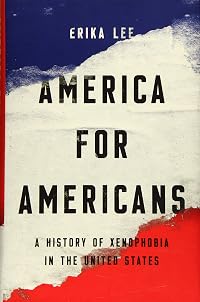
America for Americans: A History of Xenophobia in the United States
by Erika Lee
On This Page
Description
"Many of us like to think of the United States as a nation of immigrants. We pride ourselves on our history of welcoming foreigners and believe this sets our nation apart from every other. But the phrase 'a nation of immigrants' only dates from the mid-twentieth century, and has served to paper over a much darker history of hatred of -- and violence against -- foreigners arriving on our shores. As the acclaimed historian Erika Lee shows in America for Americans, the recent spasm of show more xenophobic policy and treatment of immigrants -- from the abuses of ICE to the Muslim ban to the proposed border wall -- is only the latest manifestation of another, less known but even more influential American creed. As Lee argues, an intense fear of strangers based on their race, religion, ethnicity, or national origin has always been at the heart of the American project. From Benjamin Franklin calling German immigrants 'swarthy' aliens to the anti-Chinese exclusion movement in 1876 San Francisco to modern paranoia over Mexican immigration and the 'browning of America,' xenophobia has been an ideological force working hand-in-hand with American nationalism, capitalism, and racism. Offering a new framework and theory of xenophobia to explain what it is, what it does, and how it works, Lee shows that more often than not in our nation's history, xenophobia has been the rule -- not the exception. At the same time, she reveals why we cannot understand institutionalized racism, sexism, classism without first examining the role of xenophobia in creating these related problems. Forcing us to reckon with the less palatable side of American history and beliefs, America for Americans is a necessary corrective and ultimately a spur to action for any concerned citizen"-- show lessTags
Recommendations



















Member Reviews
Very detailed history of how xenophobia is a part of America’s ethos since the days before the Revolutionary war to the present - only the way it is propagated has changed its face. The author’s writing style can feel a bit dry, but the book is full of eye opening historical events that need to be remembered and taught, and especially not glossed over anymore.
A timely and smart look at the history of xenophobia in the US and how that history has led us to where we are, politically, today.
Fascinating, often uncomfortable, occasionally a bit too detailed. Does a good job of drawing connections from earliest European colonization through to contemporary times.
A disturbing journey through America's history of xenophobia, including this latest wave at the time of publication (2018).
Page 143: In his unpublished sequel to Mein Kampf, drafted in 1928, Hitler applauded the [U.S.] 1924 Immigration Act as an effort to exclude the "foreign body" of "strangers to the blood" of the ruling race. The United States' recommitment to being a "Nordic-German" state was to be commended. America became, in Hitler's view, a racial model for Europe.
Indeed.
Page 143: In his unpublished sequel to Mein Kampf, drafted in 1928, Hitler applauded the [U.S.] 1924 Immigration Act as an effort to exclude the "foreign body" of "strangers to the blood" of the ruling race. The United States' recommitment to being a "Nordic-German" state was to be commended. America became, in Hitler's view, a racial model for Europe.
Indeed.
nonfiction (US history; xenophobic persecution of citizens and immigration policy)
enlightening--history that you don't learn in school (but should). Doesn't deal a lot with racism against Black Americans but there is some overlap. Well worth reading for those who have an interest in government and history.
enlightening--history that you don't learn in school (but should). Doesn't deal a lot with racism against Black Americans but there is some overlap. Well worth reading for those who have an interest in government and history.
This definitive history of American xenophobia is "essential reading for anyone who wants to build a more inclusive society" (Ibram X. Kendi, New York Times-bestselling author of How to Be an Antiracist).
Ratings
Members
- Recently Added By
Author Information

6+ Works 894 Members
Erika Lee is a Regents Professor, the Rudolph J. Vecoli Chair in immigration History and director of the Immigration History Research Center at the University of Minnesota, and president-elect of the Organization of American Historians. The author of The Making of Asian America and other award-winning books, Lee lives in Minneapolis, MN.
Awards and Honors
Awards
Classifications
- Genres
- History, Nonfiction, Anthropology, General Nonfiction
- DDC/MDS
- 305.800973 — Society, government, & culture Social sciences, sociology & anthropology Social group - Age, Gender, Ethnicity Ethnic and national groups standard subdivisions / Ethnic and national groups with ethnic origins from more than one continent, of European descent standard subdivisions Biography And History North America United States
- LCC
- E184 .A1 .L4135 — History of the United States United States Elements in the population Afro-Americans
- BISAC
Statistics
- Members
- 242
- Popularity
- 133,661
- Reviews
- 6
- Rating
- (4.10)
- Languages
- English
- Media
- Paper, Audiobook, Ebook
- ISBNs
- 6
- ASINs
- 2