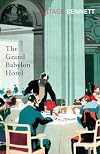
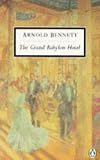
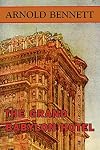
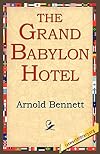
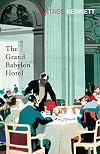
The Grand Babylon Hotel
by Arnold Bennett
On This Page
Description
Arnold Bennett's The Grand Babylon Hotel, from 1902, tells the story of a German prince mysteriously disappearing. American millionaire Theodore Racksole and his daughter Nella stay at the exclusive Grand Babylon Hotel. When Nella is denied her dinner order of steak and Bass beer, Racksole's solution is to purchase the entire hotel for exactly four hundred thousand pounds and one guinea, the one guinea added after the former owner decides to haggle..
Tags
Recommendations

























Member Reviews
A delightful “lark”: a humorous Edwardian mystery, told in short chapters, each ending on a cliff-hanger or surprising revelation (written for serialisation). It sounds clichéd, but is so well done, that it merely adds to the charm.
Theodore Racksole is an American millionaire “who owned one thousand miles of railway, several towns, and sixty votes in Congress”. He and his daughter, Nella, visit The Grand Babylon Hotel in London, which he buys on a whim because the head waiter refuses to serve steak with a bottle of Bass beer.
Consequences and drama
After this extravagant fit of pique, Racksole decides he rather likes the idea of actually running the place, frequented as it is by European royalty and other curious characters. But show more there is more intrigue than he first realises, which he and Nella are soon uncovering and trying to solve. Racksole is rich, but money does not make him as omnipotent in London, where he is unknown, as it did in the US.
There is death, disappointment, disguise, political scheming, minor royals, kidnap, assassination, message drops, secret passages, secret passwords, foreign travel, chases, assignations, love, rejection, and anything else you might expect from the genre, all crammed into just over 200 beautifully written pages.
Plausibility isn’t its strong suit, and I wonder about Nella’s motivation in particular, but it’s a tribute to Bennett’s writing that it mattered not a jot to me. I kept turning the pages with joy and anticipation. My only regret is that it wasn’t longer.
Bennett's fondness for grand hotels
Arnold Bennett spent a lot of time at The Savoy, in London. So much so, the chef perfected and named the writer's favourite dish, a rich creamy omelette using smoked haddock and cream, so an eggy version of kedgeree. Many decades later, it's still on the menu at The Savoy Grill (and elsewhere).
Image: Omelette Arnold Bennett (Source of photo, including Felicity Cloake's recipe.)
Quotes
At times, it has a feel of Oscar Wilde:
* “That air of profound importance of which only really first class waiters have the secret.”
* “The calculated insolence of the words was cleverly masked beneath an accent of humble submission.”
* “An amiable scorn blended with an evident desire to propitiate and please.”
* “The functions of a head waiter are generally more ornamental, spectacular, and morally impressive than useful.”
* “His indifference was so superb, so gorgeous, that Racksole instantly divined that it was assumed for the occasion.”
* “The difficult task of retaining one’s own dignity while not interfering with that of other people.”
* “The clever and calculated insolence of his tone cut her like a lash as she lay bound in the chair.”
* “It is astonishing how well a secret can be kept when the possessors of the secret are handled with the proper mixture of firmness and persuasion.”
* “A prince is never seriously ill until he is dead. Such is statecraft.”
Other lines are more Wodehousian:
* “Like all people who have lived easy and joyous lives in those fair regions where gold smooths every crease and law keeps a tight hand on disorder, she found it hard to realise that there were other regions where gold was useless and law without power.”
* “She stood like a statue of scorn.”
* “The deck was as white and smooth as her own hand… All the brass-work, from the band round the slender funnel to the concave surface of the binnacle, shone like gold. The tapered masts stretched upwards at a rakish angle… The rays of sun fell on her caressingly, like a restorative. All around the water was changing from wonderful greys and dark blues to still more wonderful pinks and translucent unearthly greens; the magic kaleidoscope of dawn was going forward in its accustomed way, regardless of the vicissitudes of mortals.”
Nevertheless, Bennett is his own man, with his own voice. show less
Theodore Racksole is an American millionaire “who owned one thousand miles of railway, several towns, and sixty votes in Congress”. He and his daughter, Nella, visit The Grand Babylon Hotel in London, which he buys on a whim because the head waiter refuses to serve steak with a bottle of Bass beer.
Consequences and drama
After this extravagant fit of pique, Racksole decides he rather likes the idea of actually running the place, frequented as it is by European royalty and other curious characters. But show more there is more intrigue than he first realises, which he and Nella are soon uncovering and trying to solve. Racksole is rich, but money does not make him as omnipotent in London, where he is unknown, as it did in the US.
There is death, disappointment, disguise, political scheming, minor royals, kidnap, assassination, message drops, secret passages, secret passwords, foreign travel, chases, assignations, love, rejection, and anything else you might expect from the genre, all crammed into just over 200 beautifully written pages.
Plausibility isn’t its strong suit, and I wonder about Nella’s motivation in particular, but it’s a tribute to Bennett’s writing that it mattered not a jot to me. I kept turning the pages with joy and anticipation. My only regret is that it wasn’t longer.
Bennett's fondness for grand hotels
Arnold Bennett spent a lot of time at The Savoy, in London. So much so, the chef perfected and named the writer's favourite dish, a rich creamy omelette using smoked haddock and cream, so an eggy version of kedgeree. Many decades later, it's still on the menu at The Savoy Grill (and elsewhere).
Image: Omelette Arnold Bennett (Source of photo, including Felicity Cloake's recipe.)
Quotes
At times, it has a feel of Oscar Wilde:
* “That air of profound importance of which only really first class waiters have the secret.”
* “The calculated insolence of the words was cleverly masked beneath an accent of humble submission.”
* “An amiable scorn blended with an evident desire to propitiate and please.”
* “The functions of a head waiter are generally more ornamental, spectacular, and morally impressive than useful.”
* “His indifference was so superb, so gorgeous, that Racksole instantly divined that it was assumed for the occasion.”
* “The difficult task of retaining one’s own dignity while not interfering with that of other people.”
* “The clever and calculated insolence of his tone cut her like a lash as she lay bound in the chair.”
* “It is astonishing how well a secret can be kept when the possessors of the secret are handled with the proper mixture of firmness and persuasion.”
* “A prince is never seriously ill until he is dead. Such is statecraft.”
Other lines are more Wodehousian:
* “Like all people who have lived easy and joyous lives in those fair regions where gold smooths every crease and law keeps a tight hand on disorder, she found it hard to realise that there were other regions where gold was useless and law without power.”
* “She stood like a statue of scorn.”
* “The deck was as white and smooth as her own hand… All the brass-work, from the band round the slender funnel to the concave surface of the binnacle, shone like gold. The tapered masts stretched upwards at a rakish angle… The rays of sun fell on her caressingly, like a restorative. All around the water was changing from wonderful greys and dark blues to still more wonderful pinks and translucent unearthly greens; the magic kaleidoscope of dawn was going forward in its accustomed way, regardless of the vicissitudes of mortals.”
Nevertheless, Bennett is his own man, with his own voice. show less
Enoch Arnold Bennett, 1867-1931. In his own words: "Am I to sit still and see other fellows pocketing two guineas apiece for stories which I can do better myself? Not me. If anyone imagines my sole aim is art for art’s sake, they are cruelly deceived."
This statement would perhaps deter me, were they to come from a postmodern writer. It does not with Bennett. I found "The Grand Babylon Hotel" delightful. The story originally appeared as a serial in "The Daily Mail".
What kept me glued was, I believe, exactly that which prompted Theodore Racksole, New York millionaire, to buy the Grand Babylon from our dear Mr. Babylon (steak and a bottle of Bass being only a convenient excuse). I mean to say it was glitz, glamor, German princes, show more Teutonic blood lines, Hebrew money lenders, Royalty, Power—these things were where the intrigue lay for Racksole and I.
It was a bit strange to read a mystery in which we early on come to know "who done it", but not the why. What a fiend that Jules was! Unlike Racksole, I remain highly apprehensive of Mr. Rocco's future business affairs, as well as those of the nefarious Miss Spencer. Just imagine the gall of Rocco! A world famous chef who would clandestinely embalm a murdered man in the place of his employment!
Who could not enjoy such settings as the Grand Babylon, its deep and dark wine cellar of exquisiteness, a European gaming palace complete with roulette table, a boat chase on the Thames, the Belgian city of Osten. I could not help but make a comparison of aspect and origin between Mr. Babylon and Christie's Hercule Poirot.
I'm glad that I came to the Grand Babylon. It does not take itself too seriously and contains—besides a unique class of characters—quite an adventure. I truly envy Prince Aribert winning the hand of the fair American Nella Racksole. What a handful he will have... Who cares though, with her looks along with her father's money... And, though a bit adventurous, truly she is a sweet girl! show less
This statement would perhaps deter me, were they to come from a postmodern writer. It does not with Bennett. I found "The Grand Babylon Hotel" delightful. The story originally appeared as a serial in "The Daily Mail".
What kept me glued was, I believe, exactly that which prompted Theodore Racksole, New York millionaire, to buy the Grand Babylon from our dear Mr. Babylon (steak and a bottle of Bass being only a convenient excuse). I mean to say it was glitz, glamor, German princes, show more Teutonic blood lines, Hebrew money lenders, Royalty, Power—these things were where the intrigue lay for Racksole and I.
It was a bit strange to read a mystery in which we early on come to know "who done it", but not the why. What a fiend that Jules was! Unlike Racksole, I remain highly apprehensive of Mr. Rocco's future business affairs, as well as those of the nefarious Miss Spencer. Just imagine the gall of Rocco! A world famous chef who would clandestinely embalm a murdered man in the place of his employment!
Who could not enjoy such settings as the Grand Babylon, its deep and dark wine cellar of exquisiteness, a European gaming palace complete with roulette table, a boat chase on the Thames, the Belgian city of Osten. I could not help but make a comparison of aspect and origin between Mr. Babylon and Christie's Hercule Poirot.
I'm glad that I came to the Grand Babylon. It does not take itself too seriously and contains—besides a unique class of characters—quite an adventure. I truly envy Prince Aribert winning the hand of the fair American Nella Racksole. What a handful he will have... Who cares though, with her looks along with her father's money... And, though a bit adventurous, truly she is a sweet girl! show less
Romp of a thriller dashed off in serial form, such that each short chapter ends in suspense or revelation. Brisk, melodramatic adventures whirl us around 1890s London’s high society and some low: magnates, aristocrats, plotters and proteans. With the simple characterisations and contrived plotting of a Tintin comic, this lacks any interiority or depth, so a marked contrast to Bennet’s denser later work, but is an enjoyable read all the same.
Dated, but still enjoyable, early thriller from Arnold Bennett. A headstrong New York millionaire, foiled in getting what he wants for dinner, on a whim buys a great London hotel, and finds that he gets far more than he bargained for, what with European intrigue. Very much of a piece with Oppenheim and the others of that ilk. A few amusing howlers by Bennett are in the book (he ascribes luxury in New York City to 8th Avenue, of all places, and describes West Orange as being in "New Jersey, New York"). A whole lot of caricatures, but really, that is very much the whole spirit of the thing. Just sit back with the popcorn.
The great novelist Arnold Bennett started his career as a writer with this, a popular fiction designed to appeal to the ordinary reader of adventure and INCIDENT. And, through much of his career, Bennett would come back to this form, and occasionally write a classic of popular fiction, such as "Buried Alive." This novel is a lark, a hoot, a holler, a bit of fast-paced drollery. It's hard to describe, actually. And perhaps I shouldn't try until I read it again. But my memory, after over a decade, still warms to this book.
One word of advice: Snobs need not even try. This is not an attempt at character revelation or sociological analysis -- two things Bennett, in his more serious work, was emintently capable of providing. Here Bennett show more tries for something very different. And succeeds. But unbendable snobs (such as the great H.L. Mencken) hate these books.
I don't. show less
One word of advice: Snobs need not even try. This is not an attempt at character revelation or sociological analysis -- two things Bennett, in his more serious work, was emintently capable of providing. Here Bennett show more tries for something very different. And succeeds. But unbendable snobs (such as the great H.L. Mencken) hate these books.
I don't. show less
It's pretty clear when reading this that it was serialized first, but the format does make reading this very fast-paced. I loved the main girl in this and the romance subplot was cute.
A hoot. The author was a young junior editor on a magazine that ran trashy serials. He said to himself, "The trashy serials I am getting are lousy, I could write a better one." So he did.
Members
- Recently Added By
Lists

Boarding House and Hotel Fiction
73 works; 25 members

Books Read in 2016
4,666 works; 197 members
Author Information

193+ Works 6,838 Members
Arnold Bennett was born on May 27, 1867 in Hanley, Staffordshire, England. He began his working career as a law clerk and later he left the legal field and became an editor for the magazine Woman. His first novel was "A Man from the North." He wrote several novels set in Hanley, the town where he was born. These are known as the Five Town novels. show more Other titles include "The Babylon Hotel," "The Truth about an Author," and "How to Live on 24 Hours a Day." Bennett won the 1923 James Tait Black Memorial Prize for his novel "Riceyman Steps." "The Journal of Arnold Bennett" was published posthumously in three volumes. Bennett was also the author of "Hugo" which was made into a major motion picture in 2011 starring Jude law and Ben Kingsley, directed by Martin Scorsese. During WWI, Bennett was Director of Propaganda for France at the Ministry of Information. (At that time "propaganda" did not have the negative connotations it would have later in the twentieth century.) This appointment was based on the recommendation of Lord Beaverbrook, who also recommended him as Deputy Minister of that department at the end of the war. Bennett refused a knighthood in 1918. He died in London of typhoid fever on March 27, 1931. (Bowker Author Biography) show less
Some Editions
Series
Belongs to Publisher Series
Common Knowledge
- Canonical title*
- Grand Hotel Babylon
- Original publication date
- 1902
- People/Characters
- Theodore Racksole; Nella Racksole
- Important places
- The Grand Babylon Hotel, London, England, UK; Ostend, West Flanders, Belgium
- Related movies
- The Grand Babylon Hotel (1916 | IMDb)
- First words
- 'Yes, sir?'
- Last words
- (Click to show. Warning: May contain spoilers.)And so was brought to a close the complex chain of events which had begun when Theodore Racksole ordered a steak and a bottle of Bass at the table d'hôte of the Grand Babylon Hôtel.
- Original language
- English
*Some information comes from Common Knowledge in other languages. Click "Edit" for more information.
Classifications
Statistics
- Members
- 356
- Popularity
- 88,169
- Reviews
- 10
- Rating
- (3.25)
- Languages
- 8 — English, Finnish, French, German, Galician, Hungarian, Spanish, Swedish
- Media
- Paper, Audiobook, Ebook
- ISBNs
- 64
- ASINs
- 19