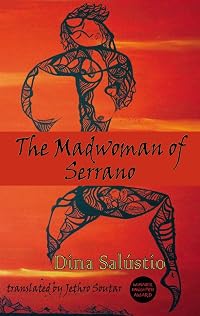
The Madwoman of Serrano (Dedalus Africa)
by Dina Salústio
On This Page
Description
Serrano is an isolated village where a madwoman roams. But is she really mad or is she marginalized because she is wise and a woman? Could her babbling be prophecy? One day a girl falls from the sky and is found in the forest by Jeronimo. The villagers are suspicious of the newcomer, but Jeronimo falls in love with her. When she gives birth and disappears, Jeronimo takes care of the child, naming her Filipa. Years later, estranged from Jeronimo after being taken from the village in show more mysterious circumstances, Filipa is a successful businesswoman in the city. Her memories of growing up in Serrano and her friendship with the madwoman become increasingly vivid.When the madwoman's warnings come true and Serrano's sheltered existence is threatened by plans to build a dam, Jeronimo heads for the city himself. Will he and Filipa finally be reunited? show lessTags
Recommendations













Member Reviews
This is the first novel by a female author to be published in Cape Verde, and the first to be translated into English.
The novel opens in Serrano, an isolated village on the cusp of modernization. It is a mystical place, full of magical realism. The midwife is the most powerful member of the village, delivering babies and whispering their fates to them, initiating boys into manhood, and using her wisdom to maintain the balance between nature and the inhabitants. Watching over everything as both an outsider and the ultimate insider is the madwoman, reborn every 33 years until her fate is fulfilled.
Jeronimo leaves the village to fulfill his military service and wants to stay in the city and be a mechanic, but he promises his father to show more return and tend their land. One day he finds a delirious woman in the woods and falls in love with her. He is an intermediary between the rural village and the modern city.
Filipa lives in the city and is a successful businesswoman, but feels empty and rudderless since she left Serrano as a child. Life in the city is modern and sensible, but she misses her father and her friend, the madwoman.
Moving back and forth between village and city, Jeronimo and Filipa, the novel explores themes of urbanization and environmental degradation, female empowerment, and the murky delineations between sanity and madness. The author's language reflects the environment, being lush and convoluted when the action takes place in Serrano and almost staccato when in the city. Recommended for those interested in magical realism and/or ecofeminism. show less
The novel opens in Serrano, an isolated village on the cusp of modernization. It is a mystical place, full of magical realism. The midwife is the most powerful member of the village, delivering babies and whispering their fates to them, initiating boys into manhood, and using her wisdom to maintain the balance between nature and the inhabitants. Watching over everything as both an outsider and the ultimate insider is the madwoman, reborn every 33 years until her fate is fulfilled.
Jeronimo leaves the village to fulfill his military service and wants to stay in the city and be a mechanic, but he promises his father to show more return and tend their land. One day he finds a delirious woman in the woods and falls in love with her. He is an intermediary between the rural village and the modern city.
Filipa lives in the city and is a successful businesswoman, but feels empty and rudderless since she left Serrano as a child. Life in the city is modern and sensible, but she misses her father and her friend, the madwoman.
Moving back and forth between village and city, Jeronimo and Filipa, the novel explores themes of urbanization and environmental degradation, female empowerment, and the murky delineations between sanity and madness. The author's language reflects the environment, being lush and convoluted when the action takes place in Serrano and almost staccato when in the city. Recommended for those interested in magical realism and/or ecofeminism. show less
#ReadAroundTheWorld. #Cabo Verde
This book is a story by Cabo Verdean author Dina Salústio, in fact the first novel written by a woman to be published in Cabo Verde (Cape Verde) and the first novel from that country to be translated into English. It is a story full of magical realism, love and loss. As the author says herself, “It is a story, then, like many others, of an unknown time and place, of everywhere and of always, a story in which women and men are crushed by too much beauty or, more commonly, too much cruelty”
Cabo Verde is an island archipelago in the Atlantic off West Africa. The people are predominantly Creole, the official language is Portuguese, but most people’s mother tongue is Creole. The islands were uninhabited show more when the Portuguese landed there in 1456, but were soon populated by slaves and Arabs taken from West Africa to work the plantations. The islands are largely Roman Catholic.
The story is set in the isolated village of Serrano which has no name for many centuries until made to choose one. It is a quiet dreamy place where no one laughs or thinks of new ideas. The men are sterile and rarely leave the village, the women must leave to have fertility treatment in the city and return pregnant with children not resembling their fathers. The village midwife is the most important person, initiating the men and delivering the children. The madwoman of Serrano is always on the fringes, shunned by the villagers but having a prophetic streak and being reincarnated periodically. The poverty of the village is contrasted with life in the city. “The poor were created for the powerful to get rich on, sin against and use to mock ideals of equality and seek their own salvation.”
Jeronimo eventually discovers a strange girl who has escaped a plane crash but is amnestic. He nurses her back to health and then raises the child, Filipa, she unexpectedly leaves him with. The story later follows these three characters to the city.
I found this story difficult to get into initially due to rapid transitions between points of view and time setting. I did find myself becoming invested in Jeronimo and Filipas’ story as it unfolded. Then the ending seemed rapid too. This was an interesting read but suffered from some pacing issues. show less
This book is a story by Cabo Verdean author Dina Salústio, in fact the first novel written by a woman to be published in Cabo Verde (Cape Verde) and the first novel from that country to be translated into English. It is a story full of magical realism, love and loss. As the author says herself, “It is a story, then, like many others, of an unknown time and place, of everywhere and of always, a story in which women and men are crushed by too much beauty or, more commonly, too much cruelty”
Cabo Verde is an island archipelago in the Atlantic off West Africa. The people are predominantly Creole, the official language is Portuguese, but most people’s mother tongue is Creole. The islands were uninhabited show more when the Portuguese landed there in 1456, but were soon populated by slaves and Arabs taken from West Africa to work the plantations. The islands are largely Roman Catholic.
The story is set in the isolated village of Serrano which has no name for many centuries until made to choose one. It is a quiet dreamy place where no one laughs or thinks of new ideas. The men are sterile and rarely leave the village, the women must leave to have fertility treatment in the city and return pregnant with children not resembling their fathers. The village midwife is the most important person, initiating the men and delivering the children. The madwoman of Serrano is always on the fringes, shunned by the villagers but having a prophetic streak and being reincarnated periodically. The poverty of the village is contrasted with life in the city. “The poor were created for the powerful to get rich on, sin against and use to mock ideals of equality and seek their own salvation.”
Jeronimo eventually discovers a strange girl who has escaped a plane crash but is amnestic. He nurses her back to health and then raises the child, Filipa, she unexpectedly leaves him with. The story later follows these three characters to the city.
I found this story difficult to get into initially due to rapid transitions between points of view and time setting. I did find myself becoming invested in Jeronimo and Filipas’ story as it unfolded. Then the ending seemed rapid too. This was an interesting read but suffered from some pacing issues. show less
Ratings
Members
- Recently Added By
Lists

Best African and African diaspora books
111 works; 4 members

Speculative Fiction from around the World
610 works; 18 members

Cabo Verde
19 works; 1 member
Author Information
5 Works 36 Members
Some Editions
Awards and Honors
Common Knowledge
- Original title
- A Louca de Serrano
- Original publication date
- 1998 (original Portuguese) (original Portuguese); 2019 (English translation) (English translation)
- People/Characters
- Jeronimo; Filipa
- Important places
- Serrano, Cape Verde
- First words
- This is the story of Serrano, a village of one hundred and ninety-three souls, including a young madwoman, several infants and three babies on the way, two of them twin girls, according to the midwife, who was peering through... (show all) a crack in her warped shutters when she saw a women's shadow cross the square at the same moment the sun crossed the moon, sending deep vibrations through the valley and playing havoc with time.
- Last words
- (Click to show. Warning: May contain spoilers.)Filipa felt free and alone.
- Original language
- Portuguese
Classifications
- Genres
- Fiction and Literature, General Fiction
- DDC/MDS
- 869.35 — Literature & rhetoric Spanish Literature Literatures of Portuguese and Galician languages Portuguese fiction 21st Century
- LCC
- PQ9942.9 .S25 .L6313 — Language and Literature French, Italian, Spanish and Portuguese literatures Portuguese literature Provincial, local, colonial, etc.
- BISAC
Statistics
- Members
- 28
- Popularity
- 1,011,082
- Reviews
- 2
- Rating
- (4.17)
- Languages
- English
- Media
- Paper, Ebook
- ISBNs
- 2
- ASINs
- 1