On This Page
Description
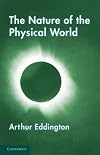
Arthur S. Eddington, FRS, (1882-1944) was one of the most prominent British scientists of his time. He made major contributions to astrophysics and to the broader understanding of the revolutionary theories of relativity and quantum mechanics. He is famed for his astronomical observations of 1919, confirming Einstein's prediction of the curving of the paths of starlight, and he was the first major interpreter of Einstein's physics to the English-speaking world. His 1928 book, The Nature of th...Tags
Recommendations


























Member Reviews
That statement, you might think, accords with Philip Goff's interpretation (in _Galileo's Error_, 2019) of this public-lectures-based volume by highly accomplished physicist Eddington as developing the neutral monism of Bertrand Russell (_The Analysis of Matter_, 1927) into full-blown panpsychism, which nowadays is sometimes ascribed to the Integrated Information Theory of consciousness. But, in the closing chapters where I expected this development to be nailed down, all I see is a woolly miasma of ruminations involving mysticism, religion, spirituality, god-talk, and theology. Yuck. The good part of the book is the first two-thirds of it, which includes insightful accounts of relativity, thermodynamics, and the then-newborn quantum show more theory of Heisenberg and Schrödinger. Eddington was not as polished a wordsmith as Russell, I'd say, but his writing was similar to Russell's in its old-fashioned male centeredness and restrictive-relative-clause "whichiness". show less
This is a tale from one of the most sensational moments in human history. Eddington, a magnificent story teller, is ably placed to tell it. General relativity was barely a decade old; quantum mechanics had just been formulated. Co-incident with the Solvay conference that fixed the standard interpretation of quantum mechanics, Eddington gives us a view less dominated by continental philosophy. Indeed this work conveys all the hope, optimism, confusion and misconceptions of this amazing age.
For those with current knowledge, it is intriguing to see how much more we now know about the cosmos; and how prescient some of his conjectures are. Actually the work is best known for the unorthodox views on entropy and a metaphysical substratum show more beneath a metrical physics. He gives clear reasons for such beliefs.
Hence Eddington suggests that all physical laws will ultimately be shown to be statistical just like thermodynamic laws. In this context he places the inevitable decay of organization as of greatest importance, as the originator of a direction for experienced time.
Furthermore he takes it as given that conscious thoughts are beyond the realm of science which he limits to the jurisdiction of symbols. He asserts the need for a qualitative substratum to underpin both mind and matter. Yet he is uncomfortable using the terminology of neutral monism. The neutral moniker suggests an equal weighting for the qualitative. In his mind, the way to reconcile mind and matter is to accept that everything is in the mind eg even all our perceptions of matter. Furthermore the mind gives us insight in the purpose of being.
Of course the Gifford Lectures are given to promote theology. Thus Eddington asks from where the organization of the cosmos comes and how the laws of nature are set. He suggests the indeterminate nature of quantal measurement supplies an opening for volition. However, he points out that to understand mind, some unity-forming process is missing. show less
For those with current knowledge, it is intriguing to see how much more we now know about the cosmos; and how prescient some of his conjectures are. Actually the work is best known for the unorthodox views on entropy and a metaphysical substratum show more beneath a metrical physics. He gives clear reasons for such beliefs.
Hence Eddington suggests that all physical laws will ultimately be shown to be statistical just like thermodynamic laws. In this context he places the inevitable decay of organization as of greatest importance, as the originator of a direction for experienced time.
Furthermore he takes it as given that conscious thoughts are beyond the realm of science which he limits to the jurisdiction of symbols. He asserts the need for a qualitative substratum to underpin both mind and matter. Yet he is uncomfortable using the terminology of neutral monism. The neutral moniker suggests an equal weighting for the qualitative. In his mind, the way to reconcile mind and matter is to accept that everything is in the mind eg even all our perceptions of matter. Furthermore the mind gives us insight in the purpose of being.
Of course the Gifford Lectures are given to promote theology. Thus Eddington asks from where the organization of the cosmos comes and how the laws of nature are set. He suggests the indeterminate nature of quantal measurement supplies an opening for volition. However, he points out that to understand mind, some unity-forming process is missing. show less
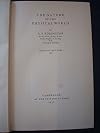
Volume 922 of Everyman's Library with dustcover intact.
Ratings
Members
- Recently Added By
Lists

Books referenced in Jim Holt's Why Does the World Exist?
119 works; 1 member

Trinity College Booklist (1951): Class One, Natural Science
98 works; 2 members

Best Books of 1926-1935
403 works; 10 members
Author Information

30+ Works 866 Members
Born in Kendal, England, Arthur Eddington was the son of the headmaster of the Kendal school. At the age of 16, Eddington won a scholarship to Owens College in Manchester, graduating with a degree in physics in 1902. Although he was very shy in public, he had an outstanding ability to convey mathematical concepts to the layperson. Eddington was show more widely known in the early twentieth century for his popular books, many of which remain in print. But he also was one of the pioneers of twentieth-century astrophysics, a founder of many important lines of astrophysical research. Eddington spent a few years studying stellar motions at the Royal Observatory at Greenwich. However, most of his professional career was spent at Cambridge University, where he was Plumian Professor of Astronomy and observatory director for four decades. But Eddington's most important contribution relates to the understanding of relativity and the structure and composition of stars. He was one of the first people outside Germany to understand and appreciate Albert Einstein's general theory of relativity. This led to his expedition to Principe (in South America) to test the theory experimentally. Although the source of stellar energy, nuclear fusion, had not been discovered, Eddington's analysis of stellar interiors in the 1920s correctly demonstrated the composition of stars and stellar behavior. He predicted that nuclear reactions were ultimately responsible for the phenomenon of sunshine. In his later years, Eddington was preoccupied with establishing fundamental numerical relationships between various cosmic quantities. In fact, he first recognized the fundamental importance of a number called the fine structure constant, which is a measure of the strength of electrical interaction. (Bowker Author Biography) show less
Awards and Honors
Notable Lists
Series

Belongs to Publisher Series
Everyman's Library (922)
Common Knowledge
- Original publication date
- 1928
Classifications
Statistics
- Members
- 235
- Popularity
- 138,422
- Reviews
- 4
- Rating
- (3.88)
- Languages
- English, Italian
- Media
- Paper, Ebook
- ISBNs
- 21
- ASINs
- 24