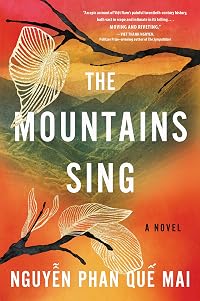
The Mountains Sing
by Nguyen Phan Que Mai
On This Page
Description
With the epic sweep of Min Jin Lee's Pachinko and Yaa Gyasi's Homegoing and the lyrical beauty of Vaddey Ratner's In the Shadow of the Banyan, The Mountains Sing tells an enveloping, multigenerational tale of the Tr̂àn family, set against the backdrop of the Vịêt Nam War.Tr̂àn Dịêu Lan, who was born in 1920, was forced to flee her family farm with her six children during the Land Reform as the Communist government rose in the North. Years later in Hà Ṇôi, her young show more granddaughter, Hương, comes of age as her parents and uncles head off down the Ĥò Chí Minh Trail to fight in a conflict that tore not just her beloved country, but her family apart.Vivid, gripping, and steeped in the language and traditions of Vịêt Nam, The Mountains Sing brings to life the human costs of this conflict from the point of view of the Vietnamese people themselves, while showing us the true power of kindness and hope. The Mountains Sing is celebrated Vietnamese poet Nguŷẽn Phan Qûé Mai's first novel in English. show lessTags
Recommendations










Member Reviews
This gorgeous, and sometimes brutal, multi-generational Trần family saga spans more than half a century of Vietnamese history, beginning in the French colonial period in the late 1930s through to the present day, narrated by Hương, who was born in 1960, and her grandmother, the family’s matriarch, Diệu Lan, born in 1920. It’s a harrowing tale of murder, occupation, and economic changes, met by the family’s resilience, intelligence, self-reliance, kindness, and fierce independence. The title, Mountains Sing, was taken for the Vietnamese word for a hand-carved bird made by Hương’s father, lost to the war. The horrors Diệu Lan endured or witnessed – like the beheading of her father, separation from her children, the show more loss of the family fortune repeatedly, through private, government, and military action, and not hearing about the fate of her sons for years – was enough to defeat an ordinary person, but despite all of the loss and violence depicted in the novel, the story is told with grace and compassion, even for those whose actions harmed them most. The story captures the anguish of ordinary farmers who became pawns and victims of the power struggles that had nothing to do with them, and their point of view during the brutal Japanese occupation during World War II, as well as the war we refer to as the Vietnam, and the fallout from the carpet bombing and spraying of Agent Orange. I was so interested to read this perspective from ordinary (i.e., not Communist officials) citizens about the American involvement in Vietnam.
This story will stay with me for a long time, not just for its complex subject matter but also because of its lyrical writing. Through the voice of Hương, the author makes this observation: "I had resented America, too. But by reading their books, I saw the other side of them—their humanity. Somehow I was sure that if people were willing to read each other, and see the light of other cultures, there would be no war on earth." And this is exactly why the book bans going on in American are so antithetical to moral living: one can only brutalize a people if they are not exposed to their humanity, and this is exactly why dictators and fascist regimes destroy books and culture. show less
This story will stay with me for a long time, not just for its complex subject matter but also because of its lyrical writing. Through the voice of Hương, the author makes this observation: "I had resented America, too. But by reading their books, I saw the other side of them—their humanity. Somehow I was sure that if people were willing to read each other, and see the light of other cultures, there would be no war on earth." And this is exactly why the book bans going on in American are so antithetical to moral living: one can only brutalize a people if they are not exposed to their humanity, and this is exactly why dictators and fascist regimes destroy books and culture. show less
Young Hoang lives with her grandmother in 1975 in the northern part of Vietnam during the war. Her father was drafted and her mother went to find him; her grandmother is her rock as they suffer poverty and as family members start to return in the ensuing years. Interspersed are her grandmother's reminiscences of the past, starting out in a well-to-do family that was attacked during the Land Reform, forced out and living on the run with five of her six children. Most of all, it's about their indomitable spirits in the face of tragedy.
This was really excellent historical fiction, giving a more complicated, nuanced look at the Vietnam war than I've read before. Hoang and her grandma, Dieu Lan, endure so much heartbreak and the war is told show more in dispassionate but clear description, that it was hard to read at times. But there are also moments of joy. I loved Dieu Lan's commitment to her family and bravery in finding a way to come through all the hardship she does, and cheered Hoang as she grew up in war, learned difficult truths about her family members, but found happiness as well. Most of all, I learned a lot about Vietnamese history and how difficult their civil war was. Author Nguyen Phan Que Mai is a poet whose works have been translated, and this is the first of her novels to be written in English. I look forward to reading more of her work. show less
This was really excellent historical fiction, giving a more complicated, nuanced look at the Vietnam war than I've read before. Hoang and her grandma, Dieu Lan, endure so much heartbreak and the war is told show more in dispassionate but clear description, that it was hard to read at times. But there are also moments of joy. I loved Dieu Lan's commitment to her family and bravery in finding a way to come through all the hardship she does, and cheered Hoang as she grew up in war, learned difficult truths about her family members, but found happiness as well. Most of all, I learned a lot about Vietnamese history and how difficult their civil war was. Author Nguyen Phan Que Mai is a poet whose works have been translated, and this is the first of her novels to be written in English. I look forward to reading more of her work. show less
[The Mountains Sing] is beautifully written, heartbreaking and uplifting by turns. It′s the story of three generations of the Trần family. The story begins in 1972 with twelve-year-old Hương and her grandmother trying to get home from school during a bombing by American B-52s. They are the only remaining members of their family in Hà Nội, as Hương′s parents and uncles are in the south fighting to rid their country of the occupying Americans. Daily life is almost impossible, yet they not only survive, but succeed, thanks to Hương′s grandmother, who is tenacious, hardworking, and experienced in survival. The story then switches to the grandmother′s voice, who is telling her granddaughter about her family′s history. show more
Trần Diệu Lan was born in 1920 to a wealthy farming family in northern Việt Nam. She lives through the Japanese occupation during World War II, the famine known as The Great Hunger in 1945, and the Land Reforms that devastated her family. These alternating chapters flow smoothly and complement each other as one occupying army is replaced by another. Themes of love for family and ancestral land, the kindness of strangers, and the value of education run parallel to scenes of betrayal, senseless brutality, PTSD, and the effects of Agent Orange. The Trần family represents both a fictionalized version of the author′s own family and a metaphor for the country as a whole as it is torn apart, reunited, tested, and made whole.
Born in northern Vietnam in 1973, but growing up in southern Vietnam after the war, Nguyễn Phan Quế Mai had a foot in both worlds. She won a writing competition at the age of ten, but her parents did not want her to be a writer due to the hardships authors faced from censors. Her brother started to teach her English when she was in the eighth grade, and she eventually won a scholarship to university in Australia. She has written eleven books—poetry, short fiction, and nonfiction—but this is her first novel and first book to be written in English.
It may seem ironic that I have chosen to write this novel, by far my most personal work to date, in English, which is also the language of invasive military powers and cultures. But this language has given me a new voice and a way to fictionalize the turbulent events of my country's past, including those that have not yet been sufficiently documented in Vietnamese fiction, such as the Great Hunger or the Land Reform. I am also responding to Hollywood movies and novels written by those Westerners who continue to see our country only as a place of war and the Vietnamese as people who don't need to speak—or, when we do, sound simple, naïve, cruel, or opportunistic. The canon of Việt Nam war and post-war literature in English is vast, but there is a lack of voices from inside Việt Nam.
-Climbing Many Mountains: an Essay by Nguyễn Phan Quế Mai
I highly recommend this book, both for the beautiful writing and the story. I appreciate the author′s attempt to bring a Vietnamese voice into American war literature, and I tried to honor her by replicating her use of Vietnamese diacritics. I can′t wait to read her next novel, [Dust Child], which is also set to be published by Algonquin Books. show less
Trần Diệu Lan was born in 1920 to a wealthy farming family in northern Việt Nam. She lives through the Japanese occupation during World War II, the famine known as The Great Hunger in 1945, and the Land Reforms that devastated her family. These alternating chapters flow smoothly and complement each other as one occupying army is replaced by another. Themes of love for family and ancestral land, the kindness of strangers, and the value of education run parallel to scenes of betrayal, senseless brutality, PTSD, and the effects of Agent Orange. The Trần family represents both a fictionalized version of the author′s own family and a metaphor for the country as a whole as it is torn apart, reunited, tested, and made whole.
Born in northern Vietnam in 1973, but growing up in southern Vietnam after the war, Nguyễn Phan Quế Mai had a foot in both worlds. She won a writing competition at the age of ten, but her parents did not want her to be a writer due to the hardships authors faced from censors. Her brother started to teach her English when she was in the eighth grade, and she eventually won a scholarship to university in Australia. She has written eleven books—poetry, short fiction, and nonfiction—but this is her first novel and first book to be written in English.
It may seem ironic that I have chosen to write this novel, by far my most personal work to date, in English, which is also the language of invasive military powers and cultures. But this language has given me a new voice and a way to fictionalize the turbulent events of my country's past, including those that have not yet been sufficiently documented in Vietnamese fiction, such as the Great Hunger or the Land Reform. I am also responding to Hollywood movies and novels written by those Westerners who continue to see our country only as a place of war and the Vietnamese as people who don't need to speak—or, when we do, sound simple, naïve, cruel, or opportunistic. The canon of Việt Nam war and post-war literature in English is vast, but there is a lack of voices from inside Việt Nam.
-Climbing Many Mountains: an Essay by Nguyễn Phan Quế Mai
I highly recommend this book, both for the beautiful writing and the story. I appreciate the author′s attempt to bring a Vietnamese voice into American war literature, and I tried to honor her by replicating her use of Vietnamese diacritics. I can′t wait to read her next novel, [Dust Child], which is also set to be published by Algonquin Books. show less
I grew up as the Vietnam War was raging. I knew several Americans who dodged the draft and came to Canada. I can remember the horrific images on the nightly news, including that famous photo of the young naked girl running down the street after napalm was dumped on her village. So I've always been interested in how the war affected the Vietnamese. This book is the story of a northern Vietnamese family before, during and after the war. It is fiction but the author says at the back that it is based upon experiences of her own family and those around her.
The two main characters are Tran Dieu Lan and her granddaughter Huong. The book starts in 1972 when the two of them are living in Ha Noi, sheltering from the bombs being dropped on their show more city as they can.Huong's father (Hoang) and mother (Ngoc) are both off in the war fields as are Ngoc's three brothers Dat, Thuan, and Sang. Grandmother Dieu Lan had six children with her husband Hung. During World War II, Dieu Lan saw her father get killed by Japanese soldiers. Later in 1945 there was a great famine and because the Japanese had taken all the villagers' food stores people were starving to death. Dieu Lan and her mother went to the forest to search for food. They found a field of corn and took some ears but the farmer the corn belonged to found them and whipped them, killing Dieu Lan's mother. In 1955 Dieu Lan's husband was poisoned by the Viet Minh because he espoused democratic ideas. Dieu Lan and her brother Cong had been managing the Tran family land and were quite successful. When Land Reform was promulgated by the Communist authorities they were targeted. Cong and Dieu Lan's oldest son, Minh, were arrested while Dieu Lan and her children were held in their home. During the night Cong was killed but Minh was freed by people who had been treated well by the Trans. That same night Dieu Lan and her remaining five children fled from the village. Ngoc was 15 years old and the others ranged in age down to the baby Sang who was only a year old. Dieu Lan headed for Ha Noi hoping that she would encounter Minh along the way. It was a perilous journey and one by one the children had to be left behind with people who would care for them. Only Sang made it to Ha Noi with Dieu Lan. Eventually Dieu Lan was able to reunite with all her children except Minh. Dieu Lan worked hard and also studied to become a teacher which is what she was doing when the reader first encounters her. Soon she decides that she can only provide for herself and Huong by becoming a trader on the black market. Being a trader went against the Communist ideals and Dieu Lan and Huong were ostracized by their neighbours. Dieu Lan persisted though and when the war ended and her children started trickling back home she had a place for them to live and food for them to eat. Ngoc was the first one to return home but she was badly traumatized by the war. Thuan had been killed during the war, Dat had lost both his legs when a land mine exploded, while Sang was physically okay but turned against his mother for continuing to be a trader. Huong's father never returned but he had met Dat during the war and gave him a Son ca bird that he had carved to give to Huong. Son ca means "The Mountains Sing". There was still no word from or about Minh. It was thought that he had perhaps made his way to the south before the war.
Family and ancestors mean a great deal to Dieu Lan. She is an incredibly strong woman but she grieves for those she has lost and even for those who are still alive but who have grown emotionally distant. Huong contemplates her grandmother's burdens on page 299:
"My chest hurt for Grandma. How could she cope with such awful news?...Human lives were short and fragile. Time and illnesses consumed us, like flames burning away...pieces of wood. But it didn't matter how long or short we lived. It mattered more how much light we were able to shed on those we loved and how many people we touched with our compassion."
Such a wise philosophy. show less
The two main characters are Tran Dieu Lan and her granddaughter Huong. The book starts in 1972 when the two of them are living in Ha Noi, sheltering from the bombs being dropped on their show more city as they can.Huong's father (Hoang) and mother (Ngoc) are both off in the war fields as are Ngoc's three brothers Dat, Thuan, and Sang. Grandmother Dieu Lan had six children with her husband Hung. During World War II, Dieu Lan saw her father get killed by Japanese soldiers. Later in 1945 there was a great famine and because the Japanese had taken all the villagers' food stores people were starving to death. Dieu Lan and her mother went to the forest to search for food. They found a field of corn and took some ears but the farmer the corn belonged to found them and whipped them, killing Dieu Lan's mother. In 1955 Dieu Lan's husband was poisoned by the Viet Minh because he espoused democratic ideas. Dieu Lan and her brother Cong had been managing the Tran family land and were quite successful. When Land Reform was promulgated by the Communist authorities they were targeted. Cong and Dieu Lan's oldest son, Minh, were arrested while Dieu Lan and her children were held in their home. During the night Cong was killed but Minh was freed by people who had been treated well by the Trans. That same night Dieu Lan and her remaining five children fled from the village. Ngoc was 15 years old and the others ranged in age down to the baby Sang who was only a year old. Dieu Lan headed for Ha Noi hoping that she would encounter Minh along the way. It was a perilous journey and one by one the children had to be left behind with people who would care for them. Only Sang made it to Ha Noi with Dieu Lan. Eventually Dieu Lan was able to reunite with all her children except Minh. Dieu Lan worked hard and also studied to become a teacher which is what she was doing when the reader first encounters her. Soon she decides that she can only provide for herself and Huong by becoming a trader on the black market. Being a trader went against the Communist ideals and Dieu Lan and Huong were ostracized by their neighbours. Dieu Lan persisted though and when the war ended and her children started trickling back home she had a place for them to live and food for them to eat. Ngoc was the first one to return home but she was badly traumatized by the war. Thuan had been killed during the war, Dat had lost both his legs when a land mine exploded, while Sang was physically okay but turned against his mother for continuing to be a trader. Huong's father never returned but he had met Dat during the war and gave him a Son ca bird that he had carved to give to Huong. Son ca means "The Mountains Sing". There was still no word from or about Minh. It was thought that he had perhaps made his way to the south before the war.
Family and ancestors mean a great deal to Dieu Lan. She is an incredibly strong woman but she grieves for those she has lost and even for those who are still alive but who have grown emotionally distant. Huong contemplates her grandmother's burdens on page 299:
"My chest hurt for Grandma. How could she cope with such awful news?...Human lives were short and fragile. Time and illnesses consumed us, like flames burning away...pieces of wood. But it didn't matter how long or short we lived. It mattered more how much light we were able to shed on those we loved and how many people we touched with our compassion."
Such a wise philosophy. show less
The Mountains Sing, Nguyen Phan Que Mai, author; Quyen Ngo, narrator
Intermingled in this story that depicts the horror of Vietnam’s violent history, over several decades, are love stories that will touch the reader’s hearts and illustrate a deeper and kinder picture of the culture and the people. The sharp contrast between those that are compassionate and those that are cruel is stunning and often defies logic. Sometimes, ideology overruled family devotion and loyalty;
it led to divisiveness and separation as the politics and dogma created deep conflict. Brothers turned on brothers, friends on friends and children on parents.
This multigenerational tale describes the trials of Vietnam as various internal struggles raged over several show more decades. Enemies from within and enemies from without brought injustice and violence to the people. They were helpless and not equipped to deal with it.
The story is slowly revealed to the reader as Grandma, Dieu Lan, confesses the trials of her own life to her grandchild, Huong, whom she lovingly calls by her propitious pet name, Guava. Her memories begin in 1930, around the time Grandma is 10 years old, but the story continues until 2017 when Huong has grown up and has her own family.
The story jumps back and forth in time, from Grandma’s unfolding life in the past, to Grandma’s life with Guava. In 1972, she is caring for Huong (Guava) because her own daughter, Huong’s mother, Ngoc, is serving in the military. As a doctor, she encounters the worst of what war produces. She left to join the military in the hope that she would find her missing husband and bring him home. So far, he has not returned.
Vietnam’s history is lavishly sprinkled between the pages, from the occupation of the country by France, to brutality of the Land Reform, with the People’s Agricultural Reform Tribunal, to the abuses of the Japanese during WWII, to the war between the North and the South, with America’s intervention, to the escape in boats by the desperate, and to the current day. The sheer misery of the people, as they desperately struggle to survive each conflict, is heartbreaking. It is hard to read about the pain and suffering inflicted upon innocent victims, throughout Vietnam’s history, because of ideological disagreements, but it is interesting to learn the perspective of the Vietnam War, and America’s involvement in it, from the perspective of the Vietnamese who were forced to live through the constantly changing culture and political climate.
In the North they embraced the Communists and rejected the Americans who were fighting them, and in the South, they supported the Americans, hoping they would help them defeat the Communists. However, America abandoned the South, and therefore, in the end, turned out to be the enemy of both the North and the South.
America, instead of bringing about a positive peaceful solution, brought death, destruction, drugs, alcohol and chemicals, to the Vietnamese, It is, today, a well known fact that those who were exposed to substances like Agent Orange, which was used as a defoliant, later suffered terrible consequences from that exposure.
Although at times, the narrator overtook the story with her interpretation, for the most part she did a superb job interpreting the uniqueness of each character. The author covered the history very well, without making it read like a textbook. I highly recommend the book. It does point out the failure of America in Vietnam, the abuses of war and conflicts, and the many unintended consequences that result, but it also illustrates a side of the people that has been neglected. There is a gentle beauty in their proverbs and in their eternal hope and display of courage, and in their ability to endure hardship and still rebound from the depths of despair. show less
Intermingled in this story that depicts the horror of Vietnam’s violent history, over several decades, are love stories that will touch the reader’s hearts and illustrate a deeper and kinder picture of the culture and the people. The sharp contrast between those that are compassionate and those that are cruel is stunning and often defies logic. Sometimes, ideology overruled family devotion and loyalty;
it led to divisiveness and separation as the politics and dogma created deep conflict. Brothers turned on brothers, friends on friends and children on parents.
This multigenerational tale describes the trials of Vietnam as various internal struggles raged over several show more decades. Enemies from within and enemies from without brought injustice and violence to the people. They were helpless and not equipped to deal with it.
The story is slowly revealed to the reader as Grandma, Dieu Lan, confesses the trials of her own life to her grandchild, Huong, whom she lovingly calls by her propitious pet name, Guava. Her memories begin in 1930, around the time Grandma is 10 years old, but the story continues until 2017 when Huong has grown up and has her own family.
The story jumps back and forth in time, from Grandma’s unfolding life in the past, to Grandma’s life with Guava. In 1972, she is caring for Huong (Guava) because her own daughter, Huong’s mother, Ngoc, is serving in the military. As a doctor, she encounters the worst of what war produces. She left to join the military in the hope that she would find her missing husband and bring him home. So far, he has not returned.
Vietnam’s history is lavishly sprinkled between the pages, from the occupation of the country by France, to brutality of the Land Reform, with the People’s Agricultural Reform Tribunal, to the abuses of the Japanese during WWII, to the war between the North and the South, with America’s intervention, to the escape in boats by the desperate, and to the current day. The sheer misery of the people, as they desperately struggle to survive each conflict, is heartbreaking. It is hard to read about the pain and suffering inflicted upon innocent victims, throughout Vietnam’s history, because of ideological disagreements, but it is interesting to learn the perspective of the Vietnam War, and America’s involvement in it, from the perspective of the Vietnamese who were forced to live through the constantly changing culture and political climate.
In the North they embraced the Communists and rejected the Americans who were fighting them, and in the South, they supported the Americans, hoping they would help them defeat the Communists. However, America abandoned the South, and therefore, in the end, turned out to be the enemy of both the North and the South.
America, instead of bringing about a positive peaceful solution, brought death, destruction, drugs, alcohol and chemicals, to the Vietnamese, It is, today, a well known fact that those who were exposed to substances like Agent Orange, which was used as a defoliant, later suffered terrible consequences from that exposure.
Although at times, the narrator overtook the story with her interpretation, for the most part she did a superb job interpreting the uniqueness of each character. The author covered the history very well, without making it read like a textbook. I highly recommend the book. It does point out the failure of America in Vietnam, the abuses of war and conflicts, and the many unintended consequences that result, but it also illustrates a side of the people that has been neglected. There is a gentle beauty in their proverbs and in their eternal hope and display of courage, and in their ability to endure hardship and still rebound from the depths of despair. show less
This was a beautifully written book. It’s the story of the aftermath of revolution and war and how a single event can have a role effect into the lives of many. It was heartbreaking at times but at others it was uplifting to see the strength and perseverance of Diéu Lan and her family. I loved how the book was written as stories to her granddaughter and it made me realize how sometimes a war can have no winners.
I first came across Nguyen Phan Que Mai when she hosted The American Historical Fiction Facebook Club for a week to introduce The Mountains Sing, her first novel written in English. Administrator Kari Bovee interviewed Nguyen.
" I researched for this novel my whole life: first by listening to the elderly Vietnamese people. A lot of Vietnamese history is untold (due to censorship reasons) and I wanted to document it. I spent a lot of time at my parents’ villages talking to people about their personal experiences. I interviewed countless people who fought on different sides of the war. I grounded my research through reading fiction and non-fiction books, watching movies and documentaries as well as visiting museums, libraries, special show more document archives…"~Nguyen Phan Que Mai
I was quite charmed by Nguyen and I ordered her novel from Algonquin Books.
Through her fictional family, the author takes us into the history of Vietnam across the 20th c. Tragic and heartbreaking losses pile one upon another. At the heart of the story is a woman of infinite courage and resilience who, against all odds, gathers her scattered family home.
"The challenges faced by Vietnamese people throughout history are as tall as the tallest mountain..." Grandma tells her granddaughter Huong. "The war might destroy our houses, but it can't extinguish our spirit."
Grandma is an educated, progressive thinker who is horrified by the extremists and their propaganda. Born to an enlightened land-owning family, under Land Reform she and her children flee for their lives. On the road, Grandma finds places to shelter her children, vowing she will return once she establishes a safe haven.
For Huong and her Grandma, books offer companionship, escape, and enlightenment. From American books Huong learns that Americans were "just like us," people who loved their families and worked hard to earn their food. To understand why the Japanese were so brutal toward her people, Grandma turned to books. "The more I read, the more I became afraid of wars. Wars have the power to turn graceful and cultured people into monsters." She has seen how citizens were "nothing but leaves that would fall in the thousands or millions in the surge of a single storm."
The novel's family are North Vietnamese. This perspective will shake some American readers with references to "American imperialism" and America's Southern Regime.
"I had hated the American and their allies so much before that day. I hated them for dropping bombs on our people, killing innocent civilians," Uncle Dat tells Huong. But after witnessing the massacre of teenaged American soldiers who were bathing and playing in a stream, Dat's hatred turned toward war.
After hearing her uncle's war experiences, Huong thinks, "Somehow I was sure that if people were willing to read each other, and see the light of other cultures, there would be no war on earth."
Nature can also save. The rice plants "rustling their tiny, green hands," the perfume of a rice straw bed, the song of a bird.
The Mountain Sings is the name of a bird whose song can reach heaven and return the souls of the dead through its song. Huong's father and uncle had heard these birds traveling to the front lines, and her father carved a wood bird which her uncle gives her.
It is a lovely image, centering the novel. The novel is a song, an ode to the memory of the millions who died, and a bridge that connects our cultural gap. show less
" I researched for this novel my whole life: first by listening to the elderly Vietnamese people. A lot of Vietnamese history is untold (due to censorship reasons) and I wanted to document it. I spent a lot of time at my parents’ villages talking to people about their personal experiences. I interviewed countless people who fought on different sides of the war. I grounded my research through reading fiction and non-fiction books, watching movies and documentaries as well as visiting museums, libraries, special show more document archives…"~Nguyen Phan Que Mai
I was quite charmed by Nguyen and I ordered her novel from Algonquin Books.
Through her fictional family, the author takes us into the history of Vietnam across the 20th c. Tragic and heartbreaking losses pile one upon another. At the heart of the story is a woman of infinite courage and resilience who, against all odds, gathers her scattered family home.
"The challenges faced by Vietnamese people throughout history are as tall as the tallest mountain..." Grandma tells her granddaughter Huong. "The war might destroy our houses, but it can't extinguish our spirit."
Grandma is an educated, progressive thinker who is horrified by the extremists and their propaganda. Born to an enlightened land-owning family, under Land Reform she and her children flee for their lives. On the road, Grandma finds places to shelter her children, vowing she will return once she establishes a safe haven.
For Huong and her Grandma, books offer companionship, escape, and enlightenment. From American books Huong learns that Americans were "just like us," people who loved their families and worked hard to earn their food. To understand why the Japanese were so brutal toward her people, Grandma turned to books. "The more I read, the more I became afraid of wars. Wars have the power to turn graceful and cultured people into monsters." She has seen how citizens were "nothing but leaves that would fall in the thousands or millions in the surge of a single storm."
The novel's family are North Vietnamese. This perspective will shake some American readers with references to "American imperialism" and America's Southern Regime.
"I had hated the American and their allies so much before that day. I hated them for dropping bombs on our people, killing innocent civilians," Uncle Dat tells Huong. But after witnessing the massacre of teenaged American soldiers who were bathing and playing in a stream, Dat's hatred turned toward war.
After hearing her uncle's war experiences, Huong thinks, "Somehow I was sure that if people were willing to read each other, and see the light of other cultures, there would be no war on earth."
Nature can also save. The rice plants "rustling their tiny, green hands," the perfume of a rice straw bed, the song of a bird.
The Mountain Sings is the name of a bird whose song can reach heaven and return the souls of the dead through its song. Huong's father and uncle had heard these birds traveling to the front lines, and her father carved a wood bird which her uncle gives her.
It is a lovely image, centering the novel. The novel is a song, an ode to the memory of the millions who died, and a bridge that connects our cultural gap. show less
Members
- Recently Added By
Lists

Translingualism
191 works; 4 members

THE WAR ROOM
813 works; 24 members

Fiction: Asia
85 works; 2 members
Author Information

24 Works 1,386 Members
Awards and Honors
Awards
Distinctions
Common Knowledge
- Canonical title
- The Mountains Sing
- Original publication date
- 2020-03-17
- People/Characters
- Huong; Tran Dieu Lan
- Important places
- Vietnam
- Important events
- Vietnam War
- Dedication
- For my grandmother, who perished in the Great Hunger; for my grandfather, who died because of the Land Reform; and for my uncle, whose youth the Việt Nam War consumed. For the millions of people, Vietnamese and non-Vietname... (show all)se, who lost their lives in the war. May our planet never see another armed conflict.
- First words
- My grandmother used to tell me that when our ancestors die, they don't just disappear, they continue to watch over us.
- Last words
- (Click to show. Warning: May contain spoilers.)It is flapping its wings, craning its neck, calling my grandma's songs toward Heaven.
- Publisher's editor
- Gleick, Betsy
- Blurbers
- Vuong, Ocean; Nguyen, Viet Thanh
- Original language
- English
Classifications
Statistics
- Members
- 1,014
- Popularity
- 25,805
- Reviews
- 60
- Rating
- (4.11)
- Languages
- 9 — Czech, Dutch, English, Finnish, French, German, Italian, Spanish, Swedish
- Media
- Paper, Audiobook, Ebook
- ISBNs
- 29
- ASINs
- 6