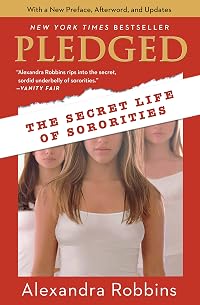
Pledged: The Secret Life of Sororities
by Alexandra Robbins 
On This Page
Description
An provocative look inside the world of sorority life offers an eye-opening view of the drugs, psychological abuse, promiscuity, racism, violence, and other problems that are rampant among young women in a typical sorority and analyzes why intelligent young women put up with these abuses in order to become part of a sorority sisterhood.Tags
Recommendations





































Member Reviews
Since Robbins attempts to portray her novel about sorority life as research, I will treat it as such. This review is how I would critique any written piece claiming to be research. Lucky for me I’m taking two classes this semester dealing specifically with proper research procedures.
1. Lack of Randomization. Robbins follows around four sorority girls. Four, out of thousands in the country. Although Robbins has reasons that she cannot follow more girls (prohibited by most national sororities and kicked off of a few campuses), this does not mean that her sample of 4 girls (all at one university, three in the same sorority) can be generalized to sorority life across the country. It cannot even be generalized to their university, let show more alone their sorority specifically. Right here, this point, delegitimizes her entire book as a valid research. But of course, that is not what Robbins is after, she is a journalist, a writer. Her goal is to sell books. If she wanted to do research, she would likely work in the background at a university, not parading around as a nineteen year old (something she proudly admits in the introduction as something not all people in their late twenties can do). Furthermore, perhaps four girls who allow themselves to be selected for such a project agree to participate because there is something they don’t like about the sorority. Unknown.
2. Data acquisition. I have issues with her methods. I don’t really mind that she went undercover, I think interesting things can come from it. But at what intervals did she interview her subjects? Were they equal intervals? How many times did she contact them? I don’t know, because she doesn’t tell us. (BIG no-no in research studies.) She does tell us that the girls would contact her when they were upset. It is any wonder, then, that the information she got from them was damaging to the sorority? When I’m upset about something, I turn to who I think I will get the most sympathy from…if these girls were upset about something in their sorority, and they happen to be part of a ‘research’ project about sororities, it makes sense that is when they would talk to Robbins. But when something was going great, perhaps they chose to celebrate with their sisters, or simply didn’t think to tell Robbins. We don’t know, because Robbins doesn’t tell us. Once again sacrificing legitimate research techniques to create a sensational best-seller.
3. Experimenter/Researcher Bias. Although Robbins claims she set out to write a ‘truthful’ book about sorority life, I have to challenge that a bit. She seems to be out to show what she deems historically white Greek organizations as the worst thing a girl could be a part of. She glosses over the positives that Greek life might bring (like service and philanthropy) to dictate that every sorority girl drinks, is loose, and likely doing drugs. To not be accused of my own bias, these are her words, “The blondes, the super-thin, the rich, the promiscuous, and the girls who smoke marijuana are separated and recognized as being distinctive, nonoverlapping groups.” (116) Basically, you can find whatever you want. If you want to see thin, party girls in a sorority, they are there. If you want to see the student body president or girl who’s working to pay her way through college, you can find that as well.
Going back to issue number one—inability to be generalized—I didn’t find that I could relate to many of the situations these girls found themselves in. Several chapters were dedicated to hazing (and implying that every organization hazes), but I was not hazed. Does that mean it doesn’t happen? No, because I, unlike Robbins, cannot speak for every person in Greek life. I also was not lied to during the pledge process, nor do I feel I was judged based on my wallet or really my looks (anyone who knows me knows I lack all form of style—this was deep into my toe sock phase). I was never pressured not to study in order to party, and remember the house having several study nights. But that’s just me.
I knew that I could not have an opinion on this book without reading it, and I encourage you to do the same. Don’t take my word for it, whether you are pro or anti Greek. But you should take into consideration what I feel to be fallacies in her logic. show less
1. Lack of Randomization. Robbins follows around four sorority girls. Four, out of thousands in the country. Although Robbins has reasons that she cannot follow more girls (prohibited by most national sororities and kicked off of a few campuses), this does not mean that her sample of 4 girls (all at one university, three in the same sorority) can be generalized to sorority life across the country. It cannot even be generalized to their university, let show more alone their sorority specifically. Right here, this point, delegitimizes her entire book as a valid research. But of course, that is not what Robbins is after, she is a journalist, a writer. Her goal is to sell books. If she wanted to do research, she would likely work in the background at a university, not parading around as a nineteen year old (something she proudly admits in the introduction as something not all people in their late twenties can do). Furthermore, perhaps four girls who allow themselves to be selected for such a project agree to participate because there is something they don’t like about the sorority. Unknown.
2. Data acquisition. I have issues with her methods. I don’t really mind that she went undercover, I think interesting things can come from it. But at what intervals did she interview her subjects? Were they equal intervals? How many times did she contact them? I don’t know, because she doesn’t tell us. (BIG no-no in research studies.) She does tell us that the girls would contact her when they were upset. It is any wonder, then, that the information she got from them was damaging to the sorority? When I’m upset about something, I turn to who I think I will get the most sympathy from…if these girls were upset about something in their sorority, and they happen to be part of a ‘research’ project about sororities, it makes sense that is when they would talk to Robbins. But when something was going great, perhaps they chose to celebrate with their sisters, or simply didn’t think to tell Robbins. We don’t know, because Robbins doesn’t tell us. Once again sacrificing legitimate research techniques to create a sensational best-seller.
3. Experimenter/Researcher Bias. Although Robbins claims she set out to write a ‘truthful’ book about sorority life, I have to challenge that a bit. She seems to be out to show what she deems historically white Greek organizations as the worst thing a girl could be a part of. She glosses over the positives that Greek life might bring (like service and philanthropy) to dictate that every sorority girl drinks, is loose, and likely doing drugs. To not be accused of my own bias, these are her words, “The blondes, the super-thin, the rich, the promiscuous, and the girls who smoke marijuana are separated and recognized as being distinctive, nonoverlapping groups.” (116) Basically, you can find whatever you want. If you want to see thin, party girls in a sorority, they are there. If you want to see the student body president or girl who’s working to pay her way through college, you can find that as well.
Going back to issue number one—inability to be generalized—I didn’t find that I could relate to many of the situations these girls found themselves in. Several chapters were dedicated to hazing (and implying that every organization hazes), but I was not hazed. Does that mean it doesn’t happen? No, because I, unlike Robbins, cannot speak for every person in Greek life. I also was not lied to during the pledge process, nor do I feel I was judged based on my wallet or really my looks (anyone who knows me knows I lack all form of style—this was deep into my toe sock phase). I was never pressured not to study in order to party, and remember the house having several study nights. But that’s just me.
I knew that I could not have an opinion on this book without reading it, and I encourage you to do the same. Don’t take my word for it, whether you are pro or anti Greek. But you should take into consideration what I feel to be fallacies in her logic. show less
Nowhere near as salacious as one might hope, Pledged doesn't tell you anything about the sorority system that you couldn't have picked up second-hand from attending an American university. Sororities are in fact fertile grounds for binge drinking, byzantine cliques, and general bitchiness. The gap between the archaically prim rules of deportment upheld by national Greek organizations and the drunken romps with frat boys indulged by active sisters is laughably vast. In perhaps her greatest reportorial coup, Robbins gets various girls to divulge their houses' secret passwords and mottoes, and these are about as inane as you'd expect them to be. The young women portrayed here often come off as likable but immature, which is completely show more consistent with their being nineteen or so years old. To their credit and the book's detriment, the four sorority sisters Robbins follows through their time at an unnamed state university somewhere in the south don't do anything particularly interesting. There are friendships and snubs, boyfriends and hook ups, alliances and squabbles, but most of it (with the exception of one sexual assault, whose consequences seem shockingly muted for everyone involved) is just standard late-adolescent drama. I'm sure it was a big deal to the women it happened to at the time, but it's all the usual college stuff that happens regardless of whether you sew a nonsensical string of Greek letters onto your hoodie.
The most interesting parts of the story only arrive second-hand as anecdotes about an older generation of women who remained cliquish about their house affiliation well into adulthood, or believed getting the right bid was a prerequisite for making the right marriage. With her focus on the present, Robbins doesn't have much opportunity to explore how archaic sorority rituals might have reinforced archaic gender roles. To some extent that's still present for the generation of women Robbins writes about (much of the social life depicted is centered around retaining the attention of fraternity brothers). However, these girls don't go to college in order to meet a husband, and since they have more options, the whole sorority business seems to be played for lower stakes. At the end of the book, you're left wondering what sororities are for these days, since friends, alcohol, dates, and roommate drama are all available to college women without the extra organizational overhead. show less
The most interesting parts of the story only arrive second-hand as anecdotes about an older generation of women who remained cliquish about their house affiliation well into adulthood, or believed getting the right bid was a prerequisite for making the right marriage. With her focus on the present, Robbins doesn't have much opportunity to explore how archaic sorority rituals might have reinforced archaic gender roles. To some extent that's still present for the generation of women Robbins writes about (much of the social life depicted is centered around retaining the attention of fraternity brothers). However, these girls don't go to college in order to meet a husband, and since they have more options, the whole sorority business seems to be played for lower stakes. At the end of the book, you're left wondering what sororities are for these days, since friends, alcohol, dates, and roommate drama are all available to college women without the extra organizational overhead. show less
The author managed to get herself inside several sororities undercover, which was promising, but her decision not to name any of the real universities, sororities, or people she talked to (to preserve her sources' anonymity and thereby protect them from the fury of their scandalized sisters) and aimless crosscutting between stories dried up my interest pretty fast.
I found this book to be particularly interesting, as I never felt any desire to join a sorority when I was in college. There were only four at RPI, where women are in the minority (the ratio was 3:1 while I attended) and while I doubt that they were exactly like the sororities detailed in Pledged, I'm sure they were awful close.
I did join (rush, pledge and become initiated into) a co-ed service fraternity so I'm familiar with things like rushing, pledging, rituals, secret handshakes and the like. My experience was a lot different than the ones discussed in this book. Among many other differences, my fraternity didn't have a house and existed primarily to do service to the campus, country and community. The social network (the show more brotherhood) was one of the biggest perks, and it's why we were a fraternity, and not just a club.
Based on my experiences, pledging a fraternity can be a vastly rewarding thing, and being a member of a fraternity is very valuable. I learned an awful lot about myself, other people, politics, drama, time management, leadership, learning things on the spot, team building, and keeping my cool under pressure.
It's too bad that the sorority experiences detailed in this book were so similar to the stereotypical high school experience. A bunch of popular girls trying to hook up with the hottest guys, eating disorders, rampant drug and alcohol use, drama, infighting and backstabbing, etc. I think that a network of women, sisters, could be a very valuable thing, but not if they're like the sororities I read about in this book. I don't feel like being a member of a society is at all empowering for women if it constantly degrades them and basically upholds superficial, patriarchal values such as the attainment of superficial beauty standards and reinforcing that the women in these groups are only as good as the men they manage to snag in the process. show less
I did join (rush, pledge and become initiated into) a co-ed service fraternity so I'm familiar with things like rushing, pledging, rituals, secret handshakes and the like. My experience was a lot different than the ones discussed in this book. Among many other differences, my fraternity didn't have a house and existed primarily to do service to the campus, country and community. The social network (the show more brotherhood) was one of the biggest perks, and it's why we were a fraternity, and not just a club.
Based on my experiences, pledging a fraternity can be a vastly rewarding thing, and being a member of a fraternity is very valuable. I learned an awful lot about myself, other people, politics, drama, time management, leadership, learning things on the spot, team building, and keeping my cool under pressure.
It's too bad that the sorority experiences detailed in this book were so similar to the stereotypical high school experience. A bunch of popular girls trying to hook up with the hottest guys, eating disorders, rampant drug and alcohol use, drama, infighting and backstabbing, etc. I think that a network of women, sisters, could be a very valuable thing, but not if they're like the sororities I read about in this book. I don't feel like being a member of a society is at all empowering for women if it constantly degrades them and basically upholds superficial, patriarchal values such as the attainment of superficial beauty standards and reinforcing that the women in these groups are only as good as the men they manage to snag in the process. show less
I couldn't keep the characters of "Amy," "Caitlin," "Sabrina," and "Vicki" apart. This is not necessarily because all sorority sisters are the same, but because Robbins failed to capture who the girls really are. She was able to capture the girls' agendas, but not their inner selves. As such, their girls' thoughts, actions, and dialogue all seemed relatively similar, which is to say that the trotted around from event to event and from boy to boy.
That said, I found this book fun to read the way I find Gossip Girl fun to watch. Does it say anything new? Not really, unless you didn't know that sometimes people can be mean and exclusive. Did Robbins sensationalize her findings or narrow her scope in a way that her results were bound to be show more amusing? Perhaps. Does it make for a good rainy day read? Absolutely. show less
That said, I found this book fun to read the way I find Gossip Girl fun to watch. Does it say anything new? Not really, unless you didn't know that sometimes people can be mean and exclusive. Did Robbins sensationalize her findings or narrow her scope in a way that her results were bound to be show more amusing? Perhaps. Does it make for a good rainy day read? Absolutely. show less
Confession: the only reason I read this book is because I really like Robbins' writing. But finishing this was more of an endurance contest than anything else. That's not Robbins' fault at all--I just have such little tolerance for the shenanigans of the mean girl culture.
SPOILERS: I was actually a little disappointed in the lack of development of the girls she followed, as well. I kept hoping one of them would realize that the sororities were completely altering their world views, but that never seemed to happen.
But if you were never in a sorority and want to see into their world, this would be a decent place to go...and might even make you grateful you avoided that mess.
SPOILERS: I was actually a little disappointed in the lack of development of the girls she followed, as well. I kept hoping one of them would realize that the sororities were completely altering their world views, but that never seemed to happen.
But if you were never in a sorority and want to see into their world, this would be a decent place to go...and might even make you grateful you avoided that mess.
Since Robbins attempts to portray her novel about sorority life as research, I will treat it as such. This review is how I would critique any written piece claiming to be research. Lucky for me I’m taking two classes this semester dealing specifically with proper research procedures.
1. Lack of Randomization. Robbins follows around four sorority girls. Four, out of thousands in the country. Although Robbins has reasons that she cannot follow more girls (prohibited by most national sororities and kicked off of a few campuses), this does not mean that her sample of 4 girls (all at one university, three in the same sorority) can be generalized to sorority life across the country. It cannot even be generalized to their university, let show more alone their sorority specifically. Right here, this point, delegitimizes her entire book as a valid research. But of course, that is not what Robbins is after, she is a journalist, a writer. Her goal is to sell books. If she wanted to do research, she would likely work in the background at a university, not parading around as a nineteen year old (something she proudly admits in the introduction as something not all people in their late twenties can do). Furthermore, perhaps four girls who allow themselves to be selected for such a project agree to participate because there is something they don’t like about the sorority. Unknown.
2. Data acquisition. I have issues with her methods. I don’t really mind that she went undercover, I think interesting things can come from it. But at what intervals did she interview her subjects? Were they equal intervals? How many times did she contact them? I don’t know, because she doesn’t tell us. (BIG no-no in research studies.) She does tell us that the girls would contact her when they were upset. It is any wonder, then, that the information she got from them was damaging to the sorority? When I’m upset about something, I turn to who I think I will get the most sympathy from…if these girls were upset about something in their sorority, and they happen to be part of a ‘research’ project about sororities, it makes sense that is when they would talk to Robbins. But when something was going great, perhaps they chose to celebrate with their sisters, or simply didn’t think to tell Robbins. We don’t know, because Robbins doesn’t tell us. Once again sacrificing legitimate research techniques to create a sensational best-seller.
3. Experimenter/Researcher Bias. Although Robbins claims she set out to write a ‘truthful’ book about sorority life, I have to challenge that a bit. She seems to be out to show what she deems historically white Greek organizations as the worst thing a girl could be a part of. She glosses over the positives that Greek life might bring (like service and philanthropy) to dictate that every sorority girl drinks, is loose, and likely doing drugs. To not be accused of my own bias, these are her words, “The blondes, the super-thin, the rich, the promiscuous, and the girls who smoke marijuana are separated and recognized as being distinctive, nonoverlapping groups.” (116) Basically, you can find whatever you want. If you want to see thin, party girls in a sorority, they are there. If you want to see the student body president or girl who’s working to pay her way through college, you can find that as well.
Going back to issue number one—inability to be generalized—I didn’t find that I could relate to many of the situations these girls found themselves in. Several chapters were dedicated to hazing (and implying that every organization hazes), but I was not hazed. Does that mean it doesn’t happen? No, because I, unlike Robbins, cannot speak for every person in Greek life. I also was not lied to during the pledge process, nor do I feel I was judged based on my wallet or really my looks (anyone who knows me knows I lack all form of style—this was deep into my toe sock phase). I was never pressured not to study in order to party, and remember the house having several study nights. But that’s just me.
I knew that I could not have an opinion on this book without reading it, and I encourage you to do the same. Don’t take my word for it, whether you are pro or anti Greek. But you should take into consideration what I feel to be fallacies in her logic. show less
1. Lack of Randomization. Robbins follows around four sorority girls. Four, out of thousands in the country. Although Robbins has reasons that she cannot follow more girls (prohibited by most national sororities and kicked off of a few campuses), this does not mean that her sample of 4 girls (all at one university, three in the same sorority) can be generalized to sorority life across the country. It cannot even be generalized to their university, let show more alone their sorority specifically. Right here, this point, delegitimizes her entire book as a valid research. But of course, that is not what Robbins is after, she is a journalist, a writer. Her goal is to sell books. If she wanted to do research, she would likely work in the background at a university, not parading around as a nineteen year old (something she proudly admits in the introduction as something not all people in their late twenties can do). Furthermore, perhaps four girls who allow themselves to be selected for such a project agree to participate because there is something they don’t like about the sorority. Unknown.
2. Data acquisition. I have issues with her methods. I don’t really mind that she went undercover, I think interesting things can come from it. But at what intervals did she interview her subjects? Were they equal intervals? How many times did she contact them? I don’t know, because she doesn’t tell us. (BIG no-no in research studies.) She does tell us that the girls would contact her when they were upset. It is any wonder, then, that the information she got from them was damaging to the sorority? When I’m upset about something, I turn to who I think I will get the most sympathy from…if these girls were upset about something in their sorority, and they happen to be part of a ‘research’ project about sororities, it makes sense that is when they would talk to Robbins. But when something was going great, perhaps they chose to celebrate with their sisters, or simply didn’t think to tell Robbins. We don’t know, because Robbins doesn’t tell us. Once again sacrificing legitimate research techniques to create a sensational best-seller.
3. Experimenter/Researcher Bias. Although Robbins claims she set out to write a ‘truthful’ book about sorority life, I have to challenge that a bit. She seems to be out to show what she deems historically white Greek organizations as the worst thing a girl could be a part of. She glosses over the positives that Greek life might bring (like service and philanthropy) to dictate that every sorority girl drinks, is loose, and likely doing drugs. To not be accused of my own bias, these are her words, “The blondes, the super-thin, the rich, the promiscuous, and the girls who smoke marijuana are separated and recognized as being distinctive, nonoverlapping groups.” (116) Basically, you can find whatever you want. If you want to see thin, party girls in a sorority, they are there. If you want to see the student body president or girl who’s working to pay her way through college, you can find that as well.
Going back to issue number one—inability to be generalized—I didn’t find that I could relate to many of the situations these girls found themselves in. Several chapters were dedicated to hazing (and implying that every organization hazes), but I was not hazed. Does that mean it doesn’t happen? No, because I, unlike Robbins, cannot speak for every person in Greek life. I also was not lied to during the pledge process, nor do I feel I was judged based on my wallet or really my looks (anyone who knows me knows I lack all form of style—this was deep into my toe sock phase). I was never pressured not to study in order to party, and remember the house having several study nights. But that’s just me.
I knew that I could not have an opinion on this book without reading it, and I encourage you to do the same. Don’t take my word for it, whether you are pro or anti Greek. But you should take into consideration what I feel to be fallacies in her logic. show less
Members
- Recently Added By
Lists

Books Read in 2015
3,299 works; 129 members

Hachette Book Group
152 works; 6 members

Shaykh Hamza's Book Recommendations
439 works; 3 members
Author Information

9+ Works 3,558 Members
Alexandra Robbins is on the staff of The New Yorker and has written for numerous magazines and newspapers. A Yale graduate, she lives in the Washington, D.C. area.
Alexandra Robbins is a LibraryThing Author, an author who lists their personal library on LibraryThing.
Awards and Honors
Distinctions
Common Knowledge
- Original publication date
- 2004-04-07
Classifications
- Genres
- General Nonfiction, Nonfiction
- DDC/MDS
- 378.19856 — Society, government, & culture Education Higher education (Tertiary education) Organization and management; curriculums
- LCC
- LJ51 .R63 — Education Student fraternities and societies, United States Student fraternities and societies, United States
- BISAC
Statistics
- Members
- 1,283
- Popularity
- 19,042
- Reviews
- 38
- Rating
- (3.22)
- Languages
- English
- Media
- Paper, Audiobook, Ebook
- ISBNs
- 10
- ASINs
- 9