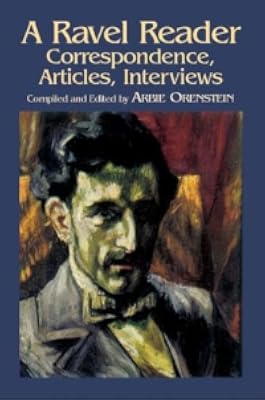
A Ravel reader : correspondence, articles, interviews
by Maurice Ravel
On This Page
Description
Considered among the most original and influential composers of the twentieth century, Maurice Ravel played a decisive role in the history of modern French music--a role that continues to be examined by students exploring the roots of musical style in our time. This outstanding compilation of articles by Ravel (who was a brilliant critic) features reviews, interviews, and some 350 letters--most of which are published here for the first time in English-from Cocteau, Colette, de Falla, Richard show more Strauss, Stravinsky, and other major figures of the era. show lessTags
Recommendations











Members
- Recently Added By
Author Information

1,024+ Works 2,340 Members
The French composer Maurice Ravel was the leading exemplar of musical impressionism. Ravel entered the Paris Conservatory in 1889, where his teachers included Gabriel Faure. As a composer, Ravel produced highly original, fluid music, much of it within the outlines of musical classicism. He excelled at piano composition and orchestration, and his show more compositions reveal many of the musical trends active in Paris after the turn of the century. His coloristic effects and occasional use of whole-tone scales and tritones place him with Claude Debussy and the impressionists. Yet the sense of proportion and the austere aspects of some of his compositions also reflect his interest in, and reverence for, classical forms of music. Ravel composed Pavanne for a Deceased Infant (1899), the piano work Jeux d'eau (1902), his song cycle Sheherazade (1903), and his String Quartet (1903) while still a student at the conservatory. In subsequent years, Ravel composed ballets, including Daphne and Chloe (1912); symphonic poems, such as La Valse (1920); two operas, L'Heure espagnole (1911) and L'Enfant et les sortileges (1912); and many pieces for piano, violin, and orchestra. His orchestration of Modest Mussorgsky's Pictures at an Exhibition (1922) attracted worldwide attention and inclusion in the repertoire of major orchestras. Another staple of major orchestras is Ravel's Bolero (1928). Ravel died in Paris following brain surgery in 1937. (Bowker Author Biography) show less
All Editions
Series
Belongs to Publisher Series
Common Knowledge
- People/Characters*
- Maurice Ravel
*Some information comes from Common Knowledge in other languages. Click "Edit" for more information.
Classifications
Statistics
- Members
- 22
- Popularity
- 1,193,369
- Languages
- English
- Media
- Paper
- ISBNs
- 2
- UPCs
- 1