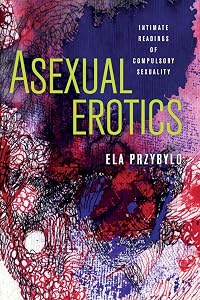
Asexual Erotics: Intimate Readings of Compulsory Sexuality
by Ela Przybylo
On This Page
Description
"Analyzes queer, feminist, and anti-racist movements; television and film; art and photography; and fiction, nonfiction, and theoretical texts to explore asexual erotics and demonstrate how asexuality has been vital to the formulation of intimate ways of knowing and being"--Tags
Recommendations





Member Reviews
Asexual Erotics è forse il libro più interessante che mi è capitato di leggere sull’asessualità: avendo ormai superato la fase che-cos’è-l’asessualità-oddio-ma-parla-di-me! sento il bisogno di letture che vadano oltre le definizioni e si inoltrino lungo i sentieri dello sguardo asessuale sul mondo. Cosa può dirci il punto di vista asessuale sulla nostra società?
Ela Przybyło (che il suo sito mi informa si pronuncia Pshy-by-wo) mi ha dato un assaggio delle potenzialità che l’asessualità ha nel dare una nuova definizione di intimità ed erotismo, togliendo il sesso da quella posizione di centralità e privilegio che ha permesso a una sessualità compulsiva di essere un’arma per ribadire e rafforzare posizioni razziste, show more sessiste, abiliste e omofobiche.
Przybyło analizza in maniera accademica e rigorosa storture che incontri vivendo una vita da asessuale, ma che non tuttз sono in grado di identificare con certezza e organizzare in un pensiero strutturato (io no di sicuro, sono una frana nel teorizzare gli eventi): per esempio, il fatto che il sesso sia al centro dell’intimità implica che ci sia uno standard al quale adeguarsi affinché la relazione sia sana. Troppo poco, o addirittura niente sesso, è sicuramente indice di qualcosa che non va nella relazione: analizzando la cosiddetta morte del letto lesbico, però, Przybyło dimostra che a non andare era più il fatto di aver preso come standard le dinamiche delle coppie eterosessuali.
Per questo non consiglio questo libro a meno che non abbiate una buona padronanza delle temetiche che girano intorno all’asessualità e alle modalità con le quali il femminismo queer indaga i vari fenomeni sociali. Però, una volta che ci avrete preso confidenza, prendete in considerazione questo libriccino, che è davvero prezioso, spero che sia il primo di tanti altri. show less
Ela Przybyło (che il suo sito mi informa si pronuncia Pshy-by-wo) mi ha dato un assaggio delle potenzialità che l’asessualità ha nel dare una nuova definizione di intimità ed erotismo, togliendo il sesso da quella posizione di centralità e privilegio che ha permesso a una sessualità compulsiva di essere un’arma per ribadire e rafforzare posizioni razziste, show more sessiste, abiliste e omofobiche.
Przybyło analizza in maniera accademica e rigorosa storture che incontri vivendo una vita da asessuale, ma che non tuttз sono in grado di identificare con certezza e organizzare in un pensiero strutturato (io no di sicuro, sono una frana nel teorizzare gli eventi): per esempio, il fatto che il sesso sia al centro dell’intimità implica che ci sia uno standard al quale adeguarsi affinché la relazione sia sana. Troppo poco, o addirittura niente sesso, è sicuramente indice di qualcosa che non va nella relazione: analizzando la cosiddetta morte del letto lesbico, però, Przybyło dimostra che a non andare era più il fatto di aver preso come standard le dinamiche delle coppie eterosessuali.
Per questo non consiglio questo libro a meno che non abbiate una buona padronanza delle temetiche che girano intorno all’asessualità e alle modalità con le quali il femminismo queer indaga i vari fenomeni sociali. Però, una volta che ci avrete preso confidenza, prendete in considerazione questo libriccino, che è davvero prezioso, spero che sia il primo di tanti altri. show less
Jan 17, 2024Italian
Ratings
Members
- Recently Added By
Published Reviews
ThingScore 25
Insulting, Troubling and Unfocused Philosophy for or against Asexuality
Ela Przybylo. Asexual Erotics: Intimate Readings of Compulsory Sexuality. 198pp, 6X9”, paperback. ISBN: 978-0-8142-5542-1. Columbus: Ohio State University Press, 2019.
**
When I was running for Mayor of Quanah, Texas some months ago, I discovered that all of my competitors listed being in a marriage with children under the show more obligatory question regarding family asked by the town newspaper. Every time I enter a conversation with a group of people, I am inevitably asked about my familial or sexual ties. For example, I was once in a writing group, pitching my publishing services, and the entire group took a break from their meal and authorial concerns to grill me regarding the reasons for my anti-sexuality and complete lack of friendship and familial connections. One of them said in response to my insistence I have found sex to be repelling and disgusting that “It’s warm!” This is a nicer way of putting it, but I think I have heard every insult listed on page 9 of this book in a cartoon full of “denial narratives”, such as, “So what you’re saying is that you’re gay, you just don’t want to admit it.” It is possible that I have never seen an American film that did not include some reference to sexual or family relationships. This suggests to me that men control nearly all filmmaking and this is a sign they cannot stop thinking about sex. It is pretty natural for the females of various species in the wild to not pursue sex, but rather to be “receptive” once a year or the like; being not into sex is the normal female condition as far as I can tell. And yet I have never questioned with deep concern or ridicule why these women I am meeting are seriously signing up to be penetrated daily without procreational aims across most of this stretch. Even Thoreau, a man, needed a couple of years to live in the woods alone to find equilibrium and time to write his masterpiece. While it would be extremely comforting to find in these pages some theoretical or philosophical logically described sympathy, the inclusion of this insult cartoon and several photographs of “lesbian” beds jointly suggests the author is echoing the cartoonish “you must be a lesbian” insult in sections that compare lesbian relationships to asexuality. Most of the chapter titles are similarly troubling. “Lesbian Bed Death…: An Erotics of Failure” suggests asexual women suffer from the loss of sex, a pursuit assumed to be a sign of the “good life” one that is “coupled and reproductive” (64). Masturbation with erotic modern toys is far more likely to lead to a positive and prompt conclusion for a woman: so it is likely an anti-sexual woman like me might reach these conclusions with more frequency than married women that have to expand energy on satisfying husbands who do not believe or want their spouses to climax. The percentage of women dying in child birth in America is rapidly climbing; at 38, I would be putting my life in danger if I now attempted an AMA pregnancy. These types of arguments are not presented in this book, which is focused on repeating the insults I hear enough of in casual chats with ignorant people in America. “Growing into Asexuality: The Queen Erotics of Childhood” begins with an anecdote of an insensitive joke the author made regarding her nieces behind being exposed to other children; she argues that offense was taken at this joke because she is “queer” rather than because referring to it as “moon rising in the sky” actually offended the parties in question. From here she covers topics such as this child’s desexualization and subjecthood, as the bum is called “a site of the child’s pleasure”. Then she spends most of the chapter on summarizing Freudian ideas on sexuality, and then covers Maggie Nelson’s The Argonauts to question what “an asexual development narrative looks like” and how to make it “tangible without desexualizing childhood” (89-99). Perhaps because I covered modern slave narratives in one of the books in this set of reviews, all of this is extremely troublesome from my perspective. The US defines a “child” as anybody under the age of 21. Without specifying a different age-range, this chapter is referring to some “children” who are in college and perhaps might already be married with a child since they gained the right to do so several years earlier. And if she intended to refer to prepubescent children, their sexualization by adults or their fellow playmates is a form of criminal pedophilia. Even consensual sex at this age is illegal, be it homosexual or heterosexual. Thus, by these legal definitions, prepubescent children are obligated to remain asexual until they leave this protected age. The discussion regarding illegal-aged children experiencing sexualized “pleasure” regarding their bodies or in interactions with others might have been appropriate a century ago when Freud recorded his ponderings, but America has enough problems with sexual abuse across all age groups, that it is really in all of our best interests to desexualize childhood, even if we have to require girls to cover all of their skin to remain safe from tempting moon-gazers. “Erotics of Excess and the Aging Spinster” argues that rather than older adults losing interest in sex, they are “willed into nonsexuality” (113). I have seen similar arguments in many TV programs, which tend to propose that older men and women have desires as well that they need to explore by pursuing sexual relationships. This approach helps corporations sell drugs to impotent men to keep them physically capable of performing the sexual act, but does it really help the elderly, many of whom catch sexually transmitted diseases in these sexualized nursing homes at a time in their lives when a small infection can lead to serious medical complications? At some points of the chapter, the author seems to be supporting the asexual choices of the characters she describes, but she still describes a friendship between women without sexual interest as an “asexual perversion” that is viewed as an “inability and unwillingness to conform” to the normalcy of capitalist work or a “hetero-coupled formation” (135). Perhaps because the author mostly talks in the first person when she describes stories that happened and refrains from stating her exact position on these theoretical conflicts, the reader is left confused regarding where the narrator stands; she keeps repeating that she is queer, but not that she is asexual, leaving the likely possibility that she resents asexuals because she is lumped with them if she fails to self-sexualize. Something is wrong with the way this book has been handled, but the lack of clarity throughout is preventing me from spotting what it is.
The publisher’s summary: “Challenging what she sees as an obsession with sex and sexuality, Ela Przybylo examines the silence around asexuality in queer, feminist, and lesbian thinking—turning to Audre Lorde’s work on erotics to propose instead an approach she calls asexual erotics, an alternative language for discussing forms of intimacy that are not reducible to sex and sexuality.” She does not achieve this goal in the bulk of this book though; in the examples I cite, there is a note regarding female intimacy of friendship, but most of the text is describing alternatives of sexualization. “Beginning with the late 1960s as a time when compulsory sexuality intensified and became increasingly tied to feminist, lesbian, and queer notions of empowerment, politics, and subjectivity, Przybylo looks to feminist political celibacy/asexuality, lesbian bed death, the asexual queer child, and the aging spinster as four figures that are asexually resonant and which benefit from an asexual reading—that is, from being read in an asexually affirming rather than asexually skeptical manner.” But her discussion of the moon-baring child refers to children having a right to be sexual? Perhaps this point can still be made if she returns to re-write this book to offer direct and clear opening paragraphs and sentences that offer her intentions.
“Through a wide-ranging analysis of pivotal queer, feminist, and anti-racist movements; television and film; art and photography; and fiction, nonfiction, and theoretical texts, each chapter explores asexual erotics and demonstrates how asexuality has been vital to the formulation of intimate ways of knowing and being. Asexual Erotics assembles a compendium of asexual possibilities that speaks against the centralization of sex and sexuality, asking that we consider the ways in which compulsory sexuality is detrimental not only to asexual and nonsexual people but to all.” Reading over her conclusion, I think I understand where this book went wrong. Przybylo jumps from one quote or summary of a text to the next without tying these points together into a coherent whole. When she does not frame portions of these reflections as referring to specific characters and how authors have handled these subjects badly she appears to be inhabiting a hatred for asexuals herself as she makes hateful statements in this regard, even if they are intended to be things the authors she is ridiculing are saying. I would like to read a great book on asexuality in the future, but this one is not going to help the matter. If the problem is ignorance, confusing the ignorant will not decrease their hatred. show less
Ela Przybylo. Asexual Erotics: Intimate Readings of Compulsory Sexuality. 198pp, 6X9”, paperback. ISBN: 978-0-8142-5542-1. Columbus: Ohio State University Press, 2019.
**
When I was running for Mayor of Quanah, Texas some months ago, I discovered that all of my competitors listed being in a marriage with children under the show more obligatory question regarding family asked by the town newspaper. Every time I enter a conversation with a group of people, I am inevitably asked about my familial or sexual ties. For example, I was once in a writing group, pitching my publishing services, and the entire group took a break from their meal and authorial concerns to grill me regarding the reasons for my anti-sexuality and complete lack of friendship and familial connections. One of them said in response to my insistence I have found sex to be repelling and disgusting that “It’s warm!” This is a nicer way of putting it, but I think I have heard every insult listed on page 9 of this book in a cartoon full of “denial narratives”, such as, “So what you’re saying is that you’re gay, you just don’t want to admit it.” It is possible that I have never seen an American film that did not include some reference to sexual or family relationships. This suggests to me that men control nearly all filmmaking and this is a sign they cannot stop thinking about sex. It is pretty natural for the females of various species in the wild to not pursue sex, but rather to be “receptive” once a year or the like; being not into sex is the normal female condition as far as I can tell. And yet I have never questioned with deep concern or ridicule why these women I am meeting are seriously signing up to be penetrated daily without procreational aims across most of this stretch. Even Thoreau, a man, needed a couple of years to live in the woods alone to find equilibrium and time to write his masterpiece. While it would be extremely comforting to find in these pages some theoretical or philosophical logically described sympathy, the inclusion of this insult cartoon and several photographs of “lesbian” beds jointly suggests the author is echoing the cartoonish “you must be a lesbian” insult in sections that compare lesbian relationships to asexuality. Most of the chapter titles are similarly troubling. “Lesbian Bed Death…: An Erotics of Failure” suggests asexual women suffer from the loss of sex, a pursuit assumed to be a sign of the “good life” one that is “coupled and reproductive” (64). Masturbation with erotic modern toys is far more likely to lead to a positive and prompt conclusion for a woman: so it is likely an anti-sexual woman like me might reach these conclusions with more frequency than married women that have to expand energy on satisfying husbands who do not believe or want their spouses to climax. The percentage of women dying in child birth in America is rapidly climbing; at 38, I would be putting my life in danger if I now attempted an AMA pregnancy. These types of arguments are not presented in this book, which is focused on repeating the insults I hear enough of in casual chats with ignorant people in America. “Growing into Asexuality: The Queen Erotics of Childhood” begins with an anecdote of an insensitive joke the author made regarding her nieces behind being exposed to other children; she argues that offense was taken at this joke because she is “queer” rather than because referring to it as “moon rising in the sky” actually offended the parties in question. From here she covers topics such as this child’s desexualization and subjecthood, as the bum is called “a site of the child’s pleasure”. Then she spends most of the chapter on summarizing Freudian ideas on sexuality, and then covers Maggie Nelson’s The Argonauts to question what “an asexual development narrative looks like” and how to make it “tangible without desexualizing childhood” (89-99). Perhaps because I covered modern slave narratives in one of the books in this set of reviews, all of this is extremely troublesome from my perspective. The US defines a “child” as anybody under the age of 21. Without specifying a different age-range, this chapter is referring to some “children” who are in college and perhaps might already be married with a child since they gained the right to do so several years earlier. And if she intended to refer to prepubescent children, their sexualization by adults or their fellow playmates is a form of criminal pedophilia. Even consensual sex at this age is illegal, be it homosexual or heterosexual. Thus, by these legal definitions, prepubescent children are obligated to remain asexual until they leave this protected age. The discussion regarding illegal-aged children experiencing sexualized “pleasure” regarding their bodies or in interactions with others might have been appropriate a century ago when Freud recorded his ponderings, but America has enough problems with sexual abuse across all age groups, that it is really in all of our best interests to desexualize childhood, even if we have to require girls to cover all of their skin to remain safe from tempting moon-gazers. “Erotics of Excess and the Aging Spinster” argues that rather than older adults losing interest in sex, they are “willed into nonsexuality” (113). I have seen similar arguments in many TV programs, which tend to propose that older men and women have desires as well that they need to explore by pursuing sexual relationships. This approach helps corporations sell drugs to impotent men to keep them physically capable of performing the sexual act, but does it really help the elderly, many of whom catch sexually transmitted diseases in these sexualized nursing homes at a time in their lives when a small infection can lead to serious medical complications? At some points of the chapter, the author seems to be supporting the asexual choices of the characters she describes, but she still describes a friendship between women without sexual interest as an “asexual perversion” that is viewed as an “inability and unwillingness to conform” to the normalcy of capitalist work or a “hetero-coupled formation” (135). Perhaps because the author mostly talks in the first person when she describes stories that happened and refrains from stating her exact position on these theoretical conflicts, the reader is left confused regarding where the narrator stands; she keeps repeating that she is queer, but not that she is asexual, leaving the likely possibility that she resents asexuals because she is lumped with them if she fails to self-sexualize. Something is wrong with the way this book has been handled, but the lack of clarity throughout is preventing me from spotting what it is.
The publisher’s summary: “Challenging what she sees as an obsession with sex and sexuality, Ela Przybylo examines the silence around asexuality in queer, feminist, and lesbian thinking—turning to Audre Lorde’s work on erotics to propose instead an approach she calls asexual erotics, an alternative language for discussing forms of intimacy that are not reducible to sex and sexuality.” She does not achieve this goal in the bulk of this book though; in the examples I cite, there is a note regarding female intimacy of friendship, but most of the text is describing alternatives of sexualization. “Beginning with the late 1960s as a time when compulsory sexuality intensified and became increasingly tied to feminist, lesbian, and queer notions of empowerment, politics, and subjectivity, Przybylo looks to feminist political celibacy/asexuality, lesbian bed death, the asexual queer child, and the aging spinster as four figures that are asexually resonant and which benefit from an asexual reading—that is, from being read in an asexually affirming rather than asexually skeptical manner.” But her discussion of the moon-baring child refers to children having a right to be sexual? Perhaps this point can still be made if she returns to re-write this book to offer direct and clear opening paragraphs and sentences that offer her intentions.
“Through a wide-ranging analysis of pivotal queer, feminist, and anti-racist movements; television and film; art and photography; and fiction, nonfiction, and theoretical texts, each chapter explores asexual erotics and demonstrates how asexuality has been vital to the formulation of intimate ways of knowing and being. Asexual Erotics assembles a compendium of asexual possibilities that speaks against the centralization of sex and sexuality, asking that we consider the ways in which compulsory sexuality is detrimental not only to asexual and nonsexual people but to all.” Reading over her conclusion, I think I understand where this book went wrong. Przybylo jumps from one quote or summary of a text to the next without tying these points together into a coherent whole. When she does not frame portions of these reflections as referring to specific characters and how authors have handled these subjects badly she appears to be inhabiting a hatred for asexuals herself as she makes hateful statements in this regard, even if they are intended to be things the authors she is ridiculing are saying. I would like to read a great book on asexuality in the future, but this one is not going to help the matter. If the problem is ignorance, confusing the ignorant will not decrease their hatred. show less
added by faktorovich
Author Information
2 Works 58 Members
Series
Belongs to Publisher Series
Common Knowledge
- Canonical title
- Asexual Erotics: Intimate Readings of Compulsory Sexuality
Classifications
- Genres
- Nonfiction, Sexuality and Gender Studies, LGBTQ+, General Nonfiction, Literature Studies and Criticism
- DDC/MDS
- 306.7 — Society, government, & culture Social sciences, sociology & anthropology Social Behavior - Dating, Marriage, Divorce Sexual relations
- LCC
- HQ23 .P78 — Social sciences The family. Marriage, Women and Sexuality The Family. Marriage. Women Sexual life Sexual behavior and attitudes. Sexuality
- BISAC
Statistics
- Members
- 50
- Popularity
- 603,602
- Reviews
- 1
- Rating
- (3.64)
- Languages
- English
- Media
- Paper
- ISBNs
- 2