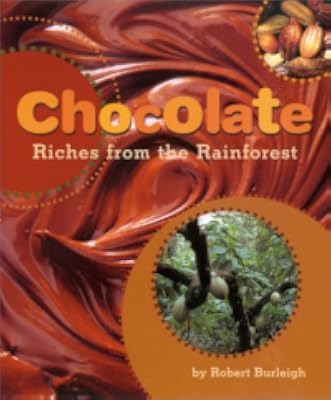
Chocolate: Riches from the Rainforest
by Robert Burleigh
On This Page
Description
Traces the history of chocolate from a drink of the Olmec and Maya and later in Europe to its popularity around the world today.Tags
Recommendations














Member Reviews
Chocolate: Riches from the Rainforest is, on the surface, a chronological history of chocolate. However, the book has a loftier aim than simply recounting the evolution of chocolate. Robert Burleigh asserts "Chocolate's story is linked with the highs and lows of the human condition during the past two millennia." This point is illustrated as Burleigh teathers complex historical and cultural events to a simple, common object, chocolate. From ancient, developed pre-Columbia cultures to slavery, and on through modern myths and ledgends to environmental degredation, chocolate is a focal point around which a thick social tapestry is woven. Although Burleigh employs wonderfully lively and exciting language, coloful photos and images of show more chocolate in its various incarnations, it is obvious that Chocolate is meant to conjure darker images and connect this impossible sweet treat with something a little more bitter. show less
This mouth-watering account of chocolate starts in the rainforests, where the cacao plant is found. Burleigh details the biology of the plant and the process that turns the fruit of the plant into the chocolate we know and love. Accompanied by wonderful photographs ancient artwork, landscapes and of course the delicacy itself, Burleigh gives a wonderfully rich history of chocolate and describes its place in society among different cultures: the Mayans, Olmecs, the Aztecs, and then the conquistadors in the 1500s. He then chronicles chocolate's travels to Europe, where it eventually was enjoyed in the solid form in the 1800s (until then it had been enjoyed only as a liquid!). Chocolate was a treat of the upper class, while slaves around show more the world worked to produce and export it. Since the later 1800s, industrial advances have changed the way chocolate is prepared, although unfortunately, the sweet has not completely detached itself from the slave trade, even today. show less
This is a great informative book. It traces the history of chocolate and its uses from the past and to the present. It goes into detail on the location and the importance of it to certain cultures. I enjoyed reading it and learning things about chocolate, about how some cultures in South America, mixed it with blood!
Who doesn't love chocolate? I picked this book because I think it might be interesting to see what one could do with this in a classroom setting. First the pictures are delecious to look at, the book was filled with informatino about where the chocolate comes from, how it was used in ceremonies to worship gods, how its produced... absolutely delecious and interesting. I also like how it discusses the rainforest and the people who work and live there because its almosta completely alien environment to a lot of children in american schools.
I really liked this book and how it dealed with social justice issues in food production without being preachy. I think it covered a lot of aspects of such a well used food, and even I learned something from it.
i love chocolate so it was nice to read this book and see where it came from. it was really interesting to read about what was done with it before it became this huge sensation around the world.
Most everyone loves chocolate so who can resist learning about it's history? I was very interested by the traditional practices chocolate was used for. This book uses something children love as a tool to introduce them to different cultures, civilizations, and history. The pictures in the book help the reader create an accurate picture of chocolate through the ages.
Members
- Recently Added By
Author Information

61+ Works 6,581 Members
Awards and Honors
Classifications
Statistics
- Members
- 182
- Popularity
- 180,865
- Reviews
- 32
- Rating
- (3.80)
- Languages
- English
- Media
- Paper
- ISBNs
- 3
- ASINs
- 1