On This Page
Description
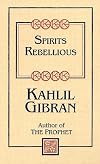
A clarion call for freedom from one of the twentieth century's most important philosophers and writers, Kahlil Gibran A book so powerful it was burned in the marketplace of Beirut at the time of its publication, Kahlil Gibran's Spirits Rebellious is a clarion call for freedom in his homeland of Lebanon--for individuals and society. Gibran's bitter denunciation of religious and political injustice flows through his lyric pen in three parables, that of "Madame Rose Hanie," "The Cry of the show more Graves," and "Kahlil the Heretic." His vision of liberty is no less powerful today. show lessTags
Recommendations
























Member Reviews
Powerful, rich writing, of a spiritual painter, whose expressions unify all the religions of the overflowing lands of the Levant. This book is a collection of three "stories" -- Madame Rose Hanie, The Cry of the Graves, and the infamous Khalil the Heretic, for which Gibran was condemned by the Sultan and his Emirs.
The Preface notes that when the author died in 1931, hundreds of religious leaders of every denomination attended. All were included -- the Maronites, Catholics, Shiites, Protestants, Mohammedans, Greek Orthodox, Jews, Sunnites, Druzes, and others.
The Preface notes that when the author died in 1931, hundreds of religious leaders of every denomination attended. All were included -- the Maronites, Catholics, Shiites, Protestants, Mohammedans, Greek Orthodox, Jews, Sunnites, Druzes, and others.
I appreciate how Gibran uses language, and the points he was trying to make in these stories, but I wasn't terribly moved.
> Babelio : https://www.babelio.com/livres/Gibran-Esprits-rebelles/111285
> Avoir l'esprit rebelle pour toujours aller de l'avant, c'est le message de Kalhil Gibran, ce grand auteur, ce grand homme. Quel esprit, quel philosophe, quel poète de la pensée ! Il faut se laisser aller, et notre pensée vagabonde et profite des expériences de vie qu'il relate avec son talent de conteur. C'est si vrai et transposable !
Petit livre a conservé sur soi.... ou dans toute bonne bibliothèque!
—Danieljean (Babelio)
> Avoir l'esprit rebelle pour toujours aller de l'avant, c'est le message de Kalhil Gibran, ce grand auteur, ce grand homme. Quel esprit, quel philosophe, quel poète de la pensée ! Il faut se laisser aller, et notre pensée vagabonde et profite des expériences de vie qu'il relate avec son talent de conteur. C'est si vrai et transposable !
Petit livre a conservé sur soi.... ou dans toute bonne bibliothèque!
—Danieljean (Babelio)
Feb 11, 2021 (Edited)French
Ratings
Members
- Recently Added By
Author Information

743+ Works 29,387 Members
Khalil Gibran, also known as Kahlil Gibran, was born on January 6, 1883 in Northern Lebanon. As a result of his family's poverty, he received no formal education as a small child but had regular visits from the local priest who taught him about the Bible as well as the Syrian and Arabic languages. After his father was imprisoned for embezzlement show more and his family's property was confiscated by the authorities, his mother decided to emigrate to the United States in 1895. They settled in Boston's South End. He attended public school and art school, where he was introduced to the artist, photographer, and publisher Fred Holland Day. A publisher used some of Gibran's drawings for book covers in 1898. His family forced him to return to Lebanon to complete his education and learn the Arabic language. He enrolled in Madrasat-al-Hikmah, a Maronite-founded school, which offered a nationalistic curriculum partial to church writings, history and liturgy. He learned Arabic, French, and exceled in poetry. He returned to the United States in 1902. In 1904, he hosted his first art exhibit, which featured his allegorical and symbolic charcoal drawings. During this exhibition, he met Mary Elizabeth Haskell, who would go on to fund Gibran's artistic development for nearly his entire life. Not only was he an artist, but he also wrote poetry and other works including The Madman, The Prophet, and Sand and Foam. He died of cirrhosis of the liver and tuberculosis on April 10, 1931. (Bowker Author Biography) show less
Some Editions
Series

Work Relationships
Is contained in
Common Knowledge
- Original publication date
- 1908
- Canonical DDC/MDS
- 892.735
Classifications
- Genres
- Religion & Spirituality, Poetry, Fiction and Literature
- DDC/MDS
- 892.735 — Literature & rhetoric Literatures of other languages Afro-Asiatic literatures Arabic (Egypt, Lebanon, Palestine, Saudi Arabia, Sudan) Arabic fiction 1800–1945
- LCC
- BR1616 .G5 — Philosophy, Psychology and Religion Christianity Christianity Liberalism
- BISAC
Statistics
- Members
- 455
- Popularity
- 67,084
- Reviews
- 3
- Rating
- (4.06)
- Languages
- 10 — Arabic, Dutch, English, Finnish, French, Hungarian, Italian, Portuguese, Spanish, Turkish
- Media
- Paper, Audiobook, Ebook
- ISBNs
- 37
- ASINs
- 36