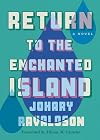
Return to the Enchanted Island
by Johary Ravaloson
On This Page
Description
"Named after the first man at the creation of the world in Malagasy mythology, Ietsy Razak was raised to perpetuate the glory of his namesake and expected to be as illuminated as his Great Ancestor. But in the chaos of modernity, his young life is marked only by restlessness, maddening insomnia, and an adolescent apathy.When an unexpected tragedy ships him off to a boarding school in France, his trip to the big city is no hero's journey. Ietsy loses himself in the immediate pleasures of body show more and mind. Weighed down by his privilege and the legacy of his name, Ietsy struggles to find a foothold.Only a return to the "Enchanted Island," as Madagascar is lovingly known, helps Ietsy stumble toward his destiny. This award-winning retelling of Madagascar's origin story offers a distinctly twenty-first-century perspective on the country's place in an ever-more-connected world. "--Provided by publisher. show lessTags
Recommendations























Member Reviews
The novel slips between the main character's present, his childhood and young adulthood, and Malagasi history and mythology. It's not always clear (to me at least) what parallels or meaning one is intended to draw between these parts, which sit somewhat separately above the surface, presumably joined beneath it. Which is to say, I suppose, that this is a book which requires some work of the reader, and that's not necessarily a bad thing.
Water, its ebb and flow, its concealing and guarding nature, and its ability to be both a barrier and a facilitator of journeying is something of a theme, particularly in the mythological sections, and which must (I again presume) have meaning in the main character's life story, named as he is, Ietsy, show more after the first created human.
What I took from it was that our birth culture shapes us, and that while we can rebel and turn from that, to recreate ourselves in our own imagined image, or in the image we absorb from the wider world, we will find more peace in accepting ourselves as formed from that earlier cultural matrix, that we can take responsibility for what it has given to and taken #from us and those around us with a guiltless acceptance. show less
Water, its ebb and flow, its concealing and guarding nature, and its ability to be both a barrier and a facilitator of journeying is something of a theme, particularly in the mythological sections, and which must (I again presume) have meaning in the main character's life story, named as he is, Ietsy, show more after the first created human.
What I took from it was that our birth culture shapes us, and that while we can rebel and turn from that, to recreate ourselves in our own imagined image, or in the image we absorb from the wider world, we will find more peace in accepting ourselves as formed from that earlier cultural matrix, that we can take responsibility for what it has given to and taken #from us and those around us with a guiltless acceptance. show less
The concept of the novel wasn’t entirely clear to me. I’ve never been drawn to stories where the main characters, thanks to inherited wealth, are spared the need to fight for their livelihood. These characters are often given endless room to “explore their complex psyches” over hundreds of pages, which I find unengaging. Unfortunately, Return to the Enchanted Island falls squarely into this category. At the center of the novel is a pampered heir from a wealthy Malagasy family, and the narrative revolves around his romantic entanglements—his triumphs and disappointments—mostly set in France. The character’s inner conflict seems to stem from reconciling his personal desires with the expectations placed upon him by his show more lineage, which hardly struck me as compelling.
Given the novel’s title, I expected Madagascar to play a much more prominent role in the story. I had hoped for a deeper immersion into the country’s culture. Instead, the most distinctive Malagasy elements were awkwardly inserted fragments of island folklore, loosely connected to the protagonist and his emotional journey. show less
Given the novel’s title, I expected Madagascar to play a much more prominent role in the story. I had hoped for a deeper immersion into the country’s culture. Instead, the most distinctive Malagasy elements were awkwardly inserted fragments of island folklore, loosely connected to the protagonist and his emotional journey. show less
A modern take on the origin story of the Malagasy people. Told in flashbacks, this is the story of affluent Ietsy, named for his people's mythic ancestor and his, implicit, reincarnation. The style is complex but beautiful, with many dreamlike passages and interesting place names. Although the middle portion of the novel is set in France, the Malagasy feel is constant throughout since the mythological, dreamy parts are continuous. It was a little hard to get into, because of style, but it picked up very soon and ended up being an enjoyable read.
Return to the Enchanted Island might have worked better for me if I had more familiarity with the culture and mythology of Madgascar. As it was, though, I bounced fairly hard off this. While Johary Ravaloson occasionally conjures up some striking imagery, he's a bit too prone to obscure allegory. The protagonist Ietsy is also one of my least favourite kinds of anti-hero: an immature, unlikeable man who has incredibly beautiful women throw themselves at him for no apparent reason.
Extremely subtle tie between the island’s mythology and the story of the up and coming ruler/playboy of #Madagascar makes me wonder: was it me, the translation, or did this just make little sense? Both the author and translator have won awards so it must be me. I’m not sure what I was reading half the time. Saved from a pan thanks to the story of the wife who settled the wealthy-beyond-words playboy down. Now she was admirable.
Suffering from insomnia, Iesty Razak passes the nights looking back over his privileged life as a member of Madagascar's hereditary elite and the derivation of his status from the island's legendary history.
The shifts in the timeline and between Iesty's life and the legendary past were not always easy to follow and I definitely felt that I could have done with more background context.
The shifts in the timeline and between Iesty's life and the legendary past were not always easy to follow and I definitely felt that I could have done with more background context.
DNF after 20% in. It wasn't horrible but I didn't care about the main character. I really wanted to learn more about Madagascar but I only learned about a selfish young man.
Members
- Recently Added By
Lists

Books Read in 2022
5,166 works; 114 members

Madagascar
21 works; 2 members
Author Information

4+ Works 144 Members
Some Editions
Awards and Honors
Notable Lists
Common Knowledge
- Canonical title
- Return to the Enchanted Island
- Original title
- Les larmes d’Ietsé
- Original publication date
- 2012
- People/Characters
- Ietsy Razak; Lea-Nour; Mr. Razak; Ranavolana I; Ninon; Arthur (show all 15); Jeannie; Néness; Charlie; Uncle Jean; Aunt Christiane; Boris; Marc; Caroline; Helen Jones
- Important places
- Madagascar; Atananarivo, Madagascar; Anosisoa, Madagascar; France; Paris, France; Saint-Malo, Ille et Vilaine, Brittany, France (show all 8); Antsirabe, Madagascar; Versailles, Île-de-France, France
- Epigraph
- Only two things really matter—there’s love, every kind of love, with every kind of pretty girl; and there’s the music of Duke Ellington, or traditional jazz.
Everything else can go, because all the rest is ... (show all)ugly—and the few pages which follow as an illustration of this draw their entire strength from the fact that the story is completely true since I made it up from beginning to end.
Boris Vian
Foreword to Mood Indigo
1947
Translated by Stanley Chapman - First words
- For some time now, even though there was likely nothing that should have disturned his nights, Ietsy would wake up.
- Last words
- (Click to show. Warning: May contain spoilers.)Enchanted as Ietsy was, buried in the land of his children.
- Original language
- French
Classifications
Statistics
- Members
- 139
- Popularity
- 235,234
- Reviews
- 11
- Rating
- (2.65)
- Languages
- English
- Media
- Paper, Audiobook, Ebook
- ISBNs
- 3
- ASINs
- 3