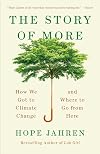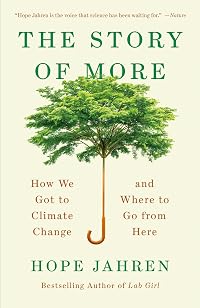
The Story of More: How We Got to Climate Change and Where to Go from Here
by Hope Jahren
On This Page
Description
"Hope Jahren is an award-winning geobiologist, a brilliant writer, and one of the seven billion people with whom we share this earth. The Story of More is her impassioned open letter to humanity as we stand at the crossroads of survival and extinction. Jahren celebrates the long history of our enterprising spirit--which has tamed wild crops, cured diseases, and sent us to the moon--but also shows how that spirit has created excesses that are quickly warming our planet to dangerous levels. In show more short, highly readable chapters, she takes us through the science behind the key inventions--from electric power to large-scale farming and automobiles--that, even as they help us, release untenable amounts of carbon dioxide into the atmosphere. She explains the current and projected consequences of greenhouse gases--from superstorms to rising sea levels--and shares the science-based tools that could help us fight back. At once an explainer on the mechanisms of warming and a capsule history of human development, The Story of More illuminates the link between our consumption habits and our endangered earth. It is the essential pocket primer on climate change that will leave an indelible impact on everyone who reads it."-- show lessTags
Recommendations











Member Reviews
I enjoyed the interplay between Jahren's personal stories of growing up in Minnesota with the stark facts of the climate emergency we face. Unfortunately, Jahren painted an overly favorable picture of the American agricultural system, praising the increases in crop and meat production, without highlighting the detrimental impact of the chemical fertilizer/pesticide cycle and soil degradation associated with monoculture. It seemed very light on systemic criticism, while putting the onus of action on the shoulders of the individual, which is exactly what polluting industries have always done (calling on Americans not to litter, instead of altering their packaging).
I loved Jahren's first book Lab Girl, and I am delighted to report that this book may just be better. Jahren uses a combination of data and nostalgia for an America past to explain how what we do impacts the environment. This is certainly not my first book about the destruction of the planet, but it is my first book that 1) did not feel like eating my peas; 2) I truly enjoyed, and 3) convinced me to make a couple minor changes, effective immediately, to help chip away at the outsize portion of the planet's natural resources the US consumes.
Lately I keep hearing the "it doesn't matter what I do, the vast majority of environmental impact comes from industry" excuse for doing nothing. Well that is certainly true that industry has the show more largest share of the blame, but industry is serving you - your choices change industry behavior. A gallon of gas moves the average commercial plane about 400 feet. Yes, that shocked me too. So if people cut down on air travel the airlines and Boeing/Airbus will start to spend on planes that do a better job, just as the oil embargo of the 70s made car companies work on mpg (which they abandoned because when gas prices went down American decided they needed Yukons more than they needed a planet for their grandchildren. The two things that really struck me were the impact of air travel, and the clear and unbending limitations on wind and solar and the cosmic joke of ethanol and biodiesel. (I knew about ethanol, you don't live in North Dakota without getting a pretty clear understanding of what ethanol is, and how much cropland it requires to get a gallon of the stuff and also the impact on air and water of manufacturing what is essentially moonshine for cars.)
Anyway, my point is this is a pleasure to read, and it is broken down in an uncondescending way so that I the reader truly understood this complicated matter, immediate and future impacts included, and also what we can do to help, though Jahren is clear it might be too late already. This is not fear mongering, it is honest and helpful and lovely. show less
Lately I keep hearing the "it doesn't matter what I do, the vast majority of environmental impact comes from industry" excuse for doing nothing. Well that is certainly true that industry has the show more largest share of the blame, but industry is serving you - your choices change industry behavior. A gallon of gas moves the average commercial plane about 400 feet. Yes, that shocked me too. So if people cut down on air travel the airlines and Boeing/Airbus will start to spend on planes that do a better job, just as the oil embargo of the 70s made car companies work on mpg (which they abandoned because when gas prices went down American decided they needed Yukons more than they needed a planet for their grandchildren. The two things that really struck me were the impact of air travel, and the clear and unbending limitations on wind and solar and the cosmic joke of ethanol and biodiesel. (I knew about ethanol, you don't live in North Dakota without getting a pretty clear understanding of what ethanol is, and how much cropland it requires to get a gallon of the stuff and also the impact on air and water of manufacturing what is essentially moonshine for cars.)
Anyway, my point is this is a pleasure to read, and it is broken down in an uncondescending way so that I the reader truly understood this complicated matter, immediate and future impacts included, and also what we can do to help, though Jahren is clear it might be too late already. This is not fear mongering, it is honest and helpful and lovely. show less
A spoonful of sugar helps the medicine go down is a concise description of The Story of More. Hope Jahren has written a passionate, direct and searing indictment of what Man has made of this planet in just her lifetime (She repeats at least 20 times she was born in 1969). And yet, every chapter (there are 19) begins with a nostalgic look at her childhood in Minnesota, her parents, family rituals, and life at that time. She had a pet chunk of ice she named Covington that she kicked all the way to school and back all winter. The book is a wonderfully odd combination of warm, fuzzy memories and stark, fraught trends and stats, that do not portend good things to come.
Minnesota and her later home in Iowa have changed dramatically over her show more lifetime. The increased amount of corn per acre is stunning, but pales before the amount of fertilizer and pesticides used to get those better yields. She says we have pushed plants to produce as much as they physically can, and where we go for more is unfathomable. Not that we make good use of it. About 20% is simply burned up in biofuels, and most of it goes to feed domesticated animals for meat. The amount actually consumed as food comes dead last. She backs it up with figures, both global and American, that demonstrate the really poor connection between then and now. (She lists them all again at the end, because frankly, it's all very hard to believe one at a time.)
Americans eat 15% more food today. It shows. They throw out 40% of the food they buy, enough to feed all the undernourished in the rest of the world. By 2004, Americans were consuming a pound and a half of sugar - a week. In sum, Americans, who make up 4% of the global population, consume 15% of the food, 15% of the energy and 20% of the electricity in the world. If the rest of mankind were to the rise to that level - the world could simply not work.
Already, half the fish we eat are farmed because there aren't enough left in the wild. The amount of excrement they produce is way more than the oceans can deal with. Similarly, cattle and our other domesticated animals produce 300 million tons of feces a year, far in excess of the amount humans produce as a result of eating them. It's not a beneficial tradeoff. To make that manure, those animals consume a billion tons of grain, in order to give consumers (just) 100 million pounds of meat. This math leads nowhere good, and Jahren soon switches from dispassionate scientist to frustration:
"The amount of fruits and vegetables that is wasted each year exceeds the annual food supply of fruit and vegetables for the whole continent of Africa. We live in an age when we can order a pair of tennis shoes from a warehouse on the other side of the planet and have them shipped to a single address in less than 24 hours; don't tell me that a global food distribution is impossible."
All this overconsumption seems to have done Americans no good. They are no happier now that they work more, eat more, drive more, fly more and consume more. Quite the opposite, according to the figures. She says we need to consume less and share more. But neither of those are American values any more, and she has no stats for trends in sharing - just aspirations. More is a one way street, an addiction and a plague on the planet. Americans have yet to notice.
Meanwhile, there are (still) a billion people with no access to electricity.
Her 19 chapters cover the gamut from plastics to cars to species extinctions, passing through global warming and greenhouse gases. She has unkind words for both deniers and alarmists; neither is doing any good. She is all about reducing consumption, and concludes with how each individual American can reduce consumption and actually make a difference. "If we want to take action, we should get started while it still matters what we do."
David Wineberg show less
Minnesota and her later home in Iowa have changed dramatically over her show more lifetime. The increased amount of corn per acre is stunning, but pales before the amount of fertilizer and pesticides used to get those better yields. She says we have pushed plants to produce as much as they physically can, and where we go for more is unfathomable. Not that we make good use of it. About 20% is simply burned up in biofuels, and most of it goes to feed domesticated animals for meat. The amount actually consumed as food comes dead last. She backs it up with figures, both global and American, that demonstrate the really poor connection between then and now. (She lists them all again at the end, because frankly, it's all very hard to believe one at a time.)
Americans eat 15% more food today. It shows. They throw out 40% of the food they buy, enough to feed all the undernourished in the rest of the world. By 2004, Americans were consuming a pound and a half of sugar - a week. In sum, Americans, who make up 4% of the global population, consume 15% of the food, 15% of the energy and 20% of the electricity in the world. If the rest of mankind were to the rise to that level - the world could simply not work.
Already, half the fish we eat are farmed because there aren't enough left in the wild. The amount of excrement they produce is way more than the oceans can deal with. Similarly, cattle and our other domesticated animals produce 300 million tons of feces a year, far in excess of the amount humans produce as a result of eating them. It's not a beneficial tradeoff. To make that manure, those animals consume a billion tons of grain, in order to give consumers (just) 100 million pounds of meat. This math leads nowhere good, and Jahren soon switches from dispassionate scientist to frustration:
"The amount of fruits and vegetables that is wasted each year exceeds the annual food supply of fruit and vegetables for the whole continent of Africa. We live in an age when we can order a pair of tennis shoes from a warehouse on the other side of the planet and have them shipped to a single address in less than 24 hours; don't tell me that a global food distribution is impossible."
All this overconsumption seems to have done Americans no good. They are no happier now that they work more, eat more, drive more, fly more and consume more. Quite the opposite, according to the figures. She says we need to consume less and share more. But neither of those are American values any more, and she has no stats for trends in sharing - just aspirations. More is a one way street, an addiction and a plague on the planet. Americans have yet to notice.
Meanwhile, there are (still) a billion people with no access to electricity.
Her 19 chapters cover the gamut from plastics to cars to species extinctions, passing through global warming and greenhouse gases. She has unkind words for both deniers and alarmists; neither is doing any good. She is all about reducing consumption, and concludes with how each individual American can reduce consumption and actually make a difference. "If we want to take action, we should get started while it still matters what we do."
David Wineberg show less
I loved this book way more than I anticipated. I strapped in for a depressing, long and boring treatise on the end of the world. Instead, I was treated to Jahren's cozy and slightly weird style, short chapters with just enough information to make you go, "Really? I want to read more!" and an ending that leaves you flipping off light switches...until you get to the line where she literally writes that flipping off light switches isn't going to do much good.
And yet, after a surprisingly humorous look at such global devastation, Jahren gives us hope by reminding us that we are not much different than our ancestors who also faced horrific struggles with limited information and leaves us with practical steps that make an impact.
Highly show more recommend, especially for young adults as this is a great introduction to climate science. show less
And yet, after a surprisingly humorous look at such global devastation, Jahren gives us hope by reminding us that we are not much different than our ancestors who also faced horrific struggles with limited information and leaves us with practical steps that make an impact.
Highly show more recommend, especially for young adults as this is a great introduction to climate science. show less
Much as Michael Pollan's book In Defense of Food can be boiled down to "Eat Food. Not too much. Mostly plants," Jahren's book could be encapsulated by her phrase USE LESS AND SHARE MORE. (88) A researcher and scientist, she provides ample evidence, and presents it in ways the average reader can understand. Quite simply, many of us are using and consuming far more than our fair share of everything - food and energy, particularly - while others are starving and suffering. This is not due to "Earth's inability to provide," but "our inability to share." Jahren offers solutions on a individual and societal level, but there's no silver bullet that will avert (further) climate change without some sacrifice for many of us who have grown show more accustomed to MORE rather than ENOUGH.
See also: The Sixth Extinction by Elizabeth Kolbert; How to Be A Conscious Eater by Sophie Egan; Losing Earth by Nathaniel Rich
Quotes/Notes
...societies that feature a low gender gap are also populated by women who give birth, on average, half as often as women who live in societies with a high gender gap....It makes sense that the most effective and long-lasting mechanism for curbing global population growth revolves around an elimination of gender inequality.
These data also imply that closing the gender gap around the world would likely result in something near replacement-level fertility...(12-13)
...most of the want and suffering that we see in our world today originates not from Earth's inability to provide but from our inability to share... (14)
avg. # global deaths/yr due to war: 50,000
homicide: 500,000
suicide: 800,000 (50,000 in America)
Every year, the world over, about 1 percent of the population becomes sick and dies. (18)
Cities...hold half the world's population, but they are...distributed very unevenly around the world. (21)
The fact that GMO plants have laboratory-altered DNA does not make them dangerous for human consumption....The problem with GMOs is [the small number of companies with an effective monopoly over the seeds][same companies that make and sell pesticides]. (36)
The production of meat requires a tremendous investment of resources [fresh water, antibiotics - most of which pass through the animals unabsorbed and make it into farm runoff - and grain]. (48)
If the entire OECD adopted the habit of just one meatless day per week, and extra 120 million tons of grain would be available to feed the hungry this very year....
Starvation is caused by our failure to share what we produce, not by the earth's ability to provide. (50)
[Aquaculture] At present, about one-third of the total catch fished out of the ocean is ground up into fish meal and then fed to fish that live in pens. (59)
Most of the rapid increase in sugar consumption between 1962 and 2000 came not in the form of food but as beverages: sodas, sports drinks, fruit punch, and lemonade. (67)
The steep increase in [high fructose corn syrup] consumption from basically nothing during the 1970s up to almost 10 percent of total calories by the year 2000 has closely coincided with Americans' sharp increase in weight over the same several decades... (69)
America...makes up 4 percent of the world's population, generates 15 percent of the world's organic waste. (76)
Americans make up 4% of the world's population but consume 15% of the world's energy production and almost 20% of the world's electricity. (83)
India and Sub-Saharan Africa...make up one-third of the world's population but consume less than 10 percent of the world's electricity. (87)
If all fuel and electricity in use today were redistributed equally to each of the seven-plus billion people on planet Earth, each person's energy use could be equal to the average consumed by people living in Switzerland during the 1960s. (88)
--If...the countries of North America, Europe, Japan, Australia, and New Zealand reduced their energy use to that level now, total global energy use would plummet by at least 20 percent, as would carbon dioxide emissions. (168)
The U.S. has witnessed a conspicuous divestment in its railroads during the last two decades [and the rail system was not robust to start with]. (93)
...only five percent of Americans use any kind of public transportation on a daily basis. (95)
America thoroughly offset any oil independence it could have gained from the miracle of renewed fuel efficiency during the 1970s and 1980s by doubling down, making more automobiles, and proceeding to use them harder. (99)
..the lack of overlap between where fossil fuels are found [the Middle East] and where they are used [OECD countries]. (105)
-the majority of plastic produced each year is consumed as disposable packaging
-more than 90% of plastic goes into a landfill, not recycling
-10% of the plastic we throw away gets into the ocean (112)
Hydroelectric power plants generate 18% of the world's electricity; wind-powered electricity generates less than 4% of the total electricity consumed around the world in a year. (117)
I do believe that renewable energy is part of the Use Less and Share More solution and that there is room to meet in the middle of using less electricity while making a larger fraction of it from water, wind, and sun [but the necessary metals for the turbines and batteries come from only two countries, Chile and Peru]. (122)
Since 1880, the average height of global sea level has gone up by more than seven inches. More than half of this rise has occurred since...1969, which means that global sea level has not only risen, the process of rise is accelerating. (149)
At present, one-quarter of the earth's population lives less than sixty miles from the coastal ocean....Bangladesh lies just barely above sea level....the people benefiting from the use of fossil fuels are not the people who suffer the most from its excess. (151)
[Sixth extinction causes: (1) loss of habitat, (2) climate change] (159-160
Since the first Europeans showed up, North and South America have lost 88 percent of their tropical forests, 90 percent of their coral reefs, and 95 percent of their tall-grass prairies. The species that were adapted to those niches have all but vanished now. (159)
Regarding the crisis in species decline, nothing has been shown to prevent extinctions so well as simply protecting habitats by preventing human access and development. (167)
Look at your own life: Can you identify the most energy-intensive thing that you do? Are you willing to change? We will never change our institutions if we cannot change ourselves....It is precisely because no single solution will save us that everything we do matters. (172)
The people of the OECD, while representing only one-sixth of the global population, use one-third of the world's energy and half the world's electricity and are responsible for one-third of the world's carbon dioxide emissions....the OECD consumes one-third of the world's meat as well as one-third of the world's sugar. (185) show less
See also: The Sixth Extinction by Elizabeth Kolbert; How to Be A Conscious Eater by Sophie Egan; Losing Earth by Nathaniel Rich
Quotes/Notes
...societies that feature a low gender gap are also populated by women who give birth, on average, half as often as women who live in societies with a high gender gap....It makes sense that the most effective and long-lasting mechanism for curbing global population growth revolves around an elimination of gender inequality.
These data also imply that closing the gender gap around the world would likely result in something near replacement-level fertility...(12-13)
...most of the want and suffering that we see in our world today originates not from Earth's inability to provide but from our inability to share... (14)
avg. # global deaths/yr due to war: 50,000
homicide: 500,000
suicide: 800,000 (50,000 in America)
Every year, the world over, about 1 percent of the population becomes sick and dies. (18)
Cities...hold half the world's population, but they are...distributed very unevenly around the world. (21)
The fact that GMO plants have laboratory-altered DNA does not make them dangerous for human consumption....The problem with GMOs is [the small number of companies with an effective monopoly over the seeds][same companies that make and sell pesticides]. (36)
The production of meat requires a tremendous investment of resources [fresh water, antibiotics - most of which pass through the animals unabsorbed and make it into farm runoff - and grain]. (48)
If the entire OECD adopted the habit of just one meatless day per week, and extra 120 million tons of grain would be available to feed the hungry this very year....
Starvation is caused by our failure to share what we produce, not by the earth's ability to provide. (50)
[Aquaculture] At present, about one-third of the total catch fished out of the ocean is ground up into fish meal and then fed to fish that live in pens. (59)
Most of the rapid increase in sugar consumption between 1962 and 2000 came not in the form of food but as beverages: sodas, sports drinks, fruit punch, and lemonade. (67)
The steep increase in [high fructose corn syrup] consumption from basically nothing during the 1970s up to almost 10 percent of total calories by the year 2000 has closely coincided with Americans' sharp increase in weight over the same several decades... (69)
America...makes up 4 percent of the world's population, generates 15 percent of the world's organic waste. (76)
Americans make up 4% of the world's population but consume 15% of the world's energy production and almost 20% of the world's electricity. (83)
India and Sub-Saharan Africa...make up one-third of the world's population but consume less than 10 percent of the world's electricity. (87)
If all fuel and electricity in use today were redistributed equally to each of the seven-plus billion people on planet Earth, each person's energy use could be equal to the average consumed by people living in Switzerland during the 1960s. (88)
--If...the countries of North America, Europe, Japan, Australia, and New Zealand reduced their energy use to that level now, total global energy use would plummet by at least 20 percent, as would carbon dioxide emissions. (168)
The U.S. has witnessed a conspicuous divestment in its railroads during the last two decades [and the rail system was not robust to start with]. (93)
...only five percent of Americans use any kind of public transportation on a daily basis. (95)
America thoroughly offset any oil independence it could have gained from the miracle of renewed fuel efficiency during the 1970s and 1980s by doubling down, making more automobiles, and proceeding to use them harder. (99)
..the lack of overlap between where fossil fuels are found [the Middle East] and where they are used [OECD countries]. (105)
-the majority of plastic produced each year is consumed as disposable packaging
-more than 90% of plastic goes into a landfill, not recycling
-10% of the plastic we throw away gets into the ocean (112)
Hydroelectric power plants generate 18% of the world's electricity; wind-powered electricity generates less than 4% of the total electricity consumed around the world in a year. (117)
I do believe that renewable energy is part of the Use Less and Share More solution and that there is room to meet in the middle of using less electricity while making a larger fraction of it from water, wind, and sun [but the necessary metals for the turbines and batteries come from only two countries, Chile and Peru]. (122)
Since 1880, the average height of global sea level has gone up by more than seven inches. More than half of this rise has occurred since...1969, which means that global sea level has not only risen, the process of rise is accelerating. (149)
At present, one-quarter of the earth's population lives less than sixty miles from the coastal ocean....Bangladesh lies just barely above sea level....the people benefiting from the use of fossil fuels are not the people who suffer the most from its excess. (151)
[Sixth extinction causes: (1) loss of habitat, (2) climate change] (159-160
Since the first Europeans showed up, North and South America have lost 88 percent of their tropical forests, 90 percent of their coral reefs, and 95 percent of their tall-grass prairies. The species that were adapted to those niches have all but vanished now. (159)
Regarding the crisis in species decline, nothing has been shown to prevent extinctions so well as simply protecting habitats by preventing human access and development. (167)
Look at your own life: Can you identify the most energy-intensive thing that you do? Are you willing to change? We will never change our institutions if we cannot change ourselves....It is precisely because no single solution will save us that everything we do matters. (172)
The people of the OECD, while representing only one-sixth of the global population, use one-third of the world's energy and half the world's electricity and are responsible for one-third of the world's carbon dioxide emissions....the OECD consumes one-third of the world's meat as well as one-third of the world's sugar. (185) show less
This 7-hour audiobook was another climate change warning but the only one (so far) that has left me feeling serene and content. Perhaps it was the narration in her soothing voice. It certainly didn't add any new hope, since her solution is for us all to reduce consumption and share. I've been doing that for years, whatever I can, while watching other Americans' wasteful behavior with astonishment.
All climate change books end with hope. ("There's still more time!") No, there's not. I'm a cynic. I don't believe it. Especially when, in the midst of obvious heat waves, fires, floods, and tornadoes, Americans (who are the highest CO2 emitters) are still not slowing down. In fact, yesterday, the Sunday after Thanksgiving, when everyone and show more his brother were heading home after the holiday, the airline industry broke all records.
Still, I'm glad I listened to this book. I liked her calm writing and now look forward to her "Lab Girl."
Recommended. show less
All climate change books end with hope. ("There's still more time!") No, there's not. I'm a cynic. I don't believe it. Especially when, in the midst of obvious heat waves, fires, floods, and tornadoes, Americans (who are the highest CO2 emitters) are still not slowing down. In fact, yesterday, the Sunday after Thanksgiving, when everyone and show more his brother were heading home after the holiday, the airline industry broke all records.
Still, I'm glad I listened to this book. I liked her calm writing and now look forward to her "Lab Girl."
Recommended. show less
Having hope requires courage.~from The Story of More by Hope Jahren
Succinct, well organized, and with a powerful narrative that is engrossing and accessible, The Story of More crunches down what I have read in numerous books into 224 pages.
Author Hope Jahren, author of the best-selling memoir Lab Girl, based the book on her climate change classes.
"All of this has convinced me that it's time to bring global change out of my classroom and into this book," Jahren writes in the introduction. "So if you'll listen, I'll tell you what happened to my world, to your world--to our world. It changed."
She starts at the very beginning--the fact that humans are on this earth and that our population is continually growing. Following a logical show more narrative, Jahren covers how we get our food and our growing energy use and the changes we have wrought on earth.
Along the way she points out that we have enough of everything but it is not shared equitably. Millions live without enough food, clean water and other things some of us take for granted. And millions of us spend money on things we don't need, wasting the clean water and energy available.
Scientists have been aware for nearly my entire lifetime that our dependence on fossil fuels was a problem. We have seen the environmental damage caused by human activity, including factory farms and our dependence on gasoline fueled cars and air travel. We know that the sea level is rising and glaciers and the polar ice caps are melting.
Jahren concludes with actions we can all take.
First, we must determine our personal values. Learn what you can about what you value. Are your personal activities in line with those values? What about your personal investments--are they in line with your values? How we spend our money and how we invest our money should reflect what we believe. Share your values with institutions to pressure change.
Americans can make a huge impact. Every step we take to limit our energy use and reduce our consumption makes an impact. We can't give up. We can do with less.
Do not be seduced by lazy nihilism.~ from The Story of More by Hope Jahren
I received a free ebook from the publisher through NetGalley in exchange for a fair and unbiased review. show less
Succinct, well organized, and with a powerful narrative that is engrossing and accessible, The Story of More crunches down what I have read in numerous books into 224 pages.
Author Hope Jahren, author of the best-selling memoir Lab Girl, based the book on her climate change classes.
"All of this has convinced me that it's time to bring global change out of my classroom and into this book," Jahren writes in the introduction. "So if you'll listen, I'll tell you what happened to my world, to your world--to our world. It changed."
She starts at the very beginning--the fact that humans are on this earth and that our population is continually growing. Following a logical show more narrative, Jahren covers how we get our food and our growing energy use and the changes we have wrought on earth.
Along the way she points out that we have enough of everything but it is not shared equitably. Millions live without enough food, clean water and other things some of us take for granted. And millions of us spend money on things we don't need, wasting the clean water and energy available.
Scientists have been aware for nearly my entire lifetime that our dependence on fossil fuels was a problem. We have seen the environmental damage caused by human activity, including factory farms and our dependence on gasoline fueled cars and air travel. We know that the sea level is rising and glaciers and the polar ice caps are melting.
Jahren concludes with actions we can all take.
First, we must determine our personal values. Learn what you can about what you value. Are your personal activities in line with those values? What about your personal investments--are they in line with your values? How we spend our money and how we invest our money should reflect what we believe. Share your values with institutions to pressure change.
Americans can make a huge impact. Every step we take to limit our energy use and reduce our consumption makes an impact. We can't give up. We can do with less.
Do not be seduced by lazy nihilism.~ from The Story of More by Hope Jahren
I received a free ebook from the publisher through NetGalley in exchange for a fair and unbiased review. show less
Members
- Recently Added By
Lists

Climate Change
87 works; 7 members

Climate Change
50 works; 1 member

All About Climate Change: Resources for Teens
5 works; 1 member

Classroom Library
22 works; 1 member

Habitat Hero books
37 works; 1 member
Author Information

4 Works 3,849 Members
Some Editions
Awards and Honors
Distinctions
Little Free Library Action Book Club Selection (Middle Readers – In Our Nature)
Common Knowledge
- Original publication date
- 2020
- Epigraph
- The universe is change; our life is what our thoughts make it.—Marcus Aurelius Antoninus (A.D. 121–180)”
- Dedication
- For my mother
and
because of my father - First words
- Important men have been arguing about global change since before I was born.
- Quotations
- Pig's Eye, Minnesota (zip code 55102), is not as glamorous as it sounds.
We live in an age when we can order a pair of shoes from a warehouse on the other side of the planet and have them shipped to a single address in less than twenty-four hours; don't tell me that a global food redistribution is... (show all) impossible.
Let's assume, for the moment, that we have a choice. Now let's ask ourselves: Is this how we want to live?
We are using more and more energy, but we have begun to find other ways to get it besides fossil fuels. The magnitude of these "other ways" is no more than a layer of icing on top of a bigger and bigger piece of energy cake t... (show all)hat we eat each day. What we never seem to do is stop and ask ourselves if we really need dessert. We've put off that question again and again, while the refineries pulse and the world burns.
A series of disasters, including Three Mile Island in 1979 and Chernobyl in 1986, alerted us to the fact that nuclear power plants—like all technologies—are only as competent as whichever Homer Simpson is at the helm.
At today's rates of electricity consumption and generation, powering America using only hydropower would require fifty functioning Hoover Dams within each one of the fifty states of the Union. Powering America using only wind... (show all) power would require more than one million wind turbines, or one every mile or so across the whole of the continental United States. As for solar energy, a land area the size of South Carolina would have to be sacrificed to solar panels in order to generate America's annual diet of electricity.
In short, the carbon dioxide molecule has a unique shape that intercepts and then absorbs heat. Add just a little carbon dioxide to a chamber of air, then let the sun shine through it, and the whole thing will heat up much mo... (show all)re than a chamber without the extra carbon dioxide.
If there is something in the world nobler than a good dog, I have not yet encountered it.
About half of the global sea-level rise that has occurred during the last fifty years is due to water added to the ocean from melting glaciers. The other half of the sea-level rise is due to the warming of the ocean surface w... (show all)aters. The oceans have absorbed most of the heat trapped by the greenhouse warming, and seawater expands as it heats up. The average temperature of the ocean surface waters has warmed by more than one degree Fahrenheit over the last fifty years; more than three inches of the total global sea level rise came just from the swelling of a warmer ocean.
Our earth is unwell. We have all but used up the brief window when we can act, and we are running out of time. I know this because many of the things around us have already started to die.
America has become that unhappy couple who is mired in fights about the dishes and laundry because both partners are too terrified to earnestly examine any sort of change.
Extinctions are part of the natural course of action on planet Earth; a new food source or living space opens up, and this creates a niche.
All species will go extinct eventually, even our own: it is one of nature's few imperatives. As of today, however, that train has not quite left the station. We still have some control over our demise—namely, how long it wi... (show all)ll take and how much our children and grandchildren will suffer. If we want to take action, we should get started while it still matters what we do. - Last words
- (Click to show. Warning: May contain spoilers.)Our history books contain so much—extravagance and deprivation, catastrophe and industry, triumph and defeat—but they don't yet include us. Out before us stretches a new century, and its story is still unwritten. As every author will tell you, there is nothing more thrilling, or as daunting, as the possibilities that burst from a blank page.
- Blurbers
- E.O. Wilson; Elizabeth Kolbert
- Original language
- English
Classifications
- Genres
- Science & Nature, Nonfiction, General Nonfiction
- DDC/MDS
- 363.738 — Society, government, & culture Social problems and social services Public Safety - Police, Crime Investigation Environmental Issues - Pollution, Recycling, Global Warming Pollution Pollutants by source
- LCC
- QC903 .J37 — Science Physics Physics Meteorology. Climatology
- BISAC
Statistics
- Members
- 490
- Popularity
- 61,506
- Reviews
- 23
- Rating
- (4.07)
- Languages
- English, Spanish
- Media
- Paper, Audiobook, Ebook
- ISBNs
- 17
- ASINs
- 4