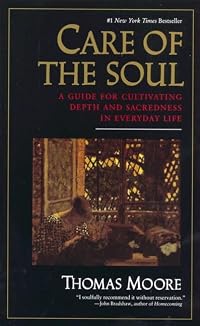
Care of the Soul: A Guide for Cultivating Depth and Sacredness in Everyday Life & Soul Mates : Honoring the Mysteries of Love and Relationship
by Thomas Moore
On This Page
Description
#1 New York Times Bestseller With a new introduction by the author and additional material, this 25th anniversary edition of the #1 New York Times bestseller by Thomas Moore provides a powerful spiritual message for our troubled times. In this special 25th anniversary edition of Thomas Moore's bestselling book Care of the Soul readers are presented with a revolutionary approach to thinking about daily life-everyday activities, events, problems and creative opportunities-and a therapeutic show more lifestyle is proposed that focuses on looking more deeply into emotional problems and learning how to sense sacredness in even ordinary things. Basing his writing on the ancient model of "care of the soul"-which provided a religious context for viewing the everyday events of life-Moore brings "care of the soul" into the 21st century. Promising to deepen and broaden the reader's perspective on his or her own life experiences, Moore draws on his own life as a therapist practicing "care of the soul," as well as his studies of the world's religions and his work in music and art, to create this inspirational guide that examines the connections between spirituality and the problems of individuals and society. show lessTags
Recommendations




































Member Reviews
Thomas Moore undertakes to define the soul, and the differences between spirituality and soul needs. This is not a "how to fix yourself" book. If you are looking for quick and simple directions on how to have a healthy soul, one, two, three, this is not the book for you. I think what he is trying to do, is to convince the reader first, that there is such a thing as soul, and second, how to define it and look for it in our daily lives.
I don't believe that I understood the half of this book, but that didn't stop me from enjoying it. In fact, I am keeping it because I want to return to it occasionally to examine passages again. The first few chapters were the most difficult for me. Moore gave some examples of how he helped people who came show more to him for therapy and related their experiences or behaviors to certain mythological figures. It is interesting, having read Robert Graves' The Greek Myths not long ago, to see the complete and utter opposite reading of them which Moore gives. Graves interprets them historically, Moore uses them as universal figures to define humanity and soul needs. They could both be right, and I suppose that is why the Myths have endured. This section of the book was difficult for me, because it seemed a bit woo-woo at times, and when Moore talked about his therapy techniques, well, if I were a patient, I would be frustrated because he isn't clear about how to overcome difficulties (which is his whole point), rather he encourages patients to explore them for soul food. Here is where I lack the ability to describe the contents. I will say though, that having read this book, I was able to gain a different perspective on some issues at work I am having with co-workers. It hasn't solved them. I can't "fix" them, however, something has shifted and the torment I was having has changed. Not gone, but viewed differently.
The chapters which resonated more with me were those near the end which defined "soul" and the differences between that and spirituality.
When the author speaks of faith, he isn't speaking of creeds or specific religions. He is speaking of the mysteries which move our souls. He says, if we allow ourselves none of those mysteries, we are denying a crucial element of our soul. For me, this can happen when I am examining some form of life or nature, whether plant, animal or mineral. Pondering its essence, its origin, its nature, its function, all of that creates awe in my heart, or my soul. The more I understand it, the more awe I experience, if I slow down and allow the awe to enter, and don't simply file away the facts in my brain, moving on to something else without pondering and giving way to the wonder. The author says even a mathematician can experience awe in their profession and the perfection or imperfection of numbers and equations. Whatever. ;)
I'm going to put some quotes here which I have underlined in the book for my own purposes.
"Care of the soul is a continuous process that concerns itself not so much with "fixing" a central flaw as with attending to the small details of everyday life, as well as to major decisions and changes."
"The way through the world is more difficult to find than the way beyond it." - Wallace Stevens in "Reply to Papini"
To sum up, the author encourages people to search for soul, to allow it room in their lives, through beauty, painful experiences, love and sorrow. His thought is that any of life's strong emotions, if allowed in and looked at with imagination, pondered and experienced, can feed soul. However, if we load ourselves down with "busy" work each and every day, if we focus only on the material aspects of life, if we don't use our imagination to look at problems, we are denying ourselves a deep part of our personhood and that leads to sickness and mental illness. show less
I don't believe that I understood the half of this book, but that didn't stop me from enjoying it. In fact, I am keeping it because I want to return to it occasionally to examine passages again. The first few chapters were the most difficult for me. Moore gave some examples of how he helped people who came show more to him for therapy and related their experiences or behaviors to certain mythological figures. It is interesting, having read Robert Graves' The Greek Myths not long ago, to see the complete and utter opposite reading of them which Moore gives. Graves interprets them historically, Moore uses them as universal figures to define humanity and soul needs. They could both be right, and I suppose that is why the Myths have endured. This section of the book was difficult for me, because it seemed a bit woo-woo at times, and when Moore talked about his therapy techniques, well, if I were a patient, I would be frustrated because he isn't clear about how to overcome difficulties (which is his whole point), rather he encourages patients to explore them for soul food. Here is where I lack the ability to describe the contents. I will say though, that having read this book, I was able to gain a different perspective on some issues at work I am having with co-workers. It hasn't solved them. I can't "fix" them, however, something has shifted and the torment I was having has changed. Not gone, but viewed differently.
The chapters which resonated more with me were those near the end which defined "soul" and the differences between that and spirituality.
When the author speaks of faith, he isn't speaking of creeds or specific religions. He is speaking of the mysteries which move our souls. He says, if we allow ourselves none of those mysteries, we are denying a crucial element of our soul. For me, this can happen when I am examining some form of life or nature, whether plant, animal or mineral. Pondering its essence, its origin, its nature, its function, all of that creates awe in my heart, or my soul. The more I understand it, the more awe I experience, if I slow down and allow the awe to enter, and don't simply file away the facts in my brain, moving on to something else without pondering and giving way to the wonder. The author says even a mathematician can experience awe in their profession and the perfection or imperfection of numbers and equations. Whatever. ;)
I'm going to put some quotes here which I have underlined in the book for my own purposes.
"Care of the soul is a continuous process that concerns itself not so much with "fixing" a central flaw as with attending to the small details of everyday life, as well as to major decisions and changes."
"The way through the world is more difficult to find than the way beyond it." - Wallace Stevens in "Reply to Papini"
To sum up, the author encourages people to search for soul, to allow it room in their lives, through beauty, painful experiences, love and sorrow. His thought is that any of life's strong emotions, if allowed in and looked at with imagination, pondered and experienced, can feed soul. However, if we load ourselves down with "busy" work each and every day, if we focus only on the material aspects of life, if we don't use our imagination to look at problems, we are denying ourselves a deep part of our personhood and that leads to sickness and mental illness. show less
Care of the soul is much neglected by the individual in our society and this neglect effects personal happiness, how we view relationships, and our feeling of fulfillment. Soul is who we are and soul is the prescription we need for our sicknesses and disorders of mind.
Moore, writing in 1992, definitely saw clearly the problems of the future: "One day I would like to make up my own DSM-III with a list of disorders I have seen in my practice. For example, I would want to include the diagnosis of Psychological Modernism, an uncritical acceptance of the values of the modern world. It includes blind faith in technology, inordinate attachment to material gadgets and conveniences, uncritical acceptance of the march of scientific progress, show more devotion to the electronic media, and a lifestyle dictated by advertising. This orientation towards life also tends toward a mechanistic and rationalistic understanding of matters of the heart. In this Modernist Syndrome, technology becomes the root metaphor for dealing with psychological problems."
Moore's many insights of 1992 have come true and society has clearly moved away from the soul and more towards technology. Technology is unavoidable but the call and tending of the soul is essential to being in balance and the pharmaceutical approach to treating mental problems is an abysmal failure. show less
Moore, writing in 1992, definitely saw clearly the problems of the future: "One day I would like to make up my own DSM-III with a list of disorders I have seen in my practice. For example, I would want to include the diagnosis of Psychological Modernism, an uncritical acceptance of the values of the modern world. It includes blind faith in technology, inordinate attachment to material gadgets and conveniences, uncritical acceptance of the march of scientific progress, show more devotion to the electronic media, and a lifestyle dictated by advertising. This orientation towards life also tends toward a mechanistic and rationalistic understanding of matters of the heart. In this Modernist Syndrome, technology becomes the root metaphor for dealing with psychological problems."
Moore's many insights of 1992 have come true and society has clearly moved away from the soul and more towards technology. Technology is unavoidable but the call and tending of the soul is essential to being in balance and the pharmaceutical approach to treating mental problems is an abysmal failure. show less
Although a best-seller in its day, time has not been kind to the writing in this book as today the prose sounds preachy, redundant, and too ethereal. It is part of the literary genre of existence as illness. As stated in the first sentence of the Introduction by Thomas Moore, "The great malady of the twentieth century, ... ", sees that century, or probably any century for that matter, and plain existence, as plagued and sick. Well, call me Ishmael too.
I was uncertain of the rating. I found the 1st third of the book to be quite well done and intriguing. The last half didn't appeal to me as much, but perhaps that is because his bias began to show. And because he reminded me of a conversation I didn't want to have and the person who made me have it anyway.
He's also a definite fan of Freud. I prefer ... not Freud most of the time. Not a favorite, but I will clearly acknowledge my bias.
He's also a definite fan of Freud. I prefer ... not Freud most of the time. Not a favorite, but I will clearly acknowledge my bias.
I read this book during my adult college days and it has become the focus or beginning point for me studying today's new spirituality. We are so far removed from the natural rhythm and the basics of life/living that we forget to just Be and remember what is truly vital and real to our experiences as human beings.
Thomas Moore is a deep, reverant person and his writings allow us to see the sacredness in our everyday beingg and give us the incentive to try and allow the sacred to emerge and be honored as it does so.
Thomas Moore is a deep, reverant person and his writings allow us to see the sacredness in our everyday beingg and give us the incentive to try and allow the sacred to emerge and be honored as it does so.
I found a lot of interesting, thought-provoking stuff here, as witnessed by the number of flags I have stuck in my copy to mark notable passages. I had to read it relatively slowly in order to absorb it (and occasionally because I hit a chapter that wasn't as compelling, especially those that focused on applying Greek myths to psychology, which was a cool concept but felt a bit forced in places).
I especially liked the sections on the role of arts/beauty and religion in the development of soul, and on depression.
I especially liked the sections on the role of arts/beauty and religion in the development of soul, and on depression.
I read this book years ago but I frequently remember stories and examples from it. One of the major insights that I gained from Thomas Moore is that there is a value to depression/sadness and that the only way out of it is to really go into it. I feel that reading this book helped me to deal with many events that came afterwards in a much more present way. There's much more to be said about this book but I've have to re-read it first!
Members
- Recently Added By
Lists

Recommend the 20 best books you've read in the last five years
2,168 works; 606 members

Books Read in 2014
2,342 works; 89 members

Books mentioned in bell hooks' All About Love
70 works; 1 member
Author Information

45+ Works 9,420 Members
Thomas Moore, Ph.D., wrote the phenomenal bestsellers Care of the Soul and SoulMates as well as many other successful books. Moore was a Catholic monk for twelve years and later became a psychotherapist, earning degrees in theology, musicology, and religion. Moore now lectures extensively throughout North America. He lives with his wife and their show more two children in New Hampshire show less
Awards and Honors
Distinctions
Common Knowledge
- Canonical title
- Care of the Soul: A Guide for Cultivating Depth and Sacredness in Everyday Life & Soul Mates : Honoring the Mysteries of Love and Relationship
- Original publication date
- 1992
- First words
- The great malady of the twentieth century, implicated in all of our troubles and affecting us individually and socially, is "loss of soul."
- Last words
- (Click to show. Warning: May contain spoilers.)Soul coalesces into the mysterious philosophers' stone, that rich, solid core of personality the alchemists sought, or it opens into the peacock's tail—a revelation of the soul's colors and a display of its dappled brilliance.
- Blurbers
- Bradshaw, John; Keen, Sam; Hillman, James; Nouwen, Henri; Dossey, Larry; Sardello, Robert (show all 7); Berends, Polly Berrien
Classifications
- Genres
- Religion & Spirituality, Nonfiction, Philosophy, General Nonfiction
- DDC/MDS
- 158.1 — Philosophy and Psychology Psychology Applied psychology Personal improvement and analysis
- LCC
- BL624 .M663 — Philosophy, Psychology and Religion Religions. Mythology. Rationalism Religions. Mythology. Rationalism Religious life
- BISAC
Statistics
- Members
- 3,756
- Popularity
- 4,225
- Reviews
- 29
- Rating
- (3.84)
- Languages
- 6 — Dutch, English, French, Italian, Norwegian (Bokmål), Spanish
- Media
- Paper, Audiobook, Ebook
- ISBNs
- 38
- UPCs
- 1
- ASINs
- 21