On This Page
Description
"In the present, Sacha knows the world's in trouble. Her brother Robert just is trouble. Their mother and father are having trouble. Meanwhile, the world's in meltdown--and the real meltdown hasn't even started yet. In the past, a lovely summer. A different brother and sister know they're living on borrowed time. This is a story about people on the brink of change. They're family, but they think they're strangers. So: Where does family begin? And what do people who think they've got nothing show more in common have in common? Summer"-- show lessTags
Recommendations
















Member Reviews
Sacha is a precocious teenager moved by the plight of the environment, both physical and social. Her younger brother, Robert, is even more precocious. He is moved by reading about Einstein, and curiously, his ties with his sister, whom he somewhat tortures. Their parents are separated but living next door to each other. They took opposing sides in the Brexit vote and, rather like Britain and Europe, they remain adjacent even after they leave. (A bit on the nose there, but that’s okay.) Charlotte and Arthur are rather like brother and sister, though they were once much more. Their connection to Sacha and Robert is at first tenuous but they become ever more entangled. And their entanglements will lead them to Daniel, who is now one show more hundred and four years old. But he too once had a sister, now lost in the mists of time.
If the plot of this novel begins to sound excruciatingly straightforward — teenage siblings meet adult near-siblings who take them to meet an ancient remainder of a sibling pair — then I’m not telling it right. For in fact everything here is connected to everything else (perhaps unsurprisingly in Einstein’s connected universe). And the reader is left to just raft along in the wake of Ali Smith’s indefatigable wordplay and enthusiasms. What always surprises me is how this doesn’t become tiring or tiresome. Ali Smith must just have the right lightness of touch.
Of course, this fourth “seasonal” novel from Smith is as much in tune with the zeitgeist as the other three in the set. Here we have abusive internment of migrants, a pandemic whose response is being bungled, the looming precipice of Brexit, and a long hot summer ahead (for all of us). From anyone else I’d shun their loquacious modishness. But here, again, it (mostly) works.
Gently recommended. show less
If the plot of this novel begins to sound excruciatingly straightforward — teenage siblings meet adult near-siblings who take them to meet an ancient remainder of a sibling pair — then I’m not telling it right. For in fact everything here is connected to everything else (perhaps unsurprisingly in Einstein’s connected universe). And the reader is left to just raft along in the wake of Ali Smith’s indefatigable wordplay and enthusiasms. What always surprises me is how this doesn’t become tiring or tiresome. Ali Smith must just have the right lightness of touch.
Of course, this fourth “seasonal” novel from Smith is as much in tune with the zeitgeist as the other three in the set. Here we have abusive internment of migrants, a pandemic whose response is being bungled, the looming precipice of Brexit, and a long hot summer ahead (for all of us). From anyone else I’d shun their loquacious modishness. But here, again, it (mostly) works.
Gently recommended. show less
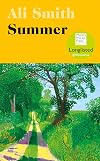
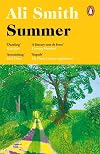
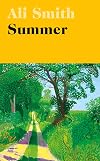
The fourth and — regrettably — last in Ali Smith's wonderful exercise in writing about the world in (almost) real time, her "Seasonal Quartet". Everything's here as we would wish: the fourth in the series of Hockney paintings of a lane in the Yorkshire Wolds; a Dickens novel (David Copperfield this time); a Shakespeare play (less predictably, it's The winter's Tale!); a forgotten artist we should have known about but didn't (Italian painter, film-maker and novelist Lorenza Mazzetti); and an unexpected footnote of history: Einstein in Norfolk.
And of course, in the foreground, there is all the improbable nastiness of the world we find ourselves in: the Virus, of course, and his bizarre return to government; the continuing attacks on show more truth and meaning and language itself (ingeniously represented by a character who never actually appears in the book, a writer who is experiencing speech apraxia); climate-disaster; the small-v virus, of course, the many meanings of "lockdown"; and so on.
The themes of Brexit, xenophobia, the immigration-removal industry, and general intolerance and hate are carried over from the previous books in the sequence, and we meet some of the characters from those books again too, with a lengthy — but relevant — digression into World War II, with Daniel Gluck from the first book recalling his internment on the Isle of Man whilst we follow his sister's undercover work helping Jews to escape from Vichy France.
There are new characters, too: the teenage siblings Sacha and Robert and their mother, the former actress Grace. Sacha is a devoted follower of Greta Thunberg, but reacts with complete incomprehension when her mother suggests that she should find a more precise source than "the internet" for that glib Hannah Arendt quote she's using in her school essay. She reacts with fear and alarm to what she hears about what's going on in the world, whilst her brother takes the moral environment he's growing up in as a licence to do whatever makes him laugh. If politicians are behaving like teenage boys, teenage boys are going to have to take things a notch further, even if that means inflicting serious injuries on your sister for the sake of concretising a metaphor...
Funny, clever, subversive, and warm, but deeply unsettling and frightening. There's a hint here that humans have been faced with tough times before and have got through them with the help of crazy, fearless individuals prepared to swim against the tide, but it's barely a hint. Nothing is resolved at the end of this book, all the work is still there for us to do ourselves. show less
And of course, in the foreground, there is all the improbable nastiness of the world we find ourselves in: the Virus, of course, and his bizarre return to government; the continuing attacks on show more truth and meaning and language itself (ingeniously represented by a character who never actually appears in the book, a writer who is experiencing speech apraxia); climate-disaster; the small-v virus, of course, the many meanings of "lockdown"; and so on.
The themes of Brexit, xenophobia, the immigration-removal industry, and general intolerance and hate are carried over from the previous books in the sequence, and we meet some of the characters from those books again too, with a lengthy — but relevant — digression into World War II, with Daniel Gluck from the first book recalling his internment on the Isle of Man whilst we follow his sister's undercover work helping Jews to escape from Vichy France.
There are new characters, too: the teenage siblings Sacha and Robert and their mother, the former actress Grace. Sacha is a devoted follower of Greta Thunberg, but reacts with complete incomprehension when her mother suggests that she should find a more precise source than "the internet" for that glib Hannah Arendt quote she's using in her school essay. She reacts with fear and alarm to what she hears about what's going on in the world, whilst her brother takes the moral environment he's growing up in as a licence to do whatever makes him laugh. If politicians are behaving like teenage boys, teenage boys are going to have to take things a notch further, even if that means inflicting serious injuries on your sister for the sake of concretising a metaphor...
Funny, clever, subversive, and warm, but deeply unsettling and frightening. There's a hint here that humans have been faced with tough times before and have got through them with the help of crazy, fearless individuals prepared to swim against the tide, but it's barely a hint. Nothing is resolved at the end of this book, all the work is still there for us to do ourselves. show less
"Whatever age you are, you still die young...."
To the tune of You Are My Sunshine:
"There will be sunshine; and lots of sunshine,
The polar icecaps are melting down.
Get suntan lotion. Here comes the ocean.
We won't have to go to Spain to get brown."
I had previously thought that each of the books in Ali Smith's Seasonal Quartet were independent of one another. The first I read was Winter, the second in the series, which I found okay, but which did not compel me to read the others in the series. But this came my way, and I read it, and I was blown away. This is the last in the series, so I guess it is the one that ties it all together. I will say that some of the characters from Winter reappear in Summer, so my recommendation is to read them show more in order, starting with Autumn.
Its hard to describe what the book is about. The focus is on Daniel Gluck and his sister Hannah, and a lot of what story there is takes place during WW II, where Daniel, whose father is a German emigrant to England, follows his father into an internment camp after the start of the war. They lose contact with Hannah, who is in Germany when the war starts. In the present day, we become involved with teenage siblings Sacha and Robert, dealing with contemporary issues like climate change, who serendipitously becomes involved in a journey to return an object of value to Daniel. And there's so much more: about art and aging; Brexit and covid; time and memory; immigration and our interconnectedness to the world. And it's all so cleverly written. I now have to go back to the beginning and read the whole series.
Highly recommended.
5 stars show less
To the tune of You Are My Sunshine:
"There will be sunshine; and lots of sunshine,
The polar icecaps are melting down.
Get suntan lotion. Here comes the ocean.
We won't have to go to Spain to get brown."
I had previously thought that each of the books in Ali Smith's Seasonal Quartet were independent of one another. The first I read was Winter, the second in the series, which I found okay, but which did not compel me to read the others in the series. But this came my way, and I read it, and I was blown away. This is the last in the series, so I guess it is the one that ties it all together. I will say that some of the characters from Winter reappear in Summer, so my recommendation is to read them show more in order, starting with Autumn.
Its hard to describe what the book is about. The focus is on Daniel Gluck and his sister Hannah, and a lot of what story there is takes place during WW II, where Daniel, whose father is a German emigrant to England, follows his father into an internment camp after the start of the war. They lose contact with Hannah, who is in Germany when the war starts. In the present day, we become involved with teenage siblings Sacha and Robert, dealing with contemporary issues like climate change, who serendipitously becomes involved in a journey to return an object of value to Daniel. And there's so much more: about art and aging; Brexit and covid; time and memory; immigration and our interconnectedness to the world. And it's all so cleverly written. I now have to go back to the beginning and read the whole series.
Highly recommended.
5 stars show less
This series has been a balm for my soul, and no doubt for the souls of many others devastated by the 21st century's rapid embrace of hatred, division, cronyism, lies, mistruths, financial inequality, social inequality, political inequality, irrational and poorly thought-out arguments, and anything else that sees kindness and reason as unnecessary barriers on the path ahead.
Summer is a fitting conclusion. While I can only award the individual novel 4 stars, the series as a whole certainly deserves 5.
The books are certainly filled with despair and fear, with that vertiginous feeling constantly rattling in the brains of those of us who know our history, utterly bewildered that all this can happen over and over again, and yet not show more surprised at all. Smith captures characters who cannot quite connect, who cannot quite see past their own worldviews to peer inside the minds of others. Yet, she also offers hope.
That hope has become harder to find, not just during the apocalyptic year of 2020, but during the entirety of my lifetime, the apex of the neoliberal movement. Smith's series is not an instruction manual, not a solution. Rather it is like the songs we sing in the darkness, to remind ourselves that we are not alone. It is a battle cry, or a gospel hymn. It reminds us that we are more than our worst selves. Like the late Shakespeare plays which are referenced frequently throughout the four volumes, Smith suggests that there is still magic in the web, that humans still have the capacity to overcome the dark times we have created, and metamorphose them into something rich and strange. show less
Summer is a fitting conclusion. While I can only award the individual novel 4 stars, the series as a whole certainly deserves 5.
The books are certainly filled with despair and fear, with that vertiginous feeling constantly rattling in the brains of those of us who know our history, utterly bewildered that all this can happen over and over again, and yet not show more surprised at all. Smith captures characters who cannot quite connect, who cannot quite see past their own worldviews to peer inside the minds of others. Yet, she also offers hope.
That hope has become harder to find, not just during the apocalyptic year of 2020, but during the entirety of my lifetime, the apex of the neoliberal movement. Smith's series is not an instruction manual, not a solution. Rather it is like the songs we sing in the darkness, to remind ourselves that we are not alone. It is a battle cry, or a gospel hymn. It reminds us that we are more than our worst selves. Like the late Shakespeare plays which are referenced frequently throughout the four volumes, Smith suggests that there is still magic in the web, that humans still have the capacity to overcome the dark times we have created, and metamorphose them into something rich and strange. show less
I think I'm destined to spend the rest of my life thinking about this stunning quartet of books and wondering: (a) how did Ali Smith write something so fast FOUR TIMES; and (b) how do these super-relevant books contain such beauty amidst such sorrow? Summer is a novel about COVID-19, but it is about so much more than that. There is death but also life, isolation but community, sorrow and unbelievable joy. And summer. Always summer.
I won't say too much about the plot, but a refresher of Autumn and Winter would help you, as some characters do come back around. And the way such vastly different stories weave together shouldn't work but totally DOES. Smith is a writing sorceress and deserves a Booker.
I won't say too much about the plot, but a refresher of Autumn and Winter would help you, as some characters do come back around. And the way such vastly different stories weave together shouldn't work but totally DOES. Smith is a writing sorceress and deserves a Booker.
The Seasonal Quartet is an unprecedented experiment in fiction for these unprecedented times. They comprise the first series of novels I've come across that were published a mere couple of months after being written, capturing the zeitgeist more precisely than the day's viral tweets. Yet each season has such depth, elegance, and polish, as if every sentence has been edited exhaustively for years. I am awe of Ali Smith's insight and astonishingly skillful writing. She seems to have matured as a novelist such that her work can be sent more or less directly to the printers. 'Summer' follows the same structure and some of the same characters as the three prior seasons, combining snapshots of the past and of artworks with scenes of families show more arguing about Brexit right here right now. Characters from other seasons reappear and meet one another; a new family is introduced. The latter features two squabbling teenage siblings, one of whom idolises Greta Thunberg and the other Dominic Cummings. Their mother and the other adult characters get lost in memories, while the teenagers look to the future with apprehension, anger, and a dogged determination to hope.
There is a distinct tapestry feeling to all the seasonal novels. They weave together generations, memories, Dickens novels, and Shakespeare plays using conversations within families and encounters with strangers. Internment is a particular theme in [b:Spring|40545817|Spring (Seasonal, #3)|Ali Smith|https://i.gr-assets.com/images/S/compressed.photo.goodreads.com/books/1529267582l/40545817._SY75_.jpg|62958956] and 'Summer'. Remembrances of German Jews suffering internment during the first and second world wars slide into current imprisonment of refugees, demonstrating that freedom can be arbitrarily withdrawn and unexpectedly returned. For instance, because of a pandemic that requires the whole population to seclude themselves. While some enforce or ignore the injustice of this, others offer kindness, support, and freedom.
I don't have the training in literary analysis to do more than pick at the corners of the seasonal quartet, but don't feel like I need to. They are wonderful reading experience whether you just let the beautiful phrases wash over you, or treat each scene as a separate snapshot, or read all four novels together as one long conversation about art, words, nature, and how they all foster connections between humans. The seasonal novels are political, just as Dickens and Shakespeare are political. Smith pins dilemmas and arguments of the moment to the page, then with seeming effortlessness shows that aren't new, that we've been over it before, that this too might pass. She is brilliant at dialogue, at description, and at explanation. I read a great deal and, frankly, she's showing other novelists up. You can open the book at random and find paragraphs that you have to declaim aloud:
Although I loved 'Summer' very much, reading it was also a deeply uncanny experience. It is an elegantly designed hardback book, with a sense of solidity and certainty about it, and one that contains the pandemic. This is the first time I've seen COVID-19 on the pages of a real book, which gives the pandemic a certain level of reality it didn't have before. In fact, it brings the coronavirus into my home, which has become The Only Safe Place In The World, and into books, my mental refuge from real life's terrors. I invited it in, knowing that this breach was inevitable, yet the loss of safety still upset me in a way that is hard to articulate. Perhaps because I grew up in books rather than online, being an Older Millennial, I still think of words online as temporary and ephemeral whereas books are permanent and authoritative. Words on bound pages are realer to me than words on a screen. For months I've told myself and others that we can never go back to the same normality that existed in 2019; now I believe that in a way that I previously could not. There will be more literary examinations of lockdown and the pandemic, explicit and allegorical, and part of me definitely wants to read them. Another part mourns, as writers have lost the option of not knowing and I have lost an inviolate place to hide. Even if novelists deliberately attempt to ignore and avoid it, how could it fail to influence them? I may be incorrect in assuming that the world's writers are no better than I am at not obsessively worrying over a global catastrophe. After all, climate change has only recently begun to manifest in fiction to any great extent. The pandemic is very different, though. It saturates the media, has reshaped our daily routines, and altered social norms with exceptional speed. Novelists and fiction readers will have to reckon with it and Ali Smith has opened the way.
I'm glad it was her, as the seasonal quartet are the most hopeful novels of recent years. When I saw her speak at last year's Edinburgh Book Festival, a teenager who could have stepped out of this very novel asked what gave her hope for the future. She said to the teenager, you do, your whole generation. That exchange could have been trite and it wasn't, indeed I found it deeply moving. Likewise this quartet, which is hard to describe in a way that does the novels any justice. They can be ironic and witty, smart and referential, yet most of all they are hopeful and loving even when dealing seriously with death and disaster.
Another odd but hopeful feature of reading 'Summer' is that I did so at the same time as Nicola Sturgeon, Scotland's First Minister. I follow her twitter feed for updates on lockdown and coronavirus case numbers; this weekend she posted that she'd be reading 'Summer' in any spare time she had. While I was curled up in an armchair reading this book, she might well have been doing the same. Although I make strenuous attempts to see politics in terms of policies and statements rather than personality judgements, it is hard to avoid warming to a leader with such great taste in books, in addition to cautious lockdown policies. If only more politicians made time to read compassionate and beautiful fiction like this.
I'd recommend 'Summer' to anyone, in fact, whether you have read any of the previous seasonal novels or not. They all fit together like a jigsaw, rather than having a serialised plot. This one feels particularly important, to me and more generally, because it is the first novel of the pandemic and for many other reasons. Fiction cannot just be a refuge, which is why I read 'Summer' as soon as possible. Novels can also comfort by contextualising reality, articulating and reshaping our thoughts about it, in a much more considered and soothing fashion than three hundred screencaps of facebook posts. Britain has been hit hard by COVID-19. Tens of thousands of people have died and hundreds are still dying, due to incompetence, cowardice, and callousness in Westminster. And there was plenty of cruelty and idiocy in UK politics before the pandemic began. Without minimising such depressing facts, Ali Smith's writing shows that there is much we can think, say, and do rather than despairing; she offers a literary antidote to hopelessness that can change your mind. There is no neat and cathartic ending, because that isn't how seasons work. After Summer, Autumn. show less
There is a distinct tapestry feeling to all the seasonal novels. They weave together generations, memories, Dickens novels, and Shakespeare plays using conversations within families and encounters with strangers. Internment is a particular theme in [b:Spring|40545817|Spring (Seasonal, #3)|Ali Smith|https://i.gr-assets.com/images/S/compressed.photo.goodreads.com/books/1529267582l/40545817._SY75_.jpg|62958956] and 'Summer'. Remembrances of German Jews suffering internment during the first and second world wars slide into current imprisonment of refugees, demonstrating that freedom can be arbitrarily withdrawn and unexpectedly returned. For instance, because of a pandemic that requires the whole population to seclude themselves. While some enforce or ignore the injustice of this, others offer kindness, support, and freedom.
I don't have the training in literary analysis to do more than pick at the corners of the seasonal quartet, but don't feel like I need to. They are wonderful reading experience whether you just let the beautiful phrases wash over you, or treat each scene as a separate snapshot, or read all four novels together as one long conversation about art, words, nature, and how they all foster connections between humans. The seasonal novels are political, just as Dickens and Shakespeare are political. Smith pins dilemmas and arguments of the moment to the page, then with seeming effortlessness shows that aren't new, that we've been over it before, that this too might pass. She is brilliant at dialogue, at description, and at explanation. I read a great deal and, frankly, she's showing other novelists up. You can open the book at random and find paragraphs that you have to declaim aloud:
And summer's surely really all about an imagined end. We head for it instinctually like it must mean something. We're always looking for it, looking to it, heading towards it all year, the way a horizon holds the promise of a sunset. We're always looking for the full open leaf, the open warmth, the promise that we'll one day soon surely be able to lie back and have summer done to us; one day soon we'll be treated well by the world. Like there really is a kinder finale and it's not just possible but assured, there's a natural harmony that'll be spread at your feet, unrolled like a sunlit landscape just for you. As if what it was always all about, your time on earth, was the full happy stretch of all the muscles of the body on a warmed patch of grass, one long sweet stem of that grass in the mouth.
Care free.
What a thought.
Summer.
The Summer's Tale.
There's no such play, Grace.
Don't be fooled.
Although I loved 'Summer' very much, reading it was also a deeply uncanny experience. It is an elegantly designed hardback book, with a sense of solidity and certainty about it, and one that contains the pandemic. This is the first time I've seen COVID-19 on the pages of a real book, which gives the pandemic a certain level of reality it didn't have before. In fact, it brings the coronavirus into my home, which has become The Only Safe Place In The World, and into books, my mental refuge from real life's terrors. I invited it in, knowing that this breach was inevitable, yet the loss of safety still upset me in a way that is hard to articulate. Perhaps because I grew up in books rather than online, being an Older Millennial, I still think of words online as temporary and ephemeral whereas books are permanent and authoritative. Words on bound pages are realer to me than words on a screen. For months I've told myself and others that we can never go back to the same normality that existed in 2019; now I believe that in a way that I previously could not. There will be more literary examinations of lockdown and the pandemic, explicit and allegorical, and part of me definitely wants to read them. Another part mourns, as writers have lost the option of not knowing and I have lost an inviolate place to hide. Even if novelists deliberately attempt to ignore and avoid it, how could it fail to influence them? I may be incorrect in assuming that the world's writers are no better than I am at not obsessively worrying over a global catastrophe. After all, climate change has only recently begun to manifest in fiction to any great extent. The pandemic is very different, though. It saturates the media, has reshaped our daily routines, and altered social norms with exceptional speed. Novelists and fiction readers will have to reckon with it and Ali Smith has opened the way.
I'm glad it was her, as the seasonal quartet are the most hopeful novels of recent years. When I saw her speak at last year's Edinburgh Book Festival, a teenager who could have stepped out of this very novel asked what gave her hope for the future. She said to the teenager, you do, your whole generation. That exchange could have been trite and it wasn't, indeed I found it deeply moving. Likewise this quartet, which is hard to describe in a way that does the novels any justice. They can be ironic and witty, smart and referential, yet most of all they are hopeful and loving even when dealing seriously with death and disaster.
Another odd but hopeful feature of reading 'Summer' is that I did so at the same time as Nicola Sturgeon, Scotland's First Minister. I follow her twitter feed for updates on lockdown and coronavirus case numbers; this weekend she posted that she'd be reading 'Summer' in any spare time she had. While I was curled up in an armchair reading this book, she might well have been doing the same. Although I make strenuous attempts to see politics in terms of policies and statements rather than personality judgements, it is hard to avoid warming to a leader with such great taste in books, in addition to cautious lockdown policies. If only more politicians made time to read compassionate and beautiful fiction like this.
I'd recommend 'Summer' to anyone, in fact, whether you have read any of the previous seasonal novels or not. They all fit together like a jigsaw, rather than having a serialised plot. This one feels particularly important, to me and more generally, because it is the first novel of the pandemic and for many other reasons. Fiction cannot just be a refuge, which is why I read 'Summer' as soon as possible. Novels can also comfort by contextualising reality, articulating and reshaping our thoughts about it, in a much more considered and soothing fashion than three hundred screencaps of facebook posts. Britain has been hit hard by COVID-19. Tens of thousands of people have died and hundreds are still dying, due to incompetence, cowardice, and callousness in Westminster. And there was plenty of cruelty and idiocy in UK politics before the pandemic began. Without minimising such depressing facts, Ali Smith's writing shows that there is much we can think, say, and do rather than despairing; she offers a literary antidote to hopelessness that can change your mind. There is no neat and cathartic ending, because that isn't how seasons work. After Summer, Autumn. show less
When it’s good, it’s very very good, but the other bits...! Smith’s distinctive style throughout the quartet has made her easy to parody, and there are so many characters by this point that the drifting between narratives is rather hard to follow. Doesn’t hang together well, in my opinion, but there are enough fine vignettes to remind you of the author’s class.
Members
- Recently Added By
Published Reviews
Like its two predecessors in Smith's acclaimed Seasonal Quartet (Autumn and Winter), this dynamic novel captures the many turmoils of life in the contemporary U.K. through ecstatic language and indirect narrative collisions. The first third, set mostly on a Scottish train platform, concerns Richard Lease, an over-the-hill TV and film director mourning his recently deceased collaborator, Paddy. show more Rife with nuanced reflections on the nature of art and mourning, Richard's ruminative section is the book's most immediate and engaging. After Richard lowers himself into the path of an oncoming train, readers meet his would-be rescuer, Brit, a security guard at a migrant detention facility. Brit has been lured into an impromptu journey by Florence, a pseudo-messianic young girl seemingly capable of inspiring empathy in even the darkest of hearts. The three mismatched characters are soon traveling together, on their way to an old battlefield where the violences of yesteryear and the present day will converge. As was the case with Autumn and Winter, the novel's setting is its foremost strength and increasingly enervating flaw, leading to writing that alternately astounds and exasperates. About three-quarters of the way through the third quarter of this series, the book's most memorable character, Richard, provides a relevant description of the whole enterprise, a response for every season: Gimmicky, but impressive all the same. show less
added by VivienneR
Lists

Top Five Books of 2020
982 works; 350 members
The Guardian Books of the Year 2020
126 works; 8 members

2021 Women's Prize for Fiction Longlist
16 works; 7 members

Top Five Books of 2022
736 works; 272 members

Books Read in 2023
5,547 works; 145 members

Books Read in 2022
5,168 works; 114 members

Books Read in 2020
4,379 works; 124 members

Books Read in 2021
5,361 works; 114 members

COVID in literature
96 works; 9 members

Novels without quotation marks
25 works; 1 member

Top Five Books of 2023
767 works; 317 members
Author Information

54+ Works 17,461 Members
Some Editions
Awards and Honors
Awards
Distinctions
Series

Work Relationships
Is contained in
Common Knowledge
- Canonical title
- Summer
- Original title
- Summer
- Original publication date
- 2020
- People/Characters
- Sacha Greenlaw; Robert Greenlaw; Charlotte; Arthur; Iris; Daniel Gluck (show all 13); Elisabeth Demand; Walter Gluck; Hannah Gluck aka Adrienne Albert; Sacha Albert; Grace Greenlaw; John; Anh Kiet aka Hero
- Epigraph
- It was a summer's night and they were
talking, in the big room with the windows
open to the garden, about the cesspool.
Virginia Woolf
Lord keep my memory green!
Charles Dickens
However vast the darkness
we must supply our own light.
Stanly Kubrick
I thought of that person,
him or her, as taking me to a country
far high sunny where I knew to be happy
was only a moment, a puttering flame in her fireplace
but burning all the misery to cinders
if it could, a sift of dross like what we mourn for
as caskets sink with horrifying blandness
into a roar, tino smoke, into light, into almost nothing.
The not quite nothing I praise it and I write it.
Edward Morgan
Oh, she's warm!
William Shakespeare - Dedication
- for my sister
Maree Morrison
Anne MacLeod
my friends
Paul Bailey
Bridget Hannigan
to keep in mind
my friend
Sarah Daniel
and for
my huckleberry friend
Sarah Wood - First words
- Everybody said: so?
- Last words
- (Click to show. Warning: May contain spoilers.)Health and luck for you and your family and your friends and your loved ones,
to my friend Sacha Greenlaw
from your friend and brother
ANH KIET / Hero
Classifications
Statistics
- Members
- 795
- Popularity
- 34,964
- Reviews
- 39
- Rating
- (4.01)
- Languages
- 16 — Catalan, Chinese, Danish, Dutch, English, German, Greek, Japanese, Korean, Norwegian, Portuguese, Russian, Serbian, Spanish, Swedish, Turkish
- Media
- Paper, Audiobook, Ebook
- ISBNs
- 39
- ASINs
- 7