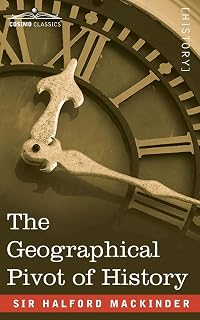
The Geographical Pivot of History
by Sir Halford John Mackinder
29 Members (3.25)
On This Page
Description
Halford John Mackinder's 'The Geographical Pivot of History' explores the interconnectedness of geography and historical developments. Published in 1904, the work examines the end of the Columbian epoch and proposes a shift in global political dynamics. Mackinder identifies the physical features of the world that have significantly influenced human actions and historical events, particularly emphasizing the geopolitical importance of the Eurasian heartland. He challenges the Eurocentric view show more of history, suggesting that European civilization's rise was largely a response to external pressures, particularly from Asia. Mackinder's analysis aims to provide a framework for understanding the geopolitical forces shaping international politics. The book is intended for scholars and students interested in geopolitics, history, and geography. show lessTags
Recommendations




























Member Reviews
Members
- Recently Added By
Lists

Robert B. Downs's Books that Changed the World
16 works; 1 member
Author Information

17 Works 157 Members
From an early age, John Mackinder was interested in the history of the countryside where he lived in England. He attended Oxford University, but, since geography was not an academic subject, he took classes in the subject closest to it that he could find---natural history. After completing his education, he began to research and explore his show more nation, eventually publishing "Britain and the British Seas" (1902), which is still considered a definitive work. Mackinder's interest and experience led to a position as Professor of Geography at Oxford, a position he used to create a renewed interest in geography. He also was responsible for making geography an academic subject. An explorer as well as a teacher, Mackinder became the first European to climb Mount Kenya, Africa's second highest mountain. From 1903 to 1908, Mackinder served as director of the London School of Economics. In 1909, he became a member of Parliament, where he remained a member until 1922, at which time he went on to hold other government posts. In 1920, he was knighted. Mackinder was a supporter of geopolitics---a belief that political developments are directly related to geographic space. Like other geopolitical theorists, he emphasized the role geography played in international relations. Mackinder acknowledged that, in the past, the sea powers had been dominant in the world. But he believed that, with the coming of railroads, that power had switched to land and that Eurasia had become the world's "heartland." And, in his view, "Who rules the Heartland . . . commands the world." Those in power in Great Britain and the United States paid little attention to this theory which he discussed in his work entitled "Democratic Ideas and Reality" (1919). But the theory was very convincing to a German geopolitician named Karl Haushofer, whose writings impressed Germany's ruler, Adolf Hitler. Hitler ultimately made the theory part of his master plan of world domination and used it to justify German expansion. (Bowker Author Biography) show less
Classifications
- Genres
- Nonfiction, General Nonfiction, History
- BISAC
Statistics
- Members
- 29
- Popularity
- 955,795
- Rating
- (3.25)
- Languages
- English
- Media
- Paper, Ebook
- ISBNs
- 4
- ASINs
- 1