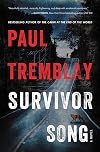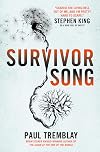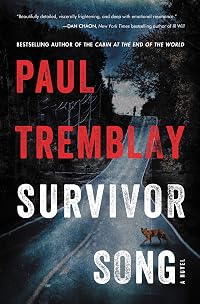
Survivor Song
by Paul Tremblay
On This Page
Description
A propulsive and chillingly prescient novel of suspense and terror from the Bram Stoker award–winning author of The Cabin at the End of the World and A Head Full of Ghosts."Absolutely riveting." — Stephen King
In a matter of weeks, Massachusetts has been overrun by an insidious rabies-like virus that is spread by saliva. But unlike rabies, the disease has a terrifyingly short incubation period of an hour or less. Those infected quickly lose their minds and are driven to bite and infect show more as many others as they can before they inevitably succumb. Hospitals are inundated with the sick and dying, and hysteria has taken hold. To try to limit its spread, the commonwealth is under quarantine and curfew. But society is breaking down and the government's emergency protocols are faltering.
Dr. Ramola "Rams" Sherman, a soft-spoken pediatrician in her mid-thirties, receives a frantic phone call from Natalie, a friend who is eight months pregnant. Natalie's husband has been killed—viciously attacked by an infected neighbor—and in a failed attempt to save him, Natalie, too, was bitten. Natalie's only chance of survival is to get to a hospital as quickly as possible to receive a rabies vaccine. The clock is ticking for her and for her unborn child.
Natalie's fight for life becomes a desperate odyssey as she and Rams make their way through a hostile landscape filled with dangers beyond their worst nightmares—terrifying, strange, and sometimes deadly challenges that push them to the brink.
Paul Tremblay once again demonstrates his mastery in this chilling and all-too-plausible novel that will leave readers racing through the pages . . . and shake them to their core.
. show less
Tags
Recommendations




Member Reviews
Paul Tremblay has done it again. The Bram Stoker award-winning author of The Cabin at the End of the World has written another suspenseful novel about survival . Instead of a crazy home invasion story, Survivor Song focuses on the spread of an insidious rabies-like virus overtaking New England. This virus has a short incubation time before the victim succumbs to feral and violent tendencies. The story centers on a woman named Natalie, who is eight months pregnant. When her husband is killed—viciously attacked by an infected neighbor—and in a failed attempt to save him, Natalie, too, is bitten, she calls the only person she knows who might be able to help her: Dr. Ramola "Rams" Sherman, a soft-spoken pediatrician in her mid-thirties, show more and one of her closest friends. Natalie's only chance of survival is to get to a hospital as quickly as possible to receive a rabies vaccine. The clock is ticking for her and for her unborn child. Can Dr. Ramola and Natalie make it in time? Will Natalie's child survive? You'll have to read to find out. Survivor Song is a harrowing journey through a ravaged New England landscape that resolves itself with one of the most memorable and slightly disturbing endings I've read in a long time. Survivor Song is ultimately about the persistence of the human spirit, the bonds of friendship, and the love of mother for her unborn child. Tremblay seems to have a knack for writing about familial bonds. Natalie is a wonderful character and is easy to empathize with. She's snarky and attempts to insert humor in a terrible situation. Throughout the story she records video entries to her unborn child, and these are easily some of the most touching passages of the story.
Reading this in the midst of the Covid-19 Pandemic was quite the experience. Tremblay has done his homework. He effectively paints a picture of a broken health care system (lacking PPE for dealing with a virus), the fear and misinformation that spreads when a virus is attacking, and the crazy Militias that attempt to take things in their control (all things we've seen happen throughout the past few months). Survivor Song is well-researched which makes the story all the more real and frightening.
Highly recommended. For fans of M.R. Carey or Stephen King. show less
Reading this in the midst of the Covid-19 Pandemic was quite the experience. Tremblay has done his homework. He effectively paints a picture of a broken health care system (lacking PPE for dealing with a virus), the fear and misinformation that spreads when a virus is attacking, and the crazy Militias that attempt to take things in their control (all things we've seen happen throughout the past few months). Survivor Song is well-researched which makes the story all the more real and frightening.
Highly recommended. For fans of M.R. Carey or Stephen King. show less
Reading this book was a little bit like reading the headlines, but hopefully it wasn’t prophetic. It makes you realize that no matter the circumstances, people haven’t, and won’t, react any different.
While the premise is familiar, the writing makes this story unique. The characters make it real. The ending brings hope. Talks of viruses and vaccines make it horribly relevant and the descriptions and detail make this a horrific read from beginning to end. Horrific is a good thing.
“Beautiful” is word rarely used for this genre, but the sincerity and care Tremblay has for his characters is both touching and refreshing. Despite blood and gory scenes, humanity is not lost, it’s revered.
I tore through this show more novel like a rabid coyote, gripping my Kindle and clicking through the pages with virulent speed. This was the perfect summertime read to put into perspective and bring to light issues that we are facing at this very moment, with a welcome light at the end of the proverbial tunnel. show less
While the premise is familiar, the writing makes this story unique. The characters make it real. The ending brings hope. Talks of viruses and vaccines make it horribly relevant and the descriptions and detail make this a horrific read from beginning to end. Horrific is a good thing.
“Beautiful” is word rarely used for this genre, but the sincerity and care Tremblay has for his characters is both touching and refreshing. Despite blood and gory scenes, humanity is not lost, it’s revered.
I tore through this show more novel like a rabid coyote, gripping my Kindle and clicking through the pages with virulent speed. This was the perfect summertime read to put into perspective and bring to light issues that we are facing at this very moment, with a welcome light at the end of the proverbial tunnel. show less
Overall Impressions
I'd heard that Paul Tremblay was a rising star amongst horror writers, so I came to 'Survivor Song' with high expectations. Paul Tremblay exceeded them, delivering a gripping, intense novel built around big ideas and driven by strong, memorable characters.
'Survivor Song' is one of those timely books that suggest precognition by the writer, or at least being tapped into the zeitgeist. Published this year, it imagines a fast-spreading, deadly virus hitting Massachusetts. Hospitals are overrun, there are shortages of PPE for front-line medical staff, disagreements between Federal and State authorities on what needs to be done, a struggle to impose a quarantine and small groups of self-appointed alt-right militia show more patrolling with guns to keep their neighbourhood safe and resist what they've convince themselves is a UN-led conspiracy to take over America using a mind-altering vaccine against a virus they released in the US.
Sadly, in these days when, despite 200,000 deaths, COVID-19 is labelled as both a hoax and an attack by the Chinese and making wearing a mask mandatory is seen as a violation of freedom and an attack on the Constitution, this all sound familiar.
What's new is that this virus is a form of fast-acting rabies, passed on by saliva. Within an hour of being bitten, people go rabid, lose their minds and start to bite others. Yep, you got it, a zombie plague.
But Paul Tremblay refuses to go down the route set out for us in all those zombie-apocalypse TV shows and video games. He keeps the focus human and real. He lets us continue to see the infected as victims, people who have been bitten and are losing themselves. He rejects the it's.-the-end-of-the-world-so-let's-abandon-civilization-and-kill-stuff knee-jerk reaction and frames the plague as something that will pass, something that can be survived, something where what we do and what we refuse to do to survive will define our futures.
As I neared the end of this book, with my emotions wrung-out, my mind buzzing with questions about what I'd do in these circumstances and with new real-to-me characters taking up residence in my memory, I tried to name what Paul Tremblay was doing to me, the kind of fear he'd been feeding me or letting feed on me.
It wasn't horror, that hair-standing-on-end from a nameless fear feeling. It wasn't terror, where the fear is like a pain so intense and overwhelming there is no room for anything else, not even the belief that it will pass. It was dread, the slow-burn cousin of the fear family. The one you see coming. The one that leaves you with your ability to think and act but slowly, inexorably extinguishes your hope.
What gives 'Survivor Song' extra bite for me is that it captures and amplifies the car-crash-in-slow-motion that has become daily life under COVID-19. The ending of the book goes a little beyond the car-crash of the plague. In some ways, it can be read as hopeful but I found it mostly sad. The survivors have a future but it's a future salvaged from the wreckage of another generation's dreams. It's a message that survival has a cost and survivors have scars but they make other people's future possible.
Paul Tremblay manages to make real the idea that as a species we are not so fragile that a major disaster topples our civilisation but that as individuals we can be ended by the actions of a moment, that what survival of the fittest really means is the survival of the fittest species, not the fittest individuals.
How it works
The book opens with a warning to the reader:
'Olden times: when wishing still helped.
This is not a fairytale. Certainly, it is not one that has been sanitised, homogenised or disneyfied, bloodless in every possible sense of the word. Beasts and human monsters defanged and claws clipped. The children safe. The children saved. The hard truths harvested from hard lives if not lost then obscured and purposely so.'
It's learning those 'hard truths harvested from hard lives' that this story is really about.
As well as rejecting the zombie fairy tales we tell ourself, Paul Tremblay breaches most of the rules of a pandemic story and the book is all the better for that. We're not following a lone scientist valiantly trying to defeat a killer disease, or leaders in government agencies trying to hold back the chaos or even a group a talented people prepped and ready to lead their tribe through the danger. We're following two women, long-term friends, one thirty-eight weeks pregnant, one a Doctor, as the super-rabies pandemic rolls over them like a forest fire. The story-telling is detailed and personal and very powerful.
Book One, which sets out the situation and introduces the two women, focuses on what it means to be in the middle of this kind of disaster. It brings home that you do what you can with what you have, you try not to let your decisions be driven only by fear and you don't let yourself think too far ahead. A lot of that felt very familiar and all of it felt scarily real.
This is a book powered by strong, clearly-drawn, complex characters. The two main characters are women in their thirties. Natalie, who is thirty-eight weeks pregnant and Rams, Dr Ramola "Rams" Sherman - her friend from college who works as a paediatrician at a local hospital. When Natalie's husband is killed by a rabid man and Natalie is bitten, she calls Rams for help and the two begin a nightmare journey looking for treatment for Natalie and a safe place for her baby to be born. Natalie and Rams are very different from one another. Natalie is a white American woman who is married and pregnant. Rams is an English woman of Indian descent who chooses to live a solitary life.
Paul Tremblay writes excellent dialogue, capturing the nuances of speech from Rams, the English doctor, through to the bro-speak of two teenage boys. He also takes the time to get us inside the heads of Natalie and Rams.
I found myself feeling a strong affinity for Rams when Paul Tremblay shared her attitude to happiness.
There would always be a point during their conversations, when Ramola would tell mom not to worry because she was happy. Which was more or less true. Although happiness was never Ramola's ambition.
Happiness held no nuance or compromise, did not allow for examination, did not allow the hopeful hungry will that fills the vacuum of failure and what might have beens. Nor did it allow for the sweetness of surprise.
Happiness was as rigid in its demands for adherence as a calendar shouting about compulsory date nights. Happiness was for dogs, lovely creatures though they were.
Ramola yearned for something more complex, something earned and something more satisfying. If she ever felt lonely, it was a passing storm. Not one she brooded upon and it was easily banished by resolving to be better about seeing friends, seeing Natalie and Paul.
What Ramola yearned for was not a gormless vision of happiness or a dewy romantic relationship, but a future when she was financially stable enough to travel wherever she wanted on holiday. In some daydreams, she travelled with friends. In others, she travelled alone. That was the life she desired to live.
The insights into Natalie's thoughts are given in a way that tugs at the emotions while showing her slowly degrading capability: she records messages to her unborn child on her phone.
Much of the novel is structured as a quest with Natalie and Rams travelling across the broken city, overcoming obstacles, risking encounters with the rabid and meeting people who may try to help them or kill them.
The quest trope is twisted in four clever ways:
the rabid are not zombies, they're sick people, the kind of sick person that Natalie may soon become, so they're more than threats to be eliminated.
the 'get the pregnant woman to the hospital' quest seems hopeless. She's infected and likely to turn rabid, She's not a I'll-die-if-my-baby-can-live sacrificial vessel but a woman who wants to live but knows she probably won't. The hospitals are as likely to be hotspots for trouble as they are sanctuaries offering help,
the back-stories of the women make them more and more real as time passes. We're not getting the fortunately-I'm- ex-Special Forces-background, or the-quiet-woman-with-a-deadly-past background, just women who you might meet anywhere in America, trying to live a life that is now being taken away from them.
as the journey continues, everything gets worse on every page but not in the 'now we have to make a desperate effort to win' way, but in a 'we are going to lose and our only choice is on how badly' way and our only hope is not to betray each other before we lose.
I was warned at the beginning of the book that this wasn't a fairy tale. I think the part that brought that home to me most was the story of the two bike-riding teen boys, self-styled zombie hunter, who try to help Natalie and Rams to get to the hospital. They have played zombie video games so often that they have convinced themselves that they know what's going on and are now heroes in their own movie.
This illusion is shattered when they encounter an informal militia in a scene that was full of tension, then violence and finally sadness. Paul Tremblay gives the boys their own 'Interlude' chapter where we break off from the quest and see what becomes of them. This was one of the toughest parts of the book. Tremblay doesn’t pull any punches. It’s not gory, just sad and doomed but he makes the sadness real and the doom count.
I strongly recommend the audiobook version of 'Survivor Song' which is delivered with great power by Erin Bennett.Click on the SoundCloud link below to hear a sample.
https://soundcloud.com/bolindaaudio/survivor-song-by-tremblay-paul show less
I'd heard that Paul Tremblay was a rising star amongst horror writers, so I came to 'Survivor Song' with high expectations. Paul Tremblay exceeded them, delivering a gripping, intense novel built around big ideas and driven by strong, memorable characters.
'Survivor Song' is one of those timely books that suggest precognition by the writer, or at least being tapped into the zeitgeist. Published this year, it imagines a fast-spreading, deadly virus hitting Massachusetts. Hospitals are overrun, there are shortages of PPE for front-line medical staff, disagreements between Federal and State authorities on what needs to be done, a struggle to impose a quarantine and small groups of self-appointed alt-right militia show more patrolling with guns to keep their neighbourhood safe and resist what they've convince themselves is a UN-led conspiracy to take over America using a mind-altering vaccine against a virus they released in the US.
Sadly, in these days when, despite 200,000 deaths, COVID-19 is labelled as both a hoax and an attack by the Chinese and making wearing a mask mandatory is seen as a violation of freedom and an attack on the Constitution, this all sound familiar.
What's new is that this virus is a form of fast-acting rabies, passed on by saliva. Within an hour of being bitten, people go rabid, lose their minds and start to bite others. Yep, you got it, a zombie plague.
But Paul Tremblay refuses to go down the route set out for us in all those zombie-apocalypse TV shows and video games. He keeps the focus human and real. He lets us continue to see the infected as victims, people who have been bitten and are losing themselves. He rejects the it's.-the-end-of-the-world-so-let's-abandon-civilization-and-kill-stuff knee-jerk reaction and frames the plague as something that will pass, something that can be survived, something where what we do and what we refuse to do to survive will define our futures.
As I neared the end of this book, with my emotions wrung-out, my mind buzzing with questions about what I'd do in these circumstances and with new real-to-me characters taking up residence in my memory, I tried to name what Paul Tremblay was doing to me, the kind of fear he'd been feeding me or letting feed on me.
It wasn't horror, that hair-standing-on-end from a nameless fear feeling. It wasn't terror, where the fear is like a pain so intense and overwhelming there is no room for anything else, not even the belief that it will pass. It was dread, the slow-burn cousin of the fear family. The one you see coming. The one that leaves you with your ability to think and act but slowly, inexorably extinguishes your hope.
What gives 'Survivor Song' extra bite for me is that it captures and amplifies the car-crash-in-slow-motion that has become daily life under COVID-19. The ending of the book goes a little beyond the car-crash of the plague. In some ways, it can be read as hopeful but I found it mostly sad. The survivors have a future but it's a future salvaged from the wreckage of another generation's dreams. It's a message that survival has a cost and survivors have scars but they make other people's future possible.
Paul Tremblay manages to make real the idea that as a species we are not so fragile that a major disaster topples our civilisation but that as individuals we can be ended by the actions of a moment, that what survival of the fittest really means is the survival of the fittest species, not the fittest individuals.
How it works
The book opens with a warning to the reader:
'Olden times: when wishing still helped.
This is not a fairytale. Certainly, it is not one that has been sanitised, homogenised or disneyfied, bloodless in every possible sense of the word. Beasts and human monsters defanged and claws clipped. The children safe. The children saved. The hard truths harvested from hard lives if not lost then obscured and purposely so.'
It's learning those 'hard truths harvested from hard lives' that this story is really about.
As well as rejecting the zombie fairy tales we tell ourself, Paul Tremblay breaches most of the rules of a pandemic story and the book is all the better for that. We're not following a lone scientist valiantly trying to defeat a killer disease, or leaders in government agencies trying to hold back the chaos or even a group a talented people prepped and ready to lead their tribe through the danger. We're following two women, long-term friends, one thirty-eight weeks pregnant, one a Doctor, as the super-rabies pandemic rolls over them like a forest fire. The story-telling is detailed and personal and very powerful.
Book One, which sets out the situation and introduces the two women, focuses on what it means to be in the middle of this kind of disaster. It brings home that you do what you can with what you have, you try not to let your decisions be driven only by fear and you don't let yourself think too far ahead. A lot of that felt very familiar and all of it felt scarily real.
This is a book powered by strong, clearly-drawn, complex characters. The two main characters are women in their thirties. Natalie, who is thirty-eight weeks pregnant and Rams, Dr Ramola "Rams" Sherman - her friend from college who works as a paediatrician at a local hospital. When Natalie's husband is killed by a rabid man and Natalie is bitten, she calls Rams for help and the two begin a nightmare journey looking for treatment for Natalie and a safe place for her baby to be born. Natalie and Rams are very different from one another. Natalie is a white American woman who is married and pregnant. Rams is an English woman of Indian descent who chooses to live a solitary life.
Paul Tremblay writes excellent dialogue, capturing the nuances of speech from Rams, the English doctor, through to the bro-speak of two teenage boys. He also takes the time to get us inside the heads of Natalie and Rams.
I found myself feeling a strong affinity for Rams when Paul Tremblay shared her attitude to happiness.
There would always be a point during their conversations, when Ramola would tell mom not to worry because she was happy. Which was more or less true. Although happiness was never Ramola's ambition.
Happiness held no nuance or compromise, did not allow for examination, did not allow the hopeful hungry will that fills the vacuum of failure and what might have beens. Nor did it allow for the sweetness of surprise.
Happiness was as rigid in its demands for adherence as a calendar shouting about compulsory date nights. Happiness was for dogs, lovely creatures though they were.
Ramola yearned for something more complex, something earned and something more satisfying. If she ever felt lonely, it was a passing storm. Not one she brooded upon and it was easily banished by resolving to be better about seeing friends, seeing Natalie and Paul.
What Ramola yearned for was not a gormless vision of happiness or a dewy romantic relationship, but a future when she was financially stable enough to travel wherever she wanted on holiday. In some daydreams, she travelled with friends. In others, she travelled alone. That was the life she desired to live.
The insights into Natalie's thoughts are given in a way that tugs at the emotions while showing her slowly degrading capability: she records messages to her unborn child on her phone.
Much of the novel is structured as a quest with Natalie and Rams travelling across the broken city, overcoming obstacles, risking encounters with the rabid and meeting people who may try to help them or kill them.
The quest trope is twisted in four clever ways:
the rabid are not zombies, they're sick people, the kind of sick person that Natalie may soon become, so they're more than threats to be eliminated.
the 'get the pregnant woman to the hospital' quest seems hopeless. She's infected and likely to turn rabid, She's not a I'll-die-if-my-baby-can-live sacrificial vessel but a woman who wants to live but knows she probably won't. The hospitals are as likely to be hotspots for trouble as they are sanctuaries offering help,
the back-stories of the women make them more and more real as time passes. We're not getting the fortunately-I'm- ex-Special Forces-background, or the-quiet-woman-with-a-deadly-past background, just women who you might meet anywhere in America, trying to live a life that is now being taken away from them.
as the journey continues, everything gets worse on every page but not in the 'now we have to make a desperate effort to win' way, but in a 'we are going to lose and our only choice is on how badly' way and our only hope is not to betray each other before we lose.
I was warned at the beginning of the book that this wasn't a fairy tale. I think the part that brought that home to me most was the story of the two bike-riding teen boys, self-styled zombie hunter, who try to help Natalie and Rams to get to the hospital. They have played zombie video games so often that they have convinced themselves that they know what's going on and are now heroes in their own movie.
This illusion is shattered when they encounter an informal militia in a scene that was full of tension, then violence and finally sadness. Paul Tremblay gives the boys their own 'Interlude' chapter where we break off from the quest and see what becomes of them. This was one of the toughest parts of the book. Tremblay doesn’t pull any punches. It’s not gory, just sad and doomed but he makes the sadness real and the doom count.
I strongly recommend the audiobook version of 'Survivor Song' which is delivered with great power by Erin Bennett.Click on the SoundCloud link below to hear a sample.
https://soundcloud.com/bolindaaudio/survivor-song-by-tremblay-paul show less
“This is not a fairy tale. This is a song.”
And this, this is a really good book! There is a rabies-like virus overrunning Massachusetts, and two women must fight like hell to survive it! One of them is pregnant. The book details their love, friendship, and intense struggle to save themselves, and the unborn child. The writing is strong and powerful, and most days, I felt I was right there with them, stressed out about strange animals, fevers, and not making it. It was a very good read.
Now for my politics:
“In the coming days, conditions will continue to deteriorate. Emergency services and other public safety nets will be stretched to their breaking points, exacerbated by the wily antagonists of fear, panic, misinformation; a show more myopic, sluggish federal bureaucracy further hamstrung by a president unwilling and woefully unequipped to make the rational, science-based decisions necessary; and exacerbated, of course, by plain old individual everyday evil.”
“In the final tally of what will be considered the end of the epidemic [but not, to be clear, the end of the virus; it will return all but encouraged and welcomed in a country where science and forethought are allowed to be dirty words, where humanity's greatest invention --- the vaccine --- is smeared and vilified by narcissistic, purposeful fools [the most dangerous kinds, where fear is harvested for fame, profit, and self-esteem], almost ten thousand people will have died."
Geez, in OUR pandemic, ongoing, there have been 140,000 dead in the United States... and counting!
And, back to my review:
A sample of the type of writing in this book:
“After shared, restrained laughter, they drive in silence, passing through the new ghost town, where the ghosts are reflections of what was and projections of what might never be again.”
The way the climactic scene is physically printed in the book is brilliant! The spacing of the sentences brings so much power and suspense to the words. I ‘felt’ the writing!
Sassafras and lullabies...
‘Neither now, nor ever.’ show less
And this, this is a really good book! There is a rabies-like virus overrunning Massachusetts, and two women must fight like hell to survive it! One of them is pregnant. The book details their love, friendship, and intense struggle to save themselves, and the unborn child. The writing is strong and powerful, and most days, I felt I was right there with them, stressed out about strange animals, fevers, and not making it. It was a very good read.
Now for my politics:
“In the coming days, conditions will continue to deteriorate. Emergency services and other public safety nets will be stretched to their breaking points, exacerbated by the wily antagonists of fear, panic, misinformation; a show more myopic, sluggish federal bureaucracy further hamstrung by a president unwilling and woefully unequipped to make the rational, science-based decisions necessary; and exacerbated, of course, by plain old individual everyday evil.”
“In the final tally of what will be considered the end of the epidemic [but not, to be clear, the end of the virus; it will return all but encouraged and welcomed in a country where science and forethought are allowed to be dirty words, where humanity's greatest invention --- the vaccine --- is smeared and vilified by narcissistic, purposeful fools [the most dangerous kinds, where fear is harvested for fame, profit, and self-esteem], almost ten thousand people will have died."
Geez, in OUR pandemic, ongoing, there have been 140,000 dead in the United States... and counting!
And, back to my review:
A sample of the type of writing in this book:
“After shared, restrained laughter, they drive in silence, passing through the new ghost town, where the ghosts are reflections of what was and projections of what might never be again.”
The way the climactic scene is physically printed in the book is brilliant! The spacing of the sentences brings so much power and suspense to the words. I ‘felt’ the writing!
Sassafras and lullabies...
‘Neither now, nor ever.’ show less
As always, Tremblay's writing keeps you turning pages breathlessly. In this novel, a variant of rabies has broken out and is killing both people and animals. Those suffering become aggressive and try to bite whatever is available. Nat, 8 months pregnant, is attacked in her home and her husband is killed. She goes to her best friend, Ramola, who is a doctor. The to begin a race against time to save Natalie's baby even though both women know that there bis no hope for Natalie.
What Tremblay does, better than any author I know, is create terrifying events that could actually happen.
What Tremblay does, better than any author I know, is create terrifying events that could actually happen.
Tremblay is one of my go-to authors. Reading this book during a pandemic was honestly pretty fantastic. For me anyway. Because that is how I deal when the world (and by world I mean my country) is in a state of WTF that should have never happened and holy hell I'm living in something I thought I'd only ever read about. Reading about it in a horror novel just puts it into a perspective that all the Black Death history books I've read don't. (Black Death: my fave pandemic)
Personal rambling aside, what Tremblay does so well is add the personal horror to the big horror. And it was just so relatable here. A mutated common disease. The waiting, the knowing, steps taken that have you both sympathizing with and screaming at Rams and Nats. The show more conspiracies. This is truly a book for our times. show less
Personal rambling aside, what Tremblay does so well is add the personal horror to the big horror. And it was just so relatable here. A mutated common disease. The waiting, the knowing, steps taken that have you both sympathizing with and screaming at Rams and Nats. The show more conspiracies. This is truly a book for our times. show less
I haven't devoured a book this fast in a while. SURVIVOR SONG is an action-packed, fast-paced, touching read that I couldn't put down. Want proof? I am writing this at 1:20 am.
The story constantly keeps you guessing as to where it'll go next. It forced me to reflect inward on what I may have done had I been in any of the main (or minor) characters' shoes, and if those decisions would be the ethical choice or not. I especially appreciated the cleverly injected (and painfully relevant) political commentary.
Don't miss this ultimate pandemic read, especially if you, like me, are a sucker for an apocalypse novel.
The story constantly keeps you guessing as to where it'll go next. It forced me to reflect inward on what I may have done had I been in any of the main (or minor) characters' shoes, and if those decisions would be the ethical choice or not. I especially appreciated the cleverly injected (and painfully relevant) political commentary.
Don't miss this ultimate pandemic read, especially if you, like me, are a sucker for an apocalypse novel.
Members
- Recently Added By
Lists

Top Five Books of 2020
982 works; 350 members

Books Set in Massachusetts
41 works; 8 members

Books Read in 2021
5,361 works; 114 members

Fiction Published in 2020
32 works; 1 member

Female Protagonist
1,056 works; 57 members
GoodReads Horror Choice Awards
160 works; 4 members

Nightmares Not Included
175 works; 3 members

Books Read in 2025
4,128 works; 98 members
Author Information

Awards and Honors
Awards
Distinctions
Common Knowledge
- Canonical title
- Survivor Song
- Original publication date
- 2020
- Epigraph
- It’s awful and still probably worse
They’re biters and rarely alone
And rarely alone.
—Big Business, “Heal the Weak” - Dedication
- For Lisa, Cole, and Emma
- First words
- This is not a fairy tale.
- Last words
- (Click to show. Warning: May contain spoilers.)She opens the first file and presses the Play button symbolized by a triangle fallen on its side.
- Blurbers
- King, Stephen
- Canonical DDC/MDS
- 813.6
- Canonical LCC
- PS3620.R445
Classifications
Statistics
- Members
- 832
- Popularity
- 33,119
- Reviews
- 41
- Rating
- (3.67)
- Languages
- Dutch, English
- Media
- Paper, Audiobook, Ebook
- ISBNs
- 21
- ASINs
- 4