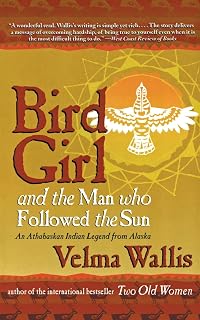
Bird Girl and the Man Who Followed the Sun
by Velma Wallis
On This Page
Description
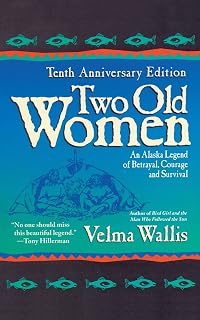
With the publication of Two Old Women, Velma Wallis firmly established herself as one of the most important voices in Native American writing. A national bestseller, her empowering fable won the Western State Book Award in 1993 and the Pacific Northwest Booksellers Association Book Award in 1994. Translated into 16 languages, it went on to international success, quickly reaching bestseller status in Germany. To date, more than 350,000 copies have been sold worldwide. Bird Girl and the Man show more Who Followed the Sun follows in this bestselling tradition. Rooted in the ancient legends of Alaska's Athabaskan Indians, it tells the stories of two adventurers who decide to leave the safety of their respective tribes. Bird Girl is a headstrong young woman who learned early on the skills of a hunter. When told that she must end her forays and take up the traditional role of wife and mother, she defies her family's expectations and confidently takes off to brave life on her own. Daagoo is a dreamer, curious about the world beyond. Longing to know what happens to the sun in winter, he sets out on a quest to find the legendary "Land of the Sun." Their stories interweave and intersect as they each face the many dangers and challenges of life alone in the wilderness. In the end, both learn that the search for individualism often comes at a high price, but that it is a price well worth paying, for through this quest comes the beginning of true wisdom. show lessTags
Recommendations


















Member Reviews
Read shortly after Velma Wallis's Two Old Woman, which is one of my favorite folk-legends of all time, Bird Girl and the Man Who Followed the Sun suffered somewhat by comparison. A Gwich'in Athabaskan folk epic, it follows the dual narratives of two rebels: Bird Girl, who prefers male activities like hunting, and who does not wish to be married; and Daagoo, a man who loves to wander, and dreams of finding the Land of the Sun, said to be far to the south...
This is a story whose cultural import quickly becomes clear, as it seeks to reconcile the needs and desires of the individual with that of her society. The adventures of the two main characters, their journeys away from their people, and their eventual return, has a neat symmetry to show more it. I found it appropriate and satisfying that the two rebels eventually find one another.
Well-written and informative as it may be however, I found that I could not enjoy Bird Girl quite as much as the author's earlier title, which is more of a reflection of my own opinions and emotional state, I would imagine, than the book's actual merit. Perhaps I was hoping that Bird Girl's narrative would offer more of an affirmation of her individual needs than it did, or perhaps my emotional reaction to her mistreatment at the hands of the Inupiaq colored my judgment, but I could not help being somewhat disappointed that her "punishment" was so severe. The folklorist in me is well aware that I am superimposing my own personal and cultural values onto the story, but there you have it... Despite my personal ambivalence however, this was a fascinating and engaging story, and well worth the reader's attention. show less
This is a story whose cultural import quickly becomes clear, as it seeks to reconcile the needs and desires of the individual with that of her society. The adventures of the two main characters, their journeys away from their people, and their eventual return, has a neat symmetry to show more it. I found it appropriate and satisfying that the two rebels eventually find one another.
Well-written and informative as it may be however, I found that I could not enjoy Bird Girl quite as much as the author's earlier title, which is more of a reflection of my own opinions and emotional state, I would imagine, than the book's actual merit. Perhaps I was hoping that Bird Girl's narrative would offer more of an affirmation of her individual needs than it did, or perhaps my emotional reaction to her mistreatment at the hands of the Inupiaq colored my judgment, but I could not help being somewhat disappointed that her "punishment" was so severe. The folklorist in me is well aware that I am superimposing my own personal and cultural values onto the story, but there you have it... Despite my personal ambivalence however, this was a fascinating and engaging story, and well worth the reader's attention. show less
After re-reading Two Old Women earlier this year, I wanted more from Velma Wallis, and this is just about it. Another beautiful re-telling of two tales of her Athabaskan heritage, the book has timeless truths about ways humans classify each other when 'other' and the ways they band together when they are united in commonality. The two legends are each about unusual stand-out, stand-alone individuals in two different Gwich'in tribes who lived along the Yukon - "two rebels who went beyond the ordinary." Here the two meet, briefly, but alternating chapters tell their individual stories. Dagoo (who also has a role in Two Old Women) is a boy who loves to explore, and to see what else is beyond the tribal land, forsaking his hunting duties to show more wander and dream. He is particularly interested in the Land of the Sun, which he has heard tales of from elders or passers-by that is far to the south and never has snow or cold. When the chief orders his father to keep him in line and make sure he contributes to the winter hunt, Dagoo gives in and excels at this job until a tribal tragedy propels him into a leadership position as a teenager. After fulfilling this role and seeing his people to safety he leaves on a wander, encountering new people, the ocean, the sun. Meanwhile, Bird Girl had been spoiled by her father because she did not like women's work and instead learned to scout and hunt with her brothers. As she came of age, the chief decreed that she could no longer behave this way and must get married. Instead, she runs away, only to be captured by a fierce enemy tribe with a vendetta. She endures years of cruelty and assault, but never loses her courage or pride until the chief, whose slave she had become, punishes her family. She takes quiet revenge and painfully makes her way back to her people, only to be misunderstood and ostracized. Bird Girl and Dagoo meet again late in life, recognizing kindred souls who had a brief encounter as children and their wisdom and stories are valued and preserved. show less
Wallisin kahdesta atapaski-legendasta koostama tarina on yhteisön ja kulttuurimuodon kuvauksessaan mielenkiitoinen joskaan ei mitenkään erityisen omaperäinen. Heimojen ja tapojen kuvaus on toki kiinnostavaa mutta ei mitenkään erityisen yksityiskohtaista. Ihan hyvä lisä aiheesta kiinnostuneelle silti. Kaunokirjallisesti vähän turhan "helppo" kirja.
Jul 31, 2007Finnish
Ratings
Members
- Recently Added By
Lists

Books Read in 2018
4,360 works; 110 members
Author Information

6+ Works 2,122 Members
Velma Wallis was born in Fort Yukon, a remote village in Interior Alaska, and now her family divides their time among Fairbanks, Fort Yukon, and traditional hunting, fishing, and trapping grounds. Wallis's books are based on the Athabaskan stories her mother told her when she was growing up
Common Knowledge
- Canonical title*
- Das Vogelmädchen und der Mann, der der Sonne folgte
- Original title
- Bird Girl and the Man who followed the Sun
- Original publication date
- 1996
- Important places*
- Alaska, USA
- Dedication*
- Dieses Buch ist allen Stämmen der Erde gewidmet.
- First words*
- Vor langer Zeit lebte in einem Land, wo die Sonne im sommer Tag und Nacht schien, aber während des bitterkalten Winters beinahe ganz verschwand, ein Stamm namens Gwich'in.
- Last words*
- (Click to show. Warning: May contain spoilers.)Sie würden die Vergangenheit hinter sich lassen und der Zukunft entgegengehen.
- Original language*
- Amerikanisch
*Some information comes from Common Knowledge in other languages. Click "Edit" for more information.
Classifications
Statistics
- Members
- 250
- Popularity
- 129,406
- Reviews
- 4
- Rating
- (3.71)
- Languages
- 8 — English, Finnish, German, Icelandic, Italian, Japanese, Norwegian (Bokmål), Spanish
- Media
- Paper
- ISBNs
- 16