
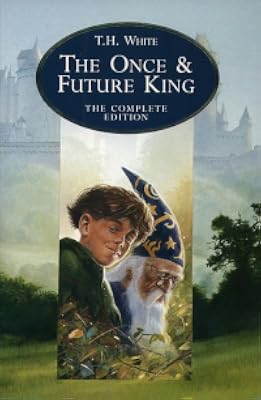
The Once and Future King, Including The Book of Merlyn
by T. H. White
The Once and Future King (Collections and Selections — compilation 1-5)
On This Page
Description
Classic Literature. Fiction. HTML:The complete box set of T.H. White's magnificent retelling of the Arthurian legend. The novel is made up of five parts: The Sword in the Stone, The Witch in the Wood, The Ill-Made Knight, The Candle in the Wind, and The Book of Merlyn. Humane, warmly funny and deeply touching, White's epic fantasy novel is a true classic.Tags
Recommendations







Member Reviews
A very thorough and exhaustive account of the life of Arthur, spiced up with some excellent dialogue and atmosphere. The last two books do tend to get a bit long-winded (and the last one I skimmed rather a lot of because some of it was repeated from The Sword in the Stone), but the first three are very good. Being familiar with other accounts of Arthurian legend, such as Malory and Chretien de Troyes, is a nice bonus when reading, because you can see what White adapted and how he accounted for things in his version of the Arthurverse. It was also a nice touch to include Malory himself in the proceedings, sending him off to tell the story of what happened to Arthur and Camelot.
As I said, the dialogue in this book is great. It is very show more lively and has some creative touches. For example, the Orkney knights (Gawain, Gaheris, Agravaine and Gareth) have very Gaelic-flavoured speech rhythms and syntax. Gawain's is particularly thick, and it softens as the book progresses and he becomes more English (although he never loses it completely).
There are also humourous moments. In the first book, Wart, Merlin and Archimedes are discussing birds and debating which species is the best. It's a fascinating conversation and shows a great respect for nature. Then Kay comes in and says, "Hey, sorry I'm late, I was out shooting birds with my crossbow. Look, I killed a thrush!" You can almost hear the others collectively facepalming at Kay's insensitivity. That comment is an excellent demonstration of Kay's personality.
Another comment, this time from Lancelot, contradicts the idea of a chivalrous knight being by necessity polite. Lancelot had been forced up a tree to retrieve a falcon belonging to a lady, and her husband tried to kill him unarmed. True to Lancelot style, Lancelot managed to get down, fetch a weapon and kill the other guy. The woman is upset, but instead of being courteous and offering a hanky, Lancelot says, "Go away...Stop howling. Your husband was a fool and you are a bore. I am not sorry I killed him." I definitely laughed out loud at that.
The animals are interesting additions as well, especially the hedgehog. Adorable! However, one can do without the goose songs. That and the various ranty bits by Merlin, and the chapter in the fourth book in which Lancelot and Guinevere spend the entire time looking out the window at various medieval scenes, are parts you can safely skim over. Savour the rest. show less
As I said, the dialogue in this book is great. It is very show more lively and has some creative touches. For example, the Orkney knights (Gawain, Gaheris, Agravaine and Gareth) have very Gaelic-flavoured speech rhythms and syntax. Gawain's is particularly thick, and it softens as the book progresses and he becomes more English (although he never loses it completely).
There are also humourous moments. In the first book, Wart, Merlin and Archimedes are discussing birds and debating which species is the best. It's a fascinating conversation and shows a great respect for nature. Then Kay comes in and says, "Hey, sorry I'm late, I was out shooting birds with my crossbow. Look, I killed a thrush!" You can almost hear the others collectively facepalming at Kay's insensitivity. That comment is an excellent demonstration of Kay's personality.
Another comment, this time from Lancelot, contradicts the idea of a chivalrous knight being by necessity polite. Lancelot had been forced up a tree to retrieve a falcon belonging to a lady, and her husband tried to kill him unarmed. True to Lancelot style, Lancelot managed to get down, fetch a weapon and kill the other guy. The woman is upset, but instead of being courteous and offering a hanky, Lancelot says, "Go away...Stop howling. Your husband was a fool and you are a bore. I am not sorry I killed him." I definitely laughed out loud at that.
The animals are interesting additions as well, especially the hedgehog. Adorable! However, one can do without the goose songs. That and the various ranty bits by Merlin, and the chapter in the fourth book in which Lancelot and Guinevere spend the entire time looking out the window at various medieval scenes, are parts you can safely skim over. Savour the rest. show less
The Once and Future King by T. H. White is based upon the 1485 book Le Morte d’Arthur by Sir Thomas Malory. It is comprised of four short novels that were published from 1938 to 1940 with the collection being put together as one book in 1958. This complex work is considered the best re-telling of the Arthurian legend.
The first book, “The Sword in the Stone”, tells of Arthur’s, called Wart in this volume, upbringing by his foster father Sir Ector, his friendship with his foster brother Kay and his instructions by Merlyn, a wizard . Merlyn knows what Arthur’s future is to be and tries to teach him how to be a good king by turning him into animals, fish and birds with each transformation meant to teach Arthur a lesson to prepare show more him. This book ends with the death of the current King, and Arthur pulling the sword Excalibur from the stone and being recognized as the new king.
Next comes “The Queen of Air and Darkness” which is set during the early years of Arthur’s reign. He is fighting a number of wars against rebellious Knights and, with the help of Merlyn, comes up with the idea of the Round Table and an order of Knights of chivalry. This book also details his seduction by his half-sister Queen Morgause and the birth of their illegitimate son, Mordred.
Part three is “The Ill-Made Knight” which switches the focus to the love story between Queen Guinevere and Sir Lancelot, how they try to hide it from Arthur, although he knows of it through Merlyn. We also see how the Lady Elaine is affected by this affair as she also loves Lancelot and is the mother of his son, Galahad. I had a hard time sympathizing with either Lancelot or Guinevere as I felt they were so wrapped up in themselves, they had not consideration of others.
The last book, ‘The Candle in the Wind” brings the various pieces of the story together by telling of the downfall of Arthur, Guinevere and Lancelot and the last days of the Kingdom of Camelot.
I was surprised at how much I enjoyed this book as I have never been a fan of King Arthur stories, I was drawn in right away by the winsome ways of Arthur, the humor and magic of Merlyn and many of the other quirky characters that were introduced throughout the book. As the story goes on, it definitely gets darker and darker but by that time the reader is fully invested in Arthur and needs to see how everything will unfold. Although the books do not mesh together seamlessly, this is a powerful and at times disturbing story about the desperate struggles that mankind involve themselves in and the evil that is often brought out by conflict. The Once and Future King is a masterpiece of historical fantasy. show less
The first book, “The Sword in the Stone”, tells of Arthur’s, called Wart in this volume, upbringing by his foster father Sir Ector, his friendship with his foster brother Kay and his instructions by Merlyn, a wizard . Merlyn knows what Arthur’s future is to be and tries to teach him how to be a good king by turning him into animals, fish and birds with each transformation meant to teach Arthur a lesson to prepare show more him. This book ends with the death of the current King, and Arthur pulling the sword Excalibur from the stone and being recognized as the new king.
Next comes “The Queen of Air and Darkness” which is set during the early years of Arthur’s reign. He is fighting a number of wars against rebellious Knights and, with the help of Merlyn, comes up with the idea of the Round Table and an order of Knights of chivalry. This book also details his seduction by his half-sister Queen Morgause and the birth of their illegitimate son, Mordred.
Part three is “The Ill-Made Knight” which switches the focus to the love story between Queen Guinevere and Sir Lancelot, how they try to hide it from Arthur, although he knows of it through Merlyn. We also see how the Lady Elaine is affected by this affair as she also loves Lancelot and is the mother of his son, Galahad. I had a hard time sympathizing with either Lancelot or Guinevere as I felt they were so wrapped up in themselves, they had not consideration of others.
The last book, ‘The Candle in the Wind” brings the various pieces of the story together by telling of the downfall of Arthur, Guinevere and Lancelot and the last days of the Kingdom of Camelot.
I was surprised at how much I enjoyed this book as I have never been a fan of King Arthur stories, I was drawn in right away by the winsome ways of Arthur, the humor and magic of Merlyn and many of the other quirky characters that were introduced throughout the book. As the story goes on, it definitely gets darker and darker but by that time the reader is fully invested in Arthur and needs to see how everything will unfold. Although the books do not mesh together seamlessly, this is a powerful and at times disturbing story about the desperate struggles that mankind involve themselves in and the evil that is often brought out by conflict. The Once and Future King is a masterpiece of historical fantasy. show less
I feel like it would be quite unfair to judge all five books as a whole, even if they are bound this way, but "What, What?"
"See, some things turn out this way, see? Even classics, see?" What, What?
I honestly went through many changes while reading this work, but that may be entirely because I keep seeing how it has changed the world, our perceptions, and especially it's influence on so many of the cultural set pieces we enjoy across a wide, wide canvas.
I was thrown, willy-nilly, into a purely Disney Sword In Stone cartoon for the first book. Hell, no matter how I wanted to pry myself from that version, I couldn't. Wart., I.E., Arthur, and the doddering old English fool, Merlin, were perfect caricatures of themselves even as they turned show more into all the birds in the sky and the fish in the sea and taught valuable lessons of what it would be to be a Knight. What, what?
Okay, I WAS thrown off my game a little bit with the introduction of the Encyclopedia Britannica and at LEAST two references to Guy Fawkes, until I finally decided to turn off my brain and let this belated realization of a kid's story have its nefarious way with me. What, what?
I quickly realized, by style and attempted humor, that a certain author by the name Terry Pratchett took all the specialized elements of this book and made something with a much more comprehensive world and better timing on the comedy and odd juxtapositions. He owed a debt to this old YA classic, absolutely, and the borrowed style is as plain as day. I wound up liking it just fine once I managed my expectations, but I still prefer Mr. Pratchett. :) But what the hell was up with Robin Hood and Tuck, What, What?
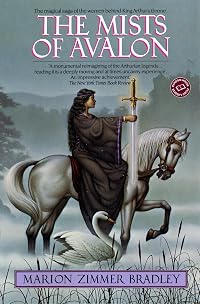
Things got slightly better by book two, with the darker "M" themes, with witchcraft and Fae, adventure and even a bit of knightly heroism. I got into it, but let me be perfectly honest: I've been spoiled by these characters through [b:The Mists of Avalon|402045|The Mists of Avalon (Avalon, #1)|Marion Zimmer Bradley|https://d.gr-assets.com/books/1388857089s/402045.jpg|806813], so it's hard to want less depth, less straight comprehensibility.
But, like the previous book, I took a lesser critical view, and with book three and book four, I was utterly delighted to find out that most of our modern shiny knights in clean halls, bursting with honor, utter fair play, and utter moral christian virtue came from T. H. White. I wondered where the hell it all went wrong, or why such amazing and widespread departures from reality and history got introduced into our public mind like the great whitewashing of our time, and now I know.
Yes, yes, I know that the Arthurian legend has always been the sock puppet for each culture that re-appropriated it, but I'll always be partial to the popular incarnation of this from the times of the crusades. (I don't care which you choose. Early, middle or late, they're all charming.) Worse, I'm truly upset with the loss of the hidden messages wrapped in metaphors and anagrams. Hell, I would have given anything for just a HINT of a Rosicrucian chemical wedding. But no, this modern incarnation is all about modern social mores, being a good christian, and bringing out the great club of politics, as was seen MOST PERFECTLY in book five.
I can't say I disagree with some of his sentiments. I hate war, too. I probably would have done everything in my power to be a pacifist, too, which is quite fun to pull out INSIDE a book ostensibly about war, domination, civil-war, and enough personal strife and tragedy to choke a war-horse.
Instead, I come away with the shiniest patina of High Nobility, hell paved with good intentions, and impossibly wise Englishmen who don't really know what the hell they're talking about. Book five. OMG. Were you expecting an old Arthur getting it on as a goose and being subject to a political treatise on capitalism and communism? Or a truly unfair slight against ants?
Yeah. Me either.
What I took away from this? Monty Python and the Search For The Holy Grail. Book three, especially. That movie is an almost perfect counterpoint to book three. I think I'm gonna pop my dvd in my player right now.
Do I sound like I don't like this work? No. Or at least, I don't dislike it. It's clear and bright and it fairly pipes the British Anthem on every page. I've never been much for patriotism, but I'm almost propagandized into the tradition.
Oh, and yeah, deep sea diving is an almost perfect way to explain to the reader the difficulties of wearing armor. And Merlin was a poor boy in modern England. What, what? See? See?
I recommend to you, dear reader, if you like your legends light and Disney, full of talking animals and lots of anachronistic conversations. Contains all of the most popular modern imaginings of the Arthurian legend, sans the deep discourses, the deeper understanding of the Holy Blood and the secrets therein.
But of course, there's always the many maidens trying to take the pure knight's virginity. That never gets old, what, what? show less
"See, some things turn out this way, see? Even classics, see?" What, What?
I honestly went through many changes while reading this work, but that may be entirely because I keep seeing how it has changed the world, our perceptions, and especially it's influence on so many of the cultural set pieces we enjoy across a wide, wide canvas.
I was thrown, willy-nilly, into a purely Disney Sword In Stone cartoon for the first book. Hell, no matter how I wanted to pry myself from that version, I couldn't. Wart., I.E., Arthur, and the doddering old English fool, Merlin, were perfect caricatures of themselves even as they turned show more into all the birds in the sky and the fish in the sea and taught valuable lessons of what it would be to be a Knight. What, what?
Okay, I WAS thrown off my game a little bit with the introduction of the Encyclopedia Britannica and at LEAST two references to Guy Fawkes, until I finally decided to turn off my brain and let this belated realization of a kid's story have its nefarious way with me. What, what?
I quickly realized, by style and attempted humor, that a certain author by the name Terry Pratchett took all the specialized elements of this book and made something with a much more comprehensive world and better timing on the comedy and odd juxtapositions. He owed a debt to this old YA classic, absolutely, and the borrowed style is as plain as day. I wound up liking it just fine once I managed my expectations, but I still prefer Mr. Pratchett. :) But what the hell was up with Robin Hood and Tuck, What, What?
Things got slightly better by book two, with the darker "M" themes, with witchcraft and Fae, adventure and even a bit of knightly heroism. I got into it, but let me be perfectly honest: I've been spoiled by these characters through [b:The Mists of Avalon|402045|The Mists of Avalon (Avalon, #1)|Marion Zimmer Bradley|https://d.gr-assets.com/books/1388857089s/402045.jpg|806813], so it's hard to want less depth, less straight comprehensibility.
But, like the previous book, I took a lesser critical view, and with book three and book four, I was utterly delighted to find out that most of our modern shiny knights in clean halls, bursting with honor, utter fair play, and utter moral christian virtue came from T. H. White. I wondered where the hell it all went wrong, or why such amazing and widespread departures from reality and history got introduced into our public mind like the great whitewashing of our time, and now I know.
Yes, yes, I know that the Arthurian legend has always been the sock puppet for each culture that re-appropriated it, but I'll always be partial to the popular incarnation of this from the times of the crusades. (I don't care which you choose. Early, middle or late, they're all charming.) Worse, I'm truly upset with the loss of the hidden messages wrapped in metaphors and anagrams. Hell, I would have given anything for just a HINT of a Rosicrucian chemical wedding. But no, this modern incarnation is all about modern social mores, being a good christian, and bringing out the great club of politics, as was seen MOST PERFECTLY in book five.
I can't say I disagree with some of his sentiments. I hate war, too. I probably would have done everything in my power to be a pacifist, too, which is quite fun to pull out INSIDE a book ostensibly about war, domination, civil-war, and enough personal strife and tragedy to choke a war-horse.
Instead, I come away with the shiniest patina of High Nobility, hell paved with good intentions, and impossibly wise Englishmen who don't really know what the hell they're talking about. Book five. OMG. Were you expecting an old Arthur getting it on as a goose and being subject to a political treatise on capitalism and communism? Or a truly unfair slight against ants?
Yeah. Me either.
What I took away from this? Monty Python and the Search For The Holy Grail. Book three, especially. That movie is an almost perfect counterpoint to book three. I think I'm gonna pop my dvd in my player right now.
Do I sound like I don't like this work? No. Or at least, I don't dislike it. It's clear and bright and it fairly pipes the British Anthem on every page. I've never been much for patriotism, but I'm almost propagandized into the tradition.
Oh, and yeah, deep sea diving is an almost perfect way to explain to the reader the difficulties of wearing armor. And Merlin was a poor boy in modern England. What, what? See? See?
I recommend to you, dear reader, if you like your legends light and Disney, full of talking animals and lots of anachronistic conversations. Contains all of the most popular modern imaginings of the Arthurian legend, sans the deep discourses, the deeper understanding of the Holy Blood and the secrets therein.
But of course, there's always the many maidens trying to take the pure knight's virginity. That never gets old, what, what? show less
Of all the Arthurian books, the best re-telling (does Le Mort d'Arthur count as a retelling or is the original?) out there. White takes the parts of the Arthurian legend that seem inexplicable to us modern types (why the Grail--why don't Lancelot and Guinevere just run away--what's up with Galahad) and makes them only too understandable. Archetypes become people, and these people become sympathetic, but the story's power doesn't diminish in the slightest.
Starts off questionable, a few times I felt like quitting. I'm glad I didnt because by the last book it ascends into the realm of greatness.
One of the classic fictionl; tales of King Arthur and his Knights of the Round Table. Orignally written as four stories, this edition has them all together. The Sword in the Stone tells of Arthur's early life, his meeting with Merlin and his experience changing into different animals. This was a really fun book and I enjoyed the learning Arthur did as Wart. We are also introduced to Pellinore and his Questing Beast which comes back in the second book. There is a Disney film of the same name which I used to love when I was younger which does a fairly decent job at this.
The second book was The Witch in the Wood which introduces the Orkney faction (Gawain, Agravaine, Geheris and Gareth) along with Arthur's main enemy Queen Morgause. It show more has some insight into the characters of the Queen and the brothers along with a very memorable event involving a unicorn. Pellinore falls in love and we meet a truely black knight. The third book is The Ill Made Knight and mostly follows Lancelot and Guenevere. It has the Quest for the Holy Grail and the beginnings of the end of the Round Table and Arthur's Fellowship. The final book in the collection is The Candle in the Wind and starts to describe the end of days. Mordred has turned against Arthur fully now along with Gawain against Lancelot and it won't be long until arthur's death. By now he is an old man and his hopes have been mostly realised.
This is a bittersweet book for the most part. It focuses on some very small details and glosses over others. After spending so much time with Pellinore in the first two books we learn he has been killed in passing later on. White also pokes a lot of fun at Arthur calling him a cuckold and a fool for letting his wife lie with another man. He also references Le Morte D'Arthur a lot and says to read that for more detail in places. Overall I am glad I have read it finally, but it definitely ins't my favourite Arthurian novel. show less
The second book was The Witch in the Wood which introduces the Orkney faction (Gawain, Agravaine, Geheris and Gareth) along with Arthur's main enemy Queen Morgause. It show more has some insight into the characters of the Queen and the brothers along with a very memorable event involving a unicorn. Pellinore falls in love and we meet a truely black knight. The third book is The Ill Made Knight and mostly follows Lancelot and Guenevere. It has the Quest for the Holy Grail and the beginnings of the end of the Round Table and Arthur's Fellowship. The final book in the collection is The Candle in the Wind and starts to describe the end of days. Mordred has turned against Arthur fully now along with Gawain against Lancelot and it won't be long until arthur's death. By now he is an old man and his hopes have been mostly realised.
This is a bittersweet book for the most part. It focuses on some very small details and glosses over others. After spending so much time with Pellinore in the first two books we learn he has been killed in passing later on. White also pokes a lot of fun at Arthur calling him a cuckold and a fool for letting his wife lie with another man. He also references Le Morte D'Arthur a lot and says to read that for more detail in places. Overall I am glad I have read it finally, but it definitely ins't my favourite Arthurian novel. show less
I suppose I was really young to tackle such a serious piece of literature, but The Once and Future King . . . I could barely get through it. Granted, I wasn't even in high school - but still. I think I've ruined a book I may have liked. I wouldn't recommend people who aren't exposed to classics, or exposed in a way that would make it a good experience. I had no experience of real literature (aside from Narnia), and I think that was a definite problem. Maybe I'll re-read it someday . . . but for now, I still loathe it.
Members
- Recently Added By
Lists

1001 Books You Must Read Before You Die
1,448 works; 1,131 members

Books with Noble Titles
179 works; 11 members

Five star books
1,755 works; 108 members

Books Read in 2018
4,360 works; 110 members

Books Read in 2021
5,361 works; 114 members

Wishlist
99 works; 1 member
Author Information

49+ Works 31,638 Members
Terence Hanbury White was born on May 29, 1906 in Bombay, India. He attended Cheltenham College, Gloucestershire, and Queen's College, Cambridge. The success of his autobiography, England Have My Bones, allowed him to leave teaching after six years and devote his time to writing. Although he wrote a wide array of novels and some poetry, he is best show more known for The Once and Future King, his four-volume retelling of the legend of King Arthur, which became the basis for both the musical, Camelot, and the Disney film, The Sword in the Stone. White died on January 17, 1964, while returning home from a lecture tour in America. (Bowker Author Biography) show less
Some Editions
Awards and Honors
Awards
Series

Belongs to Publisher Series
Work Relationships
Is contained in
Contains
Common Knowledge
- Canonical title
- The Once and Future King, Including The Book of Merlyn
- Original title
- The Once and Future King; The Candle in the Wind. The Book of Merlyn.
- Original publication date
- 1938 (The Sword in the Stone) (The Sword in the Stone); 1939 (The Queen of Air and Darkness) (The Queen of Air and Darkness); 1940 (The Ill-Made Knight) (The Ill-Made Knight); 1958 (The Candle in the Wind) (The Candle in the Wind); 1977 (The Book of Merlyn) (The Book of Merlyn)
- People/Characters
- Merlin (as Merlyn); Sir Ector; Sir Kay; King Arthur (as Wart, Arthur Pendragon); Lancelot du Lac; Morgan le Fay (show all 7); Morgause
- Important places
- Camelot; England, UK (as England); Orkney, Scotland, UK; Joyous Gard; Almesbury; Astolat
- Related movies
- The Sword in the Stone (1963 | IMDb); Camelot (1967 | IMDb)
- Dedication
- For J.A.
- First words
- On Mondays, Wednesdays and Fridays it was Court Hand and Summulae Logicales, while the rest of the week it was the Organon, Repetition and Astrology.
- Last words
- (Click to show. Warning: May contain spoilers.)Pray for Thomas Malory, Knight, and his humble disciple, who now voluntarily lays aside his books to fight for his kind.
- Canonical DDC/MDS
- 823.912
- Canonical LCC
- PR6045.H2
- Disambiguation notice
- These editions of The Once and Future King DO contain the Book of Merlyn. Please do not combine with the editions that do NOT contain the Book of Merlyn.
Classifications
Statistics
- Members
- 1,465
- Popularity
- 15,895
- Reviews
- 20
- Rating
- (3.96)
- Languages
- 7 — Danish, Dutch, English, Finnish, Italian, Polish, Spanish
- Media
- Paper, Audiobook, Ebook
- ISBNs
- 15
- ASINs
- 4