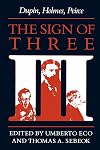
The Sign of Three. Peirce, Holmes, Dupin
by Umberto Eco, Thomas Albert Sebeok
On This Page
Description
... fascinating throughout.... the book is recreative in the highest sense." --Arthur C. Danto, The New Republic A gem for Holmes fans and armchair detectives with a penchant for logical reflection, and Peirce scholars." --Library JournalTags
Recommendations









Member Reviews
The Sign of the Three is not for the general reader. Only four stars, for some redundancy and some technical writing not of general interest. It is a series of essays regarding in large measure the formation of hypotheses; informed guesses leading to useful explanations. Dupin was Edgar Allen Poe's amateur detective who set the template for the Sherlock Holmes style of crime detection. Charles Sanders Peirce [sic], perhaps our best American philosopher, parsed methods of scientific investigation and general acquisition of knowledge, among much else.
Peirce realized that the formation of useful hypotheses, the fuel of scientific discovery and explanation in general, is neither formal induction nor deduction but rather what he termed show more abduction: informed and testable guesses. And whereas induction and deduction are subject to mathematically exact rules of formal logic, no formal rule can comprise useful abduction.
Finding and testing a provisional hypothesis does require the engines of induction and deduction: working out natural consequences implied or deducible from a hypothesis to discover whether those consequences comport with facts. If not, then the hypothesis is in error.
Arthur Conan Doyle let Holmes call his methods variously induction and deduction, but they were rather choosing from multiple hypotheses by eliminating the wrong ones by testing their various consequences. Poe called this ratiocination in the case of Dupin. Holmes's capacities appeared astonishing to Dr. Watson because Watson did not entertain the wealth of Holmes's hypotheses so as to recognize the significance of certain evident facts, nor the chain of their ramifications and of Holmes's testing of them, only to be revealed later. Of course, Holmes benefitted also from a personal fund of forensic facts, like the sources of all kinds of tobaccos, ability to recognize most perfumes, and where different types of dirt were found in London.
The Sherlock Holmes stories are a delight and a fast read. I read one in college and could not resist reading all the rest one weekend.
Peirce is a fine thinker and writer. Wikisource carries a free set of his quite readable and wryly humorous essays along the above lines at:
https://en.wikisource.org/wiki/Popular_Science_Monthly/Volume_12/January_1878/Il... . show less
Peirce realized that the formation of useful hypotheses, the fuel of scientific discovery and explanation in general, is neither formal induction nor deduction but rather what he termed show more abduction: informed and testable guesses. And whereas induction and deduction are subject to mathematically exact rules of formal logic, no formal rule can comprise useful abduction.
Finding and testing a provisional hypothesis does require the engines of induction and deduction: working out natural consequences implied or deducible from a hypothesis to discover whether those consequences comport with facts. If not, then the hypothesis is in error.
Arthur Conan Doyle let Holmes call his methods variously induction and deduction, but they were rather choosing from multiple hypotheses by eliminating the wrong ones by testing their various consequences. Poe called this ratiocination in the case of Dupin. Holmes's capacities appeared astonishing to Dr. Watson because Watson did not entertain the wealth of Holmes's hypotheses so as to recognize the significance of certain evident facts, nor the chain of their ramifications and of Holmes's testing of them, only to be revealed later. Of course, Holmes benefitted also from a personal fund of forensic facts, like the sources of all kinds of tobaccos, ability to recognize most perfumes, and where different types of dirt were found in London.
The Sherlock Holmes stories are a delight and a fast read. I read one in college and could not resist reading all the rest one weekend.
Peirce is a fine thinker and writer. Wikisource carries a free set of his quite readable and wryly humorous essays along the above lines at:
https://en.wikisource.org/wiki/Popular_Science_Monthly/Volume_12/January_1878/Il... . show less
The Sign of Three is a collection of ten essays about the detective methods of C. Auguste Dupin and Sherlock Holmes, the history of the forensic sciences, the diagnostic techniques of Sigmund Freud and Karl Popper's conjectural paradigm. The scientific method and many other methods and processes are discussed in the light of Charles S. Peirce's logic of discovery (i.e. making good guesses) or abduction as he called it. Peirce believed that we "conquer the truth by guessing, or not at all."
This is series of essays compiled by Umberto Eco and Thomas Sebeok comparing the logic methods of Charles Peirce with the fictional Sherlock Holmes. Both are surprisingly similar. A very fascinating book, though it helps to have a basic familiarity with Peirce to fully appreciate it.
Whether Holmes’ methods would be deductive or abductive is subject to some question.
Abduction, which Peirce sometimes called retroduction or hypothesis concerns the principles of discovery, or development of theories, rather than justification. [See “Abduction,” THE
CAMBRIDGE DICTIONARY OF PHILOSOPHY 1 (Robert M. Audi, ed., 1995).] For arguments that his
methods would be abductive, see, e.g., Thomas A. Sebeok & Jeam Umiker-Sebeok, “You Know
My Method”; A Juxtaposition of Charles S. Peirce and Sherlock Holmes¸ in DUPIN, HOLMES &
PEIRCE: THE SIGN OF THREE 11 (Umberto Eco & Thomas A Sebeok, eds., 1988); Umberto Eco,
Horns, Hooves, Insteps: Some Hypotheses on Three Types of Abduction, in DUPIN, HOLMES &
PEIRCE: THE SIGN OF THREE, show more supra, at 198. Arguing that it would be deductive, see, e.g., Jaakko
Hintikka & Merrill B. Hintikka, Sherlock Holmes Confronts Modern Logic: Toward a Theory of
Information-Seeking Through Questioning, in DUPIN, HOLMES & PEIRCE: THE SIGN OF THREE, supra, at 154.
from International Commentary on Evidence, vol 4, issue 2, article 2, 2006. Foreword: Perspectives on Arthur Conan Doyle and Evidence. show less
Abduction, which Peirce sometimes called retroduction or hypothesis concerns the principles of discovery, or development of theories, rather than justification. [See “Abduction,” THE
CAMBRIDGE DICTIONARY OF PHILOSOPHY 1 (Robert M. Audi, ed., 1995).] For arguments that his
methods would be abductive, see, e.g., Thomas A. Sebeok & Jeam Umiker-Sebeok, “You Know
My Method”; A Juxtaposition of Charles S. Peirce and Sherlock Holmes¸ in DUPIN, HOLMES &
PEIRCE: THE SIGN OF THREE 11 (Umberto Eco & Thomas A Sebeok, eds., 1988); Umberto Eco,
Horns, Hooves, Insteps: Some Hypotheses on Three Types of Abduction, in DUPIN, HOLMES &
PEIRCE: THE SIGN OF THREE, show more supra, at 198. Arguing that it would be deductive, see, e.g., Jaakko
Hintikka & Merrill B. Hintikka, Sherlock Holmes Confronts Modern Logic: Toward a Theory of
Information-Seeking Through Questioning, in DUPIN, HOLMES & PEIRCE: THE SIGN OF THREE, supra, at 154.
from International Commentary on Evidence, vol 4, issue 2, article 2, 2006. Foreword: Perspectives on Arthur Conan Doyle and Evidence. show less
Ratings
Members
- Recently Added By
Author Information

514+ Works 115,718 Members
Umberto Eco was born in Alessandria, Italy on January 5, 1932. He received a doctorate of philosophy from the University of Turin in 1954. His first book, Il Problema Estetico in San Tommaso, was an extension of his doctoral thesis on St. Thomas Aquinas and was published in 1956. His first novel, The Name of the Rose, was published in 1980 and won show more the Premio Strega and the Premio Anghiar awards in 1981. In 1986, it was adapted into a movie starring Sean Connery. His other works include Foucault's Pendulum, The Island of the Day Before, Baudolino, The Prague Cemetery, and Numero Zero. He also wrote children's books and more than 20 nonfiction books including Serendipities: Language and Lunacy. He taught philosophy and then semiotics at the University of Bologna. He also wrote weekly columns on popular culture and politics for L'Espresso. He died from cancer on February 19, 2016 at the age of 84. (Bowker Author Biography) show less

76+ Works 709 Members
Thomas A. Sebeok is Distinguished Professor Emeritus of Linguistics and Semiotics at Indiana University.
All Editions
Series
Belongs to Publisher Series
Common Knowledge
- Canonical title
- The Sign of Three. Peirce, Holmes, Dupin
- Original title
- The Sign of Three. Peirce, Holmes, Dupin
- Original publication date
- 1983
- People/Characters
- Charles Sanders Peirce; Sherlock Holmes; C. Auguste Dupin
Classifications
Statistics
- Members
- 158
- Popularity
- 208,119
- Reviews
- 4
- Rating
- (4.12)
- Languages
- 6 — English, French, German, Italian, Portuguese, Spanish
- Media
- Paper, Ebook
- ISBNs
- 9
- ASINs
- 1