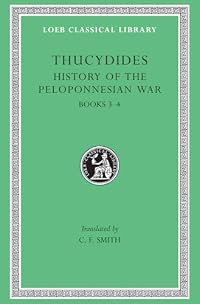
History of the Peloponnesian War, Books 3-4 (Loeb Classical Library
by Thucydides
Loeb Classical Texts: History of the Peloponnesian War (3-4)
On This Page
Description
Thucydides of Athens, one of the greatest of historians, was born about 471 BCE. He saw the rise of Athens to greatness under the inspired leadership of Pericles. In 430, the second year of the Peloponnesian War, he caught and survived the horrible plague which he described so graphically. Later, as general in 423 he failed to save Amphipolis from the enemy and was disgraced. He tells about this, not in volumes of self-justification, but in one sentence of his history of the war--that it show more befell him to be an exile for twenty years. He then lived probably on his property in Thrace, but was able to observe both sides in certain campaigns of the war, and returned to Athens after her defeat in 404. He had been composing his famous history, with its hopes and horrors, triumphs and disasters, in full detail from first-hand knowledge of his own and others. The war was really three conflicts with one uncertain peace after the first; and Thucydides had not unified them into one account when death came sometime before 396. His history of the first conflict, 431-421, was nearly complete; Thucydides was still at work on this when the war spread to Sicily and into a conflict (415-413) likewise complete in his awful and brilliant record, though not fitted into the whole. His story of the final conflict of 413-404 breaks off (in the middle of a sentence) when dealing with the year 411. So his work was left unfinished and as a whole unrevised. Yet in brilliance of description and depth of insight this history has no superior. The Loeb Classical Library edition of Thucydides is in four volumes. show lessTags
Recommendations


































Member Reviews
Libro III: Narra la rebelión de Mitilene, el debate ateniense sobre el castigo a los rebeldes y la brutal guerra civil de Corcira (Corfú).
Libro IV: Detalla la célebre victoria ateniense en Pilos y Esfacteria, la captura de rehenes espartanos y el auge del brillante general espartano Brásidas. También menciona el autor su propio papel como estratego de forma muy somera.
Libro IV: Detalla la célebre victoria ateniense en Pilos y Esfacteria, la captura de rehenes espartanos y el auge del brillante general espartano Brásidas. También menciona el autor su propio papel como estratego de forma muy somera.
May 27, 2026Spanish
Ratings
Members
- Recently Added By
Author Information

292+ Works 15,032 Members
Born into a family of Athens's old nobility claiming descent from the Homeric hero Ajax of Salamis, Thucydides pursued a political career under Pericles and served as a general in the Great Peloponnesian War of 431--404 b.c. His subsequent exile for failure to prevent a Spartan takeover of an Athenian colony in Thrace enabled him to observe the show more war from both sides. In his history of the war, he examines the policies and motives of the people involved with a calculated rationality that nevertheless conveys great passion. Although his narrative style is lucid and astringent, the language of the speeches that he gives his protagonists is some of the most difficult, yet rhetorically powerful, Greek from any period of antiquity. The work is deeply serious in tone. As Thucydides tells his readers at the beginning of the work, it contains nothing of entertainment value. He meant it, as he says, to be not simply a set-piece written for the delectation of an audience, but a "possession for ever." As Herodotus was the inventor of universal history, Thucydides was the inventor of the analytical historical monograph. He wrote in conscious contrast to Herodotus, whose work is full of entertaining fable and romance. While Herodotus wrote about the past by using all manner of traditions gleaned in his travels, Thucydides considered only contemporary history to be reliable and writes as an interrogator and witness of contemporary men and events. The gods, too, are absent from Thucydides's work, which scrutinizes human motivations as the exclusive business of history. The most powerful intellectual influences visible are the fully rational method of description and prognosis developed by the Hippocratic physicians and the tools of logical analysis and verbal argument then being forged by the Sophists. Behind these, however, lay a sense of tragedy. The history of Thucydides possesses the rhythm of a Sophoclean drama of reversal of fortune in which Athens falls from the pinnacle of imperial success and brilliance into political corruption, ruthless and amoral imperial aggression, and finally utter defeat and disaster. Athens's imperial hubris leads to its nemesis at the hands of Sparta, a conservative and landlocked state that had been powerless at the beginning of the war to inflict significant harm on the Athenians. Thucydides's work is unfinished. It ends abruptly in midsentence during a discussion of the events of the year 411 b.c. It was continued to the end of the war by Xenophon. Although very much the intellectual inferior of Thucydides, Xenophon managed by imitation to infuse this part of his Hellenica (his continuation to 362 b.c. of the history of Thucydides) with an elevation absent in the rest of his work. Until relatively recently, scholars took Thucydides at his word as an objective writer. More recently it has been recognized that his work skillfully promotes a patriotic and political argument, written in the climate of postwar recriminations. He presents Athens's empire as a natural consequence of the position of that city-state in the Greek world and the Athenian leader Pericles as Athens's greatest statesman, a leader who had governed Athens and preserved the empire with a firm and intelligent hand. Thucydides wanted to persuade his readers that Pericles was not the villain who destroyed Athens, that the blame fell to the politicians who came after him and pandered to the most extreme ambitious of the common citizens, the politicians who were the ultimate arbiters of policy in Athens's democracy. Some modern historians remain persuaded by Thucydides's portrait of Pericles and the Athenian democracy, but others argue from Thucydides's own testimony that Pericles led Athens into an unnecessary war in the belief that the opportunity had arrived to advance Athenian domination over the whole of the Greek world. (Bowker Author Biography) show less
Some Editions
Series

Belongs to Publisher Series
Common Knowledge
- Canonical title
- History of the Peloponnesian War, Books 3-4 (Loeb Classical Library (Loeb Classical Library)
- Original publication date
- 1920 (Loeb) (Loeb)
- Disambiguation notice
- Books three and four, in Ancient Greek with English annotations.
Classifications
- Genres
- History, Fiction and Literature
- DDC/MDS
- 809 — Literature & rhetoric Literature, rhetoric & criticism History, description, critical appraisal of more than two literatures
- LCC
- DF229 .T5 .S6 — History of Europe, Asia, Africa and Oceania Greece History of Greece History By period Peloponnesian War, 431-404 B.C.
- BISAC
Statistics
- Members
- 143
- Popularity
- 227,860
- Reviews
- 1
- Rating
- (4.42)
- Languages
- Dutch, English, Greek (Ancient), Spanish
- Media
- Paper, Ebook
- ISBNs
- 8
- ASINs
- 4