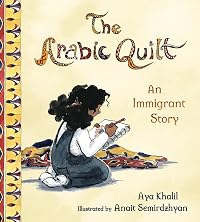
The Arabic Quilt: An Immigrant Story
by Aya Khalil (Author), Anait Semirdzhyan (Illustrator)
The Arabic Quilt (1)
On This Page
Description
The beautiful story of diversity follows a young girl named Kanzi whose most treasured reminder of her old home provides a pathway for acceptance in her new one.Tags
Recommendations



Member Reviews
I was the daughter of immigrants coming of age in the late 1960s and early 1970s. I remember cringing at how different my food was from my peers and how — well, alien — my parents were. So The Arabic Quilt: An Immigrant Story really hit home on that level. At the same time, as a teacher, I have many students who themselves the children of immigrants. I like to believe it’s easier now; however, the need for this book tells me it’s not really.
Kanzi, a recent immigrant from Egypt, so desperately wants her classmates to like her; however, on her very first day, a careless student makes Kanzi aware of her “otherness.” Author Aya Khalil pieces together a wonderful story that never overwhelms with its message. It’s as beautiful show more as the quilt created by Kanzi’s beloved teita (grandma) and Anait Semirdzhayan’s poignant illustrations.
In the interest of full disclosure, I received this book from NetGalley, Myrick Marketing & Media, and Tilbury House Publishers in exchange for an honest review. show less
Kanzi, a recent immigrant from Egypt, so desperately wants her classmates to like her; however, on her very first day, a careless student makes Kanzi aware of her “otherness.” Author Aya Khalil pieces together a wonderful story that never overwhelms with its message. It’s as beautiful show more as the quilt created by Kanzi’s beloved teita (grandma) and Anait Semirdzhayan’s poignant illustrations.
In the interest of full disclosure, I received this book from NetGalley, Myrick Marketing & Media, and Tilbury House Publishers in exchange for an honest review. show less
Egyptian-American third-grader Kanzi is concerned about fitting in at her new school. When her mother comes to drop off her lunch and a classmate makes fun of her language, Kanzi winds up in tears. Her white teacher responds with kindness, not just comforting Kanzi and asking her white classmate to apologize, but inventing an inclusive class project: Kanzi brings in the quilt her grandmother made, and she and her mother show everyone how to write their names in Arabic. The teacher then pieces together each name square and hangs it in the hallway, inspiring another teacher to do the same (in Japanese).
A beautiful book on its own, and a wonderful conversation-starter about what it really means to be American, bilingual, an immigrant. show more Back matter contains a glossary of Arabic words in Egyptian dialect (the teacher also writes several English words on the blackboard that derive from Arabic, such as coffee and algebra). show less
A beautiful book on its own, and a wonderful conversation-starter about what it really means to be American, bilingual, an immigrant. show more Back matter contains a glossary of Arabic words in Egyptian dialect (the teacher also writes several English words on the blackboard that derive from Arabic, such as coffee and algebra). show less
This story gives the readers an insight into the immigrant experience as Kanzi faces rude comments about her culture. Eventually the class creates a quilt with everybody's name prompting other classes to take on a similar approach to welcome culturally diverse students.
This is a wonderful story of a girl who is new to her school and shares her family's heritage and language with her new classmates. In sharing her story, she inspires others to share about themselves too. The story includes emotions of embarrassment, othering, diverse interests, and ultimately of pride and understanding. This is a great book to use for identity celebration lessons and you could pair it with a lesson where students make their own class quilts about their identities. The book features traditional Egyptian food and Egyptian American characters and features Arabic language. This is a great book to celebrate various cultures and languages and helps develop understanding.
An innocuous story about an Egyptian American girl overcoming some bullying at her new school by being able to share her culture with her class.
Incredibly, this gentle book got swept up in the anti-diversity book banning currently vexing our public schools, inspiring the author to create a sequel: The Great Banned-Books Bake Sale.
Incredibly, this gentle book got swept up in the anti-diversity book banning currently vexing our public schools, inspiring the author to create a sequel: The Great Banned-Books Bake Sale.
This book has been banned, I've heard. The only possible reason for challenging it would be racism. There's nothing naughty or mature or anything. Even the snooty white girl, who at first parroted her mother's insular (and racist) perspective is eventually glad to have gradually learned about the beauty of diversity.
A lovely book for anyone, and an ode to teachers who, though maybe white themselves, are doing their darndest to be loving and respectful to all their students.
A lovely book for anyone, and an ode to teachers who, though maybe white themselves, are doing their darndest to be loving and respectful to all their students.
Summary: It follows the story of a young girl coming from a different country to America. She goes to school for the first day and is bullied by a girl who does not like how she speaks a different language. She ends up making a project for her class with an Arabic quilt and makes friends which helps her accept herself for who she is.
Reflection: I love this story because it shows the true story of what immigrants go through in America. I really connected to this story and how Molly was saying people should only speak one language really reminded me of another real-life experience my mom went through exactly like that one in the book. It is a good book and shows how languages are a beautiful thing and make everything unique.
Reflection: I love this story because it shows the true story of what immigrants go through in America. I really connected to this story and how Molly was saying people should only speak one language really reminded me of another real-life experience my mom went through exactly like that one in the book. It is a good book and shows how languages are a beautiful thing and make everything unique.
Members
- Recently Added By
Lists

Youth: DEI
296 works; 2 members

SYES Library Wishlist
1,080 works; 4 members
Author Information

Awards and Honors
Awards
Notable Lists
Series

Common Knowledge
- Canonical title
- The Arabic Quilt: An Immigrant Story
- Original publication date
- 2020
- People/Characters
- Kanzi; Kanzi's mother; Kanzi's father; Kanzi's brother; Mrs. Haugen (teacher); Molly (bully)
- Dedication
- To Tota and Geddo. - A.K.
To my bilingual twins, Yulia and Yana. - A.S. - First words
- "Kanzi, habibti, you're going to be late to the first day of school," Mama calls.
- Last words
- (Click to show. Warning: May contain spoilers.)I will never be ashamed to speak,
in this language that is so unique.
Bahebek, Mama.
Bahebak, Baba. - Original language
- English
Classifications
Statistics
- Members
- 252
- Popularity
- 128,416
- Reviews
- 19
- Rating
- (4.56)
- Languages
- English
- Media
- Paper, Audiobook, Ebook
- ISBNs
- 8
- ASINs
- 1