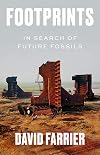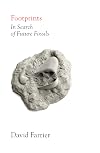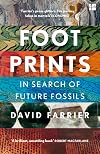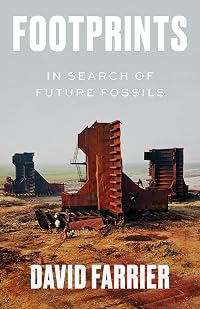
Footprints: In Search of Future Fossils
by David Farrier
On This Page
Description
The author surveys the traces we will leave for peoples in the very distant future. He shows that modern civilization has created objects and landscapes with the potential to endure through deep time, including the plastic polluting the oceans, the nuclear waste entombed within the earth, and the thirty million miles of paved roads spanning the planet. This is his meditation on climate change and the Anthropocene, and an urgent search for fossils--industrial, chemical, geological--that show more humans are leaving behind. -- adapted from inside front dust jacket. show lessTags
Recommendations


Member Reviews
My non-fiction reading has been sparse lately and 'Footprints' further supported my theory about this. It seems I cannot cope with straight-up social science at present. The pandemic has made reality, which was already pretty horrifying prior to it, too alarming to apply economic, political or social analysis to. However, I can still cope with books on subjects like environmental destruction if they are written from a disciplinary perspective outside the social sciences. Recent examples are [b:Braiding Sweetgrass: Indigenous Wisdom, Scientific Knowledge, and the Teachings of Plants|17465709|Braiding Sweetgrass Indigenous Wisdom, Scientific Knowledge, and the Teachings of Plants|Robin Wall show more Kimmerer|https://i.gr-assets.com/images/S/compressed.photo.goodreads.com/books/1366775928l/17465709._SY75_.jpg|24362458], which combines indigenous history and plant science, and 'Footprints', which is written by an English Literature professor. Ostensibly, the topic of what evidence of human civilisation will survive for hundreds of thousands, or even millions of years, is something of a downer. Areas of focus include the destruction of coral reefs, disposal of nuclear waste, volumes of plastic and other slow-decaying materials, and sea level rise due to climate change. I was reminded of several extremely depressing things that had slipped my mind, including the extent to which we have fucked up the nitrogen cycle. Yet I kept reading and finished the whole book in an evening.
I do not mean to say that 'Footprints' trivialises its subject matter, however it does aestheticise it. The fact that anecdotes and facts about environmental destruction are recounted with literary allusions for context shapes the reading experience significantly. The same material would probably have devastated me if contextualised with political or economic theory and supported by statistics, whereas Farrier's writing gives the reader distance. Although he appears sincere in his environmental concern, it is refracted into elegant fragments via Borges, Shakespeare, Sophocles, and Barthes. The specific experiences he describes, such as diving on the Great Barrier Reef and visiting a Finnish repository for nuclear waste, appear as fascinating curiosities. The tone of the book is not angry at all, rather it is curious and keen to find beauty and interest in decay and destruction. This is not entirely dissimilar to [b:Braiding Sweetgrass: Indigenous Wisdom, Scientific Knowledge, and the Teachings of Plants|17465709|Braiding Sweetgrass Indigenous Wisdom, Scientific Knowledge, and the Teachings of Plants|Robin Wall Kimmerer|https://i.gr-assets.com/images/S/compressed.photo.goodreads.com/books/1366775928l/17465709._SY75_.jpg|24362458], although there is much less distance there and more determined hope of renewal. Of course, 'Footprints' is fundamentally concerned with extremely long timescales, so temporal and emotional distance are integral to the project.
Farrier writes beautifully and 'Footprints' contains many arresting images and memorable details. I enjoyed it, while feeling keenly aware of its limitations. By focusing on objects, substances, and environmental changes that will last thousands or millions of years, Farrier sidesteps the human side of things and tacitly assumes that by that time people will be long gone. Human extinction as a result of capitalism-driven environmental destruction is a subject that should invoke outrage, horror, and a desire for change. Not every book about the environment can or should deal with that head-on. Yet when I read those that don't, I feel guilty about the more hard-hitting unread books on my shelf that I can't face right now, like [b:Climate Leviathan: A Political Theory of Our Planetary Future|34146147|Climate Leviathan A Political Theory of Our Planetary Future|Joel Wainwright|https://i.gr-assets.com/images/S/compressed.photo.goodreads.com/books/1498926163l/34146147._SX50_.jpg|55183185] and [b:Corona, Climate, Chronic Emergency: War Communism in the Twenty-First Century|54619224|Corona, Climate, Chronic Emergency War Communism in the Twenty-First Century|Andreas Malm|https://i.gr-assets.com/images/S/compressed.photo.goodreads.com/books/1595822734l/54619224._SY75_.jpg|85217012]. I can appreciate the aesthetics of ice cores, dying coral, and architecture for the long term storage of nuclear waste, but only with a certain ambivalence. What human civilisation leaves behind will be shaped not only by our economic, social, and political past, but also our immediate future. I think it's important not to step too far back from that, while also being aware that there's only so much existential fear one can confront and still be able to function as a person. 'Footprints' is gentle enough to be suitable reading during Year 2 of The Great Plague, however it is not sufficient. Angrier and more analytical social science writing on such topics is very much needed as well. show less
I do not mean to say that 'Footprints' trivialises its subject matter, however it does aestheticise it. The fact that anecdotes and facts about environmental destruction are recounted with literary allusions for context shapes the reading experience significantly. The same material would probably have devastated me if contextualised with political or economic theory and supported by statistics, whereas Farrier's writing gives the reader distance. Although he appears sincere in his environmental concern, it is refracted into elegant fragments via Borges, Shakespeare, Sophocles, and Barthes. The specific experiences he describes, such as diving on the Great Barrier Reef and visiting a Finnish repository for nuclear waste, appear as fascinating curiosities. The tone of the book is not angry at all, rather it is curious and keen to find beauty and interest in decay and destruction. This is not entirely dissimilar to [b:Braiding Sweetgrass: Indigenous Wisdom, Scientific Knowledge, and the Teachings of Plants|17465709|Braiding Sweetgrass Indigenous Wisdom, Scientific Knowledge, and the Teachings of Plants|Robin Wall Kimmerer|https://i.gr-assets.com/images/S/compressed.photo.goodreads.com/books/1366775928l/17465709._SY75_.jpg|24362458], although there is much less distance there and more determined hope of renewal. Of course, 'Footprints' is fundamentally concerned with extremely long timescales, so temporal and emotional distance are integral to the project.
Farrier writes beautifully and 'Footprints' contains many arresting images and memorable details. I enjoyed it, while feeling keenly aware of its limitations. By focusing on objects, substances, and environmental changes that will last thousands or millions of years, Farrier sidesteps the human side of things and tacitly assumes that by that time people will be long gone. Human extinction as a result of capitalism-driven environmental destruction is a subject that should invoke outrage, horror, and a desire for change. Not every book about the environment can or should deal with that head-on. Yet when I read those that don't, I feel guilty about the more hard-hitting unread books on my shelf that I can't face right now, like [b:Climate Leviathan: A Political Theory of Our Planetary Future|34146147|Climate Leviathan A Political Theory of Our Planetary Future|Joel Wainwright|https://i.gr-assets.com/images/S/compressed.photo.goodreads.com/books/1498926163l/34146147._SX50_.jpg|55183185] and [b:Corona, Climate, Chronic Emergency: War Communism in the Twenty-First Century|54619224|Corona, Climate, Chronic Emergency War Communism in the Twenty-First Century|Andreas Malm|https://i.gr-assets.com/images/S/compressed.photo.goodreads.com/books/1595822734l/54619224._SY75_.jpg|85217012]. I can appreciate the aesthetics of ice cores, dying coral, and architecture for the long term storage of nuclear waste, but only with a certain ambivalence. What human civilisation leaves behind will be shaped not only by our economic, social, and political past, but also our immediate future. I think it's important not to step too far back from that, while also being aware that there's only so much existential fear one can confront and still be able to function as a person. 'Footprints' is gentle enough to be suitable reading during Year 2 of The Great Plague, however it is not sufficient. Angrier and more analytical social science writing on such topics is very much needed as well. show less
David Farrier is a Scottish professor of literature and takes a journey around the world considering what trace elements future archaeologists might discover of our civilization millions of years hence. I hesitate to give away too much because that is a plot spoiler, but for example there are the usual suspects like plastics and radiation. He makes a case the longest lived artifacts will be in space such as junk on the moon or in geosynchronous orbit, also oil and gas bore holes in areas of stable geography since they punch down far beneath the surface making them immune from erosion. His writing is informed by literature and there are quite a few allusions to classic novels and poetry. It is oddly comforting to think along these very show more long time scales as it makes what is happening in the shorter time of global warming, say the next 100k years, seem less momentous. show less
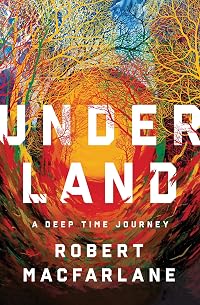
If you'd like to know what I thought of this book, just read my review of Robert MacFarlane's Underland. Perhaps it was unwise to read these so closely together because there are passages in this book which are repeated almost verbatim in the former.
Oh well!
It's still profoundly disturbing, as it does take a more narrow view at specifically human influence upon the world.
Oh well!
It's still profoundly disturbing, as it does take a more narrow view at specifically human influence upon the world.
Ratings
Members
- Recently Added By
Lists

Books cited in Progress by Samuel McDonald
160 works; 1 member
Author Information
12+ Works 153 Members
David Farrier is senior lecturer in modern and contemporary literature at the University of Edinburgh. He is author of Unsettled Narratives: The Pacific Writings of Stevenson, Ellis, Melville, and London and Postcolonial Asylum: Seeking Sanctuary before the Law.
Awards and Honors
Common Knowledge
- Original publication date
- 2020
- Dedication
- For Isaac and Annie
- Blurbers
- Hoare, Philip; Francis, Gavin
Classifications
- Genres
- Science & Nature, Nonfiction, General Nonfiction, Travel
- DDC/MDS
- 304.2 — Society, government, & culture Social sciences, sociology & anthropology Factors affecting social behavior Human ecology
- LCC
- GF47 .F37 — Geography, Anthropology and Recreation Human ecology. Anthropogeography Human ecology. Anthropogeography
- BISAC
Statistics
- Members
- 110
- Popularity
- 295,982
- Reviews
- 3
- Rating
- (3.86)
- Languages
- English, Spanish
- Media
- Paper, Audiobook, Ebook
- ISBNs
- 9
- ASINs
- 4