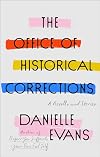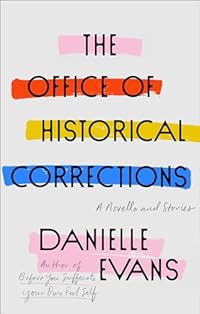
The Office of Historical Corrections: A Novella and Stories
by Danielle Evans
On This Page
Description
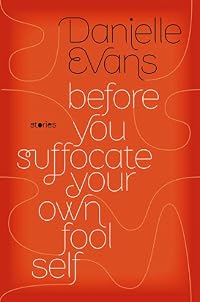
"The award-winning author of Before You Suffocate Your Own Fool Self brings her signature voice and insight to the subjects of race, grief, apology, and American history. Danielle Evans is widely acclaimed for her blisteringly smart voice and x-ray insights into the complex human relationships. With The Office of Historical Corrections, Evans zooms in on particular moments and relationships in her characters' lives in a way that allows them to speak to larger issues of race, culture, and show more history. She introduces us to Black and multi-racial characters who are experiencing the universal confusions of lust and love, and getting walloped by grief--all while exploring how history haunts us, personally and collectively. Ultimately, she provokes us to think about the truths of American history - about who gets to tell them, and the cost of setting the record straight. In "Boys Go to Jupiter" a white college student tries to reinvent herself after a photo of her in a confederate flag bikini goes viral. In "Richard of York Gave Battle in Vain" a photojournalist is forced to confront her own losses while attending an old friend's unexpectedly dramatic wedding. And in the eye-opening title novella, a black scholar from Washington DC is drawn into a complex historical mystery that spans generations and puts her job, her love life, and her oldest friendship at risk"-- show lessTags
Recommendations







Member Reviews
The novella title of the collection was my favorite, but the other stories are excellent too - all looking at ways to 'revise' history - from the personal to the political. There is sly humor in all of them and also upfront effort to right wrongs - and definitely a strong theme of empowered women. "Why Won't Women Just Say What They Want" is a genius satire featuring all the thrown-over women of a self-absorbed artist who makes efforts to make amends to them all - only for the self-gain it becomes as his art installation called Forgiveness. The women have the last laugh. "Alcatraz" is a touching story of family history and the lengths people go to to support those they love. Cecilia supports her mother who is fighting the lost cause of show more trying to get reparations for her own grandfather's inaccurate dishonorable discharge during WWII. Cecilia says: "I kept the running tally for years after that afternoon [at Alcatraz]...even after my mother stopped requesting it, even after I had stopped thinking of the world as a place that kept track of what it owed people, even after I stopped thinking of myself as a person who had the power to make demands of the world and learned to be a person who came up with her own small daily answers like everyone else." (112-13) "Boys Go to Jupiter" is chilling in the naivete and short-sightedness young people employ regarding social media and the ways they cover hurt and pain with recklessness and the desire to hurt others. After being tagged on Instagram wearing a bikini with the Confederate flag, Claire finds herself in the middle of a maelstrom of her own creation, but instead of trying to make it right, she doubles down in stubbornness which backfires when her past is revealed - also thanks to social media. But the best of the lot, The Office of Historical Corrections needs the additional length to tease out a thoughtful story that examines race, history, rivalry, truth and who gets to use it. Cassie works for a governmental office in DC called the Institute for Public History (known to its employees as the Office of Historical Corrections). Its role is to be a "national network of fact-checkers and historians, a friendly citizen army devoted to making the truth so accessible and appealing it could not be ignored....an NIH for a different sort of public healthy crises. We were the solution for decades of bad information and bad faith use of it." 165 As a young black woman, she is often trotted out to be the public face of some of these corrections because she is calm, professorial, and non-threatening. Despite this sometimes exploitative role, she loves her work ("...an urgency about the kind of work we were doing and the belief that the truth was our last best hope...." 175) and rights wrongs all over the city - a Juneteenth cake at a bakery for example that had the wrong premise attached to the day. She uses a little hand-held printer to create a sticker to place over the incorrect info, with an official IPH seal and feels like she is making a difference. She is called to handle bigger issues occasionally - and that forms the real crux of the story here - a longtime frenemy, Genevieve, another professional black woman has gone rogue and made the duty of corrections more personal. Though she was fired, she left a few hotspots in her wake and also acted off the record/payroll to correct a memorial plaque in small town WI honoring the town's first (only) Black man, Josiah Wynslow who owned a business and perished in a fire. Genevieve uncovered that the fire was started by white folks in the town, who then took over the property for their own gain, so her 'correction' put up a new plaque naming all those who took part (whose descendants still live in the area) and setting the record straight. This attracted the attention of a local white supremacist (White Justice, part of the fringe group Free Americans) who turns this into a vendetta that makes the national news. Cassie's job is to uncover the real truth (somewhere in the middle) and make it a PR situation for the good. She travels there, recalling time she spent in Eau Claire and pegging it: "I didn't trust the state...I had felt dazzled by its beauty and also claustrophobic the whole time, charmed by and hostile toward a region I had never entirely forgiven for its commitment to civility and conflict avoidance. Midwest nice was a steady, polite gaslighting I found sinister, a forced humility that prevented anyone from speaking up when they'd been diminished or disrespected lest they be labeled an outsider. I was bewildered by the pride the region took in these pathologies." (194) When Cassie arrives, Genevieve is already there, hoping to stoke this into something she can turn into an article or book, her new gig. What they discover and what results is something neither of them bargained for and is beyond their power to correct. show less
A collection of six short stories and one novella of about 100 pages, all of which deal, in some fashion or other, with the complicated and often enraging experiences of being Black and/or female in America.
Several of the short stories do a particular kind of literary-fiction thing that doesn't always work for me, where they feel like they have just enough of something that feels sort of plot-shaped to be unsatisfying when they don't resolve in a plotty way, after all. But Evans' writing is so clear and sharp and insightful that it swept any such dissatisfaction quite effectively aside. That was true for the titular novella, too, which for a while I thought might have the opposite problem -- too much focus on a slowly developing plot show more whose basic premise I had some trouble buying, perhaps -- but which certainly won me over by the end, having turned out to have a great deal to say and an impactful way of saying it. And then there's the story "Why Won't Women Just Say What they Want," which could be described as a sort of parable about the #metoo movement and male 'apologies,' which was just unreservedly brilliant in a way that hit me like a ton of bricks. show less
Several of the short stories do a particular kind of literary-fiction thing that doesn't always work for me, where they feel like they have just enough of something that feels sort of plot-shaped to be unsatisfying when they don't resolve in a plotty way, after all. But Evans' writing is so clear and sharp and insightful that it swept any such dissatisfaction quite effectively aside. That was true for the titular novella, too, which for a while I thought might have the opposite problem -- too much focus on a slowly developing plot show more whose basic premise I had some trouble buying, perhaps -- but which certainly won me over by the end, having turned out to have a great deal to say and an impactful way of saying it. And then there's the story "Why Won't Women Just Say What they Want," which could be described as a sort of parable about the #metoo movement and male 'apologies,' which was just unreservedly brilliant in a way that hit me like a ton of bricks. show less
A stunning, immersive series of stories (and a novella). In "Boys Go to Jupiter," college freshman Claire is photographed in a Confederate flag bikini purchased by the boy she's dating to annoy her stepmother; when a photo on social media riles her campus, Claire doubles down instead of apologizing; but behind Claire's floundering is her grief over her own dead mother, and the loss, through estrangement, of her "second mother," her best friend's mother who also battled cancer, but survived. In "Anything Could Disappear," Vera is on a bus to New York to help her former employer with a drug deal when a woman leaves one of her children on the bus with Vera; after a halfhearted attempt to see if anyone is looking for the boy, Vera takes show more care of him for several months, before searching again and returning him to his father, then disappearing again. In "Why Won't Women Just Say What They Want," a male artist leaves public apologies for all of the women he has wronged. And in "The Office of Historical Corrections," Cassie works at the Institute for Public History, and is sent to correct a correction made by her former colleague and lifelong friend/competition, Genevieve. In Wisconsin, the women discover there is more to the story - including, likely, a Black woman who passed as white, whose grandson is a violent white supremacist.
Epigraphs: James Baldwin and Lucille Clifton
"Happily Ever After"
...sometimes all it took to become something was to want it. (12)
"Alcatraz"
...wonder what she wanted me to do with a cautionary tale in which the caution was against growing up. (87)
"They're still your family," I insisted.
"They are NOT my family," my mother said. "We're just related." (92)
...you take nothing for granted when the price of it is etched across the face of the person you love the most, when you are born into a series of loans and know you will never by up to the cost of the debt. (95)
Here is what you have to understand about my mother's childhood: it wasn't one. (99)
"Anything Could Disappear"
Vera got good at pretending not to notice people who didn't want to be seen. (139)
"The Office of Historical Corrections"
She thought the insistence on victims without wrongdoers was at the base of the whole American problem, the lie that supported all the others. (186)
Midwest nice was a steady, polite gaslighting I found sinister, a forced humility that prevented anyone from speaking up when they'd been diminished or disrespected, lest they be labeled an outsider. (194)
Things started quickly between us but then didn't seem to know where to go. (200)
"...because you know how white people love their history right up until it's true." (Genie to Cassie, 222)
"You know how to be careful and you know how to do the right thing, but you've never known how to do both." (Genevieve to Cassie, 223)
I left...with the anticlimactic sense that my job was both done and forever undoable, a simple matter of reconciling the record books and an impossible matter of making any kind of actual repair. (239)
...the loop of history that was always a noose if you looked at it long enough. (249)
"The beauty of motherhood is that all the choices are wrong." (Genevieve, 258)
"People can convince themselves of anything if they want badly enough to believe it."
"Why are you doing any of this then? If you don't think telling people the truth makes a difference?" (259) show less
Epigraphs: James Baldwin and Lucille Clifton
"Happily Ever After"
...sometimes all it took to become something was to want it. (12)
"Alcatraz"
...wonder what she wanted me to do with a cautionary tale in which the caution was against growing up. (87)
"They're still your family," I insisted.
"They are NOT my family," my mother said. "We're just related." (92)
...you take nothing for granted when the price of it is etched across the face of the person you love the most, when you are born into a series of loans and know you will never by up to the cost of the debt. (95)
Here is what you have to understand about my mother's childhood: it wasn't one. (99)
"Anything Could Disappear"
Vera got good at pretending not to notice people who didn't want to be seen. (139)
"The Office of Historical Corrections"
She thought the insistence on victims without wrongdoers was at the base of the whole American problem, the lie that supported all the others. (186)
Midwest nice was a steady, polite gaslighting I found sinister, a forced humility that prevented anyone from speaking up when they'd been diminished or disrespected, lest they be labeled an outsider. (194)
Things started quickly between us but then didn't seem to know where to go. (200)
"...because you know how white people love their history right up until it's true." (Genie to Cassie, 222)
"You know how to be careful and you know how to do the right thing, but you've never known how to do both." (Genevieve to Cassie, 223)
I left...with the anticlimactic sense that my job was both done and forever undoable, a simple matter of reconciling the record books and an impossible matter of making any kind of actual repair. (239)
...the loop of history that was always a noose if you looked at it long enough. (249)
"The beauty of motherhood is that all the choices are wrong." (Genevieve, 258)
"People can convince themselves of anything if they want badly enough to believe it."
"Why are you doing any of this then? If you don't think telling people the truth makes a difference?" (259) show less
The six short stories and following novella in this collection each involve trauma, though often that occurs out of shot and sometimes much earlier than the main story’s action. But the after effects of trauma are never not first and foremost in the minds of its victims. Sometimes that trauma can be murder, or attempted murder. The murder or attempted murder of an individual. Or the murder or attempted murder of an entire race. Because racism — the kind of incessant, ingrained, pervasive and systemic racism that can be found in America — is an attempt to efface someone’s very humanity. One of Evans’ characters repeatedly asks herself, “Do they know I’m human yet?” Sadly, very often the answer is no, they don’t.
Although show more I enjoyed every story here, including the titular novella, by far the most stunning, for me, is, “Richard of York Gave Battle in Vain.” It is sophisticated and worldly and hilariously scathing of some of the absurdities of suburban life. But at the same time it is incredibly and movingly sad. That juxtaposition of laughter and pathos might be said to typify much of Evans’ writing. But here it reaches new heights. This one story is worth the price of admission for the whole collection and should be anthologized as often as possible.
Evans continues to impress. I look forward to whatever she writes next.
Recommended. show less
Although show more I enjoyed every story here, including the titular novella, by far the most stunning, for me, is, “Richard of York Gave Battle in Vain.” It is sophisticated and worldly and hilariously scathing of some of the absurdities of suburban life. But at the same time it is incredibly and movingly sad. That juxtaposition of laughter and pathos might be said to typify much of Evans’ writing. But here it reaches new heights. This one story is worth the price of admission for the whole collection and should be anthologized as often as possible.
Evans continues to impress. I look forward to whatever she writes next.
Recommended. show less
Holy shit. A beautiful and horrifying series of 6 short stories and a novella. The book focuses on themes of race, culture, history, and gender in tottally unique and insightful ways. Who gets to tell us the truths of American History, and what is the cost of setting these stories straight.
I really enjoyed the short stories Richard of York Gave Battle in Vain and Anything Could Disappear.
The Office of Historical Corrections was a really fascinating look into family histories and the relationships we make. The ending was astonishing.
Read more short stories and novellas!
I really enjoyed the short stories Richard of York Gave Battle in Vain and Anything Could Disappear.
The Office of Historical Corrections was a really fascinating look into family histories and the relationships we make. The ending was astonishing.
Read more short stories and novellas!
Attention to the Invisible
Danielle Evans’ collection of six short stories and the novella of the title focus on subjects most anybody can relate to: marriage, love, work, and hurt. All these come at you from a Black perspective that includes symbols of hate, whitewashed history, and a dispelling of seeing a race as monolithic. And many of these appear threaded through “The Office of Historical Corrections,” wherein Cassie and Genevieve provide differing views of the Black upper class, work, marriage, and how to address historical inaccuracies. This story delivers a couple of twists, one obvious and one less so. It also rests on a central fantasy, that a nation really would establish an Institute of Public History with the show more objective of setting straight all manner, large and small, of historical falsehoods and misconceptions pertaining to Blacks in America. In other words, it addresses the subtle but potent prejudices in everything, even as small as the name of a cake.
You’ll be tempted to jump right to this novella, but if you do be sure go back and read the other stories. You’ll recognize many themes as being universal. For instance, “Richard of York Gave Battle in Vain” concerns a wedding in which the bride believes a friend has slept with her fiancé. She excludes her from the wedding party but invites her to the affair, ostensively to discover if her suspicion is true. Things, however, speed off the rails to reveal lots about the women. In “Boys Go to Jupiter,” that symbol of slavery, hate, and racism, the Confederate flag, shows up on the bikini of a young white student who when confronted defends her choice, and it turns out there is something below the surface, and maybe the woman isn’t quiet what the symbol says about her. Or “Why Won’t Women Just Say What They Want,” featuring a famous artist who has used and abused women and turned his torrent of apologies into only oblique attacks but a new art project.
Evans writes deftly, especially when it comes to layering in revealing subtleties about her characters, as well as the pervasiveness of underlying racism in America, mostly always invisible to White Americans. show less
Danielle Evans’ collection of six short stories and the novella of the title focus on subjects most anybody can relate to: marriage, love, work, and hurt. All these come at you from a Black perspective that includes symbols of hate, whitewashed history, and a dispelling of seeing a race as monolithic. And many of these appear threaded through “The Office of Historical Corrections,” wherein Cassie and Genevieve provide differing views of the Black upper class, work, marriage, and how to address historical inaccuracies. This story delivers a couple of twists, one obvious and one less so. It also rests on a central fantasy, that a nation really would establish an Institute of Public History with the show more objective of setting straight all manner, large and small, of historical falsehoods and misconceptions pertaining to Blacks in America. In other words, it addresses the subtle but potent prejudices in everything, even as small as the name of a cake.
You’ll be tempted to jump right to this novella, but if you do be sure go back and read the other stories. You’ll recognize many themes as being universal. For instance, “Richard of York Gave Battle in Vain” concerns a wedding in which the bride believes a friend has slept with her fiancé. She excludes her from the wedding party but invites her to the affair, ostensively to discover if her suspicion is true. Things, however, speed off the rails to reveal lots about the women. In “Boys Go to Jupiter,” that symbol of slavery, hate, and racism, the Confederate flag, shows up on the bikini of a young white student who when confronted defends her choice, and it turns out there is something below the surface, and maybe the woman isn’t quiet what the symbol says about her. Or “Why Won’t Women Just Say What They Want,” featuring a famous artist who has used and abused women and turned his torrent of apologies into only oblique attacks but a new art project.
Evans writes deftly, especially when it comes to layering in revealing subtleties about her characters, as well as the pervasiveness of underlying racism in America, mostly always invisible to White Americans. show less
"How's conquering the world going, my sweet ruthless girl?"
How did I not know how amazing this author is?! I'm bummed I'm so late to the party - this book of short stories was absolutely phenomenal. Sometimes when I get in a reading slump, I read something short or I read a compilation of short stories. They are perfect to just suck you in and then spit you back out of a story and I love it!
And what an amazing collection this is! Each one felt like a fully formed story - none left me wondering why it was included or what was the purpose. All were subtly layered with such insight and things that made me pause after each story and just sit and think and wonder and really. . . sit with it. Such a great storyteller, I will definitely look show more for more from this author! show less
How did I not know how amazing this author is?! I'm bummed I'm so late to the party - this book of short stories was absolutely phenomenal. Sometimes when I get in a reading slump, I read something short or I read a compilation of short stories. They are perfect to just suck you in and then spit you back out of a story and I love it!
And what an amazing collection this is! Each one felt like a fully formed story - none left me wondering why it was included or what was the purpose. All were subtly layered with such insight and things that made me pause after each story and just sit and think and wonder and really. . . sit with it. Such a great storyteller, I will definitely look show more for more from this author! show less
Members
- Recently Added By
Lists

Top Five Books of 2020
982 works; 350 members

Top Five Books of 2022
736 works; 272 members

2021 Notable Books for Adults
24 works; 4 members

Books Read in 2021
5,361 works; 114 members
Author Information

3+ Works 1,532 Members
Some Editions
Awards and Honors
Awards
Distinctions
Notable Lists
Common Knowledge
- Publisher's editor
- McGrath, Sarah
- Canonical DDC/MDS
- 813.6
- Canonical LCC
- PS3605.V3648
Classifications
Statistics
- Members
- 999
- Popularity
- 26,004
- Reviews
- 31
- Rating
- (4.14)
- Languages
- English, Italian
- Media
- Paper, Audiobook, Ebook
- ISBNs
- 11
- ASINs
- 3