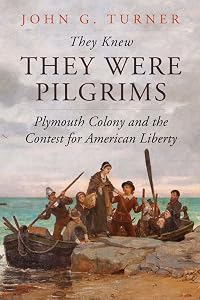
They Knew They Were Pilgrims: Plymouth Colony and the Contest for American Liberty
by John G. Turner
On This Page
Description
An ambitious new history of the Pilgrims and Plymouth Colony, published for the 400th anniversary of the Mayflower’s landing In 1620, separatists from the Church of England set sail across the Atlantic aboard the Mayflower. Understanding themselves as spiritual pilgrims, they left to preserve their liberty to worship God in accordance with their understanding of the Bible. There exists, however, an alternative, more dispiriting version of their story. In it, the Pilgrims are religious show more zealots who persecuted dissenters and decimated the Native peoples through warfare and by stealing their land. The Pilgrims’ definition of liberty was, in practice, very narrow. Drawing on original research using underutilized sources, John G. Turner moves beyond these familiar narratives in his sweeping and authoritative new history of Plymouth Colony. Instead of depicting the Pilgrims as otherworldly saints or extraordinary sinners, he tells how a variety of English settlers and Native peoples engaged in a contest for the meaning of American liberty. show lessTags
Recommendations

























Member Reviews
John G. Turner’s They Knew They Were Pilgrims takes a fresh look at the Plymouth Colony, pulling back the curtain on the comforting myths most of us grew up with. Instead of treating the Pilgrims as flawless champions of religious freedom, Turner shows how their idea of liberty often stopped short of anyone who thought differently—whether it was Native Americans, Quakers, or even neighbors with slightly different views. He argues that Plymouth’s story, often overshadowed by Massachusetts Bay, actually speaks volumes about the larger struggle over freedom and authority in early America.
Turner doesn’t shy away from the hard stuff—like land theft, religious policing, and internal power struggles—and while the voices of Native show more peoples, women, and the enslaved are hard to find in the records, he works to bring them into the story where he can. The book paints liberty not as a clear-cut ideal, but as something messy, often self-serving, and hotly contested. In a world where even theological disagreements could get you kicked out of the community, it makes you wonder about the lines we still draw today—are they about truth, or just about control? It’s a thoughtful, well-researched read that will challenge how you think about the founding stories we like to tell. show less
Turner doesn’t shy away from the hard stuff—like land theft, religious policing, and internal power struggles—and while the voices of Native show more peoples, women, and the enslaved are hard to find in the records, he works to bring them into the story where he can. The book paints liberty not as a clear-cut ideal, but as something messy, often self-serving, and hotly contested. In a world where even theological disagreements could get you kicked out of the community, it makes you wonder about the lines we still draw today—are they about truth, or just about control? It’s a thoughtful, well-researched read that will challenge how you think about the founding stories we like to tell. show less
Turner argues that Plymouth is often dismissed as a backwater compared to Boston/the Massachusetts colony, but that its struggles over (suppressing) religious freedom and governance are relevant to the larger story of British colonization. Although he tries to give consideration to the experience of Native Americans, women, and enslaved people, it’s relatively hard given who left the records. Given the history of colonists fighting over things like the difference between sprinkling an infant with water during baptism and fully immersing the infant in cold Massachusetts water, I have to wonder what distinctions we make that might look ridiculous in four hundred years.
Little Compton, RI
Ratings
Members
- Recently Added By
Author Information
6+ Works 370 Members
Classifications
- Genres
- History, Nonfiction, General Nonfiction, Religion & Spirituality
- DDC/MDS
- 974.402 — History & geography History of North America Northeastern United States (New England and Middle Atlantic states) Massachusetts 1620-1776
- LCC
- F68 .T875 — Local History of the United States, Canada and Latin America United States local history Massachusetts
- BISAC
Statistics
- Members
- 85
- Popularity
- 371,777
- Reviews
- 3
- Rating
- (4.00)
- Languages
- English
- Media
- Paper, Audiobook, Ebook
- ISBNs
- 5
- ASINs
- 2