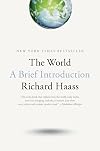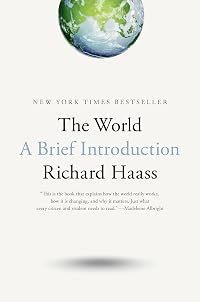
The World: A Brief Introduction
by Richard Haass
On This Page
Description
"This book is designed to provide readers with the background and building blocks they need in order to answer for themselves the critical questions about what is taking place around the world and why. It explains what makes each region of the world tick, the many challenges globalization presents, and the most influential countries, events, and ideas. Its aim is to help readers become more informed, discerning citizens, better able to arrive at sound, independent judgments and less show more vulnerable to being misled"-- show lessTags
Recommendations


Member Recommendations
Member Reviews
Here’s a disturbing thought: we live in a democracy in which it is not only possible, but highly likely, that one can complete their formal education without taking a single course in world history, politics, government, or economics. That’s true for the 70 percent of Americans whose formal education ends with high school as well as for the 30 percent who earn a college degree but focus almost exclusively on the technical courses associated with their major.
As Richard Haass writes:
“A recent survey of over eleven hundred American colleges and universities found that only 17 percent require students to take courses in U.S. government or history, while only 3 percent require them to take coursework in economics.”
Unless people are show more taking it upon themselves to learn these subjects, much of our voting public has zero experience or formal education in the subjects directly related to the issues they are voting on. You simply couldn’t ask for a population more primed for manipulation and propaganda than this.
This is the background and impetus for Richard Haass’s latest book, which seeks to correct this deficiency in knowledge by providing a crash course on the modern history of the world and the major global issues that dominate the news. While Haass can’t make you an expert in international relations in a single 300-page book, he can at least make you more conversant regarding world issues and events, less susceptible to propaganda, and better positioned to pursue further study.
The book is divided into four parts, which results in some repetition but also drives home some key points. The first part is a brief chronological history of the world from the Thirty Years’ War and Treaty of Westphalia through World War I, World War II, the Cold War, and up to the present day.
The second section covers each region of the world, including the Americas, Europe, Africa, the Middle East, South Asia, and East Asia and the Pacific. The third section covers global issues such as climate change, trade, immigration, and nuclear proliferation, and the fourth section describes the elements of global order and disorder and the balance of power.
As Haass notes, each chapter of the book deserves its own book—of which several have been written—but what Haass is attempting to provide is exactly what is missing: a higher-level overview of world history and international relations that can serve as a foundation for a deeper investigation of specific issues. This is beneficial, particularly for someone entirely new to the subject, as they may have difficulty knowing where to start without the benefit of seeing the bigger picture. And if one’s education in international relations were to consist solely from the reading of this book, that person would still be head-and-shoulders above most US citizens in their knowledge of the world.
The coverage, as far as I can tell, strives for objectivity without hiding the fact that the current US administration—by any reasonable understanding of history and politics—is placing the current world order at significant risk. The very things (in addition to nuclear deterrence) that have resulted in the long-term peace between nations since World War II, such as strong alliances, an increasing number of democracies, the delegitimization of war, and the creation of international organizations and law—all overseen by the US taking a leading role in the world—are slowly being replaced by nationalism, isolationism, xenophobia, and authoritarianism that makes global war and instability far more likely.
This is not to say that the US has not made significant mistakes in terms of foreign relations; it only suggests that the US, in isolating itself from the world order it helped to create, is only going to increase the level of instability and conflict in the world. World order does not happen on its own, and, without direction, there is a natural tendency to disorder—or to the emergence of another superpower willing to adopt the role vacated by the US (China).
While Haass’s coverage is extensive, I was surprised that inequality, while mentioned several times throughout the book, did not receive its own dedicated chapter, considering the significance of the issue. Growing levels of economic inequality have led to growing levels of political inequality, which has essentially led to the oligarchic capture of the US government. This is a major storyline worthy of further coverage, but the interested reader will have to look elsewhere. Personally, I would recommend checking out Robert Reich’s The System, Who Rigged It, How We Fix It.
Also absent from the book is any meaningful coverage of the intellectual movements underlying major political changes, such as the impact of the Scientific Revolution and the Age of Enlightenment on political thinking, particularly its influence on the US founders. The foundational political philosophy of the left and right—in large part established in the aftermath of the French Revolution by Thomas Paine (advocate of Enlightenment-era liberal ideas) and Edmund Burke (the philosophical founder of modern conservatism)—is not addressed.
But this is probably asking too much; The World admirably fulfills its basic purpose as a general introduction or refresher course on the state of the world, and represents a timely and much needed antidote to ignorance and the overconfidence that ignorance breeds. As Charles Darwin said, “Ignorance more frequently begets confidence than does knowledge.”
And what better description is there of the US voting population at large? Not only are we highly polarized; we’re also more sure of ourselves than ever—despite the fact that the data tells us almost everyone has no experience or education regarding the topics they are so overconfident about. We could all do ourselves a favor by reading this book and rethinking our positions from a more informed perspective. show less
As Richard Haass writes:
“A recent survey of over eleven hundred American colleges and universities found that only 17 percent require students to take courses in U.S. government or history, while only 3 percent require them to take coursework in economics.”
Unless people are show more taking it upon themselves to learn these subjects, much of our voting public has zero experience or formal education in the subjects directly related to the issues they are voting on. You simply couldn’t ask for a population more primed for manipulation and propaganda than this.
This is the background and impetus for Richard Haass’s latest book, which seeks to correct this deficiency in knowledge by providing a crash course on the modern history of the world and the major global issues that dominate the news. While Haass can’t make you an expert in international relations in a single 300-page book, he can at least make you more conversant regarding world issues and events, less susceptible to propaganda, and better positioned to pursue further study.
The book is divided into four parts, which results in some repetition but also drives home some key points. The first part is a brief chronological history of the world from the Thirty Years’ War and Treaty of Westphalia through World War I, World War II, the Cold War, and up to the present day.
The second section covers each region of the world, including the Americas, Europe, Africa, the Middle East, South Asia, and East Asia and the Pacific. The third section covers global issues such as climate change, trade, immigration, and nuclear proliferation, and the fourth section describes the elements of global order and disorder and the balance of power.
As Haass notes, each chapter of the book deserves its own book—of which several have been written—but what Haass is attempting to provide is exactly what is missing: a higher-level overview of world history and international relations that can serve as a foundation for a deeper investigation of specific issues. This is beneficial, particularly for someone entirely new to the subject, as they may have difficulty knowing where to start without the benefit of seeing the bigger picture. And if one’s education in international relations were to consist solely from the reading of this book, that person would still be head-and-shoulders above most US citizens in their knowledge of the world.
The coverage, as far as I can tell, strives for objectivity without hiding the fact that the current US administration—by any reasonable understanding of history and politics—is placing the current world order at significant risk. The very things (in addition to nuclear deterrence) that have resulted in the long-term peace between nations since World War II, such as strong alliances, an increasing number of democracies, the delegitimization of war, and the creation of international organizations and law—all overseen by the US taking a leading role in the world—are slowly being replaced by nationalism, isolationism, xenophobia, and authoritarianism that makes global war and instability far more likely.
This is not to say that the US has not made significant mistakes in terms of foreign relations; it only suggests that the US, in isolating itself from the world order it helped to create, is only going to increase the level of instability and conflict in the world. World order does not happen on its own, and, without direction, there is a natural tendency to disorder—or to the emergence of another superpower willing to adopt the role vacated by the US (China).
While Haass’s coverage is extensive, I was surprised that inequality, while mentioned several times throughout the book, did not receive its own dedicated chapter, considering the significance of the issue. Growing levels of economic inequality have led to growing levels of political inequality, which has essentially led to the oligarchic capture of the US government. This is a major storyline worthy of further coverage, but the interested reader will have to look elsewhere. Personally, I would recommend checking out Robert Reich’s The System, Who Rigged It, How We Fix It.
Also absent from the book is any meaningful coverage of the intellectual movements underlying major political changes, such as the impact of the Scientific Revolution and the Age of Enlightenment on political thinking, particularly its influence on the US founders. The foundational political philosophy of the left and right—in large part established in the aftermath of the French Revolution by Thomas Paine (advocate of Enlightenment-era liberal ideas) and Edmund Burke (the philosophical founder of modern conservatism)—is not addressed.
But this is probably asking too much; The World admirably fulfills its basic purpose as a general introduction or refresher course on the state of the world, and represents a timely and much needed antidote to ignorance and the overconfidence that ignorance breeds. As Charles Darwin said, “Ignorance more frequently begets confidence than does knowledge.”
And what better description is there of the US voting population at large? Not only are we highly polarized; we’re also more sure of ourselves than ever—despite the fact that the data tells us almost everyone has no experience or education regarding the topics they are so overconfident about. We could all do ourselves a favor by reading this book and rethinking our positions from a more informed perspective. show less
This book provides a useful overview of the world today and the challenges that we face. For me, I was familiar with most of the history that Haass presented in the book. The book was useful to me in that the author added some analysis and color to the facts, statistics and data he provided.
I agree with those reviewers who find that this would be a useful book for a high school and college students who are not familiar with world history, economics, geography and politics. But given the lack of knowledge shown by all age groups, this is an easy to read book that everyone can read.
Most books like this are complex, hard to understand and assumes a prior state of knowledge that a reader may not have. This book does not talk down to its show more readers. It's not intended to convince the reader of a particular point of view – – it's meant to provide information as impartially as possible.
There were two takeaways regarding challenges this country faces and the author presents them very well below:
All of this also requires that the United States get its own house in order – – reducing government debt, augmenting pandemic preparedness, reining in gun violence, reducing opioid abuse, rebuilding infrastructure, improving public education, investing more in basic research, adapting and expanding the social safety net, adopting a smart immigration system that allows talented foreigners to come and stay, healing the racial divide, ushering in police reform, and tackling the many manifestations of political dysfunction.
The real question going forward is whether the United States can recoup its reputation for reliability and restore the faith of its allies or whether there will be lingering doubts given the country's increasingly inward focus and its deepening political divisions, as underscored by the violence at the US capital on January 6, 2021. show less
I agree with those reviewers who find that this would be a useful book for a high school and college students who are not familiar with world history, economics, geography and politics. But given the lack of knowledge shown by all age groups, this is an easy to read book that everyone can read.
Most books like this are complex, hard to understand and assumes a prior state of knowledge that a reader may not have. This book does not talk down to its show more readers. It's not intended to convince the reader of a particular point of view – – it's meant to provide information as impartially as possible.
There were two takeaways regarding challenges this country faces and the author presents them very well below:
All of this also requires that the United States get its own house in order – – reducing government debt, augmenting pandemic preparedness, reining in gun violence, reducing opioid abuse, rebuilding infrastructure, improving public education, investing more in basic research, adapting and expanding the social safety net, adopting a smart immigration system that allows talented foreigners to come and stay, healing the racial divide, ushering in police reform, and tackling the many manifestations of political dysfunction.
The real question going forward is whether the United States can recoup its reputation for reliability and restore the faith of its allies or whether there will be lingering doubts given the country's increasingly inward focus and its deepening political divisions, as underscored by the violence at the US capital on January 6, 2021. show less
The title is accurate. The World, A BRIEF INTRODUCTION. Definitely gave me some good info and direction for further reading. If you expect to learn everything about the world in less than 400 pages of content, good luck.
After watching Richard on his many appearances on MSNBC Morning Joe, I was interested in seeing what he'd write about in this book. The problem- my fault- is that I'm not exactly sure what I expected to get out of this book. However, for a hint, again, see the book title.
I like the way he organized the book (historic eras, regions of the world, global issues we face, and order/ disorder).
You might not pick up anything extraordinarily new when you read this, but it might help you (me) determine what subjects/details you show more would like to study further!
I toggled between 3 and 4 stars. Still like this guy and will continue listening, and reading, what he has to say... show less
After watching Richard on his many appearances on MSNBC Morning Joe, I was interested in seeing what he'd write about in this book. The problem- my fault- is that I'm not exactly sure what I expected to get out of this book. However, for a hint, again, see the book title.
I like the way he organized the book (historic eras, regions of the world, global issues we face, and order/ disorder).
You might not pick up anything extraordinarily new when you read this, but it might help you (me) determine what subjects/details you show more would like to study further!
I toggled between 3 and 4 stars. Still like this guy and will continue listening, and reading, what he has to say... show less
I read this quickly, the prose is good, and the general story is interesting. It was interesting to start with the treaty of Westphalia at the end of the Thirty Years war, that agreement establishing the principles of statehood, respect for borders, and avoidance of interference with internal affairs in another state. The challenges facing the United States, China, Russia and India are detailed, including demographics, politics and economics. I had the sense that this was all familiar, however, to regular readers of the news. This would be an excellent book for a high school course on foreign relations and economics.
A Wall Street Journal reviewer did not like it, calling it “dry as dust” and a bureaucratic background brief
A Wall Street Journal reviewer did not like it, calling it “dry as dust” and a bureaucratic background brief
I was a happy camper reading this tome until I got to Part III, which covers the future. It this point, I found the text drab, stilted, and uninteresting, as if Part III was written by Captain Obvious. DNF.
This is a shallow history, which I expected from what the author wrote about the book, and I read it to find weak spots in my knowledge of history that this book might enlighten. It did, but there were not many of those spots, so mostly it was light reading or subjects with which I was familiar.
This is an excellent book and a fantastic primer to what is happening in the world. I bought a copy for my son, to help him come up to speed with what is happening in the world.
This is a book that must be read now because everything he writes pertains to the time we live in now. A few years from now, everything will change, and Richard Haass will need to update the book.
There is a brief history of the world- this is section 1. The history focuses on the West, because of the West's influence on world events. Next, he moved to the regions and gave a brief overview of the issues in each region. Third, described the issues facing the world, and in the last section he wrote of order and disorder.
An excellent primer!
This is a book that must be read now because everything he writes pertains to the time we live in now. A few years from now, everything will change, and Richard Haass will need to update the book.
There is a brief history of the world- this is section 1. The history focuses on the West, because of the West's influence on world events. Next, he moved to the regions and gave a brief overview of the issues in each region. Third, described the issues facing the world, and in the last section he wrote of order and disorder.
An excellent primer!
Members
- Recently Added By
Lists

Big History
72 works; 1 member
Author Information

28+ Works 1,222 Members
Richard N. Haass, president of the Council on Foreign Relations since 2003, has worked for four presidents, most recently as director of policy planning in the Department of State under George W. Bush, where he was a principal adviser to Secretary of State Colin Powell. The recipient of the State Department's Distinguished Honor Award and the show more Presidential Citizens Medal, he is the author or editor of twelve previous books. Haass lives in New York City. show less
Classifications
- Genres
- Politics and Government, History, Nonfiction, General Nonfiction
- DDC/MDS
- 327.09 — Society, government, & culture Political science International Relations: Spies Biography And History
- LCC
- JZ1329.5 .H33 — Political Science International relations International relations Scope of international relations. Political theory. By period
- BISAC
Statistics
- Members
- 349
- Popularity
- 90,555
- Reviews
- 8
- Rating
- (3.54)
- Languages
- English
- Media
- Paper, Audiobook, Ebook
- ISBNs
- 6
- ASINs
- 3