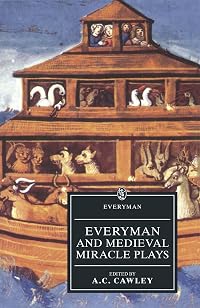
Everyman and Medieval Miracle Plays
by A. C. Cawley (Editor)
On This Page
Description
The most comprehensive paperback edition of EVERYMAN available, with introduction and extensive notes. Miracle Plays were a popular form of entertainment throughout the Middle Ages and part of the poetic and dramatic tradition on which Shakespeare drew, and EVERYMAN is perhaps the best known morality play of them all. This edition also includes a representative selection of fourteen other important Miracle Plays.Tags
Recommendations
















Member Reviews
This was a good collection! Admittedly, I don’t know what a bad collection of medieval plays would look like, or the quality of the plays that aren’t included, but I still found this to be a pretty comprehensive selection, especially as an introduction to the genre. Which this wasn’t for me, because I am a nerd and read at least a couple of this in university for fun, but whatever. I have had a medieval Thing for a long time.
Anyhow, there are a range of plays from a range of cycles in this book, each taking on a Christian story in rhyming verse with a small number of actors. There’s a little bit of historical context, and some glossing for the more difficult medieval and/or Northern English words, but beyond that, all you really show more get is the plays themselves. The verse styles they’re written in are pretty varied, which each playwright clearly having his own voice. The guy whose meter and rhyme were all over the place so that the play basically read as free verse was my favourite, I think.
And the playwrights could tell a good story. A lot of the speeches read as kind of didactic and heavy-handed today (‘twas the genre and the era, after all) but they’re still pretty engaging and I can easily picture amateur over-actors speaking the lines. It suits that style very well. And, because this is the Middle Ages, there’s also a fair bit of broad humour and slices of medieval life thrown in, like the shepherd who steals a sheep and hides it in a crib, then gets thrashed by his colleagues when discovered. It definitely makes the stories a bit different and more amusing, and being able to read the plays today provides a nice window into medieval worldviews and tastes.
The only thing I really wish had been better was some of the commentary. I’d have liked a bit more annotation beyond the glosses and more information on each play and its players than the few paragraphs we get. (Mostly I think this is an artifact of reading an older version of this collection; we’ve learned a lot in the last 70 years and I think a newer edition would have different info.)
Really, that’s about all I can say. I enjoyed the read and, as I’ve said, found it pretty interesting from a socio-historical perspective. If you’re interested in the topic, I’d certainly recommend!
8/10
Contains: A lot of Christian content, and an equally large amount of Middle English. If you don’t like your Bible stories mixed with broad comedy, this may not be for you. The rhythms of the poetry might get stuck in your head. show less
Anyhow, there are a range of plays from a range of cycles in this book, each taking on a Christian story in rhyming verse with a small number of actors. There’s a little bit of historical context, and some glossing for the more difficult medieval and/or Northern English words, but beyond that, all you really show more get is the plays themselves. The verse styles they’re written in are pretty varied, which each playwright clearly having his own voice. The guy whose meter and rhyme were all over the place so that the play basically read as free verse was my favourite, I think.
And the playwrights could tell a good story. A lot of the speeches read as kind of didactic and heavy-handed today (‘twas the genre and the era, after all) but they’re still pretty engaging and I can easily picture amateur over-actors speaking the lines. It suits that style very well. And, because this is the Middle Ages, there’s also a fair bit of broad humour and slices of medieval life thrown in, like the shepherd who steals a sheep and hides it in a crib, then gets thrashed by his colleagues when discovered. It definitely makes the stories a bit different and more amusing, and being able to read the plays today provides a nice window into medieval worldviews and tastes.
The only thing I really wish had been better was some of the commentary. I’d have liked a bit more annotation beyond the glosses and more information on each play and its players than the few paragraphs we get. (Mostly I think this is an artifact of reading an older version of this collection; we’ve learned a lot in the last 70 years and I think a newer edition would have different info.)
Really, that’s about all I can say. I enjoyed the read and, as I’ve said, found it pretty interesting from a socio-historical perspective. If you’re interested in the topic, I’d certainly recommend!
8/10
Contains: A lot of Christian content, and an equally large amount of Middle English. If you don’t like your Bible stories mixed with broad comedy, this may not be for you. The rhythms of the poetry might get stuck in your head. show less
Who knew medieval English drama was such fun to read? I didn't, until I had to buy this delightful paperback book for a graduate seminar a few years back. Honestly, I think about this book more often than I ever imagined I would. I thought about it just the other day when I ran into the woman who loved, completely loved, the King Arthur legends: well, I had suggested she watch Monty Python and the Holy Grail, and while she had been a wee bit hesitant when I explained the siege and catapults, she had agreed to do so. It turned out she loved, completely loved, the quest for the grail and we laughed heartily about the galloping and the indestructible Black Knight. This wonderful cycle of old plays (6-7 centuries ago. . .) is rendered in show more Modern English, but for non-specialists like me, that fact alone allows me to enjoy these dramas from a different place and time, and to marvel at the common threads that remain. show less
Corpus Christi pageants
Ratings
Members
- Recently Added By
Lists

Tom's Bookstore
346 works; 2 members
Author Information

Some Editions
Work Relationships
Contains
Common Knowledge
- Original title
- Everyman and Medieval Miracle Plays
- Original publication date
- late 15th-century (composition of "Everyman") (composition of "Everyman"); 1956
- People/Characters
- Everyman; Gill; Herod the Great; Lucifer; Mak; Pontius Pilate (show all 11); Cain; Abel; Noah; Abraham; Isaac, son of Abraham and Sarah
- Important places
- Medieval England
- Important events
- The Fall of Lucifer; The Flood; Expulsion from the Garden of Eden; The Harrowing of Hell; Judgement Day; Massacre of the Innocents (show all 10); Binding of Isaac; Crucifixion of Jesus of Nazareth; Nativity of Jesus Christ; The Murder of Abel
- Related movies
- Everyman (1964 | IMDb)
- First words
- PREFACE (1959 edition)
---
This volume contains the moral play Everyman and a representative collection of medieval biblical pageants.
PREFACE TO 1993 EDITION
---
Since its first publication in 1956, Professor Cawley's edition has been hugely successful in making accessible to the general reader and to school readers a representative selection of the c... (show all)ycle plays and, in Everyman, the best-known of the morality plays.
INTRODUCTION (1959 edition)
---
Apart from Everyman and the excerpt representing the Cornish drama, the plays in this volume are biblical pageants which are ultimately derived, like their counterparts in France, ... (show all)Spain, and Italy, from the Latin liturgical plays of the medieval Church. - Original language
- Middle English
- Disambiguation notice
- May need separation.
Not part of the Everyman Series.
Classifications
- Genre
- Fiction and Literature
- DDC/MDS
- 822.051608 — Literature & rhetoric English & Old English literatures English drama Drama of specific media, scope, kinds {only by more than one author} Specific kinds of drama Serious drama Religious, morality
- LCC
- PR1260 .E9 — Language and Literature English English Literature Collections of English literature
- BISAC
Statistics
- Members
- 1,098
- Popularity
- 23,197
- Reviews
- 3
- Rating
- (3.08)
- Languages
- English
- Media
- Paper
- ISBNs
- 9
- ASINs
- 23