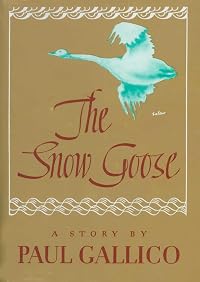
The Snow Goose
by Paul Gallico
On This Page
Description
Against the backdrop of World War II, friendship develops between a lonely crippled painter and a village girl, when together they minister to an injured snow goose.Tags
Recommendations


















Member Reviews
Overly sappy and emotionally manipulative story of a hunchback, ugly-on-the-outside-but-heart-of-gold-on-the-inside dude squatting in a lighthouse with his menagerie of wild birds, who ‘befriends’ and equally wild little girl as they ‘bond’ over a wounded goose. Over the years she visits the bird despite clearly feeling uncomfortable around the creeper who looks at her differently as she grows up. I think it’s meant to be deep and beautiful, but it just comes off as pedophilic and gross.
Physical deformity often breeds hatred of humanity in men. Rhayader did not hate; he loved very greatly, man, the animal kingdom, and all nature. His heart was filled with pity and understanding. He had mastered his handicap, but he could not master the rebuffs he suffered, due to his appearance. The thing that drove him into seclusion was his failure to find anywhere a return of the warmth that flowed from him. (p. 8)
Philip Rhayader lived alone in a lighthouse in the marshes of Essex, in England. Alone, he tended birds in his sanctuary, and painted the surrounding landscape. One day, a young girl named Frith brought him an injured snow goose. The goose had been blown off course during its annual migration in Canada. Then, on landing in show more the marsh, she was shot by hunters. Rhayader rehabilitated and released the bird, and then something highly unusual happened: the snow goose returned year after year. And each year, Frith returned to visit Rhayader and the goose. Their shared affection for the snow goose mirrored the growing bond between them. One day, Frith encounters Rhayader readying his boat to sail. He has decided to sail for Dunkirk, to help with the evacuation of British soldiers. When he leaves, the snow goose sets sail with him, flying in circles over the small boat. Fritha is left behind to care for the other birds and look after Rhayader's paintings. From this point the story crescendos into a heart-wrenching tale of love and hope.
Gallico's writing is absolutely gorgeous.
Tidal creeks and estuaries and the crooked, meandering arms of many little rivers whose mouths lap at the edge of the ocean cut through the sodden land that seems to rise and fall and breathe with the recurrence of the daily tides. It is desolate, utterly lonely, and made lonelier by the calls and cries of the wildfowl that make their homes in the marshlands and saltings -- the wildgeese and the gulls, the teal and the widgeon, the tedshanks and curlews that pick their way through the tidal pools. (p. 5)
This may be a children's book, but its lessons of love, friendship, and valor are timeless and just as meaningful for adult readers. show less
Philip Rhayader lived alone in a lighthouse in the marshes of Essex, in England. Alone, he tended birds in his sanctuary, and painted the surrounding landscape. One day, a young girl named Frith brought him an injured snow goose. The goose had been blown off course during its annual migration in Canada. Then, on landing in show more the marsh, she was shot by hunters. Rhayader rehabilitated and released the bird, and then something highly unusual happened: the snow goose returned year after year. And each year, Frith returned to visit Rhayader and the goose. Their shared affection for the snow goose mirrored the growing bond between them. One day, Frith encounters Rhayader readying his boat to sail. He has decided to sail for Dunkirk, to help with the evacuation of British soldiers. When he leaves, the snow goose sets sail with him, flying in circles over the small boat. Fritha is left behind to care for the other birds and look after Rhayader's paintings. From this point the story crescendos into a heart-wrenching tale of love and hope.
Gallico's writing is absolutely gorgeous.
Tidal creeks and estuaries and the crooked, meandering arms of many little rivers whose mouths lap at the edge of the ocean cut through the sodden land that seems to rise and fall and breathe with the recurrence of the daily tides. It is desolate, utterly lonely, and made lonelier by the calls and cries of the wildfowl that make their homes in the marshlands and saltings -- the wildgeese and the gulls, the teal and the widgeon, the tedshanks and curlews that pick their way through the tidal pools. (p. 5)
This may be a children's book, but its lessons of love, friendship, and valor are timeless and just as meaningful for adult readers. show less
I'm not sure what to call this--a 20th century fable? It's a short tale of Philip Rhayader, a kind and artistic soul with a deformed body. In his twenties, he moves to the English seacoast to live in seclusion, away from the repulsive looks and attitudes of "normal" people. He spends his time painting, sailing his boat and caring for the birds that take up residence in his property. He finds peace in this lifestyle, but one day a young girl from the nearby village brings a injured snow goose to him. As she helps him care for the bird, a tenuous relationship develops. It's a short, quiet, emotional tale in which love and fear, beauty and ugliness mix together to give a brief peek into reality.
--J.
--J.
“He had mastered his handicap, but he could not master the rebuffs he suffered, due to his appearance. The thing that drove him into seclusion was his failure to find anywhere a return of the warmth that flowed from him.”
In 1930, painter Philip Rhayader takes up residence in an abandoned lighthouse on the marshlands of the Essex coast, retreating from a society that has judged him and been unkind to him on account of his physical deformities. He spends his time amid nature, sailing his small boat, painting and providing sanctuary to birds during the harsh winters. When Frith, a young girl from a local village, appears at his door with an injured snow goose, Philip cares for it, nursing it back to health and christens it “The Lost show more Princess”. Every year the snow goose returns in October before flying north, in the spring. Frith, drawn to the snow goose, also returns. The friendship between Philip and Frith friendship grows over the years - a friendship forged from their loneliness and a shared love for nature. But as WWII looms large, Philip is unable to remain unaffected by the events happening around him and in a selfless act of courage, decides to play his part.
Originally written as a short story in 1940 and developed into a novella in 1941, Paul Gallico’s The Snow Goose is an incredibly moving story about loneliness, kindness, friendship and sacrifice. I was directed to this story while reading a novel inspired by the same. At barely fifty pages, this is a short yet immersive read and I’ll admit that I shed more than a few tears. Though this is considered a children’s story, I believe the subject matter and the historical context would appeal to more mature readers. show less
In 1930, painter Philip Rhayader takes up residence in an abandoned lighthouse on the marshlands of the Essex coast, retreating from a society that has judged him and been unkind to him on account of his physical deformities. He spends his time amid nature, sailing his small boat, painting and providing sanctuary to birds during the harsh winters. When Frith, a young girl from a local village, appears at his door with an injured snow goose, Philip cares for it, nursing it back to health and christens it “The Lost show more Princess”. Every year the snow goose returns in October before flying north, in the spring. Frith, drawn to the snow goose, also returns. The friendship between Philip and Frith friendship grows over the years - a friendship forged from their loneliness and a shared love for nature. But as WWII looms large, Philip is unable to remain unaffected by the events happening around him and in a selfless act of courage, decides to play his part.
Originally written as a short story in 1940 and developed into a novella in 1941, Paul Gallico’s The Snow Goose is an incredibly moving story about loneliness, kindness, friendship and sacrifice. I was directed to this story while reading a novel inspired by the same. At barely fifty pages, this is a short yet immersive read and I’ll admit that I shed more than a few tears. Though this is considered a children’s story, I believe the subject matter and the historical context would appeal to more mature readers. show less
This is a lovely little book. Full of tenderness – in the characters of the young girl who finds a hurt bird and in the hunchback who tends to its wounds; and in the language used to describe the great marsh, which sounds as if it would be a forbidding place, but which descriptions feel as if they are uttered with love by the author or perhaps felt by the artist he pens.
Primarily, The Snow Goose is a sweet story about relationships, of the snow goose and the two who saved it. But 1940 was a dangerous time in that part of the world, and breath is held awaiting the outcome, while one character waits, and two leave their marsh to assist in the rescue at Dunkirk.
Spanning ten years in 58 pages, but needing not a line more, the story is show more short but poignant. This book is a treasure and deserves every one of the 5 stars that is mine to give. show less
Primarily, The Snow Goose is a sweet story about relationships, of the snow goose and the two who saved it. But 1940 was a dangerous time in that part of the world, and breath is held awaiting the outcome, while one character waits, and two leave their marsh to assist in the rescue at Dunkirk.
Spanning ten years in 58 pages, but needing not a line more, the story is show more short but poignant. This book is a treasure and deserves every one of the 5 stars that is mine to give. show less
Philip Rhyader is an outcast. An artist suffering from kyphosis, it becomes his natural habit to retreat from the world into his lighthouse on the edge of the bleak Essex marshes where he paints and cares for his adopted family of migratory birds.
One cold day, Fritha, a young local girl with flaxen hair and intense, violet eyes, arrives on Rhyander’s doorstep with an injured bird. Despite her inherited fear of the hunchbacked man, she has heard rumours of his healing powers and way with wild animals. The bird is a Canadian Snow Goose, travelled hundreds of miles in its migration only to be shot down by a rogue hunter’s gun. They call her La Princess Perdue.
As war rumbles on across the wild ocean they know so well, Rhyander and the show more young girl develop an unexpected friendship under the wing of their Snow Goose. Although the recovery and eventual departure of the bird could spell the end of a special period for the pair, as their Princesse returns to the lighthouse without fail every year, so does Fritha. However, the fate of the bird and his old friends become inexorably linked as the pull of the conflict across the waves becomes so strong that even the outcast must play his part.
This beautiful fable of love, friendship and loyalty is universal yet so subtle in parts that I think it far more appropriate to finally experience this book as an adult. In their unity with the natural world around them, Gallico creates a setting that wipes away all artifice and leaves us with an eerie beauty and timeless message.
‘Greys and blues and soft greens are the colours, for when the skies are dark in the long 7345288winters, the many waters of the beaches and marshes reflect the cold and sombre colour. But sometimes, with sunrise and sunset, sky and land are aflame with red and golden fire.’ p.8
‘And so, when one sunset she heard the high-pitched, well-remembered note cried from the heavens, it brought no instant of false hope to her heart. This moment, it seemed, she had lived before many times.’ p.44
With its magical blend of tenderness and Rhayader’s loneliness, The Snow Goose could very easily leave its readers devastated by the closing pages. Instead, we leave full of love and reflection. Call me corny, I simply don’t care - everyone should have this evocative little novella tucked in the wings of their library.
http://relishreads.com/2014/01/20/the-snow-goose/ show less
One cold day, Fritha, a young local girl with flaxen hair and intense, violet eyes, arrives on Rhyander’s doorstep with an injured bird. Despite her inherited fear of the hunchbacked man, she has heard rumours of his healing powers and way with wild animals. The bird is a Canadian Snow Goose, travelled hundreds of miles in its migration only to be shot down by a rogue hunter’s gun. They call her La Princess Perdue.
As war rumbles on across the wild ocean they know so well, Rhyander and the show more young girl develop an unexpected friendship under the wing of their Snow Goose. Although the recovery and eventual departure of the bird could spell the end of a special period for the pair, as their Princesse returns to the lighthouse without fail every year, so does Fritha. However, the fate of the bird and his old friends become inexorably linked as the pull of the conflict across the waves becomes so strong that even the outcast must play his part.
This beautiful fable of love, friendship and loyalty is universal yet so subtle in parts that I think it far more appropriate to finally experience this book as an adult. In their unity with the natural world around them, Gallico creates a setting that wipes away all artifice and leaves us with an eerie beauty and timeless message.
‘Greys and blues and soft greens are the colours, for when the skies are dark in the long 7345288winters, the many waters of the beaches and marshes reflect the cold and sombre colour. But sometimes, with sunrise and sunset, sky and land are aflame with red and golden fire.’ p.8
‘And so, when one sunset she heard the high-pitched, well-remembered note cried from the heavens, it brought no instant of false hope to her heart. This moment, it seemed, she had lived before many times.’ p.44
With its magical blend of tenderness and Rhayader’s loneliness, The Snow Goose could very easily leave its readers devastated by the closing pages. Instead, we leave full of love and reflection. Call me corny, I simply don’t care - everyone should have this evocative little novella tucked in the wings of their library.
http://relishreads.com/2014/01/20/the-snow-goose/ show less
I was startled to find this volume on a bookshelf in my mother's apartment. It had been given to her mother 70 years ago by a friend who wrote on the last page "An interesting but pathetic story."
Just a few months earlier, I had tracked down a rough online copy of the British movie made from this story that, when it aired as a Hallmark television special in 1971, deeply affected my preteen self. Lately, I had become obsessed with seeing it again, but discovered the award-winning film with Jenny Agutter and Richard Harris was never (and apparently never will be) sanctioned for reproduction. Though I do not normally condone unauthorized copying, I was grateful to have the chance to spend an hour reacquainting myself with that influential show more picture.
Last week, book unexpectedly in hand, I gulped down the story in a matter of minutes, tracking the video version across the pages and finding only occasional alterations.
That is all to say any rating or review I impart on this book is inextricably tied to my first and second exposures to the story. I am happy now to know the picturesque and compassionate source of the heartrending film, and appreciate Gallico's genuine accounting in the original. Next times through I'll pace myself, allowing the words to repaint my mind's eye, so I can enjoy two visions of one moving tale. show less
Just a few months earlier, I had tracked down a rough online copy of the British movie made from this story that, when it aired as a Hallmark television special in 1971, deeply affected my preteen self. Lately, I had become obsessed with seeing it again, but discovered the award-winning film with Jenny Agutter and Richard Harris was never (and apparently never will be) sanctioned for reproduction. Though I do not normally condone unauthorized copying, I was grateful to have the chance to spend an hour reacquainting myself with that influential show more picture.
Last week, book unexpectedly in hand, I gulped down the story in a matter of minutes, tracking the video version across the pages and finding only occasional alterations.
That is all to say any rating or review I impart on this book is inextricably tied to my first and second exposures to the story. I am happy now to know the picturesque and compassionate source of the heartrending film, and appreciate Gallico's genuine accounting in the original. Next times through I'll pace myself, allowing the words to repaint my mind's eye, so I can enjoy two visions of one moving tale. show less
Members
- Recently Added By
Lists

The Guardian's 1000 Novels Everyone Must Read
1,005 works; 551 members

Read the book and saw the movie
1,170 works; 195 members

Best War Stories
87 works; 16 members

Children's Books about World War II (1939-1945)
143 works; 12 members

Sonlight Books
1,487 works; 25 members

Blue Pyramid 1,276 Best Books of All Time
1,248 works; 32 members

Fictional Characters With Disabilities
43 works; 9 members

Animals in the Title
498 works; 11 members

CCE 1000 Good Books List
1,033 works; 12 members

Teen Historical Fiction
29 works; 1 member

THE WAR ROOM
813 works; 24 members
Author Information

113+ Works 9,595 Members
Some Editions
Awards and Honors
Work Relationships
Common Knowledge
- Canonical title*
- La principessa smarrita
- Original title
- The Snow Goose. A story of Dunkirk
- Original publication date
- 1941
- People/Characters
- Philip Rhayader; Fritha
- Important places
- Dunkirk, Hauts-de-France, France; France; Chelmbury, Essex, England, UK; Wickaeldroth, Essex, England, UK; Essex, England, UK; England, UK
- Important events
- World War II (1939 | 1945); Fall of France (1940-05-10 | 1940-06-22); Battle of Dunkirk (1940-05-26 | 1940-06-04); Dunkirk Evacuation (1940-05-27 | 1940-06-04)
- Related movies
- Hallmark Hall of Fame: The Snow Goose (1971 | IMDb)
- Dedication
- For my parents, Esther and Irwin Peck
-B.P. - First words
- The great marsh lies on the Essex coast between the village of Chelmbury and the ancient Saxon oyster-fishing hamlet of Wickaeldroth.
- Quotations
- He painted the loneliness and the smell of the salt-laden cold, the eternity and agelessness of marshes, the wild living creatures, dawn flights, and frightened things taking to the air, and winged shadows at night hiding fro... (show all)m the moon.
Her imagination was captured by the presence of this strange white princess from a land far over the sea, a land that was all pink as she knew from the map that Rhayader showed her, and on which they traced the stormy path of... (show all) the lost bird from its home in Canada to the Great Marsh of Essex.
Men are huddled on the beaches like hunted birds, Frith, like the wounded and hunted birds we used to find and bring to sanctuary. Over them fly the steel peregrines, hawks and gyrfalcons, and they have no shelter from these ... (show all)iron birds of prey. They are lost and storm-driven and harried, like the Princess Perdue you found and brought to me out of the marshes many years ago, and we healed her. They need help, my dear, as our wild creatures have needed help, and that is why I must go. It is something that I can do. Yes, I can. For once - for once I can be a man and play my part. - Last words
- (Click to show. Warning: May contain spoilers.)Only the frightless gulls wheeled and soared and mewed their plaint over the place where it had been.
- Original language
- English
- Disambiguation notice
- The original short story in The Saturday Evening Post (1940) was different from the expanded book version (1941)
*Some information comes from Common Knowledge in other languages. Click "Edit" for more information.
Classifications
- Genres
- Fiction and Literature, Children's Books, General Fiction
- DDC/MDS
- 823.912 — Literature & rhetoric English & Old English literatures English fiction 1900- 1901-1999 1901-1945
- LCC
- PZ7 .G137 .S — Language and Literature Fiction and juvenile belles lettres Fiction and juvenile belles lettres Juvenile belles lettres
- BISAC
Statistics
- Members
- 1,554
- Popularity
- 14,788
- Reviews
- 40
- Rating
- (4.19)
- Languages
- 6 — Dutch, English, German, Greek, Italian, Spanish
- Media
- Paper, Audiobook, Ebook
- ISBNs
- 42
- ASINs
- 54