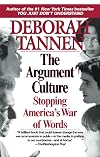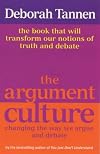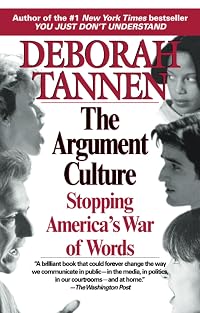
The Argument Culture: Stopping America's War of Words
by Deborah Tannen
On This Page
Description
The Argument Culture is about a pervasive warlike atmosphere that makes us approach anything we need to accomplish as a fight between two opposing sides. The argument culture urges us to regard the world--and the people in it--in an adversarial frame of mind. It rests on the assumption that opposition is the best way to get anything done: The best way to explore an idea is to set up a debate; the best way to cover the news is to find spokespeople who express the most extreme, polarized views show more and present them as "both sides"; the best way to settle disputes is litigation that pits one party against the other; the best way to begin an essay is to oppose someone; and the best way to show you're really thinking is to criticize and attack. Sometimes these approaches work well, but often they create more problems than they solve. Our public encounters have become more and more like having an argument with a spouse: You're not trying to understand what the other person is saying; you're just trying to win the argument. But just as spouses have to learn ways of settling differences without inflicting real damage on each other, so we, as a society, have to find constructive and creative ways of resolving disputes and differences. Public discussions require making an argument for a point of view, not having an argument--as in having a fight. The war on drugs, the war on cancer, the battle of the sexes, politicians' turf battles--in the argument culture, war metaphors pervade our talk and shape our thinking. Tannen shows how deeply entrenched this cultural tendency is, the forms it takes, and how it affects us every day--sometimes in useful ways, but often causing, rather than avoiding, damage. In the argument culture, the quality of information we receive is compromised, and our spirits are corroded by living in an atmosphere of unrelenting contention. Tannen explores the roots of the argument culture, the role played by gender, and how other cultures suggest alternative ways to negotiate disagreement and mediate conflicts--and make things better, in public and in private, wherever people are trying to resolve differences and get things done. The Argument Culture is a remarkable book that will change forever the way you perceive the world. You will listen to our public voices in a whole new way. show lessTags
Recommendations














Member Reviews
Written a quarter of a century ago, this book warned us of what has since become a lot worse. Many newer books such as Hate Inc.: Why Today's Media Makes Us Despise One Anotherand Why We're Polarized, or The Meritocracy Trap: How America's Foundational Myth Feeds Inequality, Dismantles the Middle Class, and Devours the Elite cover some of the outcomes, but this book addresses the way of thinking underlying it all. The policies of competition come out of the view that we are individuals whose freedom depends on self-interest. The alternative would be communism.
But even that opposition is an example of the binary thinking this book explains. It turns out that changing the way we think requires more than logical analysis.
But even that opposition is an example of the binary thinking this book explains. It turns out that changing the way we think requires more than logical analysis.
Although this book is a few years old, it is even more sharply applicable. The first few chapters are the laying out of data and can seem scattered but the final few chapters pull together her ideas in a powerful way. I agreed more and more as I read and saw how the culture of critque and agonism has created many of the scenarios she predicts (less than half the population voting in the 2000 election). Should be required reading for anyone invovled in public discourse in ANY way. I can only hope that the horror of the terrorist attacks will perhaps cause some of the argument culture to fade away. Now, more than ever, we need thoughtful reflection.
Ms. Tannen's writing style is engaging, her anecdotes were interesting and her conclusions seemed plausible... at first, anyway. Unfortunately, her reasoning (particularly her over-generalizations) drove me bonkers.
Preaching to the choir. Only she’s much less skeptical about the intentionality of it all, at least on certain levels, than I am.
And goodness, but so many words to say this. Repetitive and not really all that illuminating.
I know; I sound very critical, and after reading this book I should be more collaborative or supportive or what have you. I actually agree with much of what she says, which is why I shouldn't feel like I had to wade through all of that, like it was more of an obligation than a free pursuit.
I guess if you have no idea what she is talking about, or if your first response to the idea of America as being rife with antagonism is a reflexive denial or dismissal, then this is the book for you.
And goodness, but so many words to say this. Repetitive and not really all that illuminating.
I know; I sound very critical, and after reading this book I should be more collaborative or supportive or what have you. I actually agree with much of what she says, which is why I shouldn't feel like I had to wade through all of that, like it was more of an obligation than a free pursuit.
I guess if you have no idea what she is talking about, or if your first response to the idea of America as being rife with antagonism is a reflexive denial or dismissal, then this is the book for you.
contends that making every issue a debate is detrimental to public policy
Ratings
Members
- Recently Added By
Author Information

35+ Works 6,190 Members
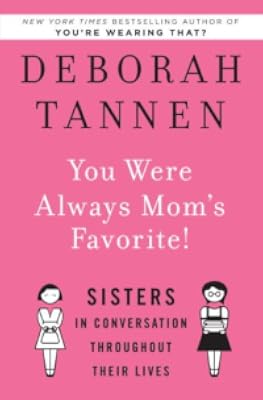
Deborah Tannen is the bestselling author of "The Argument Culture", "Talking from 9 to 5", "That's Not What I Meant", & "You Just Don't Understand", which was on "The New York Times" bestseller list for nearly four years, including eight months as number one. She is a professor at Georgetown University, in Washington D.C. "I Only Say This Because show more I Love You" is her seventeenth book. Her latest book is entitled, "You Were Always Mom's Favorite: Sisters in Conversation Throughout Their Lives." (Publisher Provided) show less
Common Knowledge
- Canonical title*
- Laß uns richtig streiten. Vom Wortgefecht zum Dialog
- Original title
- The Argument Culture. Moving from Debate to Dialogue
- Alternate titles*
- Laß uns richtig streiten
- Dedication
- To Miriam Tannen and Naomi Tannen my sisters in every sense of the word
- First words
- This is not another book about civility.
- Last words
- (Click to show. Warning: May contain spoilers.)It's a challenge we must undertake, because our public and private lives are at stake.
*Some information comes from Common Knowledge in other languages. Click "Edit" for more information.
Classifications
- DDC/MDS
- 808.001 — Literature & rhetoric Literature, rhetoric & criticism Composition Rhetoric and anthologies Rhetoric and anthologies -- Subdivisions Philosophy and Theory
- LCC
- P301.5 .P47 .T36 — Language and Literature Philology. Linguistics Language. Linguistic theory. Comparative grammar Style. Composition. Rhetoric
- BISAC
Statistics
- Members
- 372
- Popularity
- 84,114
- Reviews
- 5
- Rating
- (3.65)
- Languages
- 5 — Dutch, English, German, Spanish, Swedish
- Media
- Paper, Audiobook, Ebook
- ISBNs
- 15
- ASINs
- 2