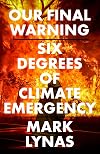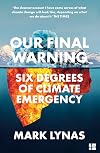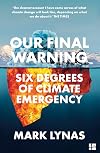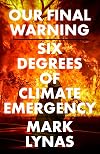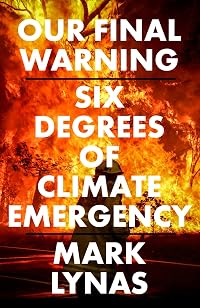
Our Final Warning: Six Degrees of Climate Emergency
by Mark Lynas
On This Page
Description
This book must not be ignored. It really is our final warning. Mark Lynas delivers a vital account of the future of our earth, and our civilisation, if current rates of global warming persist. And it's only looking worse. We are living in a climate emergency. But how much worse could it get? Will civilisation collapse? Are we already past the point of no return? What kind of future can our children expect? Rigorously cataloguing the very latest climate science, Mark Lynas explores the course show more we have set for Earth over the next century and beyond. Degree by terrifying degree, he charts the likely consequences of global heating and the ensuing climate catastrophe. At one degree - the world we are already living in - vast wildfires scorch California and Australia, while monster hurricanes devastate coastal cities. At two degrees the Arctic ice cap melts away, and coral reefs disappear from the tropics. At three, the world begins to run out of food, threatening millions with starvation. At four, large areas of the globe are too hot for human habitation, erasing entire nations and turning billions into climate refugees. At five, the planet is warmer than for 55 million years, while at six degrees a mass extinction of unparalleled proportions sweeps the planet, even raising the threat of the end of all life on Earth. These escalating consequences can still be avoided, but time is running out. We must largely stop burning fossil fuels within a decade if we are to save the coral reefs and the Arctic. If we fail, then we risk crossing tipping points that could push global climate chaos out of humanity's control. This book must not be ignored. It really is our final warning. show lessTags
Recommendations












Member Reviews
Mark Lynas is a British author who is best known for his Six Degrees: Our Future on a Hotter Planet published in 2007. This is an update 13 years later and it is even more pessimistic given what has happened with no reduction in CO2 emissions. Both books follow a simple, clear and calm format. Chapter 1 is a description of the world at 1 degrees. And so on up to Chapter 6. It is based on the best science available, sourced to academic journals such as Nature and the IPCC. Assuming CO2 levels continue to climb steadily, it's likely we will reach 3 degrees by mid to late century. This is game over because natural tipping points take over and society ceases to function due to widespread drought and killer heat as it reaches 4-6 degrees. show more It's also possible 2 degrees will cause this, there is no safe level from here out.
Almost every major extinction event in history has been caused by global warming, we live on a perilously balanced planet. There is no historic parallel for the rate and amount of CO2 emissions, it exceeds the worst extinction the Siberian Traps by a factor of 60 in terms of speed of emissions. And while there have been periods when the total ppm exceed our own, things are different now - the sun is brighter causing more warming per molecule then in the past, and again no historic precedent for speed and volume of emissions. Lynas ends this hopeless book with a tone of hope: do not give up. Immediately stop all fossil fuel usage no matter the cost. If enough people take this approach we will see dramatic changes and perhaps in time because there isn't much left.
I'm rating this highly not because of the message, there are already many excellent global warming books. This one stands out by focusing on the big picture without going too far into the weeds and becoming doom scrolling which can leave you exhausted and demoralized. This is a large complex topic and there is a lot to know but this gets all the pieces correct. show less
Almost every major extinction event in history has been caused by global warming, we live on a perilously balanced planet. There is no historic parallel for the rate and amount of CO2 emissions, it exceeds the worst extinction the Siberian Traps by a factor of 60 in terms of speed of emissions. And while there have been periods when the total ppm exceed our own, things are different now - the sun is brighter causing more warming per molecule then in the past, and again no historic precedent for speed and volume of emissions. Lynas ends this hopeless book with a tone of hope: do not give up. Immediately stop all fossil fuel usage no matter the cost. If enough people take this approach we will see dramatic changes and perhaps in time because there isn't much left.
I'm rating this highly not because of the message, there are already many excellent global warming books. This one stands out by focusing on the big picture without going too far into the weeds and becoming doom scrolling which can leave you exhausted and demoralized. This is a large complex topic and there is a lot to know but this gets all the pieces correct. show less
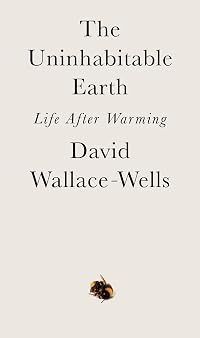
Very similar subject matter to The Uninhabitable Earth: Life After Warming, I preferred this treatment. There was much less personal pontificating (at least until the very end, where it belongs), just laying out the current understanding of what happens at each stage of warming, in 1 degree increments. While this approach can get a bit monotonous after the first few iterations, it dramatically shows the enormous difference between each level of warming, and underscores the need to do whatever it takes to limit the increase to the smallest amount possible.
An excellent prediction of future global heating and its likely effects. The book was published in 2019. I'd like to get the author's take on 2023 since this summer seems to have had the worst heatwaves so far. (Our high today is 106 F, which is still much better than Phoenix... or the Middle East.)
My only complaint, and it's minor... The author used mostly metric units. As an engineer, I'm used to converting between metric and English. And I have a good sense of meters and kilometers, but not degrees Celsius. It would have been helpful to include the Fahrenheit degrees in parentheses. No matter... I fetched my engineering calculator and kept it handy. (Yes, I'm old enough to use a calculator and, in fact, even had a slide rule way back show more when, which was a wonderful, intuitive tool.)
A highly recommended book for the brave! show less
My only complaint, and it's minor... The author used mostly metric units. As an engineer, I'm used to converting between metric and English. And I have a good sense of meters and kilometers, but not degrees Celsius. It would have been helpful to include the Fahrenheit degrees in parentheses. No matter... I fetched my engineering calculator and kept it handy. (Yes, I'm old enough to use a calculator and, in fact, even had a slide rule way back show more when, which was a wonderful, intuitive tool.)
A highly recommended book for the brave! show less
Ratings
Members
- Recently Added By
Lists

Climate Change
50 works; 1 member
Author Information

12+ Works 1,106 Members
Awards and Honors
Common Knowledge
- Original publication date
- 2020
- Important events
- global warming
Classifications
- Genres
- Science & Nature, Nonfiction, General Nonfiction
- DDC/MDS
- 363.73874 — Society, government, & culture Social problems and social services Public Safety - Police, Crime Investigation Environmental Issues - Pollution, Recycling, Global Warming Pollution Pollutants by source Fumes, gases, smoke Greenhouse gases
- LCC
- QC981.8 .G56 .L96 — Science Physics Physics Meteorology. Climatology Climatology and weather
- BISAC
Statistics
- Members
- 80
- Popularity
- 397,860
- Reviews
- 3
- Rating
- (4.75)
- Languages
- Dutch, English, German, Italian
- Media
- Paper, Audiobook, Ebook
- ISBNs
- 8
- ASINs
- 5