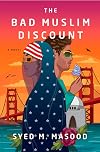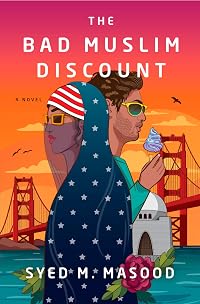
The Bad Muslim Discount
by Syed M. Masood
On This Page
Description
Following two families from Pakistan and Iraq in the 1990s to San Francisco in 2016, The Bad Muslim Discount is an inclusive, comic novel about Muslim immigrants finding their way in modern America.“Masood’s novel presents a stereoscopic, three-dimensional view of contemporary Muslim America: the way historical conflict in the Middle East lingers in individual lives, the way gossip travels in a close-knit immigrant community.” —The New York Times Book Review
It is 1995, and Anvar show more Faris is a restless, rebellious, and sharp-tongued boy doing his best to grow up in Karachi, Pakistan. As fundamentalism takes root within the social order and the zealots next door attempt to make Islam great again, his family decides, not quite unanimously, to start life over in California. Ironically, Anvar's deeply devout mother and his model-Muslim brother adjust easily to life in America, while his fun-loving father can't find anyone he relates to. For his part, Anvar fully commits to being a bad Muslim.
At the same time, thousands of miles away, Safwa, a young girl living in war-torn Baghdad with her grief-stricken, conservative father will find a very different and far more dangerous path to America. When Anvar and Safwa's worlds collide as two remarkable, strong-willed adults, their contradictory, intertwined fates will rock their community, and families, to their core.
The Bad Muslim Discount is an irreverent, poignant, and often hysterically funny debut novel by an amazing new voice. With deep insight, warmth, and an irreverent sense of humor, Syed M. Masood examines universal questions of identity, faith (or lack thereof), and belonging through the lens of Muslim Americans. show less
Tags
Recommendations








Member Reviews
Mostly, I really enjoyed it. There were great voices and characters. I wanted a story about the immigrant experience and I got a good one. It got a little navel gaze-y and kinda preachy for one of our narrators after his character arc peaked but I can get behind arguing universal vs relative morality at least. I probably could have done without so much religion, which was a major theme. I bristle at organized religion anyway and conservative Islam, with centuries old ideals and rules, can be pretty gnarly, especially for women, so I somewhat resent what I perceived as the author wrapping everything up with "well they think what they're doing is right so how much can we really blame them? Everyone messes up, and everyone gets messed up show more so just do your best." Like, no, we have to agree that some things are just not fine. Honor killing is not fine and I'm not going to fully respect a culture that allows any wiggle room there. Just like state-sanctioned torture is simply not fine. It's definitely part of a bigger discussion that is summed up in the title. If you're good at following your chosen moral compass, but inflict hurt on others while doing so, are you a 'good' person? show less
Excellent. I love the complex, nuance, human, *real* characters, so many, even the minor ones. I love the use of language. I admire the author's credentials. I love learning about Karachi, Muslim-Americans, Pakistan history, etc. etc. I have to return the book to the library at p. 109, however. And that's where it got tough for me, so I don't think I'll be trying again to check it out again to finish; it's ultimately just not for me..
I could already quote so much. But this struck me as somewhat representative of Anvar when he's still a cocky university student: "I wasn't going to kneel at the altar of the perpetually offended."
And a representative example of the heart, the authenticity, of this labor of love. In the beginning, saying show more goodbye to grandma, remembering Lot's wife: "Anyone who didn't look back, I realized then, was stone already."
I do highly recommend this if you're interested. Just don't expect non-stop hilarity; it's not quite as light as the blurb implies.
Now my only question is, what does the 'discount' in the title refer to?
Sept. 2024 show less
I could already quote so much. But this struck me as somewhat representative of Anvar when he's still a cocky university student: "I wasn't going to kneel at the altar of the perpetually offended."
And a representative example of the heart, the authenticity, of this labor of love. In the beginning, saying show more goodbye to grandma, remembering Lot's wife: "Anyone who didn't look back, I realized then, was stone already."
I do highly recommend this if you're interested. Just don't expect non-stop hilarity; it's not quite as light as the blurb implies.
Now my only question is, what does the 'discount' in the title refer to?
Sept. 2024 show less
Wow, just wow. This was the most engaging book I have read in a long time. I just couldn't put it down, and I had so many thoughts and feelings about it that I want to discuss with other readers. It didn't quite stick the landing but considering it's only Masood's sophomore effort (and first adult novel), it's truly impressive.
The Bad Muslim Discount is a frequently uneasy mash-up of Masood's previous YA novel, [b:More Than Just a Pretty Face|42655335|More Than Just a Pretty Face|Syed M. Masood|https://i.gr-assets.com/images/S/compressed.photo.goodreads.com/books/1567543911l/42655335._SX50_.jpg|66401590], with its wisecracking protagonist, and Khaled Hosseini's bestseller [b:The Kite Runner|77203|The Kite Runner|Khaled show more Hosseini|https://i.gr-assets.com/images/S/compressed.photo.goodreads.com/books/1579036753l/77203._SY75_.jpg|3295919]. The chapters narrated by Anvar span his life from a childhood in Pakistan to his immigration to America with his family, his high school/early college years falling in love, and the aftermath of that relationship. The impact of violence and anti-Muslim sentiment is acknowledged, but it's in the background. Anvar could be a Muslim counterpart to any number of "'man child" heroes created by [a:Nick Hornby|2929|Nick Hornby|https://images.gr-assets.com/authors/1422915487p2/2929.jpg] or [a:Jonathan Tropper|26163|Jonathan Tropper|https://images.gr-assets.com/authors/1550353256p2/26163.jpg].
Then in sharp contrast are the chapters narrated by the woman known as Azza, who starts out in Iraq and ends up in the same apartment complex as Anvar many years later. Her life is much more tragic, filled with violence, death and abuse. While Anvar's chapters are frequently humorous, there is nothing funny about the trauma that Azza experiences along her journey.
The book has a lot to say about what it means to be a "good" Muslim, and I found Anvar's theory about why the religion has been co-opted by fundamentalists fascinating, as well as his pointed connections between this form of Islam and American nationalism. The specter of the 2016 election looms large in the latter half of the book; families like Anvar's who have come to our country to escape extremism can't believe that the "orange man" who wants to build a wall to prevent Mexican immigration and ban Muslims from entering the country could possibly prevail. Their naivete is a sharp reminder that, as horrified as I felt as a white woman when Trump was elected, the stakes were much higher for families like Anvar's.
Masood has also populated his book with memorable secondary characters, including Anvar's traditional yet modern parents and his obsequious brother, Azza's tormented father, and a remarkable landlord/guardian angel who provides rent discounts to "good Muslims" and is frequently the voice of reason as Anvar struggles to do the right thing.
Anvar and Azza meet about halfway through the book, and what happens then is not exactly what you expect. Their interactions put their backgrounds in sharp contrast, and it almost but not quite renders Anvar's problems inconsequential. Masood walks a fine line, trying to portray that both characters' dilemmas have validity, but occasionally the differences make Anvar look like a clueless idiot. I wish Masood had allowed Anvar to be a bit more heroic in his actions; to a certain extent Azza is there just to teach him a lesson that he is slow to learn. But then again, this is real life, and not everything gets tied up in a neat bow.
I'm being deliberately vague to avoid spoilers but all I can say is, read this book. You will laugh, you will be mad, you will think and have questions, but I can say without a doubt that you will not forget it. I have a feeling that this won't find the audience it deserves, which is a shame because it should be on every book club list in 2021. show less
The Bad Muslim Discount is a frequently uneasy mash-up of Masood's previous YA novel, [b:More Than Just a Pretty Face|42655335|More Than Just a Pretty Face|Syed M. Masood|https://i.gr-assets.com/images/S/compressed.photo.goodreads.com/books/1567543911l/42655335._SX50_.jpg|66401590], with its wisecracking protagonist, and Khaled Hosseini's bestseller [b:The Kite Runner|77203|The Kite Runner|Khaled show more Hosseini|https://i.gr-assets.com/images/S/compressed.photo.goodreads.com/books/1579036753l/77203._SY75_.jpg|3295919]. The chapters narrated by Anvar span his life from a childhood in Pakistan to his immigration to America with his family, his high school/early college years falling in love, and the aftermath of that relationship. The impact of violence and anti-Muslim sentiment is acknowledged, but it's in the background. Anvar could be a Muslim counterpart to any number of "'man child" heroes created by [a:Nick Hornby|2929|Nick Hornby|https://images.gr-assets.com/authors/1422915487p2/2929.jpg] or [a:Jonathan Tropper|26163|Jonathan Tropper|https://images.gr-assets.com/authors/1550353256p2/26163.jpg].
Then in sharp contrast are the chapters narrated by the woman known as Azza, who starts out in Iraq and ends up in the same apartment complex as Anvar many years later. Her life is much more tragic, filled with violence, death and abuse. While Anvar's chapters are frequently humorous, there is nothing funny about the trauma that Azza experiences along her journey.
The book has a lot to say about what it means to be a "good" Muslim, and I found Anvar's theory about why the religion has been co-opted by fundamentalists fascinating, as well as his pointed connections between this form of Islam and American nationalism. The specter of the 2016 election looms large in the latter half of the book; families like Anvar's who have come to our country to escape extremism can't believe that the "orange man" who wants to build a wall to prevent Mexican immigration and ban Muslims from entering the country could possibly prevail. Their naivete is a sharp reminder that, as horrified as I felt as a white woman when Trump was elected, the stakes were much higher for families like Anvar's.
Masood has also populated his book with memorable secondary characters, including Anvar's traditional yet modern parents and his obsequious brother, Azza's tormented father, and a remarkable landlord/guardian angel who provides rent discounts to "good Muslims" and is frequently the voice of reason as Anvar struggles to do the right thing.
Anvar and Azza meet about halfway through the book, and what happens then is not exactly what you expect. Their interactions put their backgrounds in sharp contrast, and it almost but not quite renders Anvar's problems inconsequential. Masood walks a fine line, trying to portray that both characters' dilemmas have validity, but occasionally the differences make Anvar look like a clueless idiot. I wish Masood had allowed Anvar to be a bit more heroic in his actions; to a certain extent Azza is there just to teach him a lesson that he is slow to learn. But then again, this is real life, and not everything gets tied up in a neat bow.
I'm being deliberately vague to avoid spoilers but all I can say is, read this book. You will laugh, you will be mad, you will think and have questions, but I can say without a doubt that you will not forget it. I have a feeling that this won't find the audience it deserves, which is a shame because it should be on every book club list in 2021. show less
Masood has masterfully blended a sense of humor with very serious topics. His novel helps one see the possibilities and challenges of being Muslim in the United States. For example, how does a fundamentalist Muslim live a life in San Francisco? How do Muslim woman fit in? Masood, Muslim-American, joins the growing group of great hyphenated-American writers and their outstanding contributions to American literature.
Quotes: (page 63) “I smiled and didn't point out that Allah didn't say how much hardship would have to be endured before the promised ease came or what kind of ease it would be. Death too was ease of a kind. Maybe those weren't verses of solace at all. Maybe they were just the truth about the human condition: you will suffer show more and then, one day, you will suffer no more.”
(page 160) “'Easy for you to say. I practice Islam at a fourth-grade level.'
He patted my shoulder and smiled, obviously mistaking the truth for self-deprecation. 'You'll do fine. I appreciate it. I always have to find new ways to engage them. Every time I believe I am making progress, something happens to distract them from the True Path. Americans like to keep you entertained. It keeps kids from thinking. There is always a big game or a playoff, new music or a new show they just have to watch. Every time I feel like they're starting to focus on spiritual matters, the material world seduces them again.'
(page 188) “His speech was uninspiring, but as the congregation rose to pray, I couldn't help but admire the friendly, practical religion that was California's Islam. There are thinly veiled politics in some mosques in Karachi and the severity of brimstone can be found in the mosques of Bradford, England. Islam in Toronto is sometimes shrill; I remember an iman there screeching at his audience, demanding that they go home and take hammers to their television sets, because the devil resides there. In the mosques of California, however, a calm prevails.”
(page 239) “I could try to uncover her past, to know where she came from, and maybe I could even find out who she was. I might be able to convince her to tell me what happened to her, and I could probably compel her to inform the police. For a brief moment, I could change the course of her narrative.
I had no right to do that though. Her story was not mine. Her mind, her soul were indeed, as she'd said, alien to me. I could never experience the world as she experienced it. I was blind to the light in which she saw everything, including me and even herself.
The mystery of the universe is not just grand, it is also small. It is not just vast, but also particular.”
(page 295) I'd felt inadequate, like I wasn't meant for the enormously sad charge before me. And I'd been right. If Aamir hadn't spoken God's name then, I would certainly have forgotten to do so and my sacrifice would've been fatally flawed.
Then again, Abraham hadn't been alone when he tried to follow God's command either. He hadn't been required to pass the test by himself. His son had been with him.” show less
Quotes: (page 63) “I smiled and didn't point out that Allah didn't say how much hardship would have to be endured before the promised ease came or what kind of ease it would be. Death too was ease of a kind. Maybe those weren't verses of solace at all. Maybe they were just the truth about the human condition: you will suffer show more and then, one day, you will suffer no more.”
(page 160) “'Easy for you to say. I practice Islam at a fourth-grade level.'
He patted my shoulder and smiled, obviously mistaking the truth for self-deprecation. 'You'll do fine. I appreciate it. I always have to find new ways to engage them. Every time I believe I am making progress, something happens to distract them from the True Path. Americans like to keep you entertained. It keeps kids from thinking. There is always a big game or a playoff, new music or a new show they just have to watch. Every time I feel like they're starting to focus on spiritual matters, the material world seduces them again.'
(page 188) “His speech was uninspiring, but as the congregation rose to pray, I couldn't help but admire the friendly, practical religion that was California's Islam. There are thinly veiled politics in some mosques in Karachi and the severity of brimstone can be found in the mosques of Bradford, England. Islam in Toronto is sometimes shrill; I remember an iman there screeching at his audience, demanding that they go home and take hammers to their television sets, because the devil resides there. In the mosques of California, however, a calm prevails.”
(page 239) “I could try to uncover her past, to know where she came from, and maybe I could even find out who she was. I might be able to convince her to tell me what happened to her, and I could probably compel her to inform the police. For a brief moment, I could change the course of her narrative.
I had no right to do that though. Her story was not mine. Her mind, her soul were indeed, as she'd said, alien to me. I could never experience the world as she experienced it. I was blind to the light in which she saw everything, including me and even herself.
The mystery of the universe is not just grand, it is also small. It is not just vast, but also particular.”
(page 295) I'd felt inadequate, like I wasn't meant for the enormously sad charge before me. And I'd been right. If Aamir hadn't spoken God's name then, I would certainly have forgotten to do so and my sacrifice would've been fatally flawed.
Then again, Abraham hadn't been alone when he tried to follow God's command either. He hadn't been required to pass the test by himself. His son had been with him.” show less
This is far more than a story about a young man who continually disappoints his parents. It is about how finding your way in a closely knit community when your views differ. It’s a book to make the reader think about religious expectations and the immigrant community. Anvar came with his family to America as a young teen from Pakistan. Not only does he struggle with normal acculturation, but his older brother seems to be perfect in the eyes of his Muslim parents. Anvar questions everything, including the Iman at the mosque. Another thread in the book introduces the reader to Safwa, a young Muslim woman from Afghanistan, who with her father illegally immigrates to the US. Two young Muslims raised in two different family and cultural show more settings eventually find their lives entwined as Safwa finds she can longer live the fearful shadow life her father and fiancé have planned for her. Insightful and humorous, Masood has written a book showing that when we stereotype a religion, we are doing a disservice to the faith and to individuals. Read slowly through the last quarter of the book, there’s much reflection on the Muslim culture and how to find your own voice. show less
This is a classic coming of age story with an immigrant twist.
The story is told from the point of view of several young adults in current-day San Francisco. Anvar, Aamir and Zuha come from very loving, intact Pakistani families. In contrast Safwa/Azza's family history is full of heart breaking violence, untimely death and war.
There are so many crisscrossing story lines here. One of my favorites is the hilarious sibling rivalry between Anvar and Aamir. There is also an amazing friendship that grows into romance between Anvar and Zuha. And the most disturbing story line follows Safwa/Azza as she navigates between an overbearing, violent father and an abusive, malevolent, unwanted fiance.
As the story unfolds, it also touches on what it show more means to be an immigrant and a Muslim in 21st century America. In some ways this is the classic American story - the push/pull between the adopted culture and the culture from the country left behind, differing expectations between the immigrating parents/grandparents and the Americanization of the children's generation.
The author skillfully wove a lot of complex stories together and directed the readers sympathies toward every single character in the book, even the despicable ones. show less
The story is told from the point of view of several young adults in current-day San Francisco. Anvar, Aamir and Zuha come from very loving, intact Pakistani families. In contrast Safwa/Azza's family history is full of heart breaking violence, untimely death and war.
There are so many crisscrossing story lines here. One of my favorites is the hilarious sibling rivalry between Anvar and Aamir. There is also an amazing friendship that grows into romance between Anvar and Zuha. And the most disturbing story line follows Safwa/Azza as she navigates between an overbearing, violent father and an abusive, malevolent, unwanted fiance.
As the story unfolds, it also touches on what it show more means to be an immigrant and a Muslim in 21st century America. In some ways this is the classic American story - the push/pull between the adopted culture and the culture from the country left behind, differing expectations between the immigrating parents/grandparents and the Americanization of the children's generation.
The author skillfully wove a lot of complex stories together and directed the readers sympathies toward every single character in the book, even the despicable ones. show less
I wanted this to be a four star read. Part of the low rating is inevitably fallout from having such high expectations. The rest of it--what a boring book. Reading about the varied sexual adventures of a teacher is dull and uninteresting to me unless i'm in the mood for a creepy teacher-student thing. I was not, here. It just--does every woman climb into bed with this man? Because as the book continued, that was the story being pushed. Quaid was at times, a chillingly realistic villain and at others, a cliche, cartoon one. I wish the author had stuck to the chillingly realistic side of it. I thought the title of the book and the concept it referred to were really interesting. Each character in this book was increasingly unlikeable. Was show more this somehow about morally gray people who are also annoying, and I missed that? The last hundred pages of the book, everyone's voices started to blend together. Despite being different characters with different ways of observing their surroundings and emotions, they all sounded the same. I kept having to flip back and forth between titled section breaks to figure out who was saying what and why. I feel like fifty pages could have been cut. I don't know who the intended audience for this book was, so I can't comment "I probably wasn't the intended audience."
I don't know who I would recommend this to. I will, however, look for other works by the author because I was absorbed in every page. I swung back and forth between absorbed and annoyed. show less
I don't know who I would recommend this to. I will, however, look for other works by the author because I was absorbed in every page. I swung back and forth between absorbed and annoyed. show less
Members
- Recently Added By
Lists

Arab and Arab Diaspora Literature We Recommend
112 works; 53 members

Islam & the Middle East
127 works; 1 member
Author Information
8+ Works 555 Members
Common Knowledge
- Canonical title
- The Bad Muslim Discount
Classifications
Statistics
- Members
- 312
- Popularity
- 102,641
- Reviews
- 16
- Rating
- (4.01)
- Languages
- English
- Media
- Paper, Audiobook, Ebook
- ISBNs
- 5
- ASINs
- 2