On This Page
Description
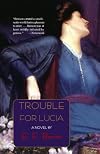
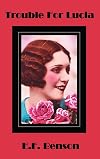
In "Trouble for Lucia," Lucia learns to ride a bicycle, and we live through the saga of Blue Birdie (Mrs. Wyse's dead budgerigar [parakeet] invoke in a seance).Lucia and Georgie renew their acquaintance with the operatic diva Olga Braceley and the composer Cortese, but nobody in Tilling believes her when she claims to have entertained a duchess overnight. Lucia becomes Mayor of Tilling and Miss Mapp is appointed her Mayoress. This is the sixth volume in the "Lucia" Series.Tags
Recommendations






















Member Recommendations
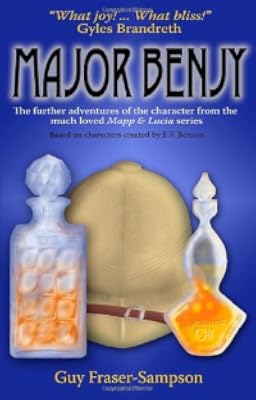
Quaint1 If you enjoy the Tilling novels, you will probably enjoy Major Benjy, which fills in some of the gaps in the story between "Miss Mapp" and the rest of the series!
Member Reviews
It's with a certain sadness I finish the last of Benson's Lucia novels, not for the finishing itself as I can, and will, re-read them, but because the intimations of growth I thought I saw in Lucia's character in the previous two books came to naught.
If Olga Bracely and Miss Mapp represent the better and worse aspects of Lucia's character, then, like Georgie, I'm more attracted to her in the former, and repelled by her in the latter mode.
Crediting Benson with knowing what he was doing, Lucia is ultimately shown to be a weak and vain person who tries but fails to rise above her petty, self-centred vindictiveness, and whose airs of being The Champion of the Poor are founded in hollow self-aggrandisement, along with the social stratum she show more represents. Benson's choice to make the satirical point was, it's sadly clear, prophetic given the subsequent course of social & world events,
but leaves us (well, me, at least) with a diminished Lucia.
I do hold out hope for Lucia, though, as she has shown herself amenable to influence from two benignant sources: the gossipy, but ultimately kind-hearted, Georgie Pillson, and the irreverent and unaffected Quaint Irene. I cross my fingers in hope of Lucia's redemption, and of those she represents.
I have the Tom Holt continuations, and hope that perhaps he takes things in that direction. show less
If Olga Bracely and Miss Mapp represent the better and worse aspects of Lucia's character, then, like Georgie, I'm more attracted to her in the former, and repelled by her in the latter mode.
Crediting Benson with knowing what he was doing, Lucia is ultimately shown to be a weak and vain person who tries but fails to rise above her petty, self-centred vindictiveness, and whose airs of being The Champion of the Poor are founded in hollow self-aggrandisement, along with the social stratum she show more represents. Benson's choice to make the satirical point was, it's sadly clear, prophetic given the subsequent course of social & world events,
but leaves us (well, me, at least) with a diminished Lucia.
I do hold out hope for Lucia, though, as she has shown herself amenable to influence from two benignant sources: the gossipy, but ultimately kind-hearted, Georgie Pillson, and the irreverent and unaffected Quaint Irene. I cross my fingers in hope of Lucia's redemption, and of those she represents.
I have the Tom Holt continuations, and hope that perhaps he takes things in that direction. show less
NOTE: This review applies to the entire Mapp and Lucia series.
This appears to be one of those series that people either love or hate. Set in the early decades of the 20th century, E.F. Benson skewers the frivolous lives of the elite in rural English villages. The heroine is Mrs. Emmeline Lucas, known to all as Lucia (the Italian pronunciation, if you please). Lucia rules the village of Riseholme with an iron fist in a velvet glove, ruthlessly running the social lives of the others in her social class. Despite their occasional resentment and attempts to break free of Lucia's influence, the village invariably finds life gray and boring without their benevolent dictator in residence.
The second book in the series, Miss Mapp, at first show more appears to be a completely unrelated book, as Lucia does not appear and instead the main character is Elizabeth Mapp, a never-married woman "of a certain age" in the village of Tilling. Like Lucia, she rules her social class with a strong will, although with somewhat less grace than her counterpart in Riseholme. The third book, Lucia in London, leaves Mapp and Tilling behind and returns to focus on Lucia, this time on her adventures during the social season in London.
Finally, in Book Four (Mapp and Lucia), the irresistible force (Lucia) meets the immovable object (Mapp) when Lucia decides to move to Tilling. This town is not big enough for both of them to rule, and the schemes and shenanigans that ensue are delightfully sharp and witty. Their tussles continue in the final two books in the series, Lucia's Progress and Trouble for Lucia.
The lives of the people spotlighted in Riseholme and in Tilling are spectacularly shallow. The biggest intrigues involve who is paired with who at the evening bridge games, and gossip is traded freely during the morning marketing, when anyone who is anyone gathers on the High Street with their baskets and their cutting observations. Scarcely a reference is ever made to world wars or depressions, even though both raged throughout the time period of these books. To read such accounts written in a serious manner would be intolerably smug, but Benson's writing is slyly cutting, as he appears to take all of the plotting with the utmost sincerity even while winking at the reader with his asides.
Readers who prefer their heroes and heroines to be a bit less shallow and a bit more kind will find the Lucia series less than enjoyable, as will those readers neither old enough to remember the early 20th century nor with any interest in life among the middle class (being, in those days and in that country, truly in the middle between the poor and working classes on one end and the aristocracy on the other). Those who, like me, enjoy a sharp bite to their fiction will find themselves alternately rooting for the downfall of Mapp and Lucia and cheering their subsequent rise back to prominence. show less
This appears to be one of those series that people either love or hate. Set in the early decades of the 20th century, E.F. Benson skewers the frivolous lives of the elite in rural English villages. The heroine is Mrs. Emmeline Lucas, known to all as Lucia (the Italian pronunciation, if you please). Lucia rules the village of Riseholme with an iron fist in a velvet glove, ruthlessly running the social lives of the others in her social class. Despite their occasional resentment and attempts to break free of Lucia's influence, the village invariably finds life gray and boring without their benevolent dictator in residence.
The second book in the series, Miss Mapp, at first show more appears to be a completely unrelated book, as Lucia does not appear and instead the main character is Elizabeth Mapp, a never-married woman "of a certain age" in the village of Tilling. Like Lucia, she rules her social class with a strong will, although with somewhat less grace than her counterpart in Riseholme. The third book, Lucia in London, leaves Mapp and Tilling behind and returns to focus on Lucia, this time on her adventures during the social season in London.
Finally, in Book Four (Mapp and Lucia), the irresistible force (Lucia) meets the immovable object (Mapp) when Lucia decides to move to Tilling. This town is not big enough for both of them to rule, and the schemes and shenanigans that ensue are delightfully sharp and witty. Their tussles continue in the final two books in the series, Lucia's Progress and Trouble for Lucia.
The lives of the people spotlighted in Riseholme and in Tilling are spectacularly shallow. The biggest intrigues involve who is paired with who at the evening bridge games, and gossip is traded freely during the morning marketing, when anyone who is anyone gathers on the High Street with their baskets and their cutting observations. Scarcely a reference is ever made to world wars or depressions, even though both raged throughout the time period of these books. To read such accounts written in a serious manner would be intolerably smug, but Benson's writing is slyly cutting, as he appears to take all of the plotting with the utmost sincerity even while winking at the reader with his asides.
Readers who prefer their heroes and heroines to be a bit less shallow and a bit more kind will find the Lucia series less than enjoyable, as will those readers neither old enough to remember the early 20th century nor with any interest in life among the middle class (being, in those days and in that country, truly in the middle between the poor and working classes on one end and the aristocracy on the other). Those who, like me, enjoy a sharp bite to their fiction will find themselves alternately rooting for the downfall of Mapp and Lucia and cheering their subsequent rise back to prominence. show less
The final installment in the six-book Lucia saga isn't quite up to the standard set by the other five. Don't get me wrong: It's definitely> worth reading, especially when Lucia is stymied in her attempt to induce the crème of Tilling society to play bridge with betting so as to set a good example for the lower classes; when the "quaint Irene" Coles paints a scandalous parody of the Mapp-Flints, which goes on to win prizes and praise in London; and when Elizabeth Mapp-Flint turns green with jealousy as Lucia starts a bicycling craze. (Even Elizabeth's husband, Major Benjy, turns traitor and takes up cycling behind her back.)
Now Mayor of Tilling, Lucia has grown simply so smug and domineering that she's just not as sympathetic a show more character. In Mapp and Lucia and Lucia's Progress, the reader roots for the capable and generous (if self-promoting) Lucia to triumph over that skinflint busybody, Miss Mapp, who spreads malice and dissension wherever she goes. (Both those books are combined in one volume in Miss Mapp and Lucia - Lucia's Progress.) Still, after becoming as surfeit with Lucia's snobbery and condescension as the denizens of Tilling, near the end of the book, one rallies back to her cause. When the malicious and jealous Elizabeth tries to bring Lucia down by spreading rumors that Georgie Pillson, now Lucia's husband, has begun an amorous affair with the opera singer Olga Bracely and that Poppy and that the Duchess of Sheffield never did spend the night at Mallards -- both iniquitous lies -- Lucia craftily gets her own back.That final party where Poppy's reappearance and favor chagrin the Tillingites -- except for Elizabeth, who has no shame -- simply brings joy to the soul. Who hasn't ever dreamed of that kind of fortune and vindication?
Even if Lucia can be too much, her determination and brilliance and her sincere generosity make up for it. As in Lucia in London, where one tires midway through the book of Lucia's social climbing and intrigues, one eventually regains one's admiration for the clever Lucia, who never loses her aplomb, her drive -- or her luck. show less
Now Mayor of Tilling, Lucia has grown simply so smug and domineering that she's just not as sympathetic a show more character. In Mapp and Lucia and Lucia's Progress, the reader roots for the capable and generous (if self-promoting) Lucia to triumph over that skinflint busybody, Miss Mapp, who spreads malice and dissension wherever she goes. (Both those books are combined in one volume in Miss Mapp and Lucia - Lucia's Progress.) Still, after becoming as surfeit with Lucia's snobbery and condescension as the denizens of Tilling, near the end of the book, one rallies back to her cause. When the malicious and jealous Elizabeth tries to bring Lucia down by spreading rumors that Georgie Pillson, now Lucia's husband, has begun an amorous affair with the opera singer Olga Bracely and that Poppy and that the Duchess of Sheffield never did spend the night at Mallards -- both iniquitous lies -- Lucia craftily gets her own back.
Even if Lucia can be too much, her determination and brilliance and her sincere generosity make up for it. As in Lucia in London, where one tires midway through the book of Lucia's social climbing and intrigues, one eventually regains one's admiration for the clever Lucia, who never loses her aplomb, her drive -- or her luck. show less
The last of the original series of these novels, this is perhaps the least of them. And that's fair: Benson was in his 70s by the time this novel was published, and would die mere months later. Still, the world of Tilling is richly embroidered and there is plenty of fun to be had. Perhaps the laughs don't come every single line, and one almost feels like one is reading a light novel rather than a light comic novel, but fans will still delight in the madness. Just not a place to start for a newcomer.
Luckily we have numerous authors who have taken up the baton of this series since the 1980s - some wonderful, some less so - so that we are assured that Elizabeth, Georgie, Lucia, Diva, Irene and the gang will never truly leave us.
Luckily we have numerous authors who have taken up the baton of this series since the 1980s - some wonderful, some less so - so that we are assured that Elizabeth, Georgie, Lucia, Diva, Irene and the gang will never truly leave us.
The last in the Mapp and Lucia series (right - there aren't any more?) and I've really enjoyed these. They are a bit ridiculous but the characters are so much fun. This one has plenty of Georgie, who I love best. I'll miss this series. Maybe I'll reread them someday.
The last of the Mapp / Lucia stories. Lucia is to become mayor of Tilling, and the question on everybody's mind is: who will be mayoress? All manner of social complications arise involving, inter alia, a dead budgerigar, Major Benjy's riding crop, and Quaint Irene's new take on Botticelli; Lucia starts a craze for bicycling; Olga Bracely returns to test Georgie's loyalty and a stray Duchess causes general havoc. Lucia over-reaches herself just a bit, but Mapp's jubilation may turn out to be premature. In short, Tilling as we know it and love it.
Benson was mayor of Rye himself, so presumably what he tells us about local politics is drawn from experience. I felt sometimes in this book that Benson was trying a bit too hard to find show more something new to say about his characters -- the underlying story is much the same as in Lucia in London, after all -- but the wealth of incident is enough to keep us amused. show less
Benson was mayor of Rye himself, so presumably what he tells us about local politics is drawn from experience. I felt sometimes in this book that Benson was trying a bit too hard to find show more something new to say about his characters -- the underlying story is much the same as in Lucia in London, after all -- but the wealth of incident is enough to keep us amused. show less
When Lucia becomes mayor of Tilling, the idea is generally put about that she needs a mayoress, and finally Lucia decides it must be Mapp who would be far less troublesome if she had the post. Mayorial obligations are not quite as onerous as Lucia expected, though she manages to make them as onerous as possible by carting (empty) tin boxes around with her and attempting to educate everyone with her lectures. She becomes unpopular even with husband Georgie who causes many a tongue to wag when he spends a little too much time with his opera singer friend Olga who has returned to Riseholme. Meanwhile Diva has opened a teashop (or is it a gambling den), Lucia has an encounter with a forgetful Duchess who is obsessed with beards, quaint show more Irene's portrait of Mapp and Benjy satirizing Boticelli's Venus on a seashell gets a national award and many other incidents stir lots of little storms in teapots. show less
Members
- Recently Added By
Lists

Best cycling books (novels and narrative non-fiction)
15 works; 2 members

Books Read in 2021
5,361 works; 113 members

Folio Society
831 works; 53 members
Author Information

256+ Works 9,814 Members
Some Editions
Series

Work Relationships
Is contained in
Common Knowledge
- Canonical title
- Trouble for Lucia
- Original publication date
- 1939
- People/Characters
- Emmeline Lucas (Lucia | Emmeline Pillson); Elizabeth Mapp (Elizabeth Mapp-Flint); Georgie Pillson; Godiva Plaistow (Diva); Algernon Wyse; Susan Wyse (show all 24); Kenneth Bartlett (Padre); Evie Bartlett; Olga Bracely; Benjamin Flint (Benjamin Mapp-Flint, Major Benjy); Foljambe (Georgie's parlourmaid); Chapman (Lucia's chauffeur); Grosvenor (Lucia's parlourmaid); Irene Coles (Quaint Irene); Mrs. Simpson (Lucia's secretary); Lucy (Qiaint Irene's parlourmaid); Janet (Diva's parlourmaid); Mr. Rice (the poulterer); Inspector Morrison; Figgis (the Wyses' butler); Cortese (composer); Dorothy Cortese; Poppy Sheffield (Duchess of Sheffield); Susan Leg (Rudolph da Vinci)
- Important places
- Tilling, Hampshire, England, UK; Mallards, Tilling, Hampshire, England, UK; Starlings Cottage, Porpoise Street, Tilling, Hampshire, England, UK; Wasters, Tilling, Hampshire, England, UK; Landgate Street, Tilling, Hampshire, England, UK; Covent Garden Opera House, Covent Garden, London, England, UK (show all 8); Risholme, Worcestershire, England, UK; Sheffield Castle
- First words
- Lucia Pillson, the Mayor-Elect of Tilling and her husband Georgie were talking together one October afternoon in the garden-room at Mallards. The debate demanded the exercise of their keenest faculties.
- Last words
- (Click to show. Warning: May contain spoilers.)"Such a treat for them all! They will remember this evening. Perfect!"
Classifications
Statistics
- Members
- 460
- Popularity
- 66,258
- Reviews
- 10
- Rating
- (4.18)
- Languages
- English, French, German
- Media
- Paper, Audiobook, Ebook
- ISBNs
- 30
- ASINs
- 10