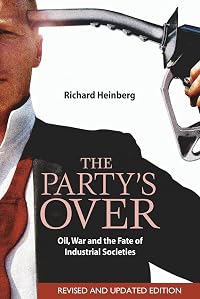
The Party's Over: Oil, War and the Fate of Industrial Societies
by Richard Heinberg
On This Page
Description
An updated edition of this bestselling book on the end of oil -- and its consequences.Tags
Recommendations
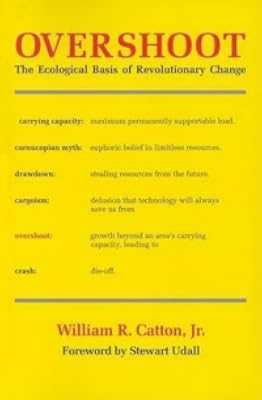





Member Recommendations
Member Reviews
The definitive 'beginners guide' to peak oil. A highly readable and accessible treatment of the subject. The obligatory 'solutions' chapter at the end of the book is pretty fluffy though; you can probably afford to just skim over it.
This was the first book I read on the topic of peak oil, so it was an eye-opening experience. It makes the case for peak oil to a general audience without too much technical detail and describes the likely consequences. He may be too dismissive of alternative power sources, notably solar thermal technologies, which M.K. Hubbert thought were viable in principle even in the 1960's, but at this point we are a long way from making that a reality.
Heinberg presents an assessment of the status of remaining global fossil fuel supplies that will give little hope to those who believe that industrial society can gradually transition from fossil fuels over the next few decades into renewables.
He presents a bleak future for the oil age and advocates the adoption of a sustainable society, which will require a completely different worldview than the one(s) that have brought modern society to the current state of affairs.
He presents a bleak future for the oil age and advocates the adoption of a sustainable society, which will require a completely different worldview than the one(s) that have brought modern society to the current state of affairs.
Book Description
The world is about to run out of cheap oil and change dramatically. Within the next few years, global production will peak. Thereafter, even if industrial societies begin to switch to alternative energy sources, they will have less net energy each year to do all the work essential to the survival of complex societies. We are entering a new era, as different from the industrial era as the latter was from medieval times.
In The Party's Over, Richard Heinberg places this momentous transition in historical context, showing how industrialism arose from the harnessing of fossil fuels, how competition to control access to oil shaped the geopolitics of the twentieth century and how contention for dwindling energy resources in the show more twenty-first century will lead to resource wars in the Middle East, Central Asia and South America. He describes the likely impacts of oil depletion and all of the energy alternatives. Predicting chaos unless the United States-the world's foremost oil consumer-is willing to join with other countries to implement a global program of resource conservation and sharing, he also recommends a "managed collapse" that might make way for a slower-paced, low-energy, sustainable society in the future.
More readable than other accounts of this issue, with fuller discussion of the context, social implications and recommendations for personal, community, national and global action, Heinberg's updated book is a riveting wake-up call for human-kind as the oil era winds down, and a critical tool for understanding and influencing current US foreign policy.
Richard Heinberg, from Santa Rosa, California, has been writing about energy resources issues and the dynamics of cultural change for many years. A member of the core faculty at New College of California, he is an award-winning author of three previous books. His Museletter was nominated for the Best Alternative Newsletter award by Utne in 1993. show less
The world is about to run out of cheap oil and change dramatically. Within the next few years, global production will peak. Thereafter, even if industrial societies begin to switch to alternative energy sources, they will have less net energy each year to do all the work essential to the survival of complex societies. We are entering a new era, as different from the industrial era as the latter was from medieval times.
In The Party's Over, Richard Heinberg places this momentous transition in historical context, showing how industrialism arose from the harnessing of fossil fuels, how competition to control access to oil shaped the geopolitics of the twentieth century and how contention for dwindling energy resources in the show more twenty-first century will lead to resource wars in the Middle East, Central Asia and South America. He describes the likely impacts of oil depletion and all of the energy alternatives. Predicting chaos unless the United States-the world's foremost oil consumer-is willing to join with other countries to implement a global program of resource conservation and sharing, he also recommends a "managed collapse" that might make way for a slower-paced, low-energy, sustainable society in the future.
More readable than other accounts of this issue, with fuller discussion of the context, social implications and recommendations for personal, community, national and global action, Heinberg's updated book is a riveting wake-up call for human-kind as the oil era winds down, and a critical tool for understanding and influencing current US foreign policy.
Richard Heinberg, from Santa Rosa, California, has been writing about energy resources issues and the dynamics of cultural change for many years. A member of the core faculty at New College of California, he is an award-winning author of three previous books. His Museletter was nominated for the Best Alternative Newsletter award by Utne in 1993. show less
Thorough discussion of everything from ecology to human history to the automobile to the roles of oil to ways to evaluate the value and efficiency of various forms of energy. It's fascinating and very engaging. I'd recommend it to anyone living in an industrial society.
This is the best general introduction to the subject of "peak oil" and one of the first to break this subject to a general audience. Readers of TheOilDrum.com won't find anything in this they don't already know, but for newbies it's great.
If you want to read a realisitic assessment of what the current stae of the world's oil reserves are, then this book is for you. Heinberg looks at an explians authoritative evidence that results in disturbing , serious and perhaps catastrophic results. If you want to understand how the world's oil supply is distributed and what the options for change are, this is for you.
Members
- Recently Added By
Author Information

26+ Works 1,655 Members
Richard Heinberg is the author of thirteen previous books, including The Party's Over, Powerdown, Peak Everything, and The End of Growth. He is Senior Fellow of the Post Carbon Institute and is widely regarded as one of the world's most effective communicators of the urgent need to transition away from fossil fuels. He lives in Santa Rosa, CA.
Series
Belongs to Publisher Series
Common Knowledge
- Canonical title*
- La festa è finita: la scomparsa del petrolio, le nuove guerre, il futuro…
*Some information comes from Common Knowledge in other languages. Click "Edit" for more information.
Classifications
- Genres
- Economics, Nonfiction, Science & Nature, General Nonfiction, Politics and Government, History
- DDC/MDS
- 333.8232 — Society, government, & culture Economics Economics of land and energy Subsurface resources - nonrenewable Fossil Fuels Oil And Natural Gas Oil
- LCC
- HD9560.6 .H45 — Social sciences Industries. Land use. Labor Industries. Land use. Labor Special industries and trades Mineral industries. Metal trade
- BISAC
Statistics
- Members
- 407
- Popularity
- 76,484
- Reviews
- 11
- Rating
- (4.03)
- Languages
- 6 — Arabic, English, French, German, Italian, Spanish
- Media
- Paper, Ebook
- ISBNs
- 12
- ASINs
- 2