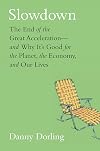
Slowdown: The End of the Great Acceleration―and Why It’s Good for the Planet, the Economy, and Our Lives
by Danny Dorling
On This Page
Description
Drawing from an incredibly rich trove of global data, this groundbreaking book reveals that human progress has been slowing down since the early 1970s. Danny Dorling uses compelling visualizations to illustrate how fertility rates, growth in GDP per person, increases in life expectancy, and even the frequency of new social movements have all steadily declined over the last few generations. Perhaps most surprising of all is the fact that even as new technologies frequently reshape our show more everyday lives and are widely believed to be propelling our civilization into new and uncharted waters, the rate of technological progress is also rapidly dropping. Rather than lament this turn of events, Dorling embraces it as a moment of promise and a move toward stability, and he notes that many of the older great strides in progress that have defined recent history also brought with them widespread warfare, divided societies, and massive inequality. show lessTags
Recommendations


















Member Reviews
An erudite book, covering many topics with a lot of detail, like population, GDP, climate, and so on. The main thesis seems to be that the age of unending growth in coming to an end, as we approach a steady state or even shrinking economy in much of the world. The author discusses the types of accommodation that will be required, but reassures us that the non-expanding world will be better for everyone, with less inequality, less environmental damage, and so on. To illustrate these trends, he uses a different type of diagram to present the time series, which he calls the phase diagram. This has absolute change on the horizontal axis, and absolute levels on the vertical axis. Time is not on the axis, so selected data points are labeled show more with the year. It is debatable whether this sort of presentation aids the understanding, in fact it may interfere with it for the average reader. However, it is obvious that his heart is in the right place (he is the rare economist who actually calls out the creative destruction theory), and there is much to learn. I would have been happier if he had developed in more detail the consequences of the slowing economy, and how the world is exactly going to manage the de-escalation of the growth curve and the de-carbonisation of the world economy. A glaring blind spot is the lack of any reference to the growing religious intolerance and fanaticism in many parts of the world. Love Kirsten's birds in the graphs! show less
Ratings
Members
- Recently Added By
Lists

Books cited in Progress by Samuel McDonald
160 works; 1 member
Author Information

37+ Works 900 Members
Danny Dorling, is the Halford Mackinder Professor of Geography, Oxford. He appears regularly on TV and radio, and writes for the Guardian, New Statesman and other newspapers. Among his books are All That Is Solid; Population 10 Billion; So You Think You Know About Britain?; and Injustice.
Classifications
- Genres
- Sociology, Economics, Nonfiction, General Nonfiction, Science & Nature, History
- DDC/MDS
- 303.44 — Society, government, & culture Social sciences, sociology & anthropology Social processes Social change Growth and development
- LCC
- HM891 .D67 — Social sciences Sociology (General) Sociology Social change
- BISAC
Statistics
- Members
- 44
- Popularity
- 675,741
- Reviews
- 1
- Rating
- (4.00)
- Languages
- English
- Media
- Paper, Audiobook, Ebook
- ISBNs
- 5
- ASINs
- 1