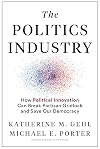
The Politics Industry: How Political Innovation Can Break Partisan Gridlock and Save Our Democracy
by Katherine M. Gehl
On This Page
Description
Our political system in America is broken, right? Wrong. The truth is, the American political system is working exactly how it is designed to work, and it isn't designed or optimized today to work for us-for ordinary citizens. Most people believe that our political system is a public institution with high-minded principles and impartial rules derived from the Constitution. In reality, it has become a private industry dominated by a textbook duopoly - the Democrats and the Republicans-and show more plagued and perverted by unhealthy competition between the players. Tragically, it has, therefore, become incapable of delivering solutions to America's key economic and social challenges. In fact, there's virtually no connection between our political leaders solving problems and getting reelected. In The Politics Industry, business leader and path-breaking political innovator Katherine Gehl and world-renowned business strategist Michael Porter take a radical new approach. They ingeniously apply the tools of business analysis-and Porter's distinctive Five Forces framework-to show how the political system functions just as every other competitive industry does, and how the duopoly has led to the devastating outcomes we see today. Using this competition lens, Gehl and Porter identify the most powerful lever for change-a strategy comprised of a clear set of choices in two key areas: how our elections work and how we make our laws. Their bracing assessment and practical recommendations cut through the endless debate about various proposed fixes, such as term limits and campaign finance reform. The result: true political innovation. The Politics Industry is an original and completely nonpartisan guide that will open your eyes to the true dynamics and profound challenges of the American political system and provide real solutions for reshaping the system for the benefit of all. show lessTags
Recommendations


















Member Reviews
If you weren’t disgusted enough with politics in America, here are Katherine Gehl and Michael Porter to put parameters on exactly how pathetic it all is. In The Politics Industry, they look at parties as if they were a for profit industry, using Porter’s famous and standard Five Forces. They find the industry not just unresponsive, but with the worst customer service anywhere. Think airlines on steroids.
The reason is simple. They’re in it for themselves, for the power and the money. Citizens are merely an inconvenience every couple of years. The rest of the time, it’s all about them. They have a business to run – their own. They have modified the rules of government to suit their needs. They have zero desire to solve problems, show more because problems allow them to complain about the other party and make themselves indispensable. And just exactly like Trump and his loyalty fetish, total adherence to the party is an unshakeable requirement. Doesn’t matter how bad the bill is, you vote the way you’re told, or they will see to it you never come back. This is American democracy at work.
The authors call the two parties a duopoly, a textbook case from Porter’s experience. In the real world, Porter says, an entrepreneur would see this as a market inefficiency and therefore opportunity and compete the hell out of them. But this is America. Third parties face impossible obstacles. The duopoly always wins, and Americans always lose, the authors say. It is a highly profitable industry. $16 billion poured in for the 2016 election alone. Donald Trump ran the first profitable presidential campaign in history. It is all totally divorced from government of for and by the people.
Competition is forbidden. Independents face much harder requirements to get on ballots than party members. Anyone who loses a primary is forbidden by law from running in the election in most states. (They call it the Sore Loser law.) Even the presidential debates are under their full control. They used to be run as a public service of the League of Women Voters, but the parties took over and regulate every detail from the angle of the desks to the bland and banal questions that don’t get answered anyway. Some 42% of Americans register as independents because parties offer them no quarter and no choice. Party voters check straight ticket without ever even knowing who the candidates are. “American politics is an industrial-strength, nation-crippling perversion of competition,” the authors say.
The political-industrial complex views action as a threat. It wants problems to fester. They keep the donations flowing. The amount of donations raised by electeds determines their personal success, position, and promotion. The party in power spends most of its time gathering power, refusing to allow debates, refusing to allow votes, and ensuring issues do not get resolved on their watch. It’s all about perpetuating power. It’s no different than Russia or China that Americans love to criticize for their singleminded pursuit of control.
The absurd primary system ensures only the most extreme candidates win. Moderates have no place. “Party primaries create an eye-of-the-needle through which no problem-solving politician can pass.” In many states, only those registered to the party can vote in the primary, and that is the real election, because gerrymandering ensures the party will take that district regardless. (In the district next to ours, the Democrats often don’t even bother with a candidate, so if you don’t vote in the primary, you get no vote at all.) Even Harvard Business Alumni think America’s greatest competitive weakness is its political system.
Compromise is vilified. Cooperating across the aisle is treason. Moderates will be primaried out of a job. Electeds are there to do the party’s bidding, no matter how damaging or counter-intuitive, and certainly without regard to constituents’ needs. They too are just cogs in the duopoly machine running amok.
What to do? The authors have two big ideas. First, make elections about the top five votegetters from the primaries. Next, make the election Ranked Choice Voting (RCV). In RCV, if the top votegetter doesn’t have 50% + 1, they eliminate the lowest candidate and reassign his or her votes among the others. Because everyone gets five votes: first, second third fourth and fifth choice among the five candidates. For once, the winner will actually have a majority, every time. Today, 35% can take the prize. It’s called plurality, not majority, and it’s a leftover from the British system that has proven so unfortunate in say, the Brexit vote.
The other idea is what amounts to a constitutional convention on structure – which is not in the US constitution, so rules can be modified, just as the duopoly has been doing all along. They call it the Legislative Machinery Innovation Committee and somehow it will be made up of experts and not special interests. Good luck with that. It will work on the principle of zero-based budgeting, from Porter’s experience in business consulting. Unfortunately, government doesn’t work like business, as Trump is finding out to his huge frustration. Deficit spending is actually impossible to avoid with the dollar as strong as it is, and interest rates as low as they are. Surpluses are damaging to the economy. So that’s not going very far, either, I’m afraid.
The thing that really annoys me about this book is that it has the exact same conclusion as a dozen other books I have reviewed on dysfunctional US government. You, dear reader, are the answer. You have to get involved. You are more powerful than you think. You have your own network, your own locality, your local media, and your own influence. You can volunteer, post online, join a movement, and donate money. It’s all in your own hands. Americans have come to this sad point before, notably in the Gilded Age, when equality and corruption were actually worse. But bottom up, scattered efforts by people just like you pulled the country back from the abyss. So your hard work can save us again, for a while.
The message has become tiresome, but in the specific case of multiple primary winners, there is real movement to report. Several states have begun implementing RCV and/or multiple candidates out of the primaries. The duopoly absolutely hates that. Both Democratic leader Nancy Pelosi and Republican leader Kevin McCarthy are on record as hating it. So it must be right. This alone makes it worth pushing for.
On the other hand, why settle for complex voting procedures? The simplest solution is to go back to Ancient Greece where it all started. Political office is an obligation, a service like jury duty. It was not meant to be a lifelong career where electeds get rich. So one term only. No need to raise PAC money. No need to bow to pressure. One term means parties can’t threaten electeds if they don’t vote right, if they don’t raise enough money for the party, or if they co-operate with the other party. Lobbying becomes all but impossible. It means solving problems. All by setting term limits to one. The authors don’t go this far.
At least some states allow citizen initiatives. When the RCV referendum is put to voters, and it wins, the duopoly sues to prevent it becoming law. How sick is this, the authors do not say. But if the court has not been packed by the duopoly, the citizens can win. It is now a well-trodden path, and the playbook works. In other words, it is still possible to have free and fair elections, even in America, if voters are willing to fight against their own elected representatives for it.
The duopoly is the coronavirus. It infects and damages everyone. But it is nonetheless fragile. Gehl and Porter’s proposals are simple handsoap to break the bonds of the coronavirus - the parties that threaten us all.
David Wineberg show less
The reason is simple. They’re in it for themselves, for the power and the money. Citizens are merely an inconvenience every couple of years. The rest of the time, it’s all about them. They have a business to run – their own. They have modified the rules of government to suit their needs. They have zero desire to solve problems, show more because problems allow them to complain about the other party and make themselves indispensable. And just exactly like Trump and his loyalty fetish, total adherence to the party is an unshakeable requirement. Doesn’t matter how bad the bill is, you vote the way you’re told, or they will see to it you never come back. This is American democracy at work.
The authors call the two parties a duopoly, a textbook case from Porter’s experience. In the real world, Porter says, an entrepreneur would see this as a market inefficiency and therefore opportunity and compete the hell out of them. But this is America. Third parties face impossible obstacles. The duopoly always wins, and Americans always lose, the authors say. It is a highly profitable industry. $16 billion poured in for the 2016 election alone. Donald Trump ran the first profitable presidential campaign in history. It is all totally divorced from government of for and by the people.
Competition is forbidden. Independents face much harder requirements to get on ballots than party members. Anyone who loses a primary is forbidden by law from running in the election in most states. (They call it the Sore Loser law.) Even the presidential debates are under their full control. They used to be run as a public service of the League of Women Voters, but the parties took over and regulate every detail from the angle of the desks to the bland and banal questions that don’t get answered anyway. Some 42% of Americans register as independents because parties offer them no quarter and no choice. Party voters check straight ticket without ever even knowing who the candidates are. “American politics is an industrial-strength, nation-crippling perversion of competition,” the authors say.
The political-industrial complex views action as a threat. It wants problems to fester. They keep the donations flowing. The amount of donations raised by electeds determines their personal success, position, and promotion. The party in power spends most of its time gathering power, refusing to allow debates, refusing to allow votes, and ensuring issues do not get resolved on their watch. It’s all about perpetuating power. It’s no different than Russia or China that Americans love to criticize for their singleminded pursuit of control.
The absurd primary system ensures only the most extreme candidates win. Moderates have no place. “Party primaries create an eye-of-the-needle through which no problem-solving politician can pass.” In many states, only those registered to the party can vote in the primary, and that is the real election, because gerrymandering ensures the party will take that district regardless. (In the district next to ours, the Democrats often don’t even bother with a candidate, so if you don’t vote in the primary, you get no vote at all.) Even Harvard Business Alumni think America’s greatest competitive weakness is its political system.
Compromise is vilified. Cooperating across the aisle is treason. Moderates will be primaried out of a job. Electeds are there to do the party’s bidding, no matter how damaging or counter-intuitive, and certainly without regard to constituents’ needs. They too are just cogs in the duopoly machine running amok.
What to do? The authors have two big ideas. First, make elections about the top five votegetters from the primaries. Next, make the election Ranked Choice Voting (RCV). In RCV, if the top votegetter doesn’t have 50% + 1, they eliminate the lowest candidate and reassign his or her votes among the others. Because everyone gets five votes: first, second third fourth and fifth choice among the five candidates. For once, the winner will actually have a majority, every time. Today, 35% can take the prize. It’s called plurality, not majority, and it’s a leftover from the British system that has proven so unfortunate in say, the Brexit vote.
The other idea is what amounts to a constitutional convention on structure – which is not in the US constitution, so rules can be modified, just as the duopoly has been doing all along. They call it the Legislative Machinery Innovation Committee and somehow it will be made up of experts and not special interests. Good luck with that. It will work on the principle of zero-based budgeting, from Porter’s experience in business consulting. Unfortunately, government doesn’t work like business, as Trump is finding out to his huge frustration. Deficit spending is actually impossible to avoid with the dollar as strong as it is, and interest rates as low as they are. Surpluses are damaging to the economy. So that’s not going very far, either, I’m afraid.
The thing that really annoys me about this book is that it has the exact same conclusion as a dozen other books I have reviewed on dysfunctional US government. You, dear reader, are the answer. You have to get involved. You are more powerful than you think. You have your own network, your own locality, your local media, and your own influence. You can volunteer, post online, join a movement, and donate money. It’s all in your own hands. Americans have come to this sad point before, notably in the Gilded Age, when equality and corruption were actually worse. But bottom up, scattered efforts by people just like you pulled the country back from the abyss. So your hard work can save us again, for a while.
The message has become tiresome, but in the specific case of multiple primary winners, there is real movement to report. Several states have begun implementing RCV and/or multiple candidates out of the primaries. The duopoly absolutely hates that. Both Democratic leader Nancy Pelosi and Republican leader Kevin McCarthy are on record as hating it. So it must be right. This alone makes it worth pushing for.
On the other hand, why settle for complex voting procedures? The simplest solution is to go back to Ancient Greece where it all started. Political office is an obligation, a service like jury duty. It was not meant to be a lifelong career where electeds get rich. So one term only. No need to raise PAC money. No need to bow to pressure. One term means parties can’t threaten electeds if they don’t vote right, if they don’t raise enough money for the party, or if they co-operate with the other party. Lobbying becomes all but impossible. It means solving problems. All by setting term limits to one. The authors don’t go this far.
At least some states allow citizen initiatives. When the RCV referendum is put to voters, and it wins, the duopoly sues to prevent it becoming law. How sick is this, the authors do not say. But if the court has not been packed by the duopoly, the citizens can win. It is now a well-trodden path, and the playbook works. In other words, it is still possible to have free and fair elections, even in America, if voters are willing to fight against their own elected representatives for it.
The duopoly is the coronavirus. It infects and damages everyone. But it is nonetheless fragile. Gehl and Porter’s proposals are simple handsoap to break the bonds of the coronavirus - the parties that threaten us all.
David Wineberg show less
Ratings
Members
- Recently Added By
Lists

How it can be.
14 works; 2 members
Author Information
1 Work 55 Members
Classifications
- Genres
- Politics and Government, Nonfiction, Business, General Nonfiction
- DDC/MDS
- 324.0973 — Society, government, & culture Political science Politics & Elections Biography And History North America
- LCC
- JK1726 .G45 — Political Science Political institutions and public administration (United States) Political institutions and public administration United States Political rights. Practical politics
- BISAC
Statistics
- Members
- 55
- Popularity
- 557,074
- Reviews
- 1
- Rating
- (4.29)
- Languages
- English
- Media
- Paper, Audiobook, Ebook
- ISBNs
- 5
- ASINs
- 2