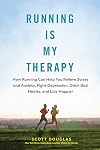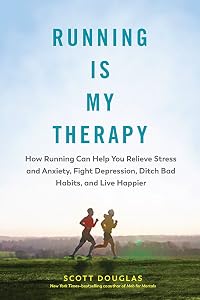
Running Is My Therapy: Relieve Stress and Anxiety, Fight Depression, Ditch Bad Habits, and Live Happier
by Scott Douglas
On This Page
Description
There's no other book like this. Longtime running writer Scott Douglas marshals expert advice (including his own, cultivated from more than 100,000 miles of personal experience), and a growing body of scientific research to show how running can make us happier. How? Everyone knows that running builds stronger muscles and a healthier heart; science now shows it also helps develop a healthier brain. For those struggling with depression and anxiety, a consistent running routine can enhance the show more mental-health benefits of talk therapy, antidepressants, and cognitive behavioral therapy. The key to running's therapeutic power lies in its lasting physiological effects, inducing changes in brain structure and chemistry that other forms of exercise don't. Thanks to the body's release of natural pain-relievers that includes the best mood boost in all of sports. Running is my therapy is no longer just a mantra for seasoned runners; with science behind him, Douglas presents proven methods so that we can all use running to improve our mental health and live happier-in and out of running shoes. show lessTags
Recommendations










Member Reviews
In 2003, my 42 year old cousin passed away from cancer. He was an avid runner, and each year took part in Atlanta's Peachtree Road Race. I decided to take up running after he passed so that I could keep running the race in his honor and memory. That decision led to an almost decade long love affair with running. Well, sometimes love, sometimes pure avarice, but I kept running. Through rain, winter weather, in Nikes, Vibrams, huaraches, and even bare feet. Then, somewhere around 2013 or so, I stopped. I lost my mojo.
This book has me eager to run again, though for different reasons. Now I'm 52. I deal with anxiety, and on some days, a partly cloudy mood that feels like minor depression takes hold. I don't want to take meds and I want to show more steer the mental ship back on course. I want to live a life that holistically mitigates the symptoms and causes of anxiety and minor depression. And so, while I used to run as a form of fitness, as exercise, as a way to honor a lost loved one and to 'find myself', I am now contemplating running to - for lack of a better term - save my life. To keep the wolves at bay, to find a sense of hunger and ambition again, to shake off the listlessness and malaise. This book was a great tool in inspiring that.
In concise, digestible chapters, Douglas addresses how running helps with anxiety, mood, and depression. He speaks to how running creates a structure for the brain, goals that are attainable and easy to build upon, even if you are only running short distances at a glacial pace (which is my current M.O.). He addresses how antidepressants affect running (a chapter I merely skimmed, as that's not a road I wish to go down, but it was helpful to see the science of it), and how such tools as mindfulness align with running.
Some of the information here is common sense and some of it was newly enlightening because he shares some data/science I wasn't aware of that contextualizes the claims. Mostly, I used this book as leverage to inspire me to run not because I need to lose 15 lbs or to prove I've still "got it", but because now it's a health issue, on a physical, mental, emotional, and spiritual level. I need to move to stave off some monsters before they grow too big, before they get more nimble and learn to outrun me. Before their whispered chants of "you can't, you won't" grow to drown out the still audible hum of my better angels.
This is a book for anyone who runs because it keeps them "on track"...or for anyone who is willing to entertain the notion that running might be a valuable tool in their arsenal against challenging mindsets, emotions, and even chronic disorders. Douglas states more than once that running is not a cure for any of these challenges, but it is another scientifically-backed, all natural resource that might make your journey easier and more joyful. show less
This book has me eager to run again, though for different reasons. Now I'm 52. I deal with anxiety, and on some days, a partly cloudy mood that feels like minor depression takes hold. I don't want to take meds and I want to show more steer the mental ship back on course. I want to live a life that holistically mitigates the symptoms and causes of anxiety and minor depression. And so, while I used to run as a form of fitness, as exercise, as a way to honor a lost loved one and to 'find myself', I am now contemplating running to - for lack of a better term - save my life. To keep the wolves at bay, to find a sense of hunger and ambition again, to shake off the listlessness and malaise. This book was a great tool in inspiring that.
In concise, digestible chapters, Douglas addresses how running helps with anxiety, mood, and depression. He speaks to how running creates a structure for the brain, goals that are attainable and easy to build upon, even if you are only running short distances at a glacial pace (which is my current M.O.). He addresses how antidepressants affect running (a chapter I merely skimmed, as that's not a road I wish to go down, but it was helpful to see the science of it), and how such tools as mindfulness align with running.
Some of the information here is common sense and some of it was newly enlightening because he shares some data/science I wasn't aware of that contextualizes the claims. Mostly, I used this book as leverage to inspire me to run not because I need to lose 15 lbs or to prove I've still "got it", but because now it's a health issue, on a physical, mental, emotional, and spiritual level. I need to move to stave off some monsters before they grow too big, before they get more nimble and learn to outrun me. Before their whispered chants of "you can't, you won't" grow to drown out the still audible hum of my better angels.
This is a book for anyone who runs because it keeps them "on track"...or for anyone who is willing to entertain the notion that running might be a valuable tool in their arsenal against challenging mindsets, emotions, and even chronic disorders. Douglas states more than once that running is not a cure for any of these challenges, but it is another scientifically-backed, all natural resource that might make your journey easier and more joyful. show less
***.5
Most of the info is rather obvious, as the link between regular exercise and better mental health is well-known. The problem for most people suffering from depression and/or anxiety is that starting an exercise programme is a daunting enterprise, and when even getting out of bed or taking a shower is a monumental task, lacing up a pair of running shoes and venturing out into the cold dawn for a 3 mile run is the equivalent of running a marathon. The author comes from the perspective of people who are already long-time regular runners, people who already habitually exercise regularly regardless of their mental state or what else is going on in their lives. In other words, a small portion of the population, more an aberration than show more the norm. He concedes that it takes many weeks to several months for the positive effects to fully kick in, but offers little tangible advice for getting started and sticking with it. It's like telling an overweight person that they should eat less in order to lose weight. Gee thanks, I never would have thought of that.
On the positive side, the book is well organised, with chapters devoted to various aspects of mental health. There is plenty of research cited, supplemented by the author's own personal experiences as well as profiles of his running partners and other athletes (many are quite candid and help personalize the statistical results).
Overall I found it motivational, as there is plenty of evidence that in addition to cardiovascular health improvements, regular runs also have documented benefits to brain functioning. show less
Most of the info is rather obvious, as the link between regular exercise and better mental health is well-known. The problem for most people suffering from depression and/or anxiety is that starting an exercise programme is a daunting enterprise, and when even getting out of bed or taking a shower is a monumental task, lacing up a pair of running shoes and venturing out into the cold dawn for a 3 mile run is the equivalent of running a marathon. The author comes from the perspective of people who are already long-time regular runners, people who already habitually exercise regularly regardless of their mental state or what else is going on in their lives. In other words, a small portion of the population, more an aberration than show more the norm. He concedes that it takes many weeks to several months for the positive effects to fully kick in, but offers little tangible advice for getting started and sticking with it. It's like telling an overweight person that they should eat less in order to lose weight. Gee thanks, I never would have thought of that.
On the positive side, the book is well organised, with chapters devoted to various aspects of mental health. There is plenty of research cited, supplemented by the author's own personal experiences as well as profiles of his running partners and other athletes (many are quite candid and help personalize the statistical results).
Overall I found it motivational, as there is plenty of evidence that in addition to cardiovascular health improvements, regular runs also have documented benefits to brain functioning. show less
A book focused on, as the author succintly puts it, "integration of body and mind via running in managing depression and anxiety".
The first part of the book shares the author's personal experiences with their professional writing career, and how running has helped them with anxiety. It also delves into the mental health benefits of running (a minimum of twice a week is suggested), along with ample evidence and scientific data backing up their claims.
The second part of the book, and the meat of the reading, focuses on the "intersection of running and several forms of therapy". Each chapter clearly delineates what it covers: Running and Antidepressants, How Running Affects Your Mood, Running and Behavioral Therapy, and so forth.
This show more review sounds and probably feels a bit clinical - and it is. Why? I feel it matches the tone of the book - odd, considering the author shares much of their personal (and sometimes painful) experiences, in a friendly and engaging manner. Yet you can't take the journalist out of the book, and so, I found this book to read more like a highly researched magazine article. Very informative, chock full of scientific journal summaries and experts in both running and mental health. And yet... it's missing something for me.
Perhaps it's that I'm not technically a runner. The author states early on, "to be a runner, you just have to run". WIth that criteria, I am a runner. Have I struggled with depression in the past? You betcha. Do I now? No. So this may be where it falls flat for me. It's clinical, it's informative, and it's well-written. I, however, want a bit more color and 'oomph' in my books.
I would definitely recommend this book for library purchase; there are likely no other books on this specific topic, and it would be a great reference material or starting off point for students of mental health and/or running as therapy. show less
The first part of the book shares the author's personal experiences with their professional writing career, and how running has helped them with anxiety. It also delves into the mental health benefits of running (a minimum of twice a week is suggested), along with ample evidence and scientific data backing up their claims.
The second part of the book, and the meat of the reading, focuses on the "intersection of running and several forms of therapy". Each chapter clearly delineates what it covers: Running and Antidepressants, How Running Affects Your Mood, Running and Behavioral Therapy, and so forth.
This show more review sounds and probably feels a bit clinical - and it is. Why? I feel it matches the tone of the book - odd, considering the author shares much of their personal (and sometimes painful) experiences, in a friendly and engaging manner. Yet you can't take the journalist out of the book, and so, I found this book to read more like a highly researched magazine article. Very informative, chock full of scientific journal summaries and experts in both running and mental health. And yet... it's missing something for me.
Perhaps it's that I'm not technically a runner. The author states early on, "to be a runner, you just have to run". WIth that criteria, I am a runner. Have I struggled with depression in the past? You betcha. Do I now? No. So this may be where it falls flat for me. It's clinical, it's informative, and it's well-written. I, however, want a bit more color and 'oomph' in my books.
I would definitely recommend this book for library purchase; there are likely no other books on this specific topic, and it would be a great reference material or starting off point for students of mental health and/or running as therapy. show less
Ratings
Members
- Recently Added By
Author Information
6+ Works 106 Members
Scott Douglas is senior content editor for Runner's World and is the author and coauthor of seven books on running, including The Little Red Book of Running. Douglas lives in South Portland, Maine.
Classifications
- Genres
- Nonfiction, Sports and Leisure, General Nonfiction, Health & Wellness
- DDC/MDS
- 613.7 — Applied science & technology Medicine & health Personal health and Fitness Physical fitness
- LCC
- GV1061.8 .P75 .D68 — Geography, Anthropology and Recreation Recreation. Leisure Recreation. Leisure Sports Track and field athletics
- BISAC
Statistics
- Members
- 37
- Popularity
- 782,354
- Reviews
- 3
- Rating
- (3.86)
- Languages
- English
- Media
- Paper, Audiobook, Ebook
- ISBNs
- 8
- ASINs
- 3