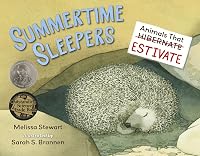
Summertime Sleepers: Animals That Estivate
by Melissa Stewart
On This Page
Description
A 2022 Robert F. Sibert Honor BookEveryone knows about animals that hibernate in the winter. But it's time to discover animals that sleep all summer long!
All science classrooms discuss animals that hibernate during winter months, but few know about animals that estivate—a prolonged sleep during hot or dry periods. Dual layers of text awaken readers to the reasons estivating animals become dormant—whether it's because warm weather threatens food supply or to avoid increased body show more temperatures. From the ladybug to the salamander, from the lungfish to the desert hedgehog, twelve estivating animals and their habits—both when sleeping and awake—are explained through clear text and elegant watercolor illustrations that create a scrapbook feel. show less
Tags
Recommendations






Member Reviews
Oh wow, this short kids' book, with its careful illustrations, is absolutely fascinating. I had no idea! Lots of rich back matter, including an enlightening essay from the illustrator, make this a 'must-buy' resource for all libraries that serve young children and families.
I suppose it will be surpassed, in time, by an even better book. After all, as a note in the back says, scientists are only now beginning to study summertime sleepers. What a wonderful line of inquiry for a young researcher to pursue... and then, eventually, to write the next book on the subject.
I suppose it will be surpassed, in time, by an even better book. After all, as a note in the back says, scientists are only now beginning to study summertime sleepers. What a wonderful line of inquiry for a young researcher to pursue... and then, eventually, to write the next book on the subject.
Many kids know about animals that hibernate in the winter, but what about those that estivate? Estivation is the summer equivalent of hibernation, and the author aims to help educate readers about creatures that sleep in the summertime.
Stewart covers a wide range of animals including insects, crustaceans, fish, amphibians, reptiles, and mammals. She points out that some, like ladybugs, snooze in groups, and others take their long naps alone. She explains where they go for their rest - some are inside clusters of leaves, some are in tree crevices or hollow logs, some are high up on tree branches, and some are underground.
For each double page spread on a particular creature, readers will see not only watercolors by Sarah S. Brannen but a show more box showing a lifelike drawing of the creature along with information like size and habitat as if from a nature guide.
In the ack matter, there are additional facts and trivia about animals that estivate, a guide to additional resources including websites, an Author’s Note, and an Illustrator’s Note.
This book has won a number of awards including a National Science Teaching Association Outstanding Science Trade Book.
Evaluation: This book for readers 6 and up will open their eyes to all the activity around them they may not have even been aware of, and could stimulate the budding scientists among them. show less
Stewart covers a wide range of animals including insects, crustaceans, fish, amphibians, reptiles, and mammals. She points out that some, like ladybugs, snooze in groups, and others take their long naps alone. She explains where they go for their rest - some are inside clusters of leaves, some are in tree crevices or hollow logs, some are high up on tree branches, and some are underground.
For each double page spread on a particular creature, readers will see not only watercolors by Sarah S. Brannen but a show more box showing a lifelike drawing of the creature along with information like size and habitat as if from a nature guide.
In the ack matter, there are additional facts and trivia about animals that estivate, a guide to additional resources including websites, an Author’s Note, and an Illustrator’s Note.
This book has won a number of awards including a National Science Teaching Association Outstanding Science Trade Book.
Evaluation: This book for readers 6 and up will open their eyes to all the activity around them they may not have even been aware of, and could stimulate the budding scientists among them. show less
Robert F. Sibert Informational Book Medal, Honor Book 2022
Wonderful nonfiction book and great topic. Most children know about hibernation but not estivation. I love books that get young readers excited about the natural world and that give them glimpses of wildlife they may not see in their own environments.
Wonderful nonfiction book and great topic. Most children know about hibernation but not estivation. I love books that get young readers excited about the natural world and that give them glimpses of wildlife they may not see in their own environments.
I selected this book because it was a Robert F Sibert Honor Book in 2022. I was not disappointed. Not only did I not realize that certain animals hibernate in the summer, I certainly did not know the term for doing so is "estivate". This book, along with the vivid and realistic illustrations, is very informative and easy to read. I have a thorough understanding of estivation and the animals who estivate after reading it. The pictures are just as informative as the words.
All science classrooms discuss animals that hibernate during winter months, but few know about animals that estivate--a prolonged sleep during hot or dry periods. Dual layers of text awaken readers to the reasons estivating animals become dormant--whether it's because warm weather threatens food supply or to avoid increased body temperatures. From the ladybug to the salamander, from the lungfish to the desert hedgehog, twelve estivating animals and their habits--both when sleeping and awake--are explained through clear text and elegant watercolor illustrations that create a scrapbook feel.
This informational picture book introduces the concept of a "summertime sleep" called estivation. Many young readers will already be familiar with the concept of winter hibernation; as hibernating animals wake up in spring, estivating animals prepare for the heat of summer. Each animal or insect is featured on a double page spread with primary text, a paragraph of more detailed information, a full-bleed illustration of the animal within its habitat, and a sketchbook page. Back matter includes "more about animals that estivate" (paragraph and sketch), "estivation versus hibernation," resources for further information, an author's note, illustrator's note, and selected sources.
We all learn about hibernation at school, but this book talks about animals that sleep in the summer instead. This one is full of facts.
Members
- Recently Added By
Lists

al.vick-wishlist-Children's
462 works; 3 members

Youth: Zoology
128 works; 1 member

Robert F. Sibert Informational Book Medal
102 works; 1 member
Author Information

192+ Works 14,274 Members
Melissa Stewart is the award-winning author of more than 100 science books for children. She has earned degrees in biology and science journalism.
Awards and Honors
Awards
Distinctions
Classifications
Statistics
- Members
- 91
- Popularity
- 352,972
- Reviews
- 9
- Rating
- (4.36)
- Languages
- English
- Media
- Paper, Audiobook, Ebook
- ISBNs
- 5
- ASINs
- 1