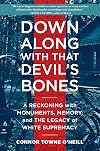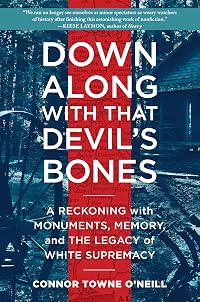
Down Along with That Devil's Bones: A Reckoning with Monuments, Memory, and the Legacy of White Supremacy
by Connor Towne O'Neill
On This Page
Description
“We can no longer see ourselves as minor spectators or weary watchers of history after finishing this astonishing work of nonfiction.” —Kiese Laymon, author of HeavyConnor Towne O’Neill’s journey onto the battlefield of white supremacy began with a visit to Selma, Alabama, in 2015. There he had a chance encounter with a group of people preparing to erect a statue to celebrate the memory of Nathan Bedford Forrest, one of the most notorious Confederate generals, a man whom show more Union general William Tecumseh Sherman referred to as “that devil.” After that day in Selma, O’Neill, a white Northerner transplanted to the South, decided to dig deeply into the history of Forrest and other monuments to him throughout the South, which, like Confederate monuments across America, have become flashpoints in the fight against racism.
Forrest was not just a brutal general, O’Neill learned; he was a slave trader and the first Grand Wizard of the Ku Klux Klan. O’Neill encountered citizens who still hold Forrest in cult-like awe, desperate to preserve what they call their “heritage,” and he also talked to others fighting to tear the monuments down. In doing so he discovered a direct line from Forrest’s ugly history straight to the heart of the battles raging today all across America. The fight over Forrest reveals a larger battle, one meant to sustain white supremacy—a system that props up all white people, not just those defending the monuments. With clear-eyed passion and honest introspection, O’Neill takes readers on a journey to understand the many ways in which the Civil War, begun in 1860, has never ended.
A brilliant and provocative blend of history, reportage, and personal essay, Down Along with That Devil’s Bones presents an important and eye-opening account of how we got from Appomattox to Charlottesville, and of our vital need to confront our past in order to transcend it and move toward a more just society.
. show less
Tags
Recommendations





Member Reviews
this is an excellent discussion of confederate statues and their real meaning, told mostly through the lens of a few monuments of nathan bedford forrest, and the struggles to have them removed/renamed. he does some personal reflecting, which is nice, and really delves into the meaning and white supremacy behind these monuments, and how impossible it is to get past our racist history when we don't acknowledge it, and when we mythologize and lionize the people who lived it. really well done.
"During the American Revolution, New Yorkers took down the statue of King George. After World War II, allied troops diligently removed Nazi symbolism from occupied Germany. After the battle of Baghdad in 2003, American Marines toppled the statue of show more Saddam Hussein. But after the American Civil War, statues of the losers started to go up instead. Why? Elodie Todd Dawson's work on Confederate Memorial Circle offers an answer. After the war, Elodie Todd Dawson, like so many women in the south, took up the burden of carrying on. Death had come for 1 in 5 of confederate soldiers, and for all three of Elodie's brothers....But Elodie's grief moved outward. She sought to make sense of the loss by enlisting as a foot soldier for The Lost Cause - the campaign of revisionist history that glorified the confederate soldier as a gallant knight who fought to protect his unimpeachable southern way of life. By emphasizing the valor of the soldier, the tragedy of his death, white southerners sidestepped the thornier questions of slavery and white supremacy as the Confederacy's raison d'être. Instead, cemetery's like Old Live Oak became ground zero for the magical thinking of the Lost Cause advocates, who emphasized the fact of the fighting, not its purpose or its consequence."
"In 1901, seven years after Turner's death, Alabamians gathered in Constitutional Convention, their explicit purpose, as Convention president John Knox put it, 'To establish white supremacy in this state. This is our problem and we should be permitted to deal with it, unobstructed by outside influences.'"
"The new constitution imposed poll taxes, property requirements, tests of literacy and constitutional knowledge, and other barriers to the franchise, which dropped the statewide number of black registered voters from more than 180,000 to less than 4,000, and in Dallas County, from 9,871 to 152, the latter a number that hardly wavered until the passage of the Voting Rights Act more than 60 years later."
"...America's conception of race has been the kneecapping of people of color in order for white people to feel tall. But claiming an identity based on a lie deranges you, so does winning a rigged game. Just look at how white people have reacted when confronted about the lie of their racial superiority in moments such as reconstruction in the civil rights movement - lynchings, night riding, terrorism, sociopathy. Instead of admitting the lie and working to establish a true democracy, white Americans consoled themselves with palliatives - Confederate flags during the civil rights movement, the Confederate monuments during Jim Crow, and made whiteness fungible, choosing to count the Irish and the Italians, say, as white, while coining markers such as quadroon and octaroon and 'one drop' to legislate blackness. Doing so eternally emphasizes some sort of 'not-blackness' at the core of American whiteness. Whiteness is a void, an emptiness, a lie on which Americans birthed and built a nation."
"The Emancipation Proclamation of Jan 1, 1863, in addition to freeing those in slavery in the rebelling states, also called for the enlistment of freedmen in the Union army. In response, the Confederacy passed a law that categorized all black soldiers as runaway slaves and called for Confederates to treat them with full and ample retaliation. Black soldiers fighting for the Union struck at the heart of their whole theory of white supremacy. White people have justified slavery by convincing themselves that black people were subhuman and thus better off, content even, under the rule of white masters. Former slaves, taking up arms against the Confederacy, flew in the face of everything they believed about their cause, about their way of life, and about themselves. As one Confederate put it, 'You cannot make soldiers of slaves or slaves of soldiers. The day you make a soldier of them is the beginning of the end of the revolution.'" show less
"During the American Revolution, New Yorkers took down the statue of King George. After World War II, allied troops diligently removed Nazi symbolism from occupied Germany. After the battle of Baghdad in 2003, American Marines toppled the statue of show more Saddam Hussein. But after the American Civil War, statues of the losers started to go up instead. Why? Elodie Todd Dawson's work on Confederate Memorial Circle offers an answer. After the war, Elodie Todd Dawson, like so many women in the south, took up the burden of carrying on. Death had come for 1 in 5 of confederate soldiers, and for all three of Elodie's brothers....But Elodie's grief moved outward. She sought to make sense of the loss by enlisting as a foot soldier for The Lost Cause - the campaign of revisionist history that glorified the confederate soldier as a gallant knight who fought to protect his unimpeachable southern way of life. By emphasizing the valor of the soldier, the tragedy of his death, white southerners sidestepped the thornier questions of slavery and white supremacy as the Confederacy's raison d'être. Instead, cemetery's like Old Live Oak became ground zero for the magical thinking of the Lost Cause advocates, who emphasized the fact of the fighting, not its purpose or its consequence."
"In 1901, seven years after Turner's death, Alabamians gathered in Constitutional Convention, their explicit purpose, as Convention president John Knox put it, 'To establish white supremacy in this state. This is our problem and we should be permitted to deal with it, unobstructed by outside influences.'"
"The new constitution imposed poll taxes, property requirements, tests of literacy and constitutional knowledge, and other barriers to the franchise, which dropped the statewide number of black registered voters from more than 180,000 to less than 4,000, and in Dallas County, from 9,871 to 152, the latter a number that hardly wavered until the passage of the Voting Rights Act more than 60 years later."
"...America's conception of race has been the kneecapping of people of color in order for white people to feel tall. But claiming an identity based on a lie deranges you, so does winning a rigged game. Just look at how white people have reacted when confronted about the lie of their racial superiority in moments such as reconstruction in the civil rights movement - lynchings, night riding, terrorism, sociopathy. Instead of admitting the lie and working to establish a true democracy, white Americans consoled themselves with palliatives - Confederate flags during the civil rights movement, the Confederate monuments during Jim Crow, and made whiteness fungible, choosing to count the Irish and the Italians, say, as white, while coining markers such as quadroon and octaroon and 'one drop' to legislate blackness. Doing so eternally emphasizes some sort of 'not-blackness' at the core of American whiteness. Whiteness is a void, an emptiness, a lie on which Americans birthed and built a nation."
"The Emancipation Proclamation of Jan 1, 1863, in addition to freeing those in slavery in the rebelling states, also called for the enlistment of freedmen in the Union army. In response, the Confederacy passed a law that categorized all black soldiers as runaway slaves and called for Confederates to treat them with full and ample retaliation. Black soldiers fighting for the Union struck at the heart of their whole theory of white supremacy. White people have justified slavery by convincing themselves that black people were subhuman and thus better off, content even, under the rule of white masters. Former slaves, taking up arms against the Confederacy, flew in the face of everything they believed about their cause, about their way of life, and about themselves. As one Confederate put it, 'You cannot make soldiers of slaves or slaves of soldiers. The day you make a soldier of them is the beginning of the end of the revolution.'" show less
The controversy over confederate statues and monuments needs to be addressed. Connor O’Neill was in all the right places at the right times to reveal the depths and depravity of the movements to preserve and promote them. He has written a book, Down Along With That Devil’s Bones, to document his recent travels, research and interviews. It is as ugly as you would expect, and less than it could be.
He picks Nathan Bedford Forrest, a name little known outside the southern United States, as his poster child. There are statues, monuments, halls and schools named after him all over the southern states. This estimable gentleman of the south, worthy of everyone’s respect and idolatry, was a slave auctioneer and Grand Wizard of the Ku Klux show more Klan, restoring white supremacy to several southern states after the south lost the civil war. That anyone would want to remove his monuments is something for all good citizens to rise up and fight against.
O’Neill visited Charlottesville for the battle over monuments, where one supporter drove his car though a crowd of protestors, killing a woman. He visited Selma, always the epicenter of controversy, Nashville, Memphis, Montgomery and more. Their links to slavery and the civil war are all noted. He asked people for their thoughts, dug into history and followed the removal of statues, often in the dead of night. It’s all very descriptive, with lots of mood setting and color. And minimal impact.
What he found should come as no surprise. Southerners are apologists for their flawed heroes. They willfully ignore the slave ownership, the beatings , the lynchings and the exhortations to slavery as highly ethical Christian living. Instead, they cite heroics in battle, or success in business – without mentioning the business was slave auctioning or that the battles were actually lost.
For whites, the old south way of life has become The Lost Cause, worthy of pity rather than criticism. O’Neill calls it all magical thinking, which also absolves white supremacists of the nastiness of their lives. They love to cite the heritage they want to honor, without the hate it specifies. Magical thinking honors the fighting but not the reason for the fighting, O’Neill says. White supremacy rests entirely on magical thinking.
Down south, the statues, monuments and flags are a ”palliative” to the white victims of the loss of the civil war. Their civil war statues always face north, i.e. never retreating. Entire universities gather in football stadiums to wave their rebel flags and hoot and holler like the victors they were not. It is (and is meant to be) a very intimidating sight, especially for black students. Weekly, throughout the fall months, every year. Blessed by the administration as good clean fun. Inspiring future generations of white supremacists.
Nathan Forrest was a self-made man. He came from the dirt poor, learned to buy and sell, and found slaves the best commodity to move. His Negro Mart, situated right between his home and the Calvary Church (still standing) on Adams St. in Memphis, saw over a thousand slaves sold every year, providing Forrest with profits of $50,000 (one million in today’s dollars) every year. He stored them there, beat them bloody and sold them off, either in auctions or to passing shoppers. He bought farms and plantations to be worked by the slaves he was unable to sell at his standard 20% markup, so the overall profits remained stellar. He was rich enough to fund his own regiment when the civil war broke out, and led it to several victories, as well as numerous defeats, for all of which he earned great praise – and the rank of lieutenant general in the confederate army. He was famous for slaughtering northern soldiers after the battle was already won, and making the rivers run red with their blood.
When the war ended, the prospect of racial equality led him to join the emerging KKK, which soon made him its leader. This allowed Forrest to command all kinds of troops again, this time committing all kinds of murder, arson, threats and intimidation in order to prevent blacks from assuming any kind of role in society. Instead, the KKK placed whites back in control like they had always been, infiltrating the police, the courts and civic institutions to ensure enforcement. When he had “redeemed” six states for white supremacy, he finally took his retirement, and catching dysentery, died at the age of 55, a hero for his exemplary life.
O’Neill says the rebel flag was uncommon until the 1940s, when overt racists like Strom Thurmond stirred white supremacist feelings. With constant setbacks at the hands of FDR, Truman and Johnson, the confederate flag took on new symbolism and became ubiquitous. But to be honest, it was never really absent. It was baked into state flags, for example. Thurmond’s Dixiecrat rebellion made no bones about white supremacy. For them, desegregation was the crisis. They were there because blacks were there. It was a clue the civil war had not been carried to its full conclusion.
O’Neill is white, and feels guilt and shame. He ends his book at a slave memorial, suitably revolting in his description. But the book left me totally unsatisfied. There are two giant factors obviously missing from it. I find it astonishing he could write this book without them, since he tries to be so thorough and fair in his descriptions and in his questioning of his subjects:
1.Ancient history shows us that the way to assimilate a conquered people is to destroy their statues. With their gods and heroes gone, they must gravitate to accepting the conquerors’ values, heroes and gods. Hundreds, if not thousands of gods have disappeared this way. (HL Mencken once tried to list them all. It was impressive.) By allowing the losing South to build new statues and monuments to their own, and through allowing them to promote the confederate flag, the United States utterly failed to acknowledge the history of the world, and is suffering that failure even today. There is no excuse for permitting white southerners to build legends around failed rebels.
Nowhere else will you see monuments to the losers. Nowhere else do they glorify criminal ideology. The whole idea is to vanquish the failed ideology, not let it fester and thrive again. That’s what the war was about. The USA never bothered to finish the civil war. Just like in Afghanistan and Iraq, it lost interest in finishing the job and reintegrating the country as something cohesive.
2. History also shows that the conquerors won the wars when they seized the flag of the vanquished. They then banned it, never to fly again. In any war, the flag will change when it is reissued. The old flag is a symbol of the defeated regime and has no right to appear ever again. To fly the rebel flag and build memorials to defeated secessionists is what is called treason in the United States, as it is in the rest of the world. Governments cannot and must not tolerate it, if only to keep the country as one. The business of it being history and that all history must be preserved is bogus, a canard for racism. Treason outranks history. Flying the confederate flag should be punishable by long prison terms.
I wanted O’Neill to challenge all the people he met and interviewed with the fact they were committing treason against the USA. Palliatives for whites is a trivial apology and a pathetic answer. Rewriting history to avoid the mention of slavery is intellectually dishonest. But honoring and glorifying a defeated enemy of the state is treason. Their disloyalty to the USA is not merely disgusting; it is a national security threat.
What would they have all said to that?
We’ll never know.
David Wineberg show less
He picks Nathan Bedford Forrest, a name little known outside the southern United States, as his poster child. There are statues, monuments, halls and schools named after him all over the southern states. This estimable gentleman of the south, worthy of everyone’s respect and idolatry, was a slave auctioneer and Grand Wizard of the Ku Klux show more Klan, restoring white supremacy to several southern states after the south lost the civil war. That anyone would want to remove his monuments is something for all good citizens to rise up and fight against.
O’Neill visited Charlottesville for the battle over monuments, where one supporter drove his car though a crowd of protestors, killing a woman. He visited Selma, always the epicenter of controversy, Nashville, Memphis, Montgomery and more. Their links to slavery and the civil war are all noted. He asked people for their thoughts, dug into history and followed the removal of statues, often in the dead of night. It’s all very descriptive, with lots of mood setting and color. And minimal impact.
What he found should come as no surprise. Southerners are apologists for their flawed heroes. They willfully ignore the slave ownership, the beatings , the lynchings and the exhortations to slavery as highly ethical Christian living. Instead, they cite heroics in battle, or success in business – without mentioning the business was slave auctioning or that the battles were actually lost.
For whites, the old south way of life has become The Lost Cause, worthy of pity rather than criticism. O’Neill calls it all magical thinking, which also absolves white supremacists of the nastiness of their lives. They love to cite the heritage they want to honor, without the hate it specifies. Magical thinking honors the fighting but not the reason for the fighting, O’Neill says. White supremacy rests entirely on magical thinking.
Down south, the statues, monuments and flags are a ”palliative” to the white victims of the loss of the civil war. Their civil war statues always face north, i.e. never retreating. Entire universities gather in football stadiums to wave their rebel flags and hoot and holler like the victors they were not. It is (and is meant to be) a very intimidating sight, especially for black students. Weekly, throughout the fall months, every year. Blessed by the administration as good clean fun. Inspiring future generations of white supremacists.
Nathan Forrest was a self-made man. He came from the dirt poor, learned to buy and sell, and found slaves the best commodity to move. His Negro Mart, situated right between his home and the Calvary Church (still standing) on Adams St. in Memphis, saw over a thousand slaves sold every year, providing Forrest with profits of $50,000 (one million in today’s dollars) every year. He stored them there, beat them bloody and sold them off, either in auctions or to passing shoppers. He bought farms and plantations to be worked by the slaves he was unable to sell at his standard 20% markup, so the overall profits remained stellar. He was rich enough to fund his own regiment when the civil war broke out, and led it to several victories, as well as numerous defeats, for all of which he earned great praise – and the rank of lieutenant general in the confederate army. He was famous for slaughtering northern soldiers after the battle was already won, and making the rivers run red with their blood.
When the war ended, the prospect of racial equality led him to join the emerging KKK, which soon made him its leader. This allowed Forrest to command all kinds of troops again, this time committing all kinds of murder, arson, threats and intimidation in order to prevent blacks from assuming any kind of role in society. Instead, the KKK placed whites back in control like they had always been, infiltrating the police, the courts and civic institutions to ensure enforcement. When he had “redeemed” six states for white supremacy, he finally took his retirement, and catching dysentery, died at the age of 55, a hero for his exemplary life.
O’Neill says the rebel flag was uncommon until the 1940s, when overt racists like Strom Thurmond stirred white supremacist feelings. With constant setbacks at the hands of FDR, Truman and Johnson, the confederate flag took on new symbolism and became ubiquitous. But to be honest, it was never really absent. It was baked into state flags, for example. Thurmond’s Dixiecrat rebellion made no bones about white supremacy. For them, desegregation was the crisis. They were there because blacks were there. It was a clue the civil war had not been carried to its full conclusion.
O’Neill is white, and feels guilt and shame. He ends his book at a slave memorial, suitably revolting in his description. But the book left me totally unsatisfied. There are two giant factors obviously missing from it. I find it astonishing he could write this book without them, since he tries to be so thorough and fair in his descriptions and in his questioning of his subjects:
1.Ancient history shows us that the way to assimilate a conquered people is to destroy their statues. With their gods and heroes gone, they must gravitate to accepting the conquerors’ values, heroes and gods. Hundreds, if not thousands of gods have disappeared this way. (HL Mencken once tried to list them all. It was impressive.) By allowing the losing South to build new statues and monuments to their own, and through allowing them to promote the confederate flag, the United States utterly failed to acknowledge the history of the world, and is suffering that failure even today. There is no excuse for permitting white southerners to build legends around failed rebels.
Nowhere else will you see monuments to the losers. Nowhere else do they glorify criminal ideology. The whole idea is to vanquish the failed ideology, not let it fester and thrive again. That’s what the war was about. The USA never bothered to finish the civil war. Just like in Afghanistan and Iraq, it lost interest in finishing the job and reintegrating the country as something cohesive.
2. History also shows that the conquerors won the wars when they seized the flag of the vanquished. They then banned it, never to fly again. In any war, the flag will change when it is reissued. The old flag is a symbol of the defeated regime and has no right to appear ever again. To fly the rebel flag and build memorials to defeated secessionists is what is called treason in the United States, as it is in the rest of the world. Governments cannot and must not tolerate it, if only to keep the country as one. The business of it being history and that all history must be preserved is bogus, a canard for racism. Treason outranks history. Flying the confederate flag should be punishable by long prison terms.
I wanted O’Neill to challenge all the people he met and interviewed with the fact they were committing treason against the USA. Palliatives for whites is a trivial apology and a pathetic answer. Rewriting history to avoid the mention of slavery is intellectually dishonest. But honoring and glorifying a defeated enemy of the state is treason. Their disloyalty to the USA is not merely disgusting; it is a national security threat.
What would they have all said to that?
We’ll never know.
David Wineberg show less
Well-written, engaging look at the role of Confederate monuments in our society today. O'Neill takes on this overwhelming topic with a personal angle from time lived in the south and a chance encounter with some folks 'guarding' the monument of Nathan Bedford Forrest. He centers the book on this particular historic figure and 4 (of the 31 in TN alone) of the memorials to him: 1 in Selma, 1 in Memphis, 1 in Murfreesboro (a building named for him on the campus of Middle TN State University) and 1 in Nashville. Forrest was not on my Civil War radar (ignorant me!) but he is definitely a hero in the South: the most promoted of all Civil War soldiers (from private to Lieutenant General) and the first Grand Wizard of the KKK. He is more show more beloved than Robert E. Lee or Jefferson B. Davis because he did not come from moneyed gentry of Southern planters, but was a striver - who pulled himself up by his boot straps by cashing in on the slave trade and was a self-made man. The sites where his statue or name exists (also quite a few roadside plaques) also happen to have significance in the Civil Rights movement. And the time they were erected or employed also happen to coincide with Black people making headway in society through business or politics. While the author has a bias, he also takes care to do plenty of historical digging to present the viewpoint of those who want to retain these monuments. "Heritage not hate" is the defenders' motto, but he points out the selective memory and dominant ideology that can cling to the wrongs of the past as 'heritage.' Pursuing this topic also forces the author to examine his own background and inherent privilege, which he shares openly. His final contribution to the topic is a counter-example of a monument that might be there for the right reasons: The Equal Justice Initiative's National Memorial for Peace and Justice, which honors lynching victims. The book is thought-provoking and timely and begs to be discussed. show less
This was an eye opening read because I had heard of Nathan Bedford Forrest but didn’t know much about him. It was fascinating how the author takes the story of activists trying to get this KKK grand wizard’s monuments down (and his supporters efforts to stop it from happening) across four different places, to give a scathing commentary on how all this discourse is more about people trying to cling onto their racist ideals rather than some perceived Southern heritage. He also gives some backstory about Forrest himself and how this slaveholder came to be such a popular figure in confederate America.
But ultimately it’s not completely a hopeful book despite being written brilliantly. The efforts of all the people trying to bring down show more these monuments is highly commendable but they do seem to be having many setbacks which is depressing; but more sad is the immense racial divisions and hate that exist, the willful ignorance regards to understanding actual history of the country, and not really having a clear idea how it can be solved. But that’s not the book’s fault and I definitely recommend the audiobook which is very well narrated. show less
But ultimately it’s not completely a hopeful book despite being written brilliantly. The efforts of all the people trying to bring down show more these monuments is highly commendable but they do seem to be having many setbacks which is depressing; but more sad is the immense racial divisions and hate that exist, the willful ignorance regards to understanding actual history of the country, and not really having a clear idea how it can be solved. But that’s not the book’s fault and I definitely recommend the audiobook which is very well narrated. show less
Although I can usually count on the history/nonfiction books that I read to be excellent, I seem to have hit a patch where my choices don't quite live up to my expectations. In this case, a native Pennsylvanian gets his MFA at Alabama, then takes a job teaching at Auburn and decides to spend his time researching the differences of opinions that people have regarding the life and legacy of Nathan Bedford Forrest. To some, he was a hero of the confederacy, the Savior of Selma and the defender of a bygone way of life. To others, he was an uneducated hick who made millions buying and selling slaves, a Grand Wizards of the Ku Klux Klan, and the Butcher of Fort Pillow, whose troops slaughtered hundreds of black Union soldiers who were show more attempting to surrender. Now, 150 years after his death, Americans are still battling to either preserve or remove the countless statues plaques and memorials erected to him or to keep or rename the hundreds of schools, streets, parks and other edifices that bear his name.
If anyone picks picks this book and reads it hoping to find a great revelation that will resolve this conflict, they will be disappointed. The world we live in is not going to join hands and sing Kum ba yah as they gather by the river anytime soon. Everyone has an opinion about this and the author's attempts to present, as fairly as he can, every conflicting point of view, tended to get tedious, especially since almost everyone's arguments were essentially the same. One side believes the other is trying to erase our history while the other side claims that such monuments are a constant reminder of the oppression under which may Americans have always lived.
The part of this book that most impressed me was O'Neill's description of a memorial 'Service of Remembrance and Reconciliation,' held in a Memphis church in whose parking lot Forrest's slave pens once stood. The description of the service, and particularly the reading of the names and ages of seventy-eight known slaves who were held there and the profound impact that it had on the congregation did give me a glimmer of hope that reconciliation may indeed be possible.
If anyone picks picks this book and reads it hoping to find a great revelation that will resolve this conflict, they will be disappointed. The world we live in is not going to join hands and sing Kum ba yah as they gather by the river anytime soon. Everyone has an opinion about this and the author's attempts to present, as fairly as he can, every conflicting point of view, tended to get tedious, especially since almost everyone's arguments were essentially the same. One side believes the other is trying to erase our history while the other side claims that such monuments are a constant reminder of the oppression under which may Americans have always lived.
The part of this book that most impressed me was O'Neill's description of a memorial 'Service of Remembrance and Reconciliation,' held in a Memphis church in whose parking lot Forrest's slave pens once stood. The description of the service, and particularly the reading of the names and ages of seventy-eight known slaves who were held there and the profound impact that it had on the congregation did give me a glimmer of hope that reconciliation may indeed be possible.
Jerry, age thirty-five.Bottom line: While I doubt that this book is going to change anyone's mind, it did give me a glimmer of hope when Memphis County Commissioner Van Turner, reminded us of Dr. King's words spoken on the steps of the Alabama state capitol after marching from Selma to Montgomery.
Charles, age forty-five.
Dick, age fourteen.
Paige, age nine.
Washington, age twenty.
Catherine, age twenty-three.
John Henry, age three.
Mary Ann, age three.
"The arc of the moral universe is long but it bends towards justice."show less
Disclaimer: I received this book as part of GoodReads' First Reads program
This book is the author's reflections on the ongoing national divide over racism and the never ending Civil War. Looking at monuments of Nathan Bedford Forrest, and the struggle to have the statues removed, on the one hand. On the other hand is the struggle to keep the monuments. The author, originally from Pennsylvania, tries to make sense of it all. As a Pennsylvanian myself, maintaining monuments to losers and traitors to the US makes no sense to me, so I found the book fascinating. I'd highly recommend this book to anyone interested in American history, and anyone trying to make sense of the ongoing battles to keep the monuments.
This book is the author's reflections on the ongoing national divide over racism and the never ending Civil War. Looking at monuments of Nathan Bedford Forrest, and the struggle to have the statues removed, on the one hand. On the other hand is the struggle to keep the monuments. The author, originally from Pennsylvania, tries to make sense of it all. As a Pennsylvanian myself, maintaining monuments to losers and traitors to the US makes no sense to me, so I found the book fascinating. I'd highly recommend this book to anyone interested in American history, and anyone trying to make sense of the ongoing battles to keep the monuments.
Thanks to Algonquin Books, and Connor O’Neill for a free ARC copy in exchange for an honest review.
This book is an in depth look at how deeply rooted racism is. How symbols can represent hatred and oppression to some, and a heritage of being Southern/Confederate to others. Connor O'Neill came to Alabama as a white Northerner. Previously he hadn't really thought about racism, naively thinking being from the North absolves you. He comes across a demonstration crying for the protection of a statue of Nathan Beford Forrest. Nathan Beford Forrest serves as the center from which O'Neill learns more about what triggers such extreme emotions. Nathan Forrest was a general in the civil war who was known for plowing in and fighting when the odds show more were against him. He also was the first Grand Wizard of the Klu Klux Klan. Using monuments and the protests surrounding them, O'Neill travels to Selma, AL; Murfreesboro, TN; Nashville, TN; and Memphis, TN. examining and talking to people on both sides. This book takes us on an intimate trip, allowing us to feel and understand what each side feels, to show us that racism is deeply ingrained and not easy to uproot. show less
This book is an in depth look at how deeply rooted racism is. How symbols can represent hatred and oppression to some, and a heritage of being Southern/Confederate to others. Connor O'Neill came to Alabama as a white Northerner. Previously he hadn't really thought about racism, naively thinking being from the North absolves you. He comes across a demonstration crying for the protection of a statue of Nathan Beford Forrest. Nathan Beford Forrest serves as the center from which O'Neill learns more about what triggers such extreme emotions. Nathan Forrest was a general in the civil war who was known for plowing in and fighting when the odds show more were against him. He also was the first Grand Wizard of the Klu Klux Klan. Using monuments and the protests surrounding them, O'Neill travels to Selma, AL; Murfreesboro, TN; Nashville, TN; and Memphis, TN. examining and talking to people on both sides. This book takes us on an intimate trip, allowing us to feel and understand what each side feels, to show us that racism is deeply ingrained and not easy to uproot. show less
Members
- Recently Added By
Lists

BLM
210 works; 1 member
Author Information
2 Works 122 Members
Some Editions
Classifications
- Genres
- Nonfiction, General Nonfiction, History, Politics and Government, Biography & Memoir
- DDC/MDS
- 322.4 — Society, government, & culture Political science Relation of the state to organized groups and their members Political action groups
- LCC
- E467.1 .F72 .O56 — History of the United States United States Civil War period, 1861-1865 The Civil War, 1861-1865
- BISAC
Statistics
- Members
- 102
- Popularity
- 317,065
- Reviews
- 9
- Rating
- (3.90)
- Languages
- English
- Media
- Paper, Audiobook, Ebook
- ISBNs
- 6
- ASINs
- 2