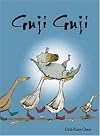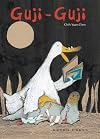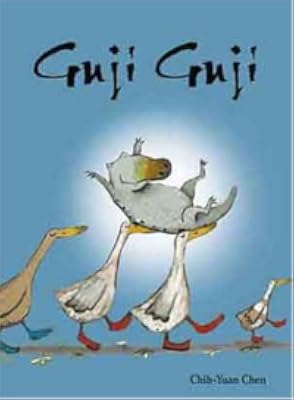
Guji Guji
by Chih-Yuan Chen
On This Page
Description
Crocodile Guji Guji was raised by a family of ducks and things are great until one day he meets three crocodiles who tell him that he isn't a duck. When they ask Guji Guji to help them trap the ducks he feels torn and must decide who he is, what he is, and what's really important.Tags
Recommendations





Member Reviews
Originally published in Chih-Yuan Chen's native Taiwan, and inspired by the life-story of one of the author/artist's American friends, who was ethnically Korean, but adopted by a non-Korean family, Guji Guji follows the adventures of a young "crocoduck," as he finds his rightful place in the world, and in his adopted community. When a crocodile egg tumbles into a mother duck's nest one day, she is too busy reading to notice. When that egg hatches out into a creature most unlike her other offspring, she accepts the situation with aplomb. Although different, in both appearance and abilities, from his siblings, Guji Guji never questions his place in his adoptive family - until, that is, three grinning adult crocodiles happen upon him and show more try to convince him that he belongs with them, and that he should lure his duck family into a trap. Suddenly, Guji Guji is confronted with the issue of identity, and with the problem of safe-guarding his anatine family...
Although I found the artwork here adorable, and believe the author's motivations, in telling this story, are admirable - Chen writes, in a statement on the rear dust-jacket flap, that "It is my hope that children from all over the world can learn to accept different people and things, and see the world with broader views and minds" - I find the storyline somewhat problematic. I don't believe that it was intentional at all, and I don't think it necessarily has to be interpreted in this way, but I could see a child reader, particularly if adopted across national, ethnic or racial lines, taking away the message that their identity of origin was somehow dangerous or undesirable: something to be abandoned. On the other hand, I could also see coming away with the message that family is defined more by love, than by "blood," so take that as you will.
The illustrations, as mentioned above, are lovely: immensely appealing, cute without being saccharine, and possessing an overall color scheme (fairly dark, in the image with the three crocodiles, lighter in those involving Guji Guji's family) that varies according to the mood of each scene. This is a book that might be very helpful for adopted children, but given the range of interpretations possible, I recommend that their parents and/or adult care-givers read it over first, to make sure it is suitable for their specific circumstances. show less
Although I found the artwork here adorable, and believe the author's motivations, in telling this story, are admirable - Chen writes, in a statement on the rear dust-jacket flap, that "It is my hope that children from all over the world can learn to accept different people and things, and see the world with broader views and minds" - I find the storyline somewhat problematic. I don't believe that it was intentional at all, and I don't think it necessarily has to be interpreted in this way, but I could see a child reader, particularly if adopted across national, ethnic or racial lines, taking away the message that their identity of origin was somehow dangerous or undesirable: something to be abandoned. On the other hand, I could also see coming away with the message that family is defined more by love, than by "blood," so take that as you will.
The illustrations, as mentioned above, are lovely: immensely appealing, cute without being saccharine, and possessing an overall color scheme (fairly dark, in the image with the three crocodiles, lighter in those involving Guji Guji's family) that varies according to the mood of each scene. This is a book that might be very helpful for adopted children, but given the range of interpretations possible, I recommend that their parents and/or adult care-givers read it over first, to make sure it is suitable for their specific circumstances. show less
One day, an extra-large egg rolls right into Mother Duck's nest. She is busy reading and doesn't notice the new addition, but this lucky event will change her life. Her hatchlings include a yellow duckling; one with blue spots; another with brown stripes; and a rather unusual, crocodile-shaped youngster, named after his first words. Guji Guji grows bigger and stronger than his siblings (and more crocodilelike), but Mother loves all her offspring the same. When three duck-hungry crocodiles make fun of Guji Guji's ways and try to tempt him into betraying his family, he is put to the test. This beautifully written story has much to say about appreciating families and differences, and it will resonate with children long after the final page show more is turned. show less
This book was a pleasure to read from beginning to end for many reasons. I found the plot of the book to be adorable, as well as educational for young readers. The message of this book was much like " The Ugly Duckling." It shows that you don't have to look the same, or act the same as everyone else to be a part of a community or loved by others. Guji Guji is a Crocodile that happened to grow up with a family of ducks, despite his clear physical differences from the ducks,he was family to them. The author then tests Guji Guji's loyalty to his duck family when he meets crocodiles for the first time. They try to convince Guji Guji to trick his family of ducks into diving into the water where the crocodiles could eat them. Despite Guji show more Guji questioning if he belonged with his duck family, he saved their lives and tricked the crocs into eating rocks instead of " juicy fat duck." Guji Guji came to peace with himself, and realized he was right where he was meant to be, and declared himself a "crocoduck." show less
I thought that this was a wonderful book. In this picture book, Guji Guji is a crocodile that hatched in a duck’s nest. The mother duck did not notice when the egg rolled into her nest, but when they all hatched she noticed how all the hatchlings were different: “one has blue spots, one has stripes, one is golden-colored... and one is, well, a lot bigger and not quite so feathery! But Mother Duck loves them all.” The language described how Mother Duck noted the differences, but to her it did not matter, she loved them all anyway. I think this sends a powerful message to the reader that aids in diminishing the reoccurring stigma of being different by implying being different does not matter. When Guji Guji encounters real show more crocodiles he begins to question his duck-ness for the first time. He ultimately realizes that Mother Duck is his mother at heart and he defends his family from the crocodiles. The illustrations in this book were wonderful and truly enhanced the story. They portrayed the issue of identity that Guji Guji felt, in different ways throughout the book. For example, at the end of the book Guji Guji’s reflection in the water is a duck. Physically he may be an alligator, but he still considers himself a duck and identifies with the ducks. Also, at the end of the book, I really liked how Guji Guji made his identity a “croco-duck.” Ultimately, the main idea of this book addressed the importance of family, identity, and loyalty. I think it also touches on adoption, too. Someone does not have to be related by blood in order to be family—love and support are always more important. show less
Guji Guji by Chih-Yuan Chen was one of my favorite books I have come across this semester. Through the simple characters of a crocodile and a family of ducks, a beautiful story about a diverse family is developed.
One reason I loved this book was the fact that it was different from the typical story of acceptance. Chen took an interesting spin on the tale of the ugly duckling. In the story of the ugly duckling, the duck is actually a goose that is born into that family. I liked how this story took it one step further and made Guji Guji a crocodile. By making the main character a completely different species that is actually a predator to the ducks, the message became stronger. Guji Guji learns from the other crocodiles that his teeth and show more claws are supposed to be used to eat duck, but he ignores them and continues to be with his family. Guji Guji looked so different from the rest of his family but is still accepted in the end.
Another reason I enjoyed this book was the illustrations. I thought the picture of Guji Guji looking into a lake had a powerful meaning. While he is a crocodile looking into the lake, his reflection is in the shape of a duck. I took this illustration to mean that what is on the inside doesn't always match someone's outward appearance. There is more to a person or crocodile) than their appearance and we shouldn't use stereotypes to judge anyone for how they should act. I liked that Chen used subtle detail in his illustration to convey strong meaning. His simple story has compelling messages that are made stronger by supporting illustrations. I thought the pictures were clear enough to help a reader grasp the meaning even if they couldn't comprehend from the text.
The main message of this story is that it's okay to be different from others, including your family. Guji Guji was born to kill ducks, but he was able to see past his expectations and discover who he really wanted to be. Each of us hasa place in the world, and it may not be as clear as what we look like where we are supposed to end up. "Guji Guji" teaches readers to be accepting of others even if they are different from you. show less
One reason I loved this book was the fact that it was different from the typical story of acceptance. Chen took an interesting spin on the tale of the ugly duckling. In the story of the ugly duckling, the duck is actually a goose that is born into that family. I liked how this story took it one step further and made Guji Guji a crocodile. By making the main character a completely different species that is actually a predator to the ducks, the message became stronger. Guji Guji learns from the other crocodiles that his teeth and show more claws are supposed to be used to eat duck, but he ignores them and continues to be with his family. Guji Guji looked so different from the rest of his family but is still accepted in the end.
Another reason I enjoyed this book was the illustrations. I thought the picture of Guji Guji looking into a lake had a powerful meaning. While he is a crocodile looking into the lake, his reflection is in the shape of a duck. I took this illustration to mean that what is on the inside doesn't always match someone's outward appearance. There is more to a person or crocodile) than their appearance and we shouldn't use stereotypes to judge anyone for how they should act. I liked that Chen used subtle detail in his illustration to convey strong meaning. His simple story has compelling messages that are made stronger by supporting illustrations. I thought the pictures were clear enough to help a reader grasp the meaning even if they couldn't comprehend from the text.
The main message of this story is that it's okay to be different from others, including your family. Guji Guji was born to kill ducks, but he was able to see past his expectations and discover who he really wanted to be. Each of us hasa place in the world, and it may not be as clear as what we look like where we are supposed to end up. "Guji Guji" teaches readers to be accepting of others even if they are different from you. show less
I loved this story! I think that it sends a subtle message that could be related to children that have been adopted. There is always a huge debate between nature vs. nurture. I really like the way this story portrays the nurture view. Guji Guji was born a crocodile but, because his egg rolled into the nest of a duck, he was raised with other ducklings. I liked the little nuances that the author added such as telling how Guji Guji learned how to walk like a duck and fall in line just like his other siblings. I also liked how Guji Guji protected his duck family from the other crocodiles in the end because he knew that the meaning of family was much deeper than who gave birth to him.
The two major themes that I can relate to this book are show more adoption and protection. Guji Guji was not born as part of his duck family but he was raised with them and learned to love them. This is true of children that are adopted. Nurture plays a very important role when talking about adoption. Guji Guji made it his priority to protect the family he knew and loved which is an important message to send to children in any family today. show less
The two major themes that I can relate to this book are show more adoption and protection. Guji Guji was not born as part of his duck family but he was raised with them and learned to love them. This is true of children that are adopted. Nurture plays a very important role when talking about adoption. Guji Guji made it his priority to protect the family he knew and loved which is an important message to send to children in any family today. show less
Guji Guji rolled into a duck's nest when he was still an egg. Although he was different, the mother duck raised him as the other ducklings and loved him like he was her own. When 3 crocodiles find the ducks, they tell Guji Guji what he really is, a crocodile. They laugh and make fun of him. They then ask him to lure the ducks into the pond so they can eat them. Guji makes a plan to protect the ducks. I enjoyed the book because it shows children how to stand up to bullies and protect your friends. It also sends the message that family can be anyone you love no matter how different you are. The only thing I did not like about the book was the illustrations. They did not look real and were very dull and not colorful. I feel it would be show more hard to children to be engaged with them. show less
Members
- Recently Added By
Lists

A Child's Book Tour of China
34 works; 5 members
Author Information
14+ Works 1,037 Members
Awards and Honors
Classifications
- Genres
- Picture Books, Children's Books
- DDC/MDS
- 398.8 — Society, government, & culture Customs, etiquette & folklore Folklore & Folktales Rhymes and rhyming games
- LCC
- PZ7 .C41818 .G — Language and Literature Fiction and juvenile belles lettres Fiction and juvenile belles lettres Juvenile belles lettres
- BISAC
Statistics
- Members
- 583
- Popularity
- 50,640
- Reviews
- 73
- Rating
- (4.09)
- Languages
- 6 — Chinese, English, French, German, Spanish, Swedish
- Media
- Paper, Audiobook
- ISBNs
- 12
- ASINs
- 1