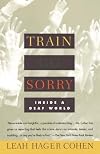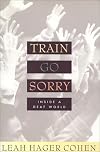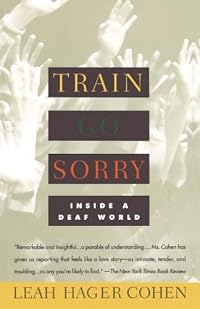
Train Go Sorry: Inside a Deaf World
by Leah Hager Cohen
On This Page
Description
This portrait of New York's Lexington School for the Deaf is not just a work of journalism. It is also a memoir, since Leah Hager Cohen grew up on the school's campus and her father is its superintendent. As a hearing person raised among the deaf, Cohen appreciates both the intimate textures of that silent world and the gulf that separates it from our own.Tags
Recommendations



















Member Reviews
Once upon a time, I thought it would be wonderful to learn sign language. I never really got beyond the alphabet in the Girl Scout Handbook, aside from learning some quite rude signs from Instagram, but I remain fascinated by the language. Because of that fascination, somewhere along the way I picked up Train Go Sorry: Inside a Deaf World by Leah Hager Cohen, thinking to read and learn more about the deaf community but I let the book languish on my shelves for ages. While some of it is unfortunately quite dated now (published in 1994), it still gives an interesting and thought-provoking look into a community and culture I've read very little about, and interacted with even less.
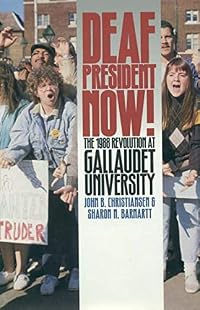
At the time of her writing of the book, Cohen's father show more Oscar was the superintendent of the Lexington School for the Deaf in New York so Cohen herself spent quite a lot of time in or adjacent to the deaf community, although as a hearing child she didn't attend the school or learn ASL herself until adulthood. She had a unique entre into the deaf community via her father and via her paternal grandparents, both of whom were deaf. The book jumps around touching on a variety of topics, from the politics, debates, and discussions within the deaf community (students and staff at Gallaudet University had just successfully protested against a hearing president) to the fears that things like the pressure to mainstream deaf children instead of maintaining dedicated schools and the push towards cochlear implants would lead to an erasure of deaf culture. She presents the arguments for and against ASL, signed exact English, and vocalization without offering a value judgment on any of them as options in the world. She discusses sign language interpreting, including her own experience learning to interpret, and considers how interpreters are not native speakers of sign language, presenting challenges that most hearing people wouldn't ever have thought about (I sure hadn't!). She shares tales of her own deaf grandparents, telling of both the difficulties (and tragedies) and the joys in their lives in a hearing world. And finally, she weaves stories of two students at the school throughout the rest of her narrative, sharing the extra challenges that James, whose family is economically disadvantaged, and Sophia, whose family is non-native English speaking, face as they work toward their high school degrees and toward a future that they are just starting to envision.
The book hops back and forth between all of Cohen's focuses, which can be a bit choppy but the information she presents is consistently interesting. She draws the attention of hearing readers to issues and concerns that they've probably never spared even one second of time thinking about, and has presented the needs and wants of the deaf community, which is not a monolith, in a balanced and thoughtful manner. There's history and personal stories both in this detailed and engaging non-fiction book. People who want insight into a people and community they probably don't have much knowledge about will learn a lot from this book, and yet leave it with a lot to think about. show less
At the time of her writing of the book, Cohen's father show more Oscar was the superintendent of the Lexington School for the Deaf in New York so Cohen herself spent quite a lot of time in or adjacent to the deaf community, although as a hearing child she didn't attend the school or learn ASL herself until adulthood. She had a unique entre into the deaf community via her father and via her paternal grandparents, both of whom were deaf. The book jumps around touching on a variety of topics, from the politics, debates, and discussions within the deaf community (students and staff at Gallaudet University had just successfully protested against a hearing president) to the fears that things like the pressure to mainstream deaf children instead of maintaining dedicated schools and the push towards cochlear implants would lead to an erasure of deaf culture. She presents the arguments for and against ASL, signed exact English, and vocalization without offering a value judgment on any of them as options in the world. She discusses sign language interpreting, including her own experience learning to interpret, and considers how interpreters are not native speakers of sign language, presenting challenges that most hearing people wouldn't ever have thought about (I sure hadn't!). She shares tales of her own deaf grandparents, telling of both the difficulties (and tragedies) and the joys in their lives in a hearing world. And finally, she weaves stories of two students at the school throughout the rest of her narrative, sharing the extra challenges that James, whose family is economically disadvantaged, and Sophia, whose family is non-native English speaking, face as they work toward their high school degrees and toward a future that they are just starting to envision.
The book hops back and forth between all of Cohen's focuses, which can be a bit choppy but the information she presents is consistently interesting. She draws the attention of hearing readers to issues and concerns that they've probably never spared even one second of time thinking about, and has presented the needs and wants of the deaf community, which is not a monolith, in a balanced and thoughtful manner. There's history and personal stories both in this detailed and engaging non-fiction book. People who want insight into a people and community they probably don't have much knowledge about will learn a lot from this book, and yet leave it with a lot to think about. show less
This book is an outstanding view into deaf culture: the issues involved in educating deaf children, the debate over whether or not being deaf is a disability or a cultural group, the ambivalence of a deaf person trying to live in two different cultures: deaf and hearing.
Leah Cohen grew up with an inside view to the deaf world--she had deaf grandparents, her father taught and ran one of the largest deaf schools in the United States. She is brutally honest about showing both sides of many debates about deaf education, deaf culture, and the hearing world's response to both. She does not provide the answers to these debates but rather illustrates the issues by shadowing two students in their high school years both in the deaf school and at show more their hearing parents' homes. I was left wondering if deafness is a culture or a disability, but I was left with a greater understanding of the deaf and how they view themselves and how the rest of the world views the deaf. I now question the mainstreaming of deaf students in our public schools as Cohen clearly demonstrates how mainstreaming would not meet the social (cultural?) and educational needs of deaf children.
Train Go Sorry was written 15 years ago. I wonder what happened to James, the black inner-city kid. Did he rise above the poverty/gang/drug/crime culture to which his hearing brother succumbed? Where did he end up living and working? Did he get married? Have children? I have similar questions about Sofia. How has the internet and cell phones with text messaging, blogging, face-booking affect deaf people who generally are behind in writing and reading English? How has technology changed communication amongst the deaf and between the deaf and hearing worlds? I wish Cohen would write a follow-up to this book to answer these questions.
This book is a must read for anyone who knows a deaf person or who is a student of deaf studies. show less
Leah Cohen grew up with an inside view to the deaf world--she had deaf grandparents, her father taught and ran one of the largest deaf schools in the United States. She is brutally honest about showing both sides of many debates about deaf education, deaf culture, and the hearing world's response to both. She does not provide the answers to these debates but rather illustrates the issues by shadowing two students in their high school years both in the deaf school and at show more their hearing parents' homes. I was left wondering if deafness is a culture or a disability, but I was left with a greater understanding of the deaf and how they view themselves and how the rest of the world views the deaf. I now question the mainstreaming of deaf students in our public schools as Cohen clearly demonstrates how mainstreaming would not meet the social (cultural?) and educational needs of deaf children.
Train Go Sorry was written 15 years ago. I wonder what happened to James, the black inner-city kid. Did he rise above the poverty/gang/drug/crime culture to which his hearing brother succumbed? Where did he end up living and working? Did he get married? Have children? I have similar questions about Sofia. How has the internet and cell phones with text messaging, blogging, face-booking affect deaf people who generally are behind in writing and reading English? How has technology changed communication amongst the deaf and between the deaf and hearing worlds? I wish Cohen would write a follow-up to this book to answer these questions.
This book is a must read for anyone who knows a deaf person or who is a student of deaf studies. show less
I really like Cohen's writing style, even though the narrative was totally disjointed. I don't know that she went "inside a deaf world" so much as provided vignettes of a particular deaf place. They were beautiful vignettes though; I was also very interested in her musings on being a hearing person in Deaf places. Her father had gained respect and acceptance despite being hearing by being a native signer with Deaf parents, while she was both hearing and a non-native signer which put her even further outside the community. Her grappling with even the idea of being an interpreter - that interpreters of every other language except ASL will only translate into their native language because one can only truly grasp all the nuance of meanings show more of a language if you learned it from birth - really got me thinking about the idea of hearing interpreters who aren't native signers, most of them, acting as an imperfect link between hearing and Deaf worlds. Very interesting. show less
Author Leah Hager Cohen's father Oscar is (was) the superintendent of the Lexington School for the Deaf (https://www.lexnyc.org/), and LHC grew up partly at Lexington, and always immersed in Deaf culture, though she did not learn ASL until she was an adult. LHC tells the story of Lexington and Deaf culture through two students, James and Sofia, as well as through other Deaf and hearing adults, including her father, and her own experience as an interpreter. She writes with deep thoughtfulness and respect, and even nearly 30 years after its initial publication, when much has happened since, TRAIN GO SORRY still seems very much a worthwhile book.
Quotes/notes
The first language becomes a scaffold from which to build the second; the two show more develop in tandem, weaving a bridge between family and school. (24)
...to many people, deafness is not a pathology but a cultural identity. (65)
...patience and desire pressed together in her heart like two gold coins in her fist. (86)
Unfortunately, during their professional training, [most doctors, audiologists, speech therapists, and educators] learn to treat deafness purely as a pathology, and then cannot begin to formulate questions that treat it like a culture. (111)
Educators have been failing deaf children for centuries. The history of deaf education has been marked by a single goal: to get deaf people to communicate like hearing people. (165)
...But hearing people dominate our society; it is hearing people's gaze that determines reality. Within this reality, deaf people are disabled....They will always be at a disadvantage. In order for that to change, society's definition of "normal" would have to change. (207-208)
Through contact comes knowledge, and the transmission of culture. (208)
...creating a juncture where two languages converged... (250)
For centuries, hearing professionals have assigned themselves the task of "rehabilitating the deaf" without ever troubling to educate themselves about deaf culture and language. (255)
For every language except sign language, the ideal interpreting situation has the interpreter working in one direction only: interpreting into the mother tongue....ASL interpreters are the only interpreters in the world who regularly, of necessity, interpret from their native language into one learned later in life... (262) show less
Quotes/notes
The first language becomes a scaffold from which to build the second; the two show more develop in tandem, weaving a bridge between family and school. (24)
...to many people, deafness is not a pathology but a cultural identity. (65)
...patience and desire pressed together in her heart like two gold coins in her fist. (86)
Unfortunately, during their professional training, [most doctors, audiologists, speech therapists, and educators] learn to treat deafness purely as a pathology, and then cannot begin to formulate questions that treat it like a culture. (111)
Educators have been failing deaf children for centuries. The history of deaf education has been marked by a single goal: to get deaf people to communicate like hearing people. (165)
...But hearing people dominate our society; it is hearing people's gaze that determines reality. Within this reality, deaf people are disabled....They will always be at a disadvantage. In order for that to change, society's definition of "normal" would have to change. (207-208)
Through contact comes knowledge, and the transmission of culture. (208)
...creating a juncture where two languages converged... (250)
For centuries, hearing professionals have assigned themselves the task of "rehabilitating the deaf" without ever troubling to educate themselves about deaf culture and language. (255)
For every language except sign language, the ideal interpreting situation has the interpreter working in one direction only: interpreting into the mother tongue....ASL interpreters are the only interpreters in the world who regularly, of necessity, interpret from their native language into one learned later in life... (262) show less
A very compelling read. The author is both part of the Deaf world, having grown up among the Deaf community at the Lexington School in New York where her father was a teacher and administrator, and yet, as a hearing person, outside that world. Very sensitive in its treatment of ASL and oralism, and of deaf culture and the hearing world's relationship to it. Cohen also paints nuanced portraits of deaf people she has known, resulting in sensitive treatment of the double discrimination that comes from being deaf and black, or an immigrant and deaf, or elderly and deaf. She addresses her own ambivalence about her role in the deaf community, about being an interpreter, about having a relationship with a deaf man. Beautifully written, too.
These days, one of the reasons I read is to learn. I hope that whether the book is fiction or non-fiction it will give me insight into something I'm ignorant of. This book definitely delivered.
Using a school in New York, which the author has a connection to, and the faces of staff, students, and her own education within the deaf community, Leah Cohen helped educate me about the challenges, education, medical aids, politics, and triumphs of the deaf.
This book was always interesting, often fascinating, sometimes touching, and a bit sad. Some of the quotes I marked:
"It took a moment for the meaning of her broad, bluntly formed syllables to sink in. As a young deaf woman, she had been judged unfit, incapable even of naming her own show more children."
"And because deaf children do not acquire an aural, spoken language naturally -- they must be taught ever minute element that hearing children absorb effortlessly -- they are sent to school with no language system at all. A bit of English and a few crude homemade signs were the only tools that most of my classmates possessed for making sense of the world."
On Cochlear implants: "During implantation, the tiny hairs of the inner ear that normally activate the auditory nerve get torn and crushed. Once this has happened, the effects are irreversible; even if the device is removed, any residual hearing that might have existed will have been obliterated. So if the implant is unsuccessful -- the definition of success including not only healthy recovery from surgery but also learning how to interpret speech from the implant's electrical signals by working with rehabilitation specialists, who may include audiologists, speech-language pathologists, psychologists, and educators -- the child worn't ever be able to benefit from a regular hearing aid."
"The National Association of the Deaf rejects the representation of deaf people as having an impairment; it characterizes them instead as having enhanced vision. If we lived in a society that did not regard hearing people as the norm, these differences might not constitute deprivations. In fact, in a society that regarded deafness as the norm, it is likely that hearing people would be at a disadvantage. But hearing people dominate our society; it is hearing people' gaze that determines reality. Within this reality, deaf people are disabled." show less
Using a school in New York, which the author has a connection to, and the faces of staff, students, and her own education within the deaf community, Leah Cohen helped educate me about the challenges, education, medical aids, politics, and triumphs of the deaf.
This book was always interesting, often fascinating, sometimes touching, and a bit sad. Some of the quotes I marked:
"It took a moment for the meaning of her broad, bluntly formed syllables to sink in. As a young deaf woman, she had been judged unfit, incapable even of naming her own show more children."
"And because deaf children do not acquire an aural, spoken language naturally -- they must be taught ever minute element that hearing children absorb effortlessly -- they are sent to school with no language system at all. A bit of English and a few crude homemade signs were the only tools that most of my classmates possessed for making sense of the world."
On Cochlear implants: "During implantation, the tiny hairs of the inner ear that normally activate the auditory nerve get torn and crushed. Once this has happened, the effects are irreversible; even if the device is removed, any residual hearing that might have existed will have been obliterated. So if the implant is unsuccessful -- the definition of success including not only healthy recovery from surgery but also learning how to interpret speech from the implant's electrical signals by working with rehabilitation specialists, who may include audiologists, speech-language pathologists, psychologists, and educators -- the child worn't ever be able to benefit from a regular hearing aid."
"The National Association of the Deaf rejects the representation of deaf people as having an impairment; it characterizes them instead as having enhanced vision. If we lived in a society that did not regard hearing people as the norm, these differences might not constitute deprivations. In fact, in a society that regarded deafness as the norm, it is likely that hearing people would be at a disadvantage. But hearing people dominate our society; it is hearing people' gaze that determines reality. Within this reality, deaf people are disabled." show less
Interesting view of the deaf world from a hearing daughter. Much like Hands of My Father by Myron Uhlberg. Mama will like this one.
Members
- Recently Added By
Author Information

16 Works 1,634 Members
Leah Hager Cohen, a graduate of the Columbia School of Journalism, established herself as a serious writer in 1994 with her nonfiction book, Train Go Sorry: Inside a Deaf World. Chosen by the American Library Association as one of the best books of 1994, Inside a Deaf World details what it was like growing up as a hearing child around deaf show more children. Cohen's first fiction novel, Heat Lightning, is a coming-of-age story told from the point of view of two sisters, ages eleven and twelve, who have to deal with the death of their parents. (Bowker Author Biography) Leah Hager Cohen earned a BA in writing at Hampshire College & an MS from the Columbia University Graduate School of Journalism. In addition to her non-fiction, she is the author of "Heat Lightning". She lives near Boston. (Bowker Author Biography) show less
Awards and Honors
Distinctions
Common Knowledge
- Original publication date
- 1994
- Important places
- Lexington School for the Deaf, New York, USA
- First words
- That our family's home was a school for the deaf did not seem in any way extraordinary to Reba, Andy, and me.
- Last words
- (Click to show. Warning: May contain spoilers.)No one could question James's riches tonight: for the first time, both of his families under one roof.
Classifications
- Genres
- Nonfiction, General Nonfiction, Biography & Memoir
- DDC/MDS
- 305.908162 — Society, Government, and Culture Social sciences, sociology & anthropology Social group - Age, Gender, Ethnicity People by occupation and miscellaneous social statuses The Intelligent And Other Disadvanted Groups Disability
- LCC
- HV2561 .N72 .N35 — Social sciences Social pathology. Social and public welfare. Criminology Social pathology. Social and public welfare. Protection, assistance and relief Special classes People with disabilities
- BISAC
Statistics
- Members
- 379
- Popularity
- 82,282
- Reviews
- 10
- Rating
- (3.80)
- Languages
- English
- Media
- Paper, Ebook
- ISBNs
- 5
- ASINs
- 4