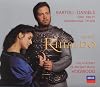
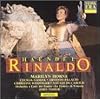
Rinaldo [audio recording]
by Georg Friedrich Händel (Composer), Torquato Tasso (Writer)
35 Members (4.50)
On This Page
Tags
Recommendations




Member Reviews
Members
- Recently Added By
Author Information

George Frideric Handel was born in Halle, Germany on February 23, 1685. As a youth, he became an accomplished harpsichordist and organist, studied violin and oboe, and mastered composing for the organ, the oboe, and the violin by the time he was 10 years old. In 1704, he made his debut as an opera composer with Almira. During his stay in Italy show more from 1706 to 1710, he composed several operas including Rodrigo and Agrippina and several dramatic chamber works, which helped establish his early success. In London, Handel composed Rinaldo, which was released during the 1710-1711 London opera season and became his breakthrough work. After Handel released Rinaldo, he spent the next few years writing and performing for English royalty, including Queen Anne and King George I. In 1719, he accepted the position of Master of the Orchestra at the Royal Academy of Music, the first Italian opera company in London. He became a naturalized British citizen in 1726. He eventually formed his own company, calling it the New Royal Academy of Music in 1727. When Italian opera fell out of style in London, he started creating oratorios Handel's musical output was prodigious. He wrote 46 operas including Julius Caesar and Berenice; 33 oratorios including The Messiah; 100 Italian solo cantatas; and numerous orchestral works. In 1751 Handel suffered a sight impairment that led to total blindness by 1753. Nonetheless, he continued to conduct performances of his works. He died April 14, 1759 at the age of 74. (Bowker Author Biography) show less

Few poets have had a more anguished life than Italy's Torquato Tasso, about whom Goethe wrote his celebrated tragedy Torquato Tasso. His great chivalric epic of the Christian crusades is Jerusalem Delivered (1575). Tasso, who was a critic before he was a poet, sought to make Homer and Virgil his models and Dante his source of Christian poetic show more inspiration, but the resulting epic, as finally published in 1581, is a work of Petrarchan melancholy. Unlike Dante or Ariosto, Tasso did not succeed in objectifying a world in the epic manner. In celebrating the deeds of heroes, he remained subjective and lyric. The reason may be, as some have suggested, that he felt Italy was a long way from becoming a significant united nation capable of sustaining a truly epic enterprise in its literature. Forlorn in love, overwhelmed by melancholy, ever suspicious of intrigues against him, Tasso became self-critical to the point of trying to rewrite his epic to placate its severest critics. He traveled much and was several times confined as insane by patrons and friends who loved him. He died in Rome, where he had been summoned to be honored, like Petrarch, with the poet's laurel. Second to Jerusalem Delivered, Tasso's most influential literary work has been his pastoral play Aminta (1581), which has been performed and highly praised. As in his epic, the poetic voice is lyric. Some modern critics have come to believe that, with his all-pervasive lyricism, Tasso was far ahead of his times. (Bowker Author Biography) show less
Some Editions
Work Relationships
Common Knowledge
- Canonical title
- Rinaldo [audio recording]
- Disambiguation notice
- Please combine full length audio recordings of the work here.
Classifications
Statistics
- Members
- 35
- Popularity
- 815,726
- Rating
- (4.50)
- Languages
- Czech, English, German, Italian
- ISBNs
- 3
- UPCs
- 1
- ASINs
- 7