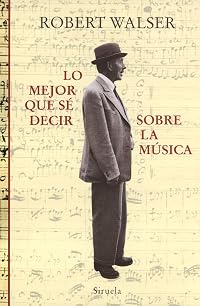
Lo mejor que sé decir sobre la música (Libros del Tiempo)
by Robert Walser
On This Page
Description
Los textos sobre mu?sica recogidos en este volumen revelan una vez ma?s al genial autor suizo como un maestro de la sutileza, la polifoni?a y el permanente cuestionamiento vital.«Cuando no escucho mu?sica, me falta algo, pero cuando la escucho es cuando de verdad me falta algo. Esto es lo mejor que se? decir sobre la mu?sica». Para Robert Walser, la mu?sica no fue solo algo bello y aute?ntico, sino tambie?n algo increi?blemente subversivo que, en cuanto distinto al lenguaje, se oponi?a a show more la limitacio?n de las convenciones. De ahi? que su obra refleje una gran afinidad con los ma?s variados universos sonoros y su estilo despliegue un muy medido tempo y unas lu?dicas cabriolas ri?tmicas. Los relatos, poemas y textos en prosa aqui? reunidos presentan estampas y reflexiones de una asombrosa lucidez sobre el arte musical y los ma?s distinguidos compositores, inte?rpretes y obras. Pero Walser no seri?a Walser si su idea de la mu?sica no reflejara adema?s su genuino rechazo a cualquier tipo de pompa o exclusividad, potenciando en cambio las facetas ma?s co?micas y cotidianas de ese gran arte que, «con una suave tristeza», amo? siempre por encima de todas las cosas. show lessTags
Member Reviews
This selection of Walser's essays, poems and short stories touching on the subject of music caught my eye particularly because I was curious to find out more about Walser's influence on Thomas Bernhard, for whom the relationship between literature and music was enormously important. In that sense, I'm not sure if it really answered any more questions than it raised, and in some ways it turned out to be a frustratingly random selection. Its real raison-d'etre as a book seems to be to act as a set of illustrations to the extended essay on Walser and Music by Brodbeck and Sorg that closes the book. Which is interesting, but doesn't really make it a book with wide general appeal. All the material is already published elsewhere, they haven't show more included any previously unknown texts.
The conclusion seems to be that Walser had a rather ambivalent relationship with music. Unlike Bernhard, he wasn't musically trained, and he didn't have any composers or performers in his circle of friends. He obviously did find music enormously important, and - not as much as Bernhard, but still conspicuously - he uses structures and patterns derived from music in a lot of his writing. But he clearly has a strong negative feeling about the bourgeois glorification of art-music and its performance - in the pieces collected here he is often very sarcastic about trained performers, concerts, and drawing-room music. He loves the accordion (which he confusingly refers to by his own word, Handharfe, hand-harp), but he mocks opera singers and virtuosi as much as he teases middle-class daughters-who-play. He seems to be passionate about opera, especially Mozart, but he doesn't quite like to admit to it: there are several essays in this collection where he comically tears apart the plot of an opera whilst clearly having a very intimate knowledge of its music. Whenever he is writing about a performance and detects himself getting sentimental about music, he changes the subject and tells us about how he is using the opportunity to make love to the servant-girl sitting next to him in the gallery. Or he damps our ardour and takes us back to the real world with a sentence saying something like "after the concert, it is usual to go home as quickly as possible, sometimes stopping for refreshment at a café on the way". show less
The conclusion seems to be that Walser had a rather ambivalent relationship with music. Unlike Bernhard, he wasn't musically trained, and he didn't have any composers or performers in his circle of friends. He obviously did find music enormously important, and - not as much as Bernhard, but still conspicuously - he uses structures and patterns derived from music in a lot of his writing. But he clearly has a strong negative feeling about the bourgeois glorification of art-music and its performance - in the pieces collected here he is often very sarcastic about trained performers, concerts, and drawing-room music. He loves the accordion (which he confusingly refers to by his own word, Handharfe, hand-harp), but he mocks opera singers and virtuosi as much as he teases middle-class daughters-who-play. He seems to be passionate about opera, especially Mozart, but he doesn't quite like to admit to it: there are several essays in this collection where he comically tears apart the plot of an opera whilst clearly having a very intimate knowledge of its music. Whenever he is writing about a performance and detects himself getting sentimental about music, he changes the subject and tells us about how he is using the opportunity to make love to the servant-girl sitting next to him in the gallery. Or he damps our ardour and takes us back to the real world with a sentence saying something like "after the concert, it is usual to go home as quickly as possible, sometimes stopping for refreshment at a café on the way". show less
Members
- Recently Added By
Author Information

274+ Works 6,984 Members
Common Knowledge
- Original title
- Das Beste, was ich über Musik zu sagen weiss
- Original publication date
- 2015
Classifications
Statistics
- Members
- 10
- Popularity
- 2,144,281
- Reviews
- 1
- Rating
- (3.50)
- Languages
- French, German, Spanish
- Media
- Paper, Ebook
- ISBNs
- 4